Beer Tasting: Palaeotis Pils 1.1

This batch was all gone last week; luckily, I got my tasting in before it was all gone.
20170702_143220Palaeotis Pils 1.1

  • The Basics
    • O.G. = 1.048; f.g. = 1.011; 4.7% abv; 4 SRM; 34 estimated IBU
  • Appearance
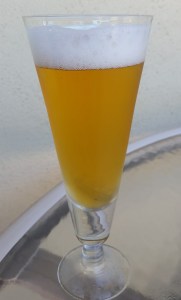
    • Light gold and crystal clear, with a thick white head on the pour that settles to a persistent blanket as I drink the beer. In the image, the condensation on the outside of the glass doesn’t do the beer’s appearance justice!
  • Aroma
    • Light and bready maltiness predominates, with a hint of slightly spicy hops behind that.
  • Flavor
    • Bready maltiness, with a restrained bitterness that builds as I drink the beer. Bitterness is persistent; it is maybe a touch harsh, and I wonder if that is because I used Warrior as the bittering addition?
  • Mouthfeel
    • Moderate body with a slightly dry finish. Carbonation is moderate–as it is pouring at the moment, with a fair bit of foam, I think I am losing some of the carbonation. This will hopefully settle down as the keg matures, as happened with my last keg of this style.
  • Would I brew this again?
    • This is decent, but I think I prefer my previous iteration of the recipe. The aroma on that one seemed a little more pronounced–both on the hops and malt side–and I feel like the flavor was just a notch better. I wonder if that was due to the decoction on the first batch? I will probably return to Magnum hops for the bittering addition in the next version of this pilsner; the Warrior hops have an ever so slight harsh edge that is out of place for a delicate pilsner. I’m also going to use a German pilsner malt–I have 10 pounds of Barke Pilsner Malt that might be perfect for this task. The malt character came up as a critique in a recent competition, so I think that’s a fairly easy fix. I’ll also return to WLP830 for the yeast.
  • Overall
    • 7/10

Kegging Updates: Raspberry Belgian, Thumbspike Saison 2.1

I’ve done a decent bit of kegging this past week, to square away some beers slated for the Lake Arrowhead Brewfest that I’ll be serving with Horse Thief Brewers. The festival is just under a month away, but with a new baby soon to arrive in the household I know that time will be tight. Gotta keg while the kegging’s good!

Raspberry Belgian, transferring to the keg

Raspberry Belgian 1.1, transferring to the keg

My cold storage space is also tight, so I’ve decided to get the beers carbonated and conditioned using a more “traditional” keg priming technique. Not only does it cut down on my CO2 usage, but it also should help to eat up any residual oxygen from the transfer and help the beers stay a bit fresher. Now of course it would be ideal to do the full keg purge with CO2 and closed transfer thing. But as I said…I’m tight for time and not keen on always blowing through my CO2 supply. I also feel that these two beers should hold up pretty well (both are fairly high alcohol and one is quite tart); if it was a delicate lager, crystal malt heavy porter, or hoppy IPA, I would definitely do things differently.

In any case, here are the details on everything.

Thumbspike Saison 2.1

I brewed this beer on June 25, and fermented it at the ambient temperature–around 75° on up. I kegged the batch on 12 July 2017, with 2.75 oz. of corn sugar boiled in 1 cup of water. Around 5 gallons went into the keg. Final gravity was 1.003, down from 1.055. This works out to around 6.8% abv.

Raspberry Belgian 1.1

I brewed this beer on 27 June, fermenting it at around 66°. On the fourth day of fermentation, 1 July 2017, I added around 1L (~4.25 cups) of Vintner’s Harvest raspberry puree. After about a week, I moved it out of the fermentation chamber to finish out at ambient temperature, around 78°.

I kegged the beer on 14 July 2017. The flavor was nice and tart, although at this point the raspberry comes through more in the aroma than in the flavor. I will have to see if that changes when I chill it and serve it carbonated; there might be some minor adjustments required prior to the festival, if that’s the case.

Because I wanted to keep this beer for home use too, I split it between two mini-kegs. Three gallons went into one, with 1.82 ounces of corn sugar boiled in 1 cup water (targeting around 3 volumes of CO2). The remaining 2 gallons or so went into another keg, which I force carbonated to around 2.8 volumes.

Final gravity for this batch was 1.013, down from 1.044. That clocks in at 4.1% abv–a very nice session beer!

Dark Helmet Schwarzbier

As I continue to work my way through lager styles, I also realized that a lot of my recent brews have been fairly light (at least color-wise). This generally fits my summer drinking preferences, but I’m starting to get the itch for something with just a touch more robustness. Now, I don’t want anything too dark and filling (after all, it’s still hot here!), and I’ve been doing a lot of amber type beers recently, so schwarzbier sounded intriguing.

To sum up the BJCP 2015 style description, schwarzbier should be roasty yet also highly drinkable. That’s intriguing! I’ve maybe only sampled one or two in the very distant past (if ever), so I was a bit in the dark (no pun intended) as to how I should craft the recipe. So, I turned to the ever-reliable Brewing Classic Styles by Zainasheff and Palmer. With a few minor adjustments for ingredients, I was ready to roll. Following the lead of Gordon Strong, I elected to add all of the dark and crystal malts at vorlauf. This is supposed to impart a smoother character, and I figured it couldn’t hurt to try.

As for the name of this brew, I’m not the first to be so clever, but that didn’t deter me. The schwartz is strong with this one.

20170703_083848.jpg

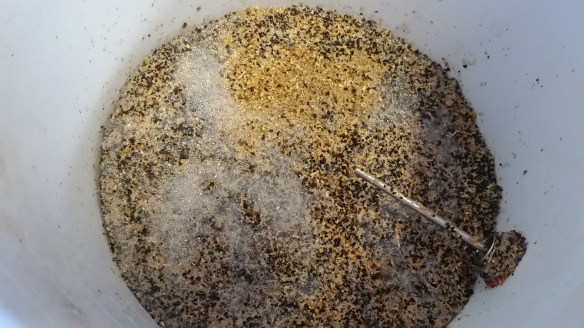
Spent grains after the mash

Dark Helmet Schwarzbier

  • 4.5 lbs. Munich I malt (Weyermann)
  • 4.25 lbs. Château Pilsen malt (Castle Malting)
  • 6 oz. chocolate malt, added at vorlauf (Briess, 350 SRM)
  • 6 oz. crystal 40 malt, added at vorlauf (Great Western)
  • 3.5 oz. black barley malt, added at vorlauf (Briess)
  • 3.5 oz. Carafa Special II, added at vorlauf (Weyermann)
  • 1.25 oz. Liberty hop pellets (4.9% alpha), 60 minute boil
  • 0.75 oz. Liberty hop pellets (4.9% alpha), 5 minute boil
  • 1 tsp. Fermax yeast nutrient, 10 minute boil
  • 1 Whirlfloc tablet, 10 minute boil
  • 2 pkg. SafLager West European Lager yeast (S-23)
  • 1 pkg. SafLager Lager dry yeast (W34/70)

Target Parameters

  • 1.046 o.g., 1.011 f.g., 4.6% abv, 26 IBU, 28 SRM, 5.5 gallons into the fermenter
  • Water built from RO and tap water to hit target of 67 ppm Ca, 7 ppm Mg, 27 ppm Na, 30 ppm SO4, 89 ppm Cl, 126 ppm HCO3, 103 ppm alkalinity, and 51 ppm RA.
  • 60 minute mash at 152°, batch sparge, 60 minute boil

Procedure

  • For my mash water, I used 3.25 gallons of RO with 1 g table salt and 3.5 g calcium chloride. For the sparge water, I treated 5 gallons of Claremont tap water with a quarter of a Campden tablet. All together, this should hit my general brewing water parameters as outlined above.
  • I mashed in with 3.25 gallons of water at 162.6°, to hit a mash temperature of 153.5°. This was down to 150° after 35 minutes.
  • I sparged with 1.5 gallons of water at 175°, let it sit for 10 minutes, added the dark grains, vorlaufed, and collected the first runnings.
  • Then, I sparged with 3.5 gallons of water at 175°, let it sit for 10 minutes, and collected the second runnings.
  • All together, I collected 6.8 gallons of wort at a gravity of 1.039, for 72% efficiency.
  • I started the boil, and added all of the hops, etc., per the schedule in the recipe.
  • After 60 minutes, I chilled the wort to 80° and put it in the fermentation chamber to chill for a few hours, until the beer was down to 48°.
  • I pitched the two packets of S-23 into a slurry of distilled water, which did show appropriate activity. But, I also noted that they were expired by 10 months.
  • There wasn’t any real activity visible in the fermenter after around 24 hours, so I opted to pitch in some extra yeast. Luckily, I happened to have a few packets of W34/70 on-hand. Fermentation was underway visible around 48 hours after the initial pitch. Perhaps I was being overly cautious, but I figured it couldn’t hurt.
  • I am fermenting this at 50°. Starting gravity was 1.046.
  • I brewed this batch on July 3, 2017.

A good use for extra fruit puree

I had about 2 cups of raspberry puree left over from the can I added into my in-progress Raspberry Belgian, and was at a bit of a loss as to what to do with it. I didn’t want to let it go to waste, but it’s also not really the sort of thing you can use that readily (outside of a smoothie, I suppose, but I think fresh fruit is way tastier for a smoothie).

Suddenly…inspiration! With grilling season well at hand here in southern California, I decided to roll the leftover puree into a nice marinade. My intention was to make something slightly smoky/sweet/spicy, and the end result definitely succeeded!

This was somewhat thrown together, so the recipe below is just general proportions. So, you should probably modify to taste. You could probably substitute any reasonably “hot” pepper into this–we just happened to have some jalapeños in the freezer.

Raspberry Jalapeño Marinade

  • 2 cups raspberry puree (Vintner’s Harvest brand)
  • 1/2 grilled and seeded jalapeño pepper
  • 1/2 cup canola oil
  • 2 tbs. lime juice
  • 1 tbs. minced garlic
  • salt to taste
  • a dash of paprika

Procedure

  • Combine all ingredients, and thoroughly blend using an immersion blender.
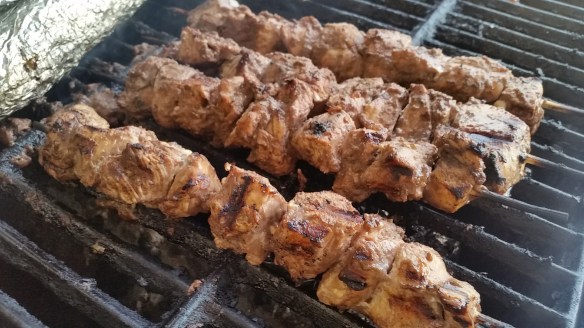
  • This produces enough marinade for around 4 large chicken breasts. I cubed the breasts into pieces around 1 or 2 inches across, and let them marinate in the fridge for a few hours. Then, I put the chicken on skewers and grilled over a medium heat. I drizzled extra marinade over the skewers around midway through cooking.
  • The result was really tasty! Interestingly, the raspberry flavor itself didn’t come through that strongly–it was more as a tart accompaniment to the mild heat of the grilled pepper.

20170709_174059

I had a bit of uncontaminated marinade set aside, perhaps a quarter cup total. I mixed this with about a cup and a half of non-fat yogurt, a teaspoon of garlic, a dash of paprika, and a teaspoon of lime juice, for a really tasty yogurt sauce. This made a nice accompaniment for dipping the grilled chicken (as well as the vegetables I also grilled). We have a bit left over, so I think it will be going onto some fish tacos later this week.

The Session #125 — Pale European Lagers: The Ultimate SMaSH beers

thesessionNote: This is my first time contributing to The Session, a monthly blogging challenge for beer aficionados. For The Session #125, Mark Linder chose the topic of SMaSH (single malt and single hop) beers.

SMaSH beers–those brews marrying a Single Malt variety and a Single Hop variety–are often promoted as something that’s interesting to try but not particularly versatile. As a homebrewer, I’ve usually thought of them as a tool to explore ingredients, perhaps fun as a technical gimmick but not necessarily a pathway to truly exceptional beer. Sure, you could get some good stuff, but it would lack complexity and get boring after a few pints. SMaSH beers were a way to turn out some pale ales with funky new hop varieties, but these were only a brief stop along the journey to a more worthy recipe. Don’t even bother entering them in a BJCP competition, because they won’t hold up well relative to their rivals with a longer ingredient list.

Then I discovered the Bohemian pilsner.

When I first sampled American-style craft beer, the cheap American lagers of my early days faded into mental oblivion. Why even bother with a watery fizz-drink, when you could blast your taste buds with a triple imperial IPA touting 190 IBUs, 12 percent alcohol, and five varieties of hops? Or what about a delightful English porter, with its malty backbone and slightly fruity yeast character? Clear beers were for quitters and college students. European lagers were mildly intriguing, but typified by badly aged and skunky six packs in green bottles. Why bother with that, when there was a world of fresh local craft brew and homebrew to explore?

An Archaeopteryx-linked beer requires the appropriate glassware.

My first homebrewed Bohemian pilsner (made with genuine Jurassic ingredients!)

Not too long ago, though, I decided to dip my homebrewing toes into the lagered waters. Bohemian pilsner (a.k.a., Czech pilsner, a.k.a., Czech premium pale lager in the 2015 BJCP guidelines) caught my attention early on…it was the original pilsner, after all! What better way to learn what this beer is all about?

Yet, I was shocked by the simplicity of the classic recipes! Bohemian pilsner malt. Czech-sourced Saaz hops. Soft water. Clean lager yeast. The rest is just up to technique–in particular, a good decoction mash was apparently the key to success.

My first attempt at a Bohemian pilsner wasn’t perfect, but wow, it was pretty darned good. This was the first time I consciously experienced Saaz hops, finally getting a name to match with that distinctive aroma and flavor. It was also the first time I experienced a genuinely fresh European-style lager in the United States, and I finally knew what the big deal was all about.

This spurred a realization. SMaSH beers weren’t just for pale ales. In fact, pale lagers are the most reliable ticket to SMaSH success. Quality malt. Quality hops. Careful water chemistry. A clean fermenting lager yeast. A bit of skill. All of this combines to a memorable and surprisingly complex brew. Of course, Czech pilsner isn’t the only lager style with a simple recipe. Munich helles, German pils, and others jostle alongside in the running. Any of these can be done quite well with a short shopping list. This is what makes them so hard to do exceptionally well, perhaps–any flaws can’t hide behind crystal malt and yeast esters.

So, what’s the style best suited to a SMaSH beer? I love all of my European pale lagers, but Bohemian pilsner wins for me every time.