
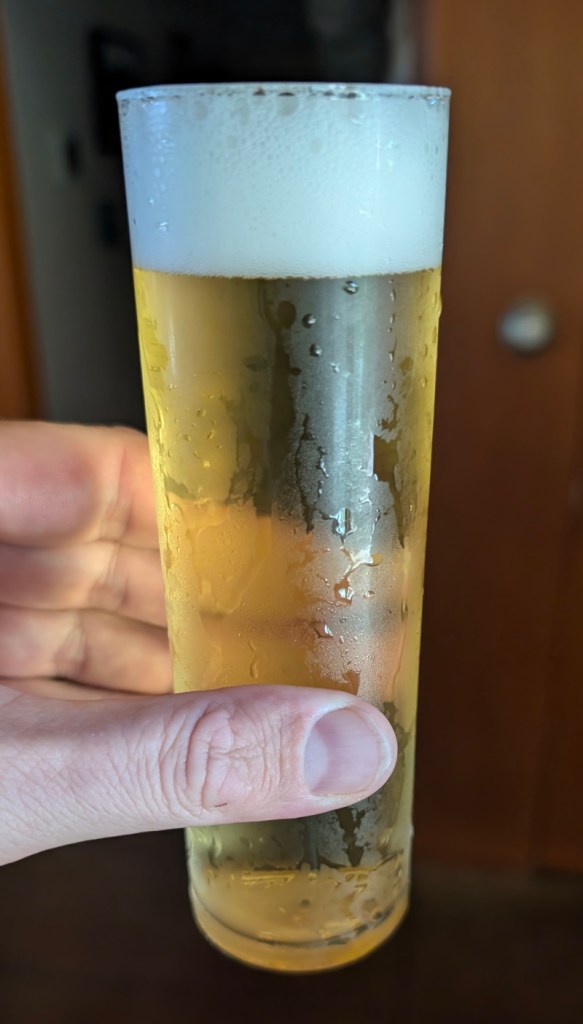
Kölsch is an accessible style, but its delicate qualities make it a challenge to brew well. Like a light lager, there isn’t much hop or malt character to hide behind, and the yeast character has a narrow separation between “subtle and pleasant” vs. “rotten fruit bomb.” Over several years, I had perfected a house recipe, but changes in ingredient availability restarted my quest.
This new recipe is, unsurprisingly, broadly similar to my old one. While searching the AHA’s recipe archives, I found an NHC-winning kölsch from 2023 (note: an AHA membership is required to view the original recipe), formulated by Metts Potter. It has a simple base of pilsner malt with a hint of Vienna (similar to my original, except I had light Munich instead of Vienna), with a light dose of Hallertauer Mittelfrueh. The original recipe used Wyeast 2565, but White Labs is easier to get so I used a close equivalent, the classic WLP029. I also had mixed pilsner malt types, to use up the last little bit of one sack of Briess. Because I had already done a kölsch semi-recently and didn’t want to get too tired of the style, I opted for a small, 3-gallon, batch.
Iceberg! Kölsch
- 4.75 lb. Synergy Select Pilsen malt (Briess)
- 0.75 lb. pilsen malt (Briess)
- 10 oz. Vienna malt (Weyermann)
- 0.25 tsp. BrewTanB, added to mash
- 0.85 oz. Hallertauer Mittelfrueh hop pellets (2.5% alpha), 60 minute boil
- 0.85 oz. Hallertauer Mittelfrueh hop pellets (2.5% alpha), 15 minute boil
- 0.25 tsp. BrewTanB, 10 minute boil
- 0.5 Whirlfloc tablet
- 1.5 g. WLN1000 yeast nutrient, 5 minute boil
- 1 pkg. German Ale/Kölsch yeast WLP029 (White Labs)
- 1 oz. Biofine Clear, added to keg
Target Parameters
- Hochkurz mash, with 5 minute rest at 144°, 45 minute rest at 148°, 10 minute rest at 153°, 45 minute rest at 163°, 15 minute mash-out at 170°, full volume mash
- 1.047 o.g., 1.012 f.g., 4.7% abv, 20 IBU, 4 SRM
- Water built from scratch, to hit 48 ppm Ca, 44 ppm SO4, 54 ppm Cl
- 3 gallon batch
Procedure
- Starting with 4.7 gallons of RO water, I added 1.4 g of calcium chloride and 1.3 g of gypsum, to hit my water profile target. I heated the strike water to 149° before adding the BrewTanB, grains, and 10 mL of 10% phosphoric acid.
- I held the mash at 144° for 5 minutes, before raising to 148° for 45 minutes, then to 153° for 10 minutes, 163° for 45 minutes, and finally 170° for 15 minutes. All of this was done while recirculating.
- After the mash, I removed the grains and brought the runnings to a boil. In total, I collected 4.36 gallons of runnings with a gravity of 1.040, for 75% mash efficiency. This high efficiency probably is a result of the extended mash time.
- Once the kettle was at a boil, I added the hops and finings per the recipe. After the full 60 minute boil, I turned off the heat, chilled to 75°, and then transferred the wort to the fermenter. Within the fermentation chamber, I chilled the batch to 64° before pitching the yeast.
- I brewed this beer on 31 May 2026; starting gravity was 1.048.
- I fermented the beer at 66°, and kegged on 30 June 2026 via a closed transfer. The beer had a very nice flavor and aroma; bitterness seems a bit lighter than in Snowdrop Kölsch, which isn’t surprising given the stats.
- Final gravity was 1.010, for 5.0% abv.
- I had a first taste of the conditioned beer on 17 August 2026; it was really nice! There was a very slight but persistent haze, so I added Biofine Clear on 19 August 2026, when I moved the beer into my kegerator. The beer was (finally!) brilliantly clear on 24 August 2026.
Tasting
- Appearance
- Light yellow, brilliantly clear beer; pours with a low but somewhat persistent white head.
- Aroma
- Medium-low pear-like yeast character. Medium-low spicy hop character. Low grainy malt character.
- Flavor
- Grainy malt at a medium-low level; medium-low level of clean bitterness with a slightly spicy quality. Light pear fruitiness in the yeast, at a low level.
- Mouthfeel
- Medium-light body, medium level of carbonation, slightly lingering bitterness on an off-dry finish.
- Would I Brew This Again?
- This is a fantastic kölsch, especially so once it was fully conditioned and dropped clear. Every element is beautifully balanced, creating an eminently drinkable beer that is perfect for a hot day. This seems like a worthy successor to Snowdrop Kölsch, as a house kölsch recipe.
- Overall
- 10/10

