
Chasing the perfect IPA is a perpetual task. As my brewing technique has advanced, I’ve transitioned into all-grain and adjusted grain bills, adjusted water chemistry, played with different hopping regimes, and implemented closed transfer into a keg. The results have, in the best batches, been quite satisfying–especially for “traditonal” C-hop IPAs and classic North American IPAs. I’ve also improved overall beer quality. Yet, I’m always looking to try something just a little different.
Hop derivative products are nothing new, including CO2 extracts, various bittering products, flavorings, and concentrated pellets (e.g., Cryo) released over the years. I keep an eye on what’s out there for homebrewers, and although I’ve dabbled with some concentrated hop pellets like Cryo, they’ve never been so knock-my-socks-off that I’ve gone exclusively to them. More recent products like Abstrax are intriguing, but just odd enough (and expensive enough) that I haven’t jumped at them. But, I’ve been reading more about all of these lately, so I thought I would give them a try. I’m also wanting to get the super crisp, super fruity profile that the best beers with Southern hemisphere hops can have. Time to experiment!
I built my current recipe exclusively around Southern hops, from Australia and New Zealand. I wanted something with big tropical fruit notes and a bit of citrus (but not straight citrus, like some North American IPAs). I chose a combo of Galaxy and Moutere to hit that for the boil and whirlpool. To amp things up, but avoid the astringency of too many hops, I implemented Cryo Riwaka, for the passionfruit and citrus notes in the dry hop. Finally, I rounded things out with a dose of Abstrax Omni Hop Profile, targeting a Galaxy-type expression. In order to let the hops shine through, I followed my all-grain, low mash temperature malt bill from recent “modern” IPA attempts. I also turned down the bitterness, from around 67 IBU in my most recent IPA to 50 IBU here. Although I don’t with US-05 as much as I used to, the peachy quality that it provides seemed like a nice way to augment the overall fruity qualities I wanted in this beer. I had a lot of fun conceptualizing the recipe in this batch, and choosing the ingredients to hit my overall concept.
Note that this is my second recipe with the name of “Gondwana IPA.” My first was over a decade ago, during only my second all-grain brew session. The name is too good to leave to an early effort, so I’m going to repurpose it for a new generation of brewing.
Gondwana IPA
- 9.5 lb. 2-row pale malt (Rahr)
- 3 lb. Synergy Select pilsen malt (Briess)
- 1 lb. Vienna malt (Weyermann)
- 0.5 tsp. BrewTanB, added to mash
- 1 oz. Moutere hop pellets (15.7% alpha), 20 minute boil
- 0.5 tsp. BrewTanB, 10 minute boil
- 1 Kick Carrageenan tablet, 5 minute boil
- 1 oz. Galaxy hop pellets (16.9% alpha), 15 minute whirlpool at 185°
- 1 oz. Moutere hop pellets (15.7% alpha), 15 minute whirlpool at 185°
- 1 pkg. Safale American ale yeast (US-05)
- 1 oz. Cryo Riwaka hops (12.4% alpha), dry hop in keg
- 2.5 mL Southern Hemisphere (AU) Tropical Omni Hop Profile, Abstrax, added to keg
- 1 oz. Biofine Clear, added to keg
Target Parameters
- 75 minute infusion mash, 148°, full volume mash
- 1.062 o.g., 1.010 f.g., 6.8% abv, 50 IBU, 4 SRM
- Water built from RO, to hit 94 ppm Ca, 156 ppm SO4, and 51 ppm Cl.
- 5.25 gallon batch
Procedure
- I built the water up from scratch, with 7.5 gallons of RO water, 8 g gypsum, and 3 g calcium chloride, to hit my brewing water profile.
- After heating the water to 154°, I added the grains as well as 18.6 mL of 10% phosphoric acid to adjust mash chemistry.
- I held the mash at `148° for 75 minutes, with recirculation, before pulling the grains and heating to a boil.
- In total, I collected 6.6 gallons of runnings with a gravity of 1.053, for 68% mash efficiency.
- Once the kettle was at a boil, I added the hops and finings per the recipe. I boiled for 60 minutes.
- After the full 60 minute boil, I chilled the wort to 185° and added the whirlpool hops, and recirculated. I had a realization, that I could use my Anvil heating element to keep the whirlpool at the temperature! It’s somewhat silly that it took me so long to realize this (temperature drops due to the recirculation, so start whirlpool temp is higher than end whirlpool temp otherwise)…but now I can incorporate that into my process for more consistent results!
- After the 15 minute whirlpool, I continued chilling down to 72°, transferred to the fermenter, pitched the yeast, and continued chilling in the fermentation chamber down to 66°.
- I brewed this beer on 15 March 2026. Starting gravity was 1.060.
- Fermentation temperature was held at 66°.
- A very light krausen was visible on the surface of the beer by 16 March 2026, and a solid krausen was visible by 17 March 2026. I noted there wasn’t a lot of bubbling in the airlock, so I wonder if there’s not a small leak somewhere in the way the lid gasket is seated.
- I started the cold crash for the beer on 15 March 2026, and kegged the beer on 1 April 2026, using a closed transfer.
- I added the Cryo hops in a large bag after the transfer was completed, doing as quick of an addition as I could. I ran the CO2 into the keg at very low pressure while doing so, to keep a blanket of CO2 in place and hopefully minimize oxygen ingress.
- Final gravity was 1.007; down from 1.060, this works out to 7.0% abv.
- I dry hopped at ~34°, while carbonating.
- I tried to remove the dry hops on 4 April 2026, but they had sunk in the keg, so I couldn’t retrieve them. Ah well!
- On 4 April 2026, I added 2.5 mL (0.5 tsp.) of the Abstrax product.
Tasting
- Appearance
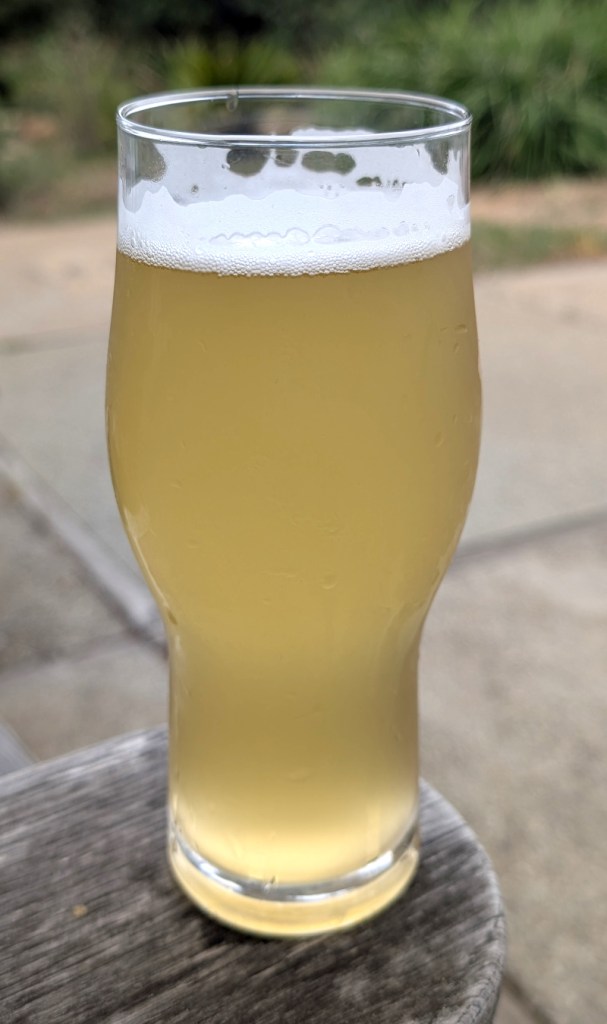
- Light gold in color, with a light shimmery haze–it’s not a “hazy” in the sense of being opaque or murky, just a beer with a hop/chill haze. The beer has a nice white head with good retention and a bit of lacing on the glass.
- Aroma
- A nice bouquet of tropical fruit, at a moderately high intensity. I perceive it as sweet orange, passionfruit, and mango.
- Flavor
- Medium high bitterness, with a flavorful hop quality–sweet pineapple, orange, a fair bit of white peach; overall, a sweet and fruity flavor from the hops. Clean fermentation, with a slight peach ring candy flavor at times. The maltiness is light and has a slightly grainy quality.
- Mouthfeel
- Medium light body, moderate carbonation, dry finish.
- Would I Brew This Again?
- This is a good IPA–I think I threaded the flavor/bitterness needle pretty well. It avoids astringency, and has a perfect level of bitterness and hop flavor for what the beer is. The sweet hop sensation is a new one for my home brews, and very cool to experience. The haze marks the beer down slightly, but that’s more cosmetic than anything. I think the Abstrax adds something, but it’s nice and subtle, without being in your face. I get the sense that in my use case it’s a support alongside the other hops rather than a “whammo” in your face experience. I like that my hopping regimen avoids the diesel flavor I got in a commercial IPA with Riwaka that I recently sampled. The “lower” bitterness (50 IBU calculated, versus 60 or 70 as in my typical batches) lets the hop flavors shine over the bitterness. In all, I think this is a successful experiment and use of a variety of non-convention (i.e., non-T90) hop products!
- Overall
- 9/10


Pingback: Frequently Brewed Recipes | Andy's Brewing Blog