Competition Results: Palaeotis Pils and Take Two Vienna Lager

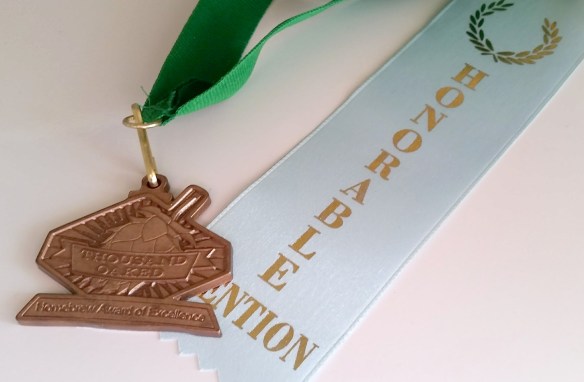
I submitted my recent Vienna lager and German pils for the 2017 Romancing the Beer Competition, hosted by Thousand Oaked Homebrewers. I was pretty happy with these beers, and was pleased to see that the judges agreed! Take Two Vienna Lager earned an honorable mention in the Amber and Dark Euro Lagers category (out of 15 entries), and Palaeotis Pils placed third in the Euro Lagers category (out of 18 entries).

Let’s take a look at the overall results, and see how they stack up against my own tastings!

20170312_084551

Take Two Vienna Lager

This beer averaged 37.5 (from scores of 37 and 38), falling at the upper end of the “very good” range by the BJCP guidelines.

Overall, the judges thought it hit most of the notes for the style. Hops were noted as nicely balanced against the malt. I was curious to see that the judges were split on mouthfeel–one thought it was pretty much perfect for the style, and the other scored it as slightly thin and watery. Similarly, the judges were split on the maltiness–one thought it was right on point, and the other thought it a bit lacking.

One judge picked up slight estery notes (or possible acetaldehyde). I suspect that this corresponds with a brief period in early fermentation when I lost temperature control due to a power outage.

Based on my tasting, it’s interesting that the recipe doesn’t terribly fit what I like in a Vienna lager (in terms of just a little bit too malty and roasty) compared with what the judges liked in a Vienna lager. I won’t likely brew this recipe again, but I am tempted now to brew something for competition more in line with my preference and see what happens!

Palaeotis Pils

I’m really proud of how this beer turned out. It came across really well on my personal tasting, and was absolutely enjoyable when it was on tap. It may not have won top tier in the category, but the judges comments make me feel like I’m on the right track. The beer averaged 38 (individual scores of 37 and 39), right at the base of the “excellent” score range.

Aroma scored well, although both judges said they were looking for a little more malt character. In terms of the hop aroma, both seemed okay with it (but one noted their perception of a tiny hint of vegetal character and that the overall hop aroma was a bit heavy). Appearance was nailed, and flavor was also pretty solid, with a balance between hops and malt. Interestingly, one judge noted perfect carbonation and the other thought it was a bit low. One thought the finish could be a touch more crisp.

So, if I brew this again, what should I change? I might add a touch of melanoidin malt, or else I might perhaps lengthen the overall decoctions. Another option might be to use a different base malt–perhaps one of the “standard” offerings from Weyermann rather than the Bohemian floor-malted version. I would probably also reduce my late hop just a touch, to about 2/3 or 3/4 of what it was originally. And, I suppose I would reduce the bitterness a tiny bit, too–maybe down to 28 or 30 IBU rather than 34. This would let the malt shine through a bit more. Another alternative (and something I might try) would be to up the overall malt bill and initial gravity a tad. I suppose I could carbonate more strongly or package more carefully, too, but given the split judging assessment, I’m not too worried about it yet.

I’ll be trying a slightly modified version of recipe again soon!

Raspberry Belgian

Our brew club is focusing on fruit beers for the April meeting, so I wanted to have something ready to go. Thumbing through the recently published Brew Your Own book, I saw a tasty-looking recipe for a clone of Funkwerks Raspberry Provincial.

One interesting thing about the BYO recipe is that it uses acidulated malt rather than kettle souring to achieve the sourness. I vacillated on which approach I would take, but in the end went for acidulated malt for simplicity.

I modified the recipe slightly for the hop bill, and also scaled it down from 5 gallons to 3 gallons. I figured I didn’t really want 5 gallons of a raspberry beer, tasty though it might be. I also will be using a home-made puree from frozen raspberries, rather than canned raspberry puree. The cans are huge, more than twice the volume I need for this recipe, and a bit expensive, so it didn’t make sense to waste the money buying a whole ton of extra raspberry. Per recommendations on the fruit puree company website, I upped the quantity of fruit by 12 percent a bit to account for all of the stuff that doesn’t make it into a typical puree can (seeds, etc.). The final modification was to go with a full-volume mash, to save a bit of time.

Raspberry Belgian

  • 2.5 lb. floor-malted Bohemian pilsner malt (Weyermann)
  • 1.25 lb. white wheat malt (Great Western Malting Co.)
  • 0.75 lb. acidulated malt (Weyermann), added to last 20 minutes of mash
  • 0.3 lb. flaked oats
  • 0.3 lb. flaked wheat
  • 0.25 lb. Carapils malt
  • 0.16 lb. rice hulls
  • 0.12 oz. Warrior hops (15.8% alpha), 60 minute boil
  • 0.20 oz. Willamette hops (5.1% alpha), 15 minute boil
  • 1 pkg. Belgian Wit Ale yeast (WLP400, White Labs), prepared in 0.5L starter
  • 17 oz. raspberry puree, added after 4 days of fermentation

Target Parameters

  • 155° mash, 60 minutes
  • 1.043 o.g., 1.011 f.g., 4.1% abv, 15 IBU, 3 SRM, 3 gallons into the fermenter

Procedure

  • I added 5.25 gallons of water at 170°, and let it cool down until it hit a temperature of 159.5°. Then, I mashed in with my grains (except for the acidulated malt) and hit a temperature of 155.4°.
  • After 40 minutes, the mash temperature was down to 150.4°. At this piont, I added the acidulated malt.
  • At the end of the 60 minute mash, the temperature was down to 148.7°. I vorlaufed and collected 4.2 gallons of wort with a gravity of 1.030. This equated to 64% efficiency. That is a fair bit below my normal efficiency in the upper 70s, but I figure that was probably due to the full volume mash, no sparge technique, as well as the high number of adjuncts.
  • I added hops per the schedule, over the course of a 60 minute boil.
  • After 60 minutes, I chilled to 70°, transferred to the fermenter while aerating, and pitched the yeast.
  • Starting gravity was 1.039, a bit below target. I think I’m okay with that, given how new this brew is to my experience. I find it interesting that, at least in a casual tasting, the flavor isn’t that prominently sour or tart. I wonder how that will come through in the finished beer?
  • I brewed this on 10 March 2017, and will be fermenting at 71°. On March 14, I will add the raspberry puree.

The Dinosaur in My Beer: March 8 at Claremont Craft Ales

Beer and science are a natural fit…even more so than beer and pretzels, in my opinion. As a homebrewer, I absolutely love geeking out over the scientific facets of the hobby. The usual history of beer starts a few thousand years ago with the rise of agriculture. But, there is so much more to the story. Every brewing ingredient–water, barley, yeast, and hops–has its own tale to tell. In many cases, the narrative extends back to the time of the dinosaurs!

So, if you are in Claremont, California, on Wednesday, March 8, swing by Claremont Craft Ales and catch my talk on the prehistory of brewing ingredients! The event starts at 6:30 pm, but you can swing by before or hang around after for some great beer and also a chance to chat with me about anything you like.

talk_logo

The basic talk will be a preview of my seminar for HomebrewCon in June. I’ll be posting more about that in the upcoming months, too.

If you haven’t been to Claremont Craft Ales (CCA) before, it’s a really great venue. A few things you can look forward to:

  • Their beer is great! I highly recommend the Jacaranda IPA as well as the Raspberry Gose (both are also available in cans).
  • CCA has plenty of options for non-beer-drinkers. In addition to a nice selection of canned dry sodas (the tasty fancy stuff, not just a bunch of Coke products), various food trucks are also there most afternoons and evenings.
  • It’s a very friendly space — kids and dogs are quite welcome. (note relevant to my talk: although dinosaurs have a reputation as a “kids topic”, my talk isn’t really geared for kids. That’s not to say it’s “adult content”–just that the presentation will be at a level where the typical 12 year old might get a little bored, because the combined topic of beer and paleontology probably isn’t in their wheelhouse, or at least it shouldn’t be.)

Interested in having me talk for your event? Drop a line via the contact form!

Image credit: Dinosaur skeleton from Iguanodon rendering by Gustave Lavalette in the public domain.

Beer Tasting: Take Two Vienna Lager

20170128_132534My latest Vienna lager ran out just a few days ago, but not before I worked in a beer tasting as well as a submission to a local beer competition. This batch earned an honorable mention (i.e., 4th out of 15 entries) in a combined Amber and Dark Euro Beers table at the 2017 Romancing the Beer competition. Tasting notes below were completed before competition results were announced, and I have not yet been able to compare my impressions with those of the judges.

  • The Basics
    • O.g. = 1.052; f.g. = 1.013; 5.1% abv; 12 SRM; 25 estimated IBU
  • Appearance
    • Deep amber, brilliantly clear beer, with a persistent ivory head.
  • Aroma
    • Slightly toasty, with a spicy and mildly floral hop note.
  • Flavor
    • Toasty maltiness, with the slightest hint of a caramel note at the very end of the finish. Hoppiness is subdued but noticeable.
  • Mouthfeel
    • Slightly dry, medium-light body.
  • Would I brew this again?
    • This is a good Vienna lager, but not a great Vienna lager (in my opinion). The slight touch of caramel on the taste throws it a bit out of style for me, and also isn’t quite what I wanted in the beer. The color is apparently within the bounds of the BJCP style guidelines, but darker than I really desire for this kind of beer. I suppose it falls within the realm of “North American Craft Vienna Lager.” For the next time around, I would reduce the melanoidin and Carafa II malts to lighten the beer and reduce any caramel notes. All that said, if I set aside stylistic preferences this is an exceptionally drinkable brew, and it was quite popular at a recent get-together.
  • Overall
    • 7/10

Beer Tasting: Good Riddance Pale Ale

20170218_163101This pale ale has disappeared surprisingly quickly; with only a little bit left in the keg, it’s a good time to do a quick tasting.

  • The Basics
    • O.g. = 1.053; f.g. = 1.011; 5.6% abv; estimated IBU = 41; 7 SRM.
  • Aroma
    • Orange and grapefruit, with a hint of tropical fruit at the background — a nice, medium-strong hop aroma.
  • Appearance
    • When poured, I get a tall, off-white head that is pretty persistent and medium-fine. The beer itself is a burnished gold color and fairly hazy (but not opaque like a NEIPA).
  • Flavor
    • The balance is towards the hops (which have a definite grapefruit character), but the malt character is still pretty nice–slightly grainy.
  • Mouthfeel
    • Bitterness is moderately high, but not over the top. The finish is a touch thinner and drier than I care for, which could be corrected by mashing a degree or two higher or adding in an extra quarter pound of crystal 20. That said, the finish is also nicely balanced between hops and malt, and isn’t puckeringly bitter like some other beers I’ve made.
  • Would I brew this again?
    • This beer was a real surprise! I like it much more than I thought I would. Considering that the main aroma hops were coming up on two years of ago, they held their own really well. I suppose the combination of vacuum seal+deep freeze paid off! This is definitely encouraging for other hops in long-term storage. Overall, the base recipe is another good one to add to my repertoire of American pale ales, with just a few minor modifications for mash temp and hops.
  • Score
    • 7/10