Big Batch Update: Saison, Amber Ale, Pilsner

There’s lots to report with kegging and fermentation for a few recent batches. So, here’s what’s new:

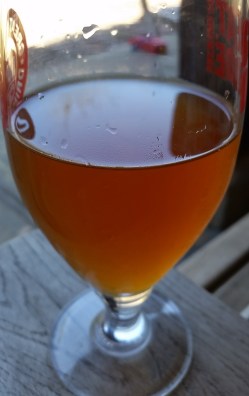
  • Thumbspike Saison 2.0
    20170528_144954

    • This might have had the quickest turn-around on any kegged beer I’ve ever done! I brewed the beer on 12 May 2017, starting with an 80° fermentation temperature. On 16 May, I raised the temperature to 85°. Everything really churned along, from start to finish (as you might expect with fermentation at those temperatures)! I kegged the beer on 20 May 2017, with a final gravity of 1.004. That works out to 6.7% abv. I’ve had it on tap for about a week, and it’s a pretty interesting and enjoyable beer. All of the ingredients melded together quite nicely, and I am pleased with the results. It’s a very refreshing brew for a warm afternoon on the patio.
    • My first impressions are that it has a very lightly fruity aroma, with a slight tartness on the flavor. Head retention seems pretty miserable at this point, but I don’t know if that’s a real feature of the beer or because I didn’t wash my glass from a previous beer before pouring this one.
  • Hell Creek Amber Ale 1.1
    • I brewed this beer on 14 April 2017, with a starting gravity of 1.060. I kegged the beer on 7 May 2017. Final gravity was 1.016, which equates to 5.8% abv.
  • Czech-ed Out Pilsner
    • This batch has the honor of being my first dumper, ever. I’ve weathered warm fermentations, low gravities, and incomplete fermentations, and have always soldiered through in the end. Alas, this particular batch just wasn’t any good. The culprit wasn’t infection, bad fermentation, or anything like that. It was bad hops! As noted in my original post, the late hop addition smelled really grassy. I should have known better than to add them to the kettle, but wasn’t quite that smart. So, I kegged the beer, carbonated it, and pulled my first sample…to a whiff of pilsner that smelled pretty much like freshly mown lawn, and not in a good way. It was almost reminiscent of jalapenos, but in any case was not reminiscent of what a good European pilsner should taste or smell like. Lesson learned!
    • In terms of fermentation history, I started fermentation at 50° on 9 April. I raised the beer to 65° on 21 April, and then dropped it to 33° on 30 April 2017. I kegged the beer on 14 May, at which point it had a final gravity of 1.011. This equates to 5.6% abv.

Palaeotis Pils 1.1

Time for another batch…this time, a retool of my German pils. Compared to the last round, I have changed just about everything, although the overall base malt is basically the same. To speed my brew day along, I’m not doing a decoction. Instead, I’m rounding out the malt bill with a little bit of melanoidin malt.

Palaeotis Pils

  • 8.5 lbs. floor-malted Bohemian pilsner malt (Weyermann)
  • 5 oz. melanoidin malt (Weyermann)
  • 3 oz. acidulated malt (BestMalz)
  • 0.3 oz. Warrior hop pellets (15.0% alpha), 60 minute boil
  • 0.5 oz. Liberty hop pellets (4.9% alpha), 30 minute boil
  • 0.5 oz. Tettnang hop pellets (3.5% alpha), 30 minute boil
  • 0.5 oz. Liberty hop pellets (4.9% alpha), 5 minute boil
  • 0.5 oz. Tettnang hop pellets (3.5% alpha), 5 minute boil
  • 1 tsp. Fermax yeast nutrient, 10 minute boil
  • 1 Whirlfloc tablet, 10 minute boil
  • 2 packages lager yeast (Fermentis W34/70)

Target Parameters

  • Infusion mash to hit target of 150°. Batch sparge.
  • Water built from R.O., to hit 59.1 ppm Ca, 8.2 ppm Mg, 89 ppm SO4, and 62.9 ppm Cl.
  • 1.048 o.g., 1.010 f.g., 4.9% abv, 34 IBU, 4 SRM, 5 gallons into fermenter

Procedure

  • For this recipe, I built my water to match the “Pilsner Water” profile on Braukaiser. For the 3.1 gallons of mash water, I added 1.2 g of gypsum, 1.2 g of epsom salt, and 1.5 g of calcium chloride. For the 5.5 gallons of sparge water, I added 2.1 g of gypsum, 1.7 g of epsom salt, and 2.7 g of calcium chloride.
  • I mashed in with 3.1 gallons of water at 160° to hit 150°, and let it rest for 60 minutes. After 35 minutes, the mash temperature had fallen to 148°.
  • After a 60 minute mash, I added 1.75 gallons of water at 200° to raise the mash temperature to to 160°. I let it sit for 10 minutes, vorlaufed, and collected the first runnings.
  • Next, I added 3.75 gallons of water at 185°, let sit for 10 minutes, vorlaufed, and collected the remainder of the runnings.
  • In total, I had 7.1 gallons of mash runnings at a gravity of 1.039, for 82% efficiency.
  • I brought the kettle to a boil, and added the hops and other ingredients per the schedule.
  • After 90 minutes, I chilled the wort down to 75°, transferred the wort while aerating, put the fermenter into the fermentation chamber, and let it cool down to 50° before pitching the yeast.
  • Starting gravity was 1.048, nearly precisely on target. I started fermentation at 50°, and raised it to 54° after four days. I brewed the beer on 20 May 2017.

Beer Tasting: Holy Helles

20170423_150736Time for another beer tasting! This Munich helles–my first attempt for the style–has been an enjoyable brew. I entered it into the first round for the NHC…it didn’t place, but I’ll be interested to see how the score sheets pan out. I should get those later this week, but until then, here are my own thoughts!

  • The Basics
    • O.G. = 1.047; f.g. = 1.012; 4.6% abv; 4 SRM; 19 estimated IBU
  • Aroma
    • Mild spicy hop note, with a moderate degree of slightly sweet maltiness behind that.
  • Appearance
    • Brilliantly clear and light gold in color. The beer pours with a thick off-white head that settles to a nice even and persistent blanket across the top of the beer.
  • Flavor
    • Nice malt character, with a bit of graininess to it. The bitterness level is subdued and definitely in the background
  • Mouthfeel
    • Relatively light bodied, moderately carbonated, with a medium-dry finish. The bitterness hangs around on the finish for awhile, although it is not overpowering.
  • Would I brew this again?
    • This is a good beer, and quite drinkable, but I think it falls down a bit in the malt character. To bring this a touch more into the Munich helles style, I might up the malt profile just a bit–it seems like it swings to the hops end on aroma just a bit more than I would prefer. One fellow homebrewer suggested using a German pilsner malt rather than the Bohemian pilsner malt I’ve been using as of late–this might be a good first step.
  • Overall: 6/10

Czech-ed Out Pilsner

My first attempt at a Bohemian pilsner turned out reasonably well, but it also had a few areas of potential improvement. The flavor was a little less well rounded than I hoped for, so I aimed for a brew that added in a small percentage of crystal malt. Additionally, the color on my previous batch was a touch paler than desired, so for this version I’m adding in a tiny percentage of Carafa II to deepen that up a bit.

20170409_125350

The recipe today is very loosely based on “Czech It Out” pilsner, published in the January/February 2017 issue of BYO. I’ve made some substitutions and adjustments for the malts and hops, but the overall gist is still there. Lots of Bohemian malt, lots of Saaz hops! Note that I did use a touch of Warrior for the bittering addition; my on-hand Saaz was low in alpha, so I needed to beef up the bittering with another hop. I also had to substitute in American crystal malt for Carahell, based on what was at my local homebrew shop.

I had a few members from my homebrew club over for the brew afternoon. Although I can do pretty much everything solo, it was nice to have the extra company!

Czech-ed Out Pilsner

  • 9.5 lbs. floor-malted Bohemian pilsner malt (Weyermann)
  • 0.5 lb. 10° crystal malt (Briess)
  • 0.25 lb. acidulated malt (Weyermann)
  • 0.2 oz. Carafa Special II malt (Weyermann)
  • 0.47 oz. Saaz hop pellets (5.6% alpha), 60 minute boil
  • 0.25 oz. Warrior hop pellets (15.8% alpha), 60 minute boil
  • 2 oz. Saaz hop pellets (3% alpha), 15 minute boil
  • 2 oz. Saaz hop pellets (3% alpha), 5 minute boil
  • 1 Whirlfloc tablet, 10 minute boil
  • 0.5 tsp Fermax yeast nutrient, 10 minute boil
  • 2 pkg. Pilsner Lager yeast (WLP800, White Labs)

Target Parameters

  • 1.053 o.g., 1.013 f.g., 5.3% abv, 40 IBU, 5 SRM, 5 gallons into the fermenter

Procedure

  • A week in advance, I prepared the yeast in a 2L starter. It ran for three days, and then I cold-crashed it in the fridge. Prior to pitching, I decanted off ~1L of spent starter.
  • I mashed in with 3.45 gallons of water at 163.7°, to hit a mash temperature of 152°. This was built up from RO water with 1 g of calcium chloride. After 60 minutes, I added an additional 1.5 gallons of RO water at ~160°, let sit for 10 minutes, and then vorlaufed. After collecting the first runnings, I added another 3.75 gallons of RO water at 180°, to raise the mash up to 165°. I let the mash sit for another 10 minutes, and collected the second runnings.
  • In total, I collected 7.3 gallons of wort at a gravity of 1.041–nearly right on my target, for ~76% mash efficiency.
  • This batch used a 90 minute boil, and I added all of the hops, etc., per the schedule. After a full 90 minutes, I turned off the flame and started chilling.
  • I’ll note that the hop pellets I used for the aroma additions (last 15 minutes of boil) had a strong herbal and almost “green” character. The latter component is maybe more than I care for, but we’ll see how it all ends up after fermentation.
  • I chilled the wort to 75°, transferred to the fermenter while aerating, and then put it in the fermentation chamber. Once everything was down to 54°, I pitched the yeast.
  • Starting gravity was. 1.054, and the beer was brewed on 9 April 2017. I’m fermenting the beer at 50°.

Dunkel-Osteus

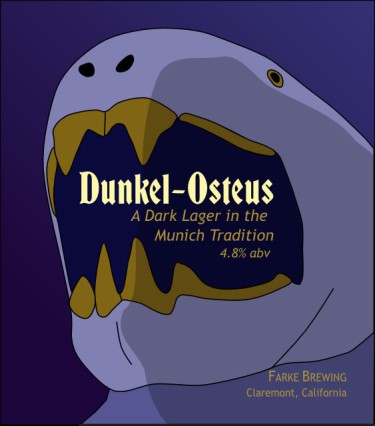
labelI love brewing new styles, and I also love a bad beer pun. The unholy marriage between the two: Dunkel-Osteus!

For this batch, I’m making a Munich dunkel. It’s a reasonably dark, malt-forward lager, in a style that I’ve not brewed previously. Musing over what to call this batch, I remembered a famous prehistoric fish, Dunkleosteus. Dunkel-Osteus was a match made in prehistoric pun heaven!

Dunkleosteus lived around 375 million years ago, during the Devonian (also known as “The Age of Fishes”). It was a giant animal, with sharp bony plates lining its jaws rather than teeth. The largest species were huge, clocking in at around 20 feet in length and a ton in body mass. These were top-tier marine predators, and are a popular exhibit in many museums today. Dunkleosteus and its close kin were an early side branch in vertebrate evolution–nothing exactly like them is around today. However, we humans inherited a common feature from the way-way-way-back ancestor we share with Dunkleosteus: our jaw bones! The open-and-shut jaw arrangement and the major bones that make up our mouth had their origins in some humble fish back before even Dunkleosteus (see this scientific paper on the evolutionary relationships of these organisms). Although the extent to which the jaws of Dunkleosteus and its kin are directly tied to our own has been debated, the latest evidence strongly suggests that they have the same essential bones and are based on the same genetic blueprints, with some evolutionary tweaks. So, next time you open wide for a tasty lager, think about how amazing it is that you are using some of the same skull bones that Dunkleosteus had!

Evolutionary Tree

A highly pruned evolutionary tree for jawed fish and kin. Everything is approximately to scale. Silhouettes via phylopic.org. Humans by Mike Keesey (public domain, right figure) and Sarah Werning (CC-BY, left figure), elephant by Mike Keesey (public domain), tyrannosaur by Emily Willoughby (CC-BY-SA), Dunkleosteus by Dmitry Bogdanov and converted to silhouette by Mike Keesey (CC-BY), tuna by Stuart Humphries (public domain).

The fossil fish Dunkleosteus was named in honor of David Dunkle, a paleontologist at the Cleveland Museum of Natural History way back in the 1950s. As such, the prehistoric organism has nothing to do with the Munich Dunkel style (and indeed, Dunkle and Dunkel are spelled differently). Nonetheless, I couldn’t pass up a good pun!

The recipe is modified slightly from a dunkel presented in Modern Homebrew Recipes, by Gordon Strong. I love the simplicity of Strong’s version–a base malt, two specialty malts, one variety of hops, and a yeast. I elected to use a single infusion mash rather than a decoction mash schedule, and upped the gravity a point or two (while still keeping it at the lower end of the style). I also replaced German Tettnang hops with American-grown Liberty, based on availability, and used dry yeast for simplicity. One major recommendations I retained from Strong’s book was to add the dark grains at vorlauf (in this case, the Carafa Special II), rather than leaving them in the mash for the whole duration. My goal was to have the Carafa just be for coloration, rather than for adding much flavor, and a short steep seemed like the best way to achieve this.

Dunkel-Osteus

  • 9 lbs. Munich II malt (Weyermann)
  • 5 oz. melanoidin malt (Weyermann)
  • 6 oz. Carafa Special II malt (Weyermann), added at vorlauf
  • 1.5 oz. Liberty hops (3.9% alpha), 60 minute boil
  • 1 tsp. Fermax yeast nutrient, 10 minute boil
  • 1 Whirlfloc tablet, 10 minute boil
  • 2 pkg. Saflager Lager yeast (Fermentis W34/70)

Target Parameters

  • 60 minute infusion mash, 154°
  • 1.050 o.g., 1.013 f.g., 4.9% abv, 22 IBU, 20 SRM

Procedure

  • I adjusted my water slightly, to fall within the “malty dark lager” profile in the Palmer and Kaminski water book. I used 5 gallons of Claremont tap water with 3 gallons of RO water and 5 g of calcium chloride. The resulting water profile should approximate 82 ppm Ca, 7 ppm Mg, 15 ppm Na, 31 ppm SO4, 94 ppm Cl, 131 ppm HCO3, and residual alkalinity of 44 ppm.
  • I added 3.25 gallons of water to my mash tun (1 gallon of RO, 2.25 gallons of tap water, and 5 g calcium chloride), at a temperature of 172° or so. I swirled it around the mash tun for a bit, and let it cool down over a period of 5 minutes or so until it hit a temperature of 166°. I mashed in at this point, to hit a temperature of 154.5°.
  • The mash cooled to around 150° after 50 minutes.
  • After 60 minutes in the mash, I added 1.5 gallons of sparge water, let it sit for 10 minutes, added the dark grains, and vorlaufed before collecting the first runnings. My sparge water was made of a blend of 2 gallons RO water and the remainder with tap water. I added ~3.25 gallons of water for the second batch sparge, stirred, let it sit for 10 minutes, and collected the second runnings.
  • I collected 6.5 gallons of wort, a touch below my target of 6.75. So, I added 0.25 gallons of RO water, to reach the target volume. The resulting wort gravity was 1.041–pretty much exactly on target, with an efficiency of 76%.
  • I started the boil, and added the hops, Whirlfloc, and yeast nutrient per the schedule. After 60 minutes, I turned off the flame and chilled the wort down to 70°.
  • Around 5.25 gallons of wort went into the fermenter, with a gravity of 1.050. It’s nice to hit the brewing targets!
  • I pitched the dry yeast immediately, and put the beer in the fermentation chamber. I’ll be fermenting this at 54° for at least two weeks. I’m in no rush with this beer (there are three other beers in the queue ahead of it), so there is no urgency to do a fast lager schedule. I brewed this beer on 10 February 2017.