The Quest for a Real Jurassic Beer

Unexpected connections between my vocation of paleontology and my avocation of brewing pop up in the strangest places.

Recently, I decided to try my hand at a traditional Bohemian pilsner. While reading up on the style in order to develop my recipe, I ran across this interesting tidbit from a technical presentation by folks from Technische Universität München and Weyermann Malting Company [link to PDF]:

The most influencing process for the production of original Bohemian malt is the floor malting process after a 48 h steeping. This is done on traditional naturally cooled Solnhofen limestone floor tiles.

Solnhofen Limestone?!!! No way! My paleontologist brain went into overdrive when I read that statement. Using Solnhofen Limestone for floor tiles is the paleontological equivalent of using Kobe beef in a McDonald’s Happy Meal. Kinda sacrilegious, but also pretty awesome. Let me take a minute to explain this seemingly inane (yet exciting) detail.

Malted barley

Malted barley

First, the brewing side. Raw barley grains are turned into malt by a brief germination, which among other things creates enzymes in the grain that break down starches into more fermentable sugars later during the brewing process itself. Germination produces a lot of heat, which can be a fire hazard in some conditions (and isn’t great for the quality of the finished malt, either). So, the grain is cooled by a combination of physical turning as well as specially cooled floors. Traditionally, the cooling was accomplished by hand-turning on stone tiles (including those made from Solnhofen Limestone, apparently). This germination period is followed by a drying and kilning period, which halts germination and readies the malted barley for brewing. The malted grains are ground up, steeped in water, the resulting liquid is boiled with hops and then fermented with yeast–and bingo, you have beer!

Now, let’s talk about rocks. Solnhofen Limestone is from Bavaria, formed in warm-water lagoons during the Late Jurassic, around 150 million years ago. The gentle waters and fine-grained ooze created the conditions for exquisite preservation of any animals that died in or near the water. Soft-bodied organisms that are rarely fossilized, including dragonflies and giant shrimp, are fairly common finds. The most widely known fossils, though, are the rare and delicate flying vertebrates. Winged reptiles such as Pterodactylus are housed in museum collections globally. And then there is the most iconic fossil of all: Archaeopteryx.

Fossil of Archaeopteryx in Solnhofen Limestone. Specimen displayed at the Museum für Naturkunde (Berlin). Photo by H. Raab, CC-BY-SA.

Fossil of Archaeopteryx in Solnhofen Limestone. Specimen displayed at the Museum für Naturkunde (Berlin). Photo by H. Raab, CC-BY-SA.

First discovered in the 1850s, the early bird Archaeopteryx is a textbook example of a transitional fossil. It preserves features of its dinosaurian ancestors, including sharp teeth and a long bony tail, as well as the long flight feathers found in today’s modern birds. The fingerprints of evolution are all over Archaeopteryx, and it has been key for many discussions on the origin of birds and flight as well as their relationship with carnivorous dinosaurs. Although new discoveries in China, Mongolia, and elsewhere have filled in additional details, the Archaeopteryx skeletons from the Solnhofen Limestone remain historically and scientifically important.

Beyond its paleontological significance, the durable and fine-grained Solnhofen Limestone has a long industrial history–indeed, the fossils are basically “by-catch” from that activity. Over the centuries, the limestone has been used for sculpture, floor tiles, and printing (lithographic) plates. A connection to brewing was new to me!

In the interest of geeky beers, I wondered: was it possible to brew a beer with malt that had rested on the same rocks as Archaeopteryx–a real Jurassic beer? I knew that Bohemian malt had traditionally been malted on Solnhofen Limestone floor tiles. But was this still the case today? Time for some sleuthing.

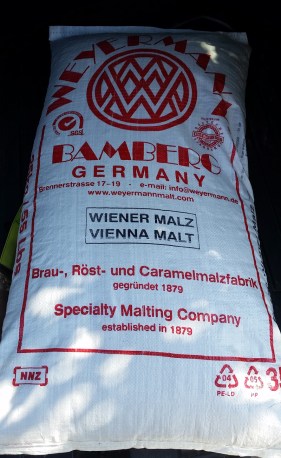
I started my investigation with Weyermann Malting. They carry a wide range of European pilsner malts; being a modern company, their product is largely produced using state-of-the-art malting techniques in order to maintain consistency and quality. This most typically entails malting on slotted metal floors to allow efficient germination and air circulation at the appropriate times in the process. These procedures create high quality malts, but they don’t involve Solnhofen Limestone.

My eye was then drawn to their floor-malted Bohemian pilsner malt. It is billed as being “made in an original floor malting facility”. That sounded promising. A little more sleuthing found a 2009 article [PDF] about the malt by Sabine Weyermann (of the very same malting company) in Scandinavian Brewers’ Review. In this article, Weyermann notes that their floor-malted pilsner malt is produced under contract at Ferdinand Brewery and Malting Company–whose malt house is floored by Solnhofen tiles.

A view inside the traditional floor malting facility at Ferdinand Brewing and Malting. From Weyermann 2009.

A view inside the traditional floor malting facility at Ferdinand Brewing and Malting. From Weyermann 2009.

My journey to Solnhofen Beer was almost complete! I sent off a quick email to several individuals at Weyermann Malting Company, to confirm if their traditional pilsner malt that is sold today is still produced on Solnhofen Limestone. Not long after, I received a response from Stefan Gottschall at Weyermann, verifying the Solnhofen connection. My quest was complete.

So, you can brew a Solnhofen-themed beer! Thanks to Weyermann’s Floor-Malted Bohemian Pilsner Malt, every sip of my latest lager has a physical connection to Archaeopteryx and all of the other Jurassic critters of ancient Bavarian lagoons. This is beer at its best–an experience not just of taste, but also one imbued with 150 million years of history and a link to the fossils I love.

An Archaeopteryx-linked beer requires the appropriate glassware.

An Archaeopteryx-linked beer requires the appropriate glassware.

Lithographica Pilsner Update

The Lithographica Pilsner has been chugging along for awhile now. After four days at 66°, the gravity was down to 1.011. I let it sit there for three more days, and then cold crashed to 33° on 18 June 2016. After over three weeks at this temperature, I kegged the beer. The final gravity was 1.011, with a clean flavor and a very clear beer. A little yeast was transferred over to the fermenter, but I am hoping that the continued cold conditioning will take care of that.

Beer Tasting: Centennial IPA

20160714_204030My Centennial IPA has been in the keg and cold conditioning/dry-hopping for nearly a month. Because I’m taking off soon for a few weeks, and because IPA’s are best fresh, now is as good of a time as any to do a tasting.

Centennial IPA

  • The Basics
    • Original gravity = 1.063; final gravity = 1.010; abv = 7.0%; estimated IBU = 59
  • Aroma
    • Very lightly sweet malt aroma, with a moderate hop aroma that is citrusy (slightly orange-hinted) and lightly floral.
  • Appearance
    • A hazy beer with a moderately deep gold color. The off-white head is fine and persistent, with modest lacing.
  • Flavor
    • As it should be, this is a hop-forward beer, with a smooth but assertive bitterness that fades in and then gently fades out. The bitterness has a piney note to it. The modest malt flavor tends toward the grainy side.
  • Mouthfeel
    • This is a fairly dry beer, with a relatively light body. Carbonation is moderate, as is appropriate for the style.
  • Would I brew this again?
    • This is a solid traditional American IPA–I would characterize it as squarely middle of the road; not in a bad way, just that it is tasty but not adventurous. In the original recipe, Gordon Strong noted that the recipe would be a solid base for any single hop American IPA; I agree! For this particular run, I feel like I’m getting a nice feel for what Centennial is as a hop. Compared to recent varieties such as Mosaic or Citra, Centennial is so “yesterday.” But, it has a character all its own that deservedly places it in the great pantheon of hops. I can’t say I’ll change much (other than hop variety) when I brew this again; it would definitely be OK with other American yeast varieties, but in terms of malt bill and brewing technique it’s spot-on.
  • Rating
    • 9/10

Beer Tasting: Accretion Porter

Porters are some of my favorites (especially during the fall through spring seasons), and seem to turn out well pretty consistently. Accretion Porter fits this trend. Details are below.

  • The Basicsaccretion_porter
    • Original gravity = 1.058; final gravity = 1.020; abv = 5.0%; estimated IBU = 41
  • Aroma
    • The aroma is exceptionally malty, with a grainy and roasty character to it., and a touch of coffee. Delicious!
  • Appearance
    • The beer is a deep, deep chocolate brown, with a light brown head that pours tall and settles down to a thin but persistant blanket over the beer.
  • Flavor
    • The roasty maltiness has a nice chocolate and coffee flavor. The hops have a gentle background flavor, with the slight herbal/woody component so classic for Northern Brewer.
  • Mouthfeel
    • This is a beer with moderate body and a smooth and pleasant, but moderately dry, finish. The carbonation is maybe a touch higher than I need (contributing to a perception of the beer being drier than it actually is).
  • Would I brew this again?
    • This is a pretty nice beer across the board; maybe a little drier and more carbonated than is needed, but the overall impression is exceptionally drinkable. I like this one!
  • Overall rating
    • 7.5/10