This is one of my most frequently brewed recipes, now in its fifth iteration. I love the kölsch style, especially my “traditional” version that eschews wheat and leans in to an all-barley grain bill. The 2026 brew represents a changing of the guard, with the Köln yeast no longer available from Lallemand, and the Edelweiss hop blend now into retirement. I truly love this recipe, and will have to reformulate a little bit for the next round. I don’t care for K-97 in this style, so I’ll probably be back to liquid yeast in my German ales.
The brew and fermentations were delightfully uneventful for this round. My only minor hiccup was realizing that my draft lines were badly in need of a clean, which greatly improved the taste on the final product. Lesson learned!
Recipe Name
- 9.5 lb. Synergy Select Pilsen Malt (Briess)
- 0.5 lb. Barke Munich malt
- 0.5 tsp. BrewTanB, added to mash
- 1.1 oz. Edelweiss hop blend pellets (5.8% alpha), 60 minute boil
- 0.5 tsp. BrewTanB, 10 minute boil
- 1 Whirlfloc tablet, 5 minute boil
- 2 pkg. Köln Kölsch style ale yeast (Lallemand)
- 0.9 oz. Edelweiss hop pellets (5.8% alpha), dry hop in primary
Target Parameters
- 60 minute infusion mash, 152°, full volume mash
- 1.046 o.g., 1.010 f.g., 4.7% abv, 24 IBU, 4 SRM
- Water built from RO, to hit 50 ppm Ca, 5 ppm Mg, 6 ppm Na, 54 ppm SO4, 72 ppm Cl
- 5.25 gallon batch
Procedure
- I built my water from 7.25 gallons of distilled water, with 3.6 g of CaCl, 1.7 g gypsum, 1.4 g epsom salt, and 0.4 g kosher salt, to hit the estimated water parameters.
- I heated the strike water to 157°, added the grains along with 1 tbs. 10% phosrphoric acid as well as the BrewTanB, and then held at 152° for 60 minutes with recirculation.
- After 60 minutes, I heated the mash to 168°, held it there for 10 minutes, and then removed the grains.
- In total, I collected 6.6 gallons of runnings with a gravity of 1.043, for 75% mash efficiency.
- I heated the runnings to a boil, adding hops and finings per the recipe. After 60 minutes, I turned off the heat and chilled to 75° before transferring to the fermenter. Then, I put the fermenter into the fermentation chamber and chilled down to 60° before pitching the yeast.
- Starting gravity was 1.049. I brewed this beer on 1 March 2026.
- I fermented at 64°, and pulled the beer to ambient on 10 March 2026. I cold crashed on 13 March 2026, adding the dry hops at that time.
- I kegged the beer on 22 March 2026, using closed transfer. I forgot that there were hops in the fermenter, so the dip tube clogged–I used a puff of CO2 to clear things out before resuming the transfer.
- Final gravity was 1.010, for 5.2% abv.
- I added ~2 oz. BioFine Clear on 27 March 2026.
Tasting
- Appearance
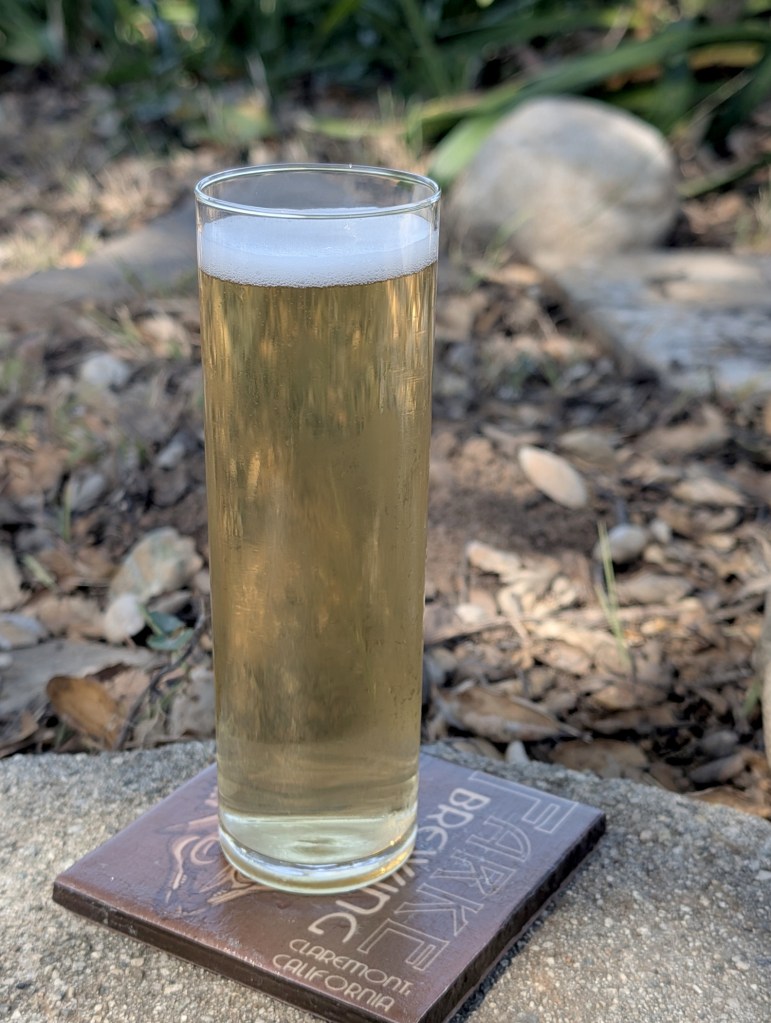
- Straw yellow color, brilliantly clear, with a low and persistent white head. It took awhile to clarify, but WOW! This is such a pretty beer.
- Aroma
- Low level of fruity aroma, with a ripe apple and pear character. Very low level of sweet malt aroma.
- Flavor
- Medium-low level of grainy maltiness, medium bitterness, medium low fruity, pear-like yeast flavor.
- Mouthfeel
- Medium body, moderate level of carbonation, dry finish.
- Would I Brew This Again?
- This is a perfect recipe! The dry hop doesn’t come through, but that’s OK. The yeast character is quite nice, as is the malt bill. I’ll need to adjust yeast and hops for the next batch, but the overall concept is excellent for a kölsch. I could probably notch the bitterness back a little; I go back and forth on whether or not it’s too much or perfect.
- Overall
- 10/10

