Continuing my exploration of Vienna malt, I turned my sights onto the most Viennese of all Vienna malt-based brews: Vienna lager. This is my first time with the style, and only my third time brewing a lager beer, so I did a fair bit of research to flesh out the basics for this batch.
My recipe was modeled primarily on “Nothing But Vienna” from Gordon Strong’s Modern Homebrew Recipes. As the name implies, Strong’s recipe was a SMaSH, which appealed to me as a way to delve as deeply as possible into the mysteries of Vienna malt. The recipe from Modern Homebrew used a decoction mash to develop the rich amber color characteristic of the Vienna lager style, which meant a great chance for me to expand my techniques!
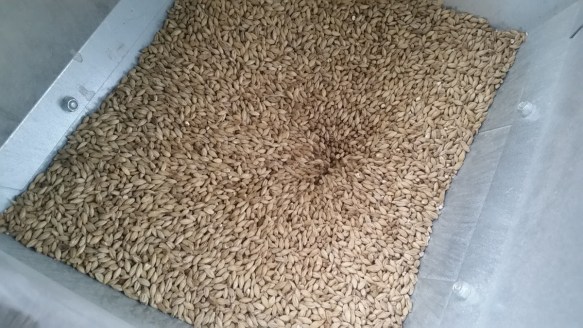
Once I had a base recipe in mind, I couldn’t resist the urge to modify it. Some of this was based on necessity, and some of this was based on my own inclination. The original brew called for whole Sterling hops; pellets were easier to track down. I also elected to use dry yeast, both for simplicity as well as to give dry lager yeast a try (in this case, the well-reviewed Saflager W34/70). Finally, I knew that I wanted to build up some water for this, but Strong’s water suggestion (RO water with just a bit of calcium chloride augmented by phosphoric acid) also departed from the “traditional” recommendation of a profile that matched some wells in Vienna itself (as listed in Noonan’s classic work). So, I modified that a bit too.
Based on my previous experience with a decoction mash, I knew that hitting mash temperatures after decoction additions was going to be a challenge. So, I adjusted all of my decoction volumes up. I got some assistance from the BeerSmith software on this. What I did was tinker with the step temperatures a bit. Let’s say my first mash step was at 144°, and my next step aimed for 150°. I knew that the mash would slip a bit below 144°–let’s say 138°–while I was doing the decoction. So, after I had the volumes for the 144° step, I changed the temperature target for that step to 138° (or whatever I thought the mash would end up at). I left the temperature for the next step the same. So, even though I was actually going for a 144°->150° mash temperature boost after the decoction, I told the software I was going for a 138°->150° boost. This upped the calculated decoction volume accordingly. As noted below, I ended up closer to my mash targets, but still not quite there yet. The main issue is that my temperature drop was more than expected, probably due to cooling in the mash tun as I strained out each decoction volume. Something to adjust for next time!
All in all, this was one of the most technically demanding (and fun!) brew sessions I’ve done to date. Here’s hoping the results match the effort!
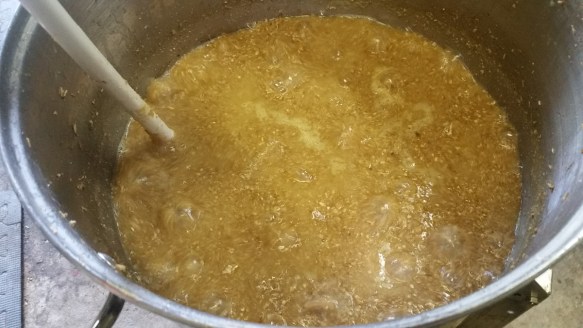
Decoction mash in progress
Decoction Envy Vienna Lager
- Distilled water, adjusted as outlined below
- 10.5 lbs. Vienna malt (Weyermann)
- 0.9 oz. Sterling hop pellets (8.1% alpha), 60 minute boil
- 0.1 oz. Sterling hop pellets (8.1% alpha), 10 minute boil
- 1 Whirlfloc tablet, 10 minute boil
- 0.5 tsp. yeast nutrient (BSG Fermax), 10 minute boil
- 2 pkg. Saflager yeast (W34/70)
Brewing Targets
- Double decoction mash, with 20 minutes at 144°, 20 minute boil of decoction and raise mash to 154°, 20 minute boil and raise mash to 168°
- Original gravity = 1.052 (actual = 1.055)
- Color = 5 SRM (probably a bit higher due to decoction)
- IBU = 29
- 90 minute boil total
Procedure
- To 6 gallons of distilled water, I added 5.1 g of gypsum, 1.5 g of calcium chloride, 5.4 g of chalk, and 1.5 mL of 10% phosphoric acid, to approximate the Vienna water profile. I note that the chalk didn’t really dissolve much, so for future brews I’m not really sure if this is a worthwhile addition.
- I mashed in with the water at 151°, to hit a mash temperature of 145°. The mash at this point is quite thin.
- After 25 minutes, I withdrew 5.5 quarts of thick mash, raised the temperature to 158°, let the mash sit for 15 minutes, and then boiled for 20 minutes.
- I added the decoction back to the mash tun, which raised the mash temperature to 147°.
- After 15 minutes, I removed 2.675 gallons of thick mash, raised it to 158° for 15 minutes, and then boiled for another 20 minutes. I added this back to the mash tun, which raised the overall mash up to around 150°.
- After 10 minutes, I vorlaufed and drained the mash tun. I added 4 gallons of sparge water (adjusted with phosphoric acid and other minerals to match the Vienna profile) at 190°, which raised the mash water to 174° or so, but put the mash bed at 170° on the dot. After a few minutes, I collected the remaining wort.
- Overall, I collected 8 gallons of wort with a starting gravity of 1.045. Wow! The efficiency was through the roof at 89%. To compensate for the high volume, I decided to boil down the wort for 30 minutes before adding the hops.
- After 30 minutes of a very vigorous boil, the wort volume was down to 7.3 gallons and 1.049 gravity. After 60 minutes or so of boiling, we were at 6.5 gallons with a gravity of 1.053. At this point, I dialed back the boil a bit, so that I wouldn’t overshoot my target gravity. At 8 minutes to go, I added .25 gallons of tap water (with Campden tablet shaving) to lower gravity a bit; prior to this, the gravity was at 1.055 and thus the absolute outside limit of the Vienna lager style. The water addition brought it down to 1.053.
- I added all hops and other additions per the recipe, with a total 90 minute boil.
- At the end of the boil, I turned off the heat and cooled the wort down to 80°. At this point, I transferred it to my fermentation chamber and set it to cool to 55°.
- Once the wort reached 55°, I sprinkled the yeast into the fermenter.
- I brewed this beer on 3 September 2016. Visible signs of fermentation were apparent by the next morning.
- I’ll be fermenting at 55° for 10-14 days, before raising the beer up to 68° for a diacetyl rest. After a few days of that, I’ll crash the beer to around 32° for a few days and then transfer to the keg.

 My Citra Wit has come and gone, but luckily I was able to squeeze in an “official” tasting in before the keg kicked!