Brew Updates: Palaeotis Pils 1.2 & Old Pine Pale Ale

I’ve kegged two of my brews in the past week, incluing my German pils and my American pale ale. Here are the details!

  • After 10 days in primary, I kegged Old Pine Pale Ale on 12 December 2017. I added the dry hops at this point, in a bag. Depending on how it works out, I may or may not remove the hops. I force carbonated the keg, and had it on tap by 16 December. The brew is pretty hazy at this point, and should clear up with time. Final gravity was 1.012, down from 1.052, working out to 5.2% abv.
  • My latest iteration of Palaeotis Pils started fermentation on 20 November 2017. It fermented at 50° until 27 November, when I raised the temperature to 54°. I raised the temperature to 66° on 2 December 2017, and cold crashed it on 10 December 2017. I kegged the beer on 16 December 2017. Final gravity was 1.010; with a starting gravity of 1.049, we’re clocking in at 5.1% abv. There is a touch of haze, which I’m going to settle out with time and cold.

Beer Tasting: Session Stout

stoutI’ve had this beer on tap for about a month; it has been really enjoyable!

Session Stout

  • The Basics
    • 1.042 s.g., 1.012 f.g., 3.9% abv, 31 IBU, 42 SRM
  •  Appearance
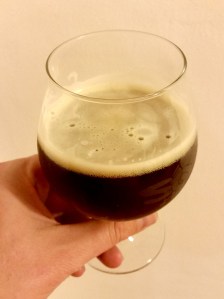
    • Clear, black beer, with a fine tan head that is moderately persistent. It looks awesome!
  • Aroma
    • The aroma has a prominent roasted character, with a tiny hint of chocolate behind that.
  • Flavor
    • The beer has a forward roasted/slightly burnt character with a dark coffee tone, as expected from the roast barley. The hop bitterness is smooth, in the background behind the malt.
  • Mouthfeel
    • The beer is fairly light bodied with moderate carbonation. The finish is dry, but smooth.
  • Would I brew this again?
    • I think so! It’s a very drinkable beer, both in terms of its flavor/mouthfeel as well as the low alcohol. I’ve been enjoying it quite a bit. If I were to make any minor changes, I would probably up the body just a little (it can tend to slightly thin after awhile). I might also experiment with a version that has more chocolate malt, to richen the  profile and make it a bit more complex than just roast barley.
  • Overall
    • 8/10

Palaeotis Pils 1.2

I really, really like a good German pils, and have iterated through two batches previously. Based on what I learned there, I refined the recipe a bit more. I opted for Magnum hops for bittering, Barke pilsner malt (courtesy of a free bag from Weyermann at Homebrew Con), and a return to decoction mashing.

Palaeotis Pils 1.2

  • 8.5 lbs. Barke pilsner malt (Weyermann)
  • 0.6 lb. acidulated malt (Bestmalz)
  • 0.6 oz. Magnum hop pellets (13.2% alpha), 60 minute boil
  • 1 Whirlfloc tablet, 10 minute boil
  • 0.5 tsp. Fermax, 10 minute boil
  • 1 oz. Hallertauer Mittelfrueh hop pellets (4.1% alpha), 5 minute boil
  • 2 pkg. Saflager lager yeast (W34/70)

Target Parameters

  • Double decoction mash, infusion to hit 45 minute rest at 151°, thick decoction to raise temperature to 158°, 10 minute rest, thin decoction to mash out at 168°. Batch sparge.
  • Water built from R.O., to hit 59.1 ppm Ca, 8.2 ppm Mg, 89 ppm SO4, and 62.9 ppm Cl.
  • 1.046 s.g., 1.008 f.g., 34 IBU, 3.4 SRM, 5.0% abv

Procedure

  • I started with RO water for both the mash and sparge. For the mash water, I added 1.65 g gypsum, 1.35 g epsom salt, and 2.1 g CaCl to 4.75 gallons of RO water. For the sparge water, I added the same masses of the salts to 3.8 gallons of RO water.
  • I mashed in with 4.75 gallons of water at 158°, to hit a 151° mash rest.
  • After 45 minutes, I pulled 2 gallons of thick decoction, raised to 160° for 10 minutes, boiled for 10 minutes, and then added it back to the mash. This raised the mash to 158°.
  • After another 10 minutes, I pulled a 1 gallon thin decoction (basically, the first runnings), boiled this for 10 minutes, and added back to the mash tun. After another 10 minutes of settling, I pulled off the first runnings.
  • Next, I added 3.8 gallons of sparge water at 185°, let it sit for 10 minutes, and then drained the mash tun.
  • In total, I collected 6.7 gallons of runnings with a gravity of 1.044–this is 88% efficiency! I added 0.5 gallons of RO water to bring the gravity down to 1.041.
  • I boiled for 60 minutes, adding the hops and other additions per the schedule. After the boil was complete, I chilled to 80° with my immersion chiller, and then chilled down to 48° overnight in my fermentation chamber.
  • I brewed the beer on 19 November 2017, and pitched the yeast on 20 November 2017. Fermentation was started at 50°, and raised to 54° on 27 November 2017. Finally, I raised the temperature to 66° on 2 December 2017.
  • In a week or so, I plan to cold crash and then keg the beer.

Old Pine Pale Ale

I’ve been doing a lot of IPAs lately, and decided to mix things up a bit with an American pale ale for my next hop-forward beer. The December 2017 issue of Brew Your Own had a clone recipe for Dale’s Pale Ale (by Oskar Blues Brewing), which is one of my favorite beers. I particularly like the malt body with it, so riffed off the recipe to come up with my own version. My other requirement was to focus on piney-type hops, so I bolstered the Cascade core with a hefty Simcoe late addition and dry hop. My hope is to turn this around pretty quickly, because I’m likely going to be out of my Thanksgiving IPA in a matter of days!

Old Pine Pale Ale

  • 9 lbs. California Select 2-row brewer’s malt (Great Western)
  • 1 lb. Golden Promise malt (Simpsons)
  • 0.75 lb. Victory (biscuit) malt (Briess)
  • 3 oz. 80°L caramel malt (Briess)
  • 2 oz. Cascade whole hops (5.5% alpha), 60 minute boil
  • 2 oz. Cascade whole hops (5.5% alpha), 10 minute boil
  • 1 oz. Simcoe hop pellets (13.6% alpha), 5 minute whirlpool after flame-out
  • 1 Whirlfloc tablet, 10 minute boil
  • 1 pkg. California Ale yeast (WLP001), prepared in starter
  • 3 oz. Simcoe hop pellets (13.6% alpha), 5 day dry-hop

Target Parameters

  • Infusion mash to hit target of 152°. Batch sparge.
  • Claremont tap water, with addition of RO water and mineral adjustments to hit target of 98 ppm Ca, 22 ppm Mg, 24 ppm Na, 196 ppm SO4, 48 ppm Cl, and 167 ppm HCO3.
  • 1.055 s.g., 1.012 f.g., 54 IBU, 7 SRM, 5.7% abv

20171202_194028

Procedure

  • Three days in advance of brewing, I prepared a 1.5 L starter (to produce enough yeast for the pitch on this batch as well as to have enough to save for later).
  • For the mash water, I added 2 gallons of RO water to 1.67 gallons of tap water, with mineral additions of 5.9 g gypsum, 0.6 g table salt, 4.8 g epsom salt, and 1.4 g CaCl. I also added 4.5 mL of phosphoric acid (75%) to balance out the pH.
  • I mashed in with 3.67 gallons of the above water at 165°, to hit a mash temperature of 153°. After 50 minutes, I added 1 gallon of tap water at 185°, let sit for another 10 minutes, vorlaufed, and collected the first runnings. I added another 3.6 gallons of tap water at 185°, let sit for 10 minutes, vorlafued, and collected the remainder of the runnings.
  • In total, I collected 6.65 gallons of runnings with a gravity of 1.045. This equates to 75% efficiency.
  • I brought everything to a boil, adding the various hops and Whirlfloc at the appointed times. After 60 minutes, I added the final hop addition, let sit for 10 minutes, and chilled down to 77° before transferring to the primary fermenter and pitching the yeast.
  • Starting gravity was 1.052, just a touch below the predicted. A slightly more vigorous boil probably would have brought things more into line. Even so, I’m not terribly worried; it’s well within overall parameters.
  • I brewed this beer on 2 December 2017, and am fermenting it at 66°.

Thanksgiving IPA 2017: Recipe & Tasting

I wanted to have a nice IPA on-hand for Thanksgiving. So, I brewed up a recipe based on my Centennial IPA, first brewed last year. The base beer is a favorite of mine, so it seemed like an easy choice. I did modify it slightly to use crystal 20 and Victory malt instead of Caravienne and Carahell. I also mixed the hopping up a little bit, maintaining focus on the citrus/pine American hops. This was combined with Mandarina Bavaria hops, to add an interesting twist that I hoped would play well with everything else.

Thanksgiving IPA 2017

  • 10.5 lbs. California Select 2-row brewer’s malt (Great Western)
  • 1.75 lbs. Vienna malt (Great Western)
  • 0.5 lb. 20°L caramel malt (Briess)
  • 0.25 lb. Victory (biscuit) malt (Briess)
  • 1 oz. Centennial hop pellets (7.6% alpha), first wort hop with 60 minute boil
  • 1 oz. Centennial hop pellets (7.6% alpha), 15 minute boil
  • 1 oz. Cascade whole hops (5.5% alpha), 10 minute boil
  • 1 oz. Centennial hop pellets (7.6% alpha), 10 minute boil
  • 1 oz. Amarillo hop pellets (9.2% alpha), 5 minute whirlpool
  • 1 oz. Mandarina Bavaria hop pellets (9.5% alpha), 5 minute whirlpool
  • 1 oz. Centennial hop pellets (7.6% alpha), 6 day loose dry hop in primary
  • 1 oz. Amarillo hop pellets (9.2% alpha), 6 day loose dry hop in primary
  • 1 oz. Mandarina Bavaria hop pellets (9.5% alpha), 6 day loose dry hop in primary
  • 1 pkg. California Ale yeast (White Labs WLP001), prepared in starter

Procedure

  • I mashed in with 4.25 gallons of Claremont tap water at 161 degrees, to hit a 150° mash target. After 60 minutes, I added 0.75 gallons of water at 185°, let sit for 10 minutes, vorlaufed and drained. I then added 3.5 gallons of water at 185°, let sit for 10 minutes, vorlaufed, and drained.
  • In total, I collected 6.75 gallons of wort at a gravity of 1.050, for 71% efficiency.
    I brought the wort to a boil, and added hops per the schedule.
  • After a 60 minute boil, I chilled to pitching temperatures and added the yeast (which was prepared in a starter).
  • Original gravity was 1.062.
  • I brewed the beer on 7 November 2017, and fermented at 66° for 6 days. On 13 November, I added the dry hops directly to the primary fermenter. On 19 November, I cold crashed the beer.
  • On the morning of 20 November, I accidentally added 0.25L of lager yeast pitch intended for another beer. Oops.
  • On the evening of 20 November, I split the beer into two kegs (2.5 gallons each). The more full keg received 1 tsp. of gelatin in 1/4 cup of water, heated to 150 degrees. The other (less full) did not get gelatin. I force carbonated the kegs.
  • Final gravity was 1.008, for 7.1% abv.

20171123_131532Tasting

  • The Basics
    • 1.062 o.g., 1.08 f.g., 7.1% abv, 62 estimated IBU, 6 SRM
  • Appearance
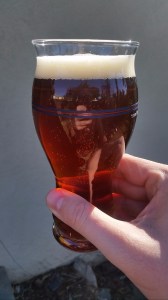
    • This beer is a deep gold, with a modest haze (it looks a bit darker in the photo due to the lighting). The head is exceptionally persistent and off-white, with beautiful lacing on the glass.
  • Aroma
    • Light yet rich citrus aroma from the hops, with a light malty aroma with a slight hint of caramel behind that
  • Flavor
    • The beer has a bready malty character, with a firm and persistent malt bitterness. The hop flavor is piney and citrusy, tending towards a grapefruit character. The bitterness is perfect, with a smooth quality and smooth finish.
  • Mouthfeel
    • The beer has a medium body and has a moderately dry finish with moderate carbonation.
  • Would I brew this again? 
    • Yes! This recipe once again satisfies, and I’m quite pleased with how the hops turned out. This is a classic west coast American IPA. The hop aroma could maybe be a touch stronger, but that’s a minor complaint overall.
  • Overall
    • 9/10