Palaeotis Pils

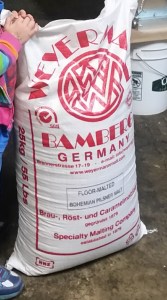
pilsner_maltOn my continued quest to learn brewing grains in depth, I recently purchased a 55 lb. sack of Weyermann’s floor-malted Bohemian pilsner malt. This is the same stuff I used for my Lithographica Pilsner, and is cool on a scientific level because the grains are malted on floors made of Solnhofen Limestone (more details here).

For my first brew with this sack of malt, I elected on doing a German pils. That’s a new style for me, and also can be brewed with a minimum complexity of ingredients (I’m really gravitating towards those sorts of simple recipes).

The name for the batch honors an important fossil bird from the Messel pits of Germany, around 47 million years old. Palaeotis is potentially an early ratite, a member of the group of birds including ostriches and emus.

Palaeotis Pils

  • 8.5 lbs. floor-malted Bohemian pilsner malt (Weyermann)
  • 0.21 lb. acidulated malt
  • 0.6 oz. Magnum hop pellets (13.2% alpha), 60 minute boil
  • 1 oz. German Hallertau hop pellets (3.2% alpha), 5 minute boil
  • 1 tsp. Fermax yeast nutrient, 10 minute boil
  • 1 Whirlfloc tablet, 10 minute boil
  • German lager yeast (White Labs WLP830), prepared in 1.7L starter

Target Parameters

  • Double decoction mash, 10 minute rest at 122°, infusion to hit 60 minute rest at 148°, thick decoction to raise temperature to 154°, 10 minute rest, thin decoction to mash out at 168°. Batch sparge.
  • Water built from R.O., to hit 59.1 ppm Ca, 8.2 ppm Mg, 89 ppm SO4, and 62.9 ppm Cl.
  • 1.045 o.g., 1.008 f.g., 4.9% abv, 34 IBU, 3 SRM, 5 gallons into fermenter

Procedure

  • Five days in advance (4 December 2016), I made a 1.75 L starter for my yeast culture. After two days on the stir plate, I cold-crashed the starter.
  • For this recipe, I built my water to match the “Pilsner Water” profile on Braukaiser. For the 3.6 gallons of mash water, I added 1.4 g of gypsum, 1.1 g of epsom salt, and 1.8 g of calcium chlorie. For the 5 gallons of sparge water, I added 1.9 g of gypsum, 1.6 g of epsom salt, and 2.5 g of calcium chloride.
  • I mashed in with 2.25 gallons of water at 134° to hit 126°, and left it for a 10 minute protein rest.
  • Next I added 5.25 quarts of water at 197°, to hit a mash temperature of 149° (after a bit of stirring).
  • After 50 minutes, I pulled a thick decoction of 7 quarts. I heated it to 154°, let it rest for 10 minutes, and brought to a boil for 10 minutes. The decoction addition brought the mash up to 156. I let the mash rest for 10 more minutes.
  • Next, I pulled 1 gallon of wort for a thin decoction, boiled it for 10 minutes, and returned it to the mash. This raised the temperature up to around 168°.
  • I pulled the first runnings, and added the 5 gallons of sparge water. After 10 minutes and a vorlauf, I collected the remainder of the wort. I had around 7 gallons, so added 0.25 gallons of water to bring up the volume to my target.
  • In total, I had 7.25 gallons of mash runnings at a gravity of 1.038, for 84% efficiency.
  • I brought the kettle to a boil, and added the hops and other ingredients per the schedule. I added 0.25 gallons of RO water during the boil, to top things up and keep the gravity from getting too high.
  • After 60 minutes, I chilled the wort down to 70°, transferred the wort while aerating, put the fermenter into the fermentation chamber, and pitched the yeast.
  • Starting gravity was 1.048, a touch above my target of 1.045. I will be fermenting this at 52°. I brewed the beer on 9 December 2016.

Beer Tasting: Lithographica Pilsner

The keg for my Bohemian pilsner is long past kicked, but better late than never, right?

  • The Basics
    • Original gravity = 1.053; final gravity = 1.011; abv = 5.5%; estimated IBU = 39
  •  Aroma
    • Light bready aroma, with a moderate spicy hops note. I might detect a very, very faint fruitiness, but this seems to come and go, so I’m not certain it is really there.
  • Appearance
    • Clear, but not brilliant, with a moderate yellow color. The head pours rather high when first poured, but settles down to a low head with good coverage. The head is fine and white.
  • Flavor
    • A moderate hoppiness is at the fore, moderately balanced against a decent but not overwhelming maltiness. The malt has a bready/grainy character. As I drink this, the hoppiness fades out nicely on the finish.
  • Mouthfeel
    • This is a beer with modest body and a medium rather than dry finish. Carbonation is moderately high.
  • Would I brew this again?
    • This beer is a pretty respectable first go at a Bohemian pilsner. It’s quite drinkable, and there isn’t anything I would call a major flaw. If I do this recipe again, I would up the maltiness a touch, darken the color to more gold than yellow, and work on improving the clarity just a little. Clarity could be fixed by more careful racking, and a little bit more time lagering before initial tapping. For increased maltiness, I might add another grain or two to the malt bill (e.g., Carapils), or else boil the decoctions for a longer stretch. This would also help burnish the color to the golden sheen that is more appropriate for the style.
  • Rating
    • 6/10

The Quest for a Real Jurassic Beer

Unexpected connections between my vocation of paleontology and my avocation of brewing pop up in the strangest places.

Recently, I decided to try my hand at a traditional Bohemian pilsner. While reading up on the style in order to develop my recipe, I ran across this interesting tidbit from a technical presentation by folks from Technische Universität München and Weyermann Malting Company [link to PDF]:

The most influencing process for the production of original Bohemian malt is the floor malting process after a 48 h steeping. This is done on traditional naturally cooled Solnhofen limestone floor tiles.

Solnhofen Limestone?!!! No way! My paleontologist brain went into overdrive when I read that statement. Using Solnhofen Limestone for floor tiles is the paleontological equivalent of using Kobe beef in a McDonald’s Happy Meal. Kinda sacrilegious, but also pretty awesome. Let me take a minute to explain this seemingly inane (yet exciting) detail.
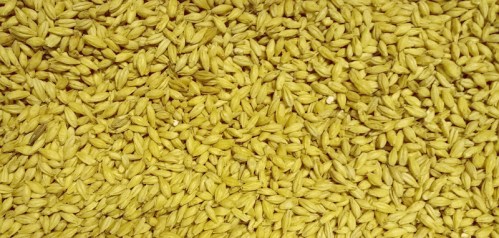
Malted barley

Malted barley

First, the brewing side. Raw barley grains are turned into malt by a brief germination, which among other things creates enzymes in the grain that break down starches into more fermentable sugars later during the brewing process itself. Germination produces a lot of heat, which can be a fire hazard in some conditions (and isn’t great for the quality of the finished malt, either). So, the grain is cooled by a combination of physical turning as well as specially cooled floors. Traditionally, the cooling was accomplished by hand-turning on stone tiles (including those made from Solnhofen Limestone, apparently). This germination period is followed by a drying and kilning period, which halts germination and readies the malted barley for brewing. The malted grains are ground up, steeped in water, the resulting liquid is boiled with hops and then fermented with yeast–and bingo, you have beer!

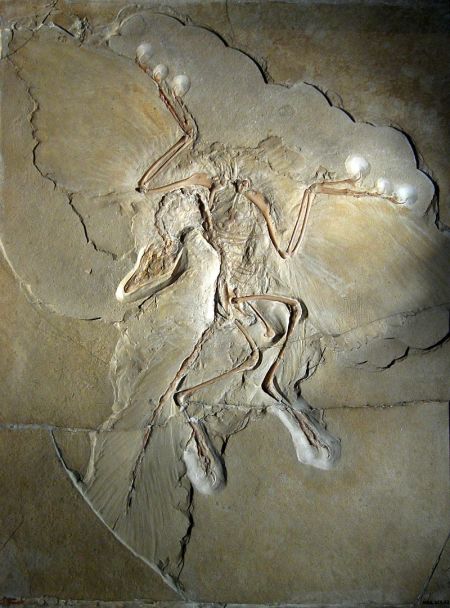
Now, let’s talk about rocks. Solnhofen Limestone is from Bavaria, formed in warm-water lagoons during the Late Jurassic, around 150 million years ago. The gentle waters and fine-grained ooze created the conditions for exquisite preservation of any animals that died in or near the water. Soft-bodied organisms that are rarely fossilized, including dragonflies and giant shrimp, are fairly common finds. The most widely known fossils, though, are the rare and delicate flying vertebrates. Winged reptiles such as Pterodactylus are housed in museum collections globally. And then there is the most iconic fossil of all: Archaeopteryx.

Fossil of Archaeopteryx in Solnhofen Limestone. Specimen displayed at the Museum für Naturkunde (Berlin). Photo by H. Raab, CC-BY-SA.

Fossil of Archaeopteryx in Solnhofen Limestone. Specimen displayed at the Museum für Naturkunde (Berlin). Photo by H. Raab, CC-BY-SA.

First discovered in the 1850s, the early bird Archaeopteryx is a textbook example of a transitional fossil. It preserves features of its dinosaurian ancestors, including sharp teeth and a long bony tail, as well as the long flight feathers found in today’s modern birds. The fingerprints of evolution are all over Archaeopteryx, and it has been key for many discussions on the origin of birds and flight as well as their relationship with carnivorous dinosaurs. Although new discoveries in China, Mongolia, and elsewhere have filled in additional details, the Archaeopteryx skeletons from the Solnhofen Limestone remain historically and scientifically important.

Beyond its paleontological significance, the durable and fine-grained Solnhofen Limestone has a long industrial history–indeed, the fossils are basically “by-catch” from that activity. Over the centuries, the limestone has been used for sculpture, floor tiles, and printing (lithographic) plates. A connection to brewing was new to me!

In the interest of geeky beers, I wondered: was it possible to brew a beer with malt that had rested on the same rocks as Archaeopteryx–a real Jurassic beer? I knew that Bohemian malt had traditionally been malted on Solnhofen Limestone floor tiles. But was this still the case today? Time for some sleuthing.

I started my investigation with Weyermann Malting. They carry a wide range of European pilsner malts; being a modern company, their product is largely produced using state-of-the-art malting techniques in order to maintain consistency and quality. This most typically entails malting on slotted metal floors to allow efficient germination and air circulation at the appropriate times in the process. These procedures create high quality malts, but they don’t involve Solnhofen Limestone.

My eye was then drawn to their floor-malted Bohemian pilsner malt. It is billed as being “made in an original floor malting facility”. That sounded promising. A little more sleuthing found a 2009 article [PDF] about the malt by Sabine Weyermann (of the very same malting company) in Scandinavian Brewers’ Review. In this article, Weyermann notes that their floor-malted pilsner malt is produced under contract at Ferdinand Brewery and Malting Company–whose malt house is floored by Solnhofen tiles.
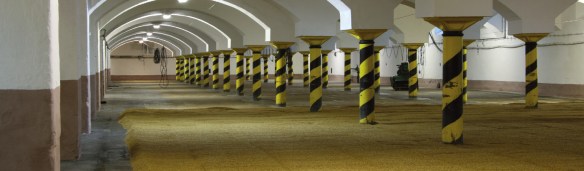
A view inside the traditional floor malting facility at Ferdinand Brewing and Malting. From Weyermann 2009.

A view inside the traditional floor malting facility at Ferdinand Brewing and Malting. From Weyermann 2009.

My journey to Solnhofen Beer was almost complete! I sent off a quick email to several individuals at Weyermann Malting Company, to confirm if their traditional pilsner malt that is sold today is still produced on Solnhofen Limestone. Not long after, I received a response from Stefan Gottschall at Weyermann, verifying the Solnhofen connection. My quest was complete.

So, you can brew a Solnhofen-themed beer! Thanks to Weyermann’s Floor-Malted Bohemian Pilsner Malt, every sip of my latest lager has a physical connection to Archaeopteryx and all of the other Jurassic critters of ancient Bavarian lagoons. This is beer at its best–an experience not just of taste, but also one imbued with 150 million years of history and a link to the fossils I love.

An Archaeopteryx-linked beer requires the appropriate glassware.

An Archaeopteryx-linked beer requires the appropriate glassware.

Lithographica Pilsner Update

The Lithographica Pilsner has been chugging along for awhile now. After four days at 66°, the gravity was down to 1.011. I let it sit there for three more days, and then cold crashed to 33° on 18 June 2016. After over three weeks at this temperature, I kegged the beer. The final gravity was 1.011, with a clean flavor and a very clear beer. A little yeast was transferred over to the fermenter, but I am hoping that the continued cold conditioning will take care of that.

Lithographica Pilsner

Hobbies have a way of sneaking up on you. My homebrewing started in earnest nearly eight years ago, when I bought some basic equipment and ingredients for a red ale. For the next few years, things chugged along with various recipes–all extract-based, and some pretty decent. Then I moved into a larger place with a dedicated garage and utility sink, and before I knew it I was expanding to full volume boils and all-grain batches. Add in temperature-controlled fermentation and a kegging setup, and things have really taken a turn for the serious.

When I started brewing, each of those subsequent technique and equipment additions were unimaginable. I didn’t have space for many things, and it was taking a good bit of energy to keep on top of the very basics of sanitation, wort chilling, and bottling. Techniques like all-grain brewing seemed like way too much hassle for my time and available facilities. Then, I got practiced, and I got space. As the basics started to become second nature, they also got a little mundane. I wanted some spice in my brewing life, and suddenly all-grain brewing didn’t seem so intimidating after all. I added all-grain brewing to my tool-kit, and have spent more than two years learning and perfecting that. Many aspects of the process are second nature now…which means I’m in a headspace where I can think about adding even more tools to my brewing toolkit.

And here I am staring down at decoction mashing.

Pilsner Malt

Decoction mashing is a long, intimidating process, and quite frankly unnecessary in many cases. Yet, it is also a deeply traditional part of brewing, and for some malts and some recipes may indeed add a bit of flavor and body not possible with infusion mashes.

I recently decided to do another pilsner, and a Bohemian pilsner seemed like a good match. I researched and designed a recipe, aiming to incorporate authentic Bohemian ingredients wherever possible. It was quite a brew day–nearly eight hours–but worth the experience and hopefully worth the beer.

I chose the name “Lithographica Pilsner” owing to a special connection between paleontology and brewing; more on this in an upcoming post!

Lithographica Pilsner

  • 10 lbs. Floor-Malted Bohemian Pilsner malt (Weyermann)
  • 3 oz. Saaz whole hops (2.7% alpha), 60 minute boil
  • 1 oz. Saaz whole hops (2.7% alpha), 30 minute boil
  • 1 oz. Saaz whole hops (2.7% alpha), 10 minute boil
  • 1 oz. Saaz whole hops (2.7% alpha), 5 minute steep
  • Pilsner Lager Yeast (WLP800, White Labs), prepared in starter
  • 1 Whirlfloc tablet (10 minute boil)
  • 0.5 tsp. yeast nutrient (10 minute boil)

Saaz Hops

Procedure

    • Four days in advance, I prepared a 2.25L yeast starter, with 233 grams of dry malt extract. I ran it for two days until it fermented out, and then cold-crashed it until it could be decanted and pitched.
    • I used two 4.5 gallon volumes of water — 4.5 gallons for the mash, and 4.5 gallons for the sparge. Each 4.5 gallon measure started as distilled water, with 0.5 g of calcium chloride.
Mash during the acid rest.

Mash during the acid rest.

  • I added 11 quarts of water at room temperature, to hit the dough-in temperature of 72°. I let this sit for 30 minutes, before proceeding to the next step.
  • Next, I added 1.6 gallons of water at 176°, to hit the acid rest temperature of 105°. I let this sit for 10 minutes, and checked the pH. At room temperature, the pH was about 5.8, so it needed to come down slightly. I added phosphoric acid in two 5 mL increments and a final 10 mL dose (20 mL total), to hit a mash pH of 5.1. I remeasured again after 30 minutes, to see the pH had stabilized at 5.3. This mash at this point had a very milky color in the thin portion, likely due to the high amount of starch.
  • Next, I pulled a 1 gallon volume of thick decoction (most of the liquid drained off), and brought it up to 158° over 10 minutes. I let it sit for another 10 minutes, and then brought it up to a boil while stirring constantly. After a 5 minute boil, I added the decoction back to the mash. This raised the mash temperature to 122.4, a little below my target protein rest of 124°. Owing to this lower mash temperature (due to thermal loss in the mash tun), I increased the volume for the next decoction.
  • Decoction in ProgressI pulled another thick decoction (2 gallons), brought it up to 160°, let it sit for 10 minutes, and then brought it up to a boil. After 5 minutes of boiling, I added this back into the mash.
  • The mash temperature was raised up to 145°, well below my target mash temperature of 154°. So, I added 0.4 gallons of boiling water, which raised the mash temperature to 149°. I then added another 0.4 gallons of boiling water, to raise the mash to 152°. This happened over the course of 20 minutes.
  • After 1 hour, I did an iodine test, and saw full conversion.
  • I pull a third, thin decoction (basically, just mash runnings) of 4.5 quarts, and brought it to a boil for 5 minutes. I added this back to the mash, which raised it to 162°.
  • I stirred, let it sit, and pulled the first runnings. I then added 4.5 gallons of water at 180°, which brought the mash temperature to 170°. I let it sit for 10 minutes, vorlaufed, and collected the second runnings (a portion was left in the mash tun).
  • All told, I collected 7.6 gallons of wort with a preboil gravity of 1.042–84% mash efficiency!
  • After bringing the wort to a boil, I boiled for 90 minutes. Hops, Whirlfloc, and yeast nutrient were added per the schedule in the recipe.
  • After the 90 minute boil, I added the final hop addition and chilled the wort down to 85°. My ground water is fairly warm now, and I had to chill the wort down to pitching temperature overnight anyhow, so I turned off the chiller and transferred the wort to my fermenter.
  • 5 gallons of wort went into the fermenter, with a starting gravity of 1.053.
  • I let the wort sit overnight in my fermentation chamber, to bring it down to pitching temperature. Due to the positioning of the temperature probe, the wort itself only got down to around 65°. It wasn’t ideal, but it was close enough to my pitching temperature (and I didn’t want to let the wort sit any longer). So, I pitched the yeast culture after decanting most of the spent wort. The wort was down to the target temperature within a few hours.
  • This beer was brewed on Thursday, June 2, 2016, and the yeast was pitched on the morning of Friday, June 3, 2016. Subtle signs of fermentation were visible by that evening, and a nice krausen had developed by the following morning (~24 hours later).
  • The fermentation chamber is set for 54°, and I’ll be following the Quick Lager schedule publicized by Brülosophy. At the moment, my plan is to:
    • Ferment at 54° for five days, and check the gravity. If I have passed 50% attenuation, I’ll move on to the next step.
    • Next, raise the temperature to 66° for a week or so.
    • Next, crash the temperature to 34°. When the temperature passes below 50°, I will add gelatin for fining.
    • After 48 hours, I will keg and carbonate, while lagering at around 34°.
  • When I checked the gravity on 7 June 2016, the beer was at 1.028, around 46% apparent attenuation. So, it needs to ferment out a few more days. The temperature was raised up to 66° on 11 June 2016.

What Did I Learn So Far?

  1. Decoction mashing is easier than I thought. This is not to say it is easy necessarily–it’s a lot of work, and adds time, but nothing about the process was really outside my comfort zone or ability. I won’t be doing it for every batch, but I’ll definitely be trying it again.
  2. Decoction mashing is a bit exhausting. It’s a lot of time stirring over a hot kettle, and you really do have to stir continuously. My arm was sore. But, it was worth it!
  3. Temperature targets are hard to hit exactly. I did find–as I had read elsewhere–that I ended up a few degrees shy of my targeted temperatures later in the process. This is probably due to thermal loss in the overall mash. So, I will have to adjust my calculations and take a larger decoction volume for each step. Lesson learned, and easy enough to incorporate next time I decoct!