
Most of us who own kegging setups probably don’t clean our draft lines as often as we should (if ever). For me, the big deterrent has been that the procedures require either 1) wasting a bunch of CO2 to push cleaning solution out of a keg or 2) specialized, somewhat costly, and unwieldy equipment. So, I was really excited awhile back to read a post on Homebrew Finds about a DIY draft line cleaner. It looked cool, but the default build was for a ball lock keg. I use pin locks, and the alternative suggestions they had for pin locks assumed quick disconnects on the draft lines, which I don’t have. So, I needed to do some minor tweaking. Fortunately, the original post gave plenty of specifics for the base build, and a little research helped me put together my own pin lock recirculating draft line cleaning system.
The basics are the same as outlined at Homebrew Finds; the only minor change is in the hardware connecting the pump to the beverage lines. Parts include:
- EcoPlus-264 Submersible Pump
- Brass Pipe Bushing (1/2″ MIP x 3/8″ FIP)
- Steel Straight Tube Fitting, 9/16″-18 SAE ORB x 3/8″-18 NPTF Thread, 3/8″ Male O-Ring Boss x 3/8″ Male NPTF
- Pin Lock Firestone 9/16-18 Liquid Keg Post
- Grounded Power Switch
- 36″ of 1/2″ silicon tubing (already in my brew kit)
- Teflon tape
The cost for everything was roughly $45 (the main costs were in the pump and power switch).

Bushing, Tube Fitting, and Keg Post
Once I had everything, I assembled the parts, using teflon tape to seal the threads. First I connected the bushing+tube fitting+keg post (in that order).
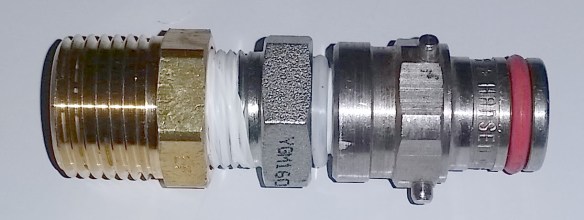
Assembled Hardware
Then, I attached that assembly to the pump. Everything fit perfectly!
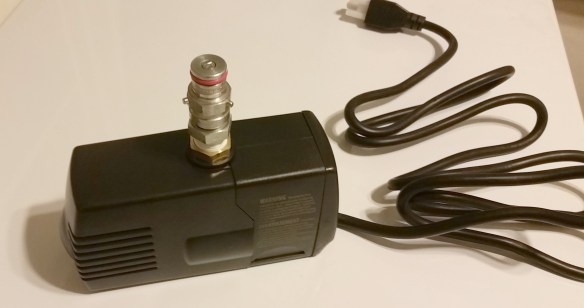
Hardware Attached to Pump
Now, I was ready to go! I attached the silicone tubing to the beer faucet, connected the beer line to the pump, and pushed some hot water through to clear the beer out of the line. After this, I ran line cleaner for 20 minutes, recirculating the cleaner by draining it out of the faucet and back into the bucket with the pump.
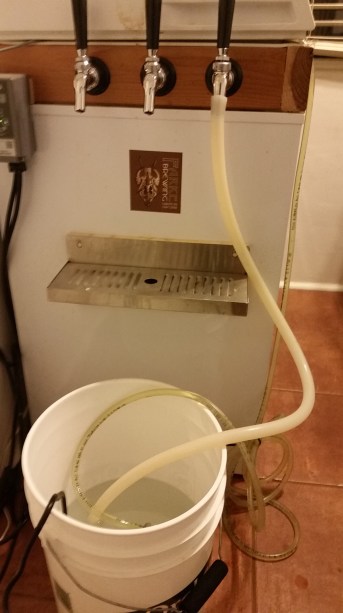
Once this was done, I rinsed out the line by running hot tap water through the entire assembly for another 20 minutes. Done, and done!
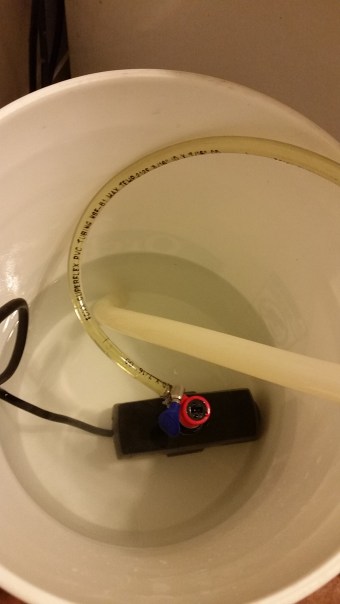
So far, I’m pretty happy with this setup, and anticipate that it will reduce my excuses for not cleaning my tap lines more frequently. This will in turn lead to tastier draft homebrew!
A big thanks to the folks at Homebrew Finds for posting such a clear and easily modified tutorial. You made my own build that much easier!
Safety note: Please use good judgement and be aware of all manufacturer warnings and safety protocols for this equipment. Be smart, be safe!
 Last night (15 June 2016), I kegged the
  After 12 days in the primary, tonight I kegged my
 Andy's Brewing Blog