
As an AHA forum discussion thread grows longer, the probability of LODO derailment approaches 1.
Beer Tasting: Dunkel-Osteus
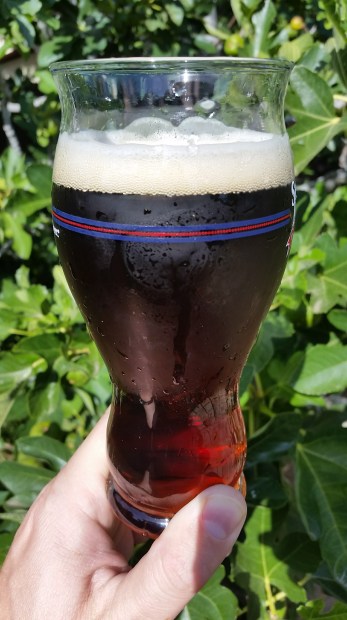 I love this beer. Quite frankly, it’s one of the best I’ve brewed in a long time. And, it was just plain enjoyable! There aren’t a lot of commercially available Munich dunkels out there, so I was happy to really get to know this style. Of course, a tasty beer sadly leads to an empty keg…with dreams of rebrewing this sometime.
- The Basics
- O.G. = 1.050; f.g. = 1.016; 4.5% abv; 20 SRM; 22 estimated IBU
- Aroma
- Nice toasty and malty-sweet aroma, with the very slightest hint of chocolate behind that. Wonderful!
- Appearance
- Deep reddish brown color with brilliant clarity and a fine ivory head that sticks around nicely. This is a really pretty beer!
- Flavor
- Rich and toasty flavor, with a clean hop profile.
- Mouthfeel
- Medium bodied, moderate carbonation that seems to fit what I have read about the style. Malt dominates the finish.
- Would I brew this again?
- Absolutely! This is a phenomenal recipe, and I’m really pleased with my first effort at the style. One friend who tasted it (whose taste I trust) suggested it is maybe a touch on the sweet side, and that a lower mash temperature would dry it out a bit. Along these lines, I might aim for a 150 or 152 degree target temperature. Alternatively, I might use the decoction schedule in Gordon Strong’s book and see if that also does the trick. In any case, this ranks among my favorite beers of 2017 and will definitely get brewed again.
- Overall
- 9.5/10
Big Batch Update: Saison, Amber Ale, Pilsner
There’s lots to report with kegging and fermentation for a few recent batches. So, here’s what’s new:
- Thumbspike Saison 2.0
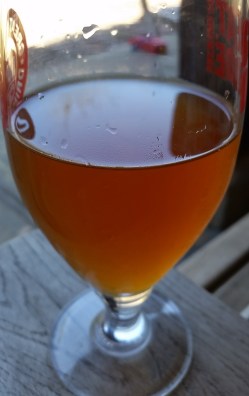
- This might have had the quickest turn-around on any kegged beer I’ve ever done! I brewed the beer on 12 May 2017, starting with an 80° fermentation temperature. On 16 May, I raised the temperature to 85°. Everything really churned along, from start to finish (as you might expect with fermentation at those temperatures)! I kegged the beer on 20 May 2017, with a final gravity of 1.004. That works out to 6.7% abv. I’ve had it on tap for about a week, and it’s a pretty interesting and enjoyable beer. All of the ingredients melded together quite nicely, and I am pleased with the results. It’s a very refreshing brew for a warm afternoon on the patio.
- My first impressions are that it has a very lightly fruity aroma, with a slight tartness on the flavor. Head retention seems pretty miserable at this point, but I don’t know if that’s a real feature of the beer or because I didn’t wash my glass from a previous beer before pouring this one.
- Hell Creek Amber Ale 1.1
- I brewed this beer on 14 April 2017, with a starting gravity of 1.060. I kegged the beer on 7 May 2017. Final gravity was 1.016, which equates to 5.8% abv.
- Czech-ed Out Pilsner
- This batch has the honor of being my first dumper, ever. I’ve weathered warm fermentations, low gravities, and incomplete fermentations, and have always soldiered through in the end. Alas, this particular batch just wasn’t any good. The culprit wasn’t infection, bad fermentation, or anything like that. It was bad hops! As noted in my original post, the late hop addition smelled really grassy. I should have known better than to add them to the kettle, but wasn’t quite that smart. So, I kegged the beer, carbonated it, and pulled my first sample…to a whiff of pilsner that smelled pretty much like freshly mown lawn, and not in a good way. It was almost reminiscent of jalapenos, but in any case was not reminiscent of what a good European pilsner should taste or smell like. Lesson learned!
- In terms of fermentation history, I started fermentation at 50° on 9 April. I raised the beer to 65° on 21 April, and then dropped it to 33° on 30 April 2017. I kegged the beer on 14 May, at which point it had a final gravity of 1.011. This equates to 5.6% abv.
Palaeotis Pils 1.1
Time for another batch…this time, a retool of my German pils. Compared to the last round, I have changed just about everything, although the overall base malt is basically the same. To speed my brew day along, I’m not doing a decoction. Instead, I’m rounding out the malt bill with a little bit of melanoidin malt.
Palaeotis Pils
- 8.5 lbs. floor-malted Bohemian pilsner malt (Weyermann)
- 5 oz. melanoidin malt (Weyermann)
- 3 oz. acidulated malt (BestMalz)
- 0.3 oz. Warrior hop pellets (15.0% alpha), 60 minute boil
- 0.5 oz. Liberty hop pellets (4.9% alpha), 30 minute boil
- 0.5 oz. Tettnang hop pellets (3.5% alpha), 30 minute boil
- 0.5 oz. Liberty hop pellets (4.9% alpha), 5 minute boil
- 0.5 oz. Tettnang hop pellets (3.5% alpha), 5 minute boil
- 1 tsp. Fermax yeast nutrient, 10 minute boil
- 1 Whirlfloc tablet, 10 minute boil
- 2 packages lager yeast (Fermentis W34/70)
Target Parameters
- Infusion mash to hit target of 150°. Batch sparge.
- Water built from R.O., to hit 59.1 ppm Ca, 8.2 ppm Mg, 89 ppm SO4, and 62.9 ppm Cl.
- 1.048 o.g., 1.010 f.g., 4.9% abv, 34 IBU, 4 SRM, 5 gallons into fermenter
Procedure
- For this recipe, I built my water to match the “Pilsner Water” profile on Braukaiser. For the 3.1 gallons of mash water, I added 1.2 g of gypsum, 1.2 g of epsom salt, and 1.5 g of calcium chloride. For the 5.5 gallons of sparge water, I added 2.1 g of gypsum, 1.7 g of epsom salt, and 2.7 g of calcium chloride.
- I mashed in with 3.1 gallons of water at 160° to hit 150°, and let it rest for 60 minutes. After 35 minutes, the mash temperature had fallen to 148°.
- After a 60 minute mash, I added 1.75 gallons of water at 200° to raise the mash temperature to to 160°. I let it sit for 10 minutes, vorlaufed, and collected the first runnings.
- Next, I added 3.75 gallons of water at 185°, let sit for 10 minutes, vorlaufed, and collected the remainder of the runnings.
- In total, I had 7.1 gallons of mash runnings at a gravity of 1.039, for 82% efficiency.
- I brought the kettle to a boil, and added the hops and other ingredients per the schedule.
- After 90 minutes, I chilled the wort down to 75°, transferred the wort while aerating, put the fermenter into the fermentation chamber, and let it cool down to 50° before pitching the yeast.
- Starting gravity was 1.048, nearly precisely on target. I started fermentation at 50°, and raised it to 54° after four days. I brewed the beer on 20 May 2017.
Beer Tasting: Ophidia IPA & CA IPA
Both of my recent IPA’s are long-gone (Ophidia IPA first, and CA IPA most recently), but I hadn’t gotten around to posting the tasting information. So, this post is a double-header!
- The Basics
- O.G. = 1.055; f.g. = 1.012; 5.6% abv; 6 SRM; 52 estimated IBU
- Aroma
- Beautiful tropical fruit aroma–guava notes are really prominent (I feel a bit silly typing out this kind of pontification, but it’s seriously there!), and a bit of citrus is behind that when it is first poured. As the beer warms up, the purported blueberry associated with Mosaic hops comes forth. It’s a very hop-forward aroma, covering up the malt.
- Appearance
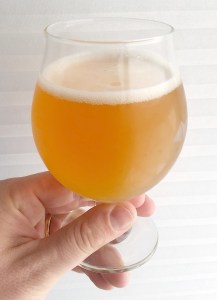
- Gold color, moderately hazy, with a low and persistent off-white head.
- Flavor
- Hop-forward once again, as you would expect for an IPA. The bitterness is clean and persists nicely from first sip to the finish. Any hop flavor is vaguely tropical and citrusy. The malt is clean, ever-so-slightly-sweet, and in the background.
- Mouthfeel
- This is a moderately dry and fairly light-bodied beer, carbonated as appropriate for the style. The dry finish lingers pleasantly on the tongue.
- Would I brew this again?
- Hmm…this is in the category of “pretty good, but not life-changing.” It hits nicely on most notes, but I think it might fall victim to “tropical hop burn-out” in the wake of many citrus/fruit-bomb IPAs and pale ales that I’ve done over the past year. I didn’t quite hit my marks for final gravity due to the mash being a bit too cool, but I’m honestly not sure if that’s a totally bad thing. The aroma is absolutely delicious–the Mosaic and Citra combo play together beautifully. This is a very drinkable beer; probably too easily drinkable! I really like it, but it is just missing something very minor that I can’t quite place in the flavor. Ah well!
- Overall
- 8/10

- The Basics
- O.G. = 1.060; f.g. = 1.009; 6.7% abv; 6 SRM; 63 estimated IBU
- Aroma
- Slightly phenolic, which overpowers any hop aroma. There is maybe a slight piney hint, but that’s about it.
- Appearance
- Gold beer with a moderate haze. The off-white head forms a persistent blanket over the surface of the beer.
- Flavor
- Pear/apple notes (probably from the yeast), with a slightly herbal/spicy character behind that–perhaps even a bit phenolic. I attribute this to a brief lapse with the fermentation chamber–the freezer side accidentally got unplugged, so the temperature peaked at 73 or 74 degrees. It’s actually rather close in many ways to what my first, non-temperature-controlled batches tasted like.
- Mouthfeel
- Medium-dry body, moderate carbonation.
- Would I brew this again?
- Maybe? Unfortunately, enjoyment of this beer is really ruined by the slight bump into high temperatures early in fermentation. I’m willing to try this temperature and technique again, though.
- Overall
- 3/10
 Andy's Brewing Blog