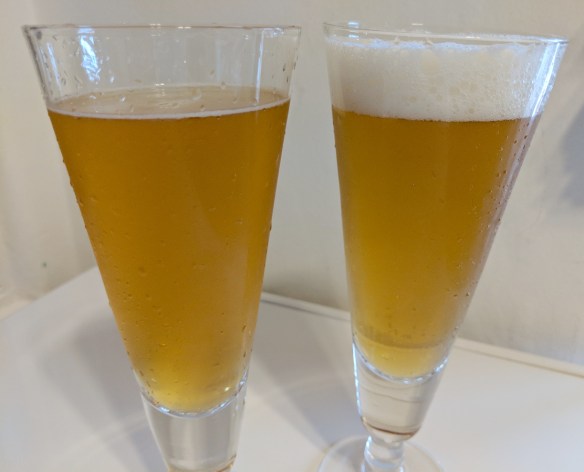
First of Maibock

My homebrew club is doing an in-club style competition for its May meeting, featuring–appropriately–maibock. Flying in the BJCP guidelines as a helles bock, this is a fairly malty, higher gravity German lager. It’s also not a style I’ve brewed before–this provides a great excuse (and is a reminder of how participating in a homebrew club can push you to try new things)!

This recipe is modified in part from one that appears in Gordon Strong’s Modern Homebrew Recipes. I adjusted the grain bill and hops slightly, and opted for an infusion mash rather than a decoction mash. The main commonality is that the recipe is basically pilsner, Vienna, and Munich malt, in descending proportions. I added in some melanoidin to help up the maltiness (particularly since I wasn’t doing a decoction mash). Finally, I adjusted this to be a 3.5 gallon batch, rather than a 5 gallon batch. This is a bigger beer, and I just didn’t want 5 gallons of the stuff!

The name is mangled from a Jonathan Coulton song; apologies to everyone.

20180210_211951

First of Maibock

  • 5 lb. Château Pilsen malt (Castle Malting)
  • 2.5 lb. Vienna malt (Great Western Malting)
  • 1.5 lb. Munich I malt (Weyermann Malting)
  • 0.25 lb. melanoidin malt (Weyermann Malting)
  • 0.45 oz. Magnum hop pellets (11.8% alpha), 60 minute boil
  • 1 oz. Tettnang hop pellets (2.2% alpha), 5 minute boil
  • 1 Whirlfloc tablet, 10 minute boil
  • 2 pkg. SafLager West European Lager yeast (S-23)

Target Parameters

  • Infusion mash to hit target of 152°, 60 minutes, batch sparge.
  • 1.068 o.g., 1.018 f.g., 6.5% abv, 27 IBU, 7 SRM
  • Water built from RO to hit target of 50 Ca, 5 Mg, 5 Na, 55 SO4, 70 Cl, 0 HCO3 ppm, RA -40

Procedure

  • To make my brewing water, I added 1.6 g gypsum, 0.3 g table salt, 1.2 g epsom salt, and 3.2 g calcium chloride to 6.5 gallons of RO water.
  • I mashed in with 3.15 gallons of water at 167° (and 4.75 mL of 75% phosphoric acid), to hit a mash temperature of 155°. After 40 minutes, the temperature was down to 152°. So, I added 0.65 gallons of water to bring the temperature back up to 157°. After a total of 60 minutes, I vorlaufed and collected the first runnings.
  • I added 2.75 gallons of water at 180°, let it sit for 10 minutes, vorlaufed, and drained the mash tun.
  • In total, I collected 5.5 gallons of runnings with a gravity of 1.049, for 78% efficiency.
  • I brought the kettle to a boil, adding hops and Whirlfloc per the schedule.
  • After 50 minutes of boiling, I measured the gravity and saw that it was at 1.058. This was well below my target, so I added 1.18 pounds of Briess pilsen DME to bring up the gravity.
  • After 60 minutes of boiling, I turned off the heat and chilled to 75°. I transferred to the fermenter, and put it in the fermentation chamber overnight to chill down to 54°. About 4 gallons of beer went into the fermenter.
  • I brewed the beer on 10 February 2018, and pitched the yeast on 11 February 2018. Prior to pitching, I hit the wort with 60 seconds of oxygen.
  • Starting gravity was 1.072.
  • On February 24, I let the beer free-rise to 64°. I’ll let it hang out at this temperature for a week or two before cold crashing.

Evaluating my first hard cider

A few weeks back, I wrote about my first attempt at a cider. The recipe was dead simple (in fact, I called it Dead Simple Hard Cider), and the whole thing had fermented out in around two weeks. It clocked in at 5.4% abv; not too much, but not too flimsy, either.

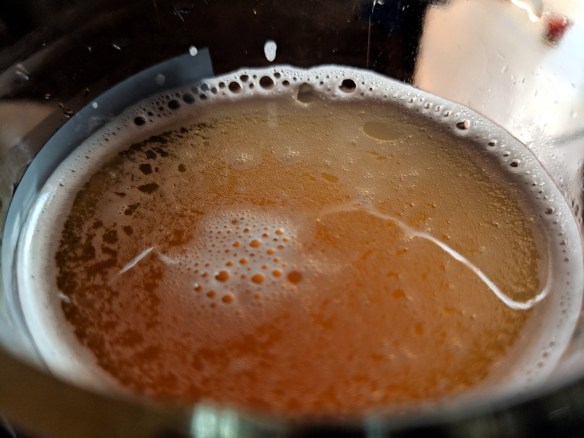
ciderThe cider has maintained a consistent haze throughout its serving lifespan, and has a very thin and not terribly persistent head (unsurprising for a cider). It’s somewhat copper/gold in color, and has a nice apple aroma (with maybe a hint of something like diacetyl?). On the flavor end of things, it’s pretty dry, but not puckeringly so. I like the crispness that this brings. The flavor is…well, apple. It’s fairly tart, like the sorts of apples you would expect for a cider. More Granny Smith than Golden Delicious.

I put this cider squarely in the win column. It hit all of the marks I was hoping for, and is surprisingly drinkable. I might try backsweetening a future batch, but not by a lot. I like my ciders tart and dry! A different yeast variety, perhaps something with a bit more character, is also in the cards. A 3 gallon batch was about perfect, too. Cider is a nice treat, but not something I really want 5 gallons of. As the keg nears its end, I’m still enjoying it! And that’s a good state to be in.

Blast from the Past: Gingerbread Winter Warmer 2016

winter_warmerLast night I pulled out a bottle of my 2016 Gingerbread Winter Warmer, and poured a snifter. Although I had kegged that beer way back in the day, I emptied the keg into a few bottles for extended aging. I figure I’ll open one a year, until the bottles are gone.

More than a year after brewing, this is a fairly enjoyable winter beer. It’s got a decent banana note, a rich, malty flavor, and a thin ivory head that disperses a few minutes after pouring. I think there might have been a little secondary fermentation in the bottle, because it seems a bit more carbonated than I remember.

We’ll do this again in a year or two!

Speaking at Nerd Nite Los Angeles, Thursday!

slide_logo

I’ll be talking about “The Dinosaur in My Beer” for Nerd Nite Los Angeles this Thursday! The event is hosted at Busby’s East, 5364 Wilshire Ave., from 7 pm to 10 pm, with the action starting at 7:45 pm. Two other speakers are on the docket for that evening–should be a fun time! Each TED-style talk is slotted for around 20 minutes each. Tickets are $10 each, and they can be ordered here.

Brew Year’s Resolutions 2018

20170903_151314It’s a new year! Having reflected on the past year of brewing as well as how I hit my resolutions for the previous year, I’m ready to set out some goals for 2018.

  • Pitch a new article for a homebrew publication.
    • This is a holdover from last year. I had one article published in Zymurgy during 2017; now, I just have to get a pitch together for something else during 2018.
  • Perfect my oatmeal stout recipe.
    • I entered my Eagle Face Oatmeal Stout in the first-round 2017 NHC, and scored an exceptionally pleasing 40. Unfortunately, comments for improvement were pretty vague (which was a bit disappointing, given the caliber of judging there). I’m going to modify the base malt a bit, perhaps, and see if I can’t kick up the score and make it into the second round.
  • Brew some more sour beer recipes.
    • I had great success during the past two years with a Berliner Weisse and am working towards a respectable raspberry Belgian sour. I’m hoping to hone the raspberry Belgian, and brew at least one other kettle soured beer. A gose or another Berliner Weisse will hopefully be in the mix.
  • Brew a perfect IPA.
    • I feel like my IPAs are good right now, but could be better. A lot of this might be in dry-hop handling; I usually keg-hop the things, but end up with a result that can be a bit harsh. The upside of this is that loss of hop flavor from oxidation is less of an issue. It’s time to find a happy medium. For 2018, I want to experiment with different ways of hopping and transferring IPAs, to finally hit peak IPA! I’ll probably start with a return to dry-hopping in the primary…I need to first see if drop-off in hop aroma is even that big of a deal anymore given my kegging and cold storage setup. I had preliminary attempts for my Thanksgiving IPA, but it didn’t stick around long enough to verify hop longevity!
  • Hit my calculated starting gravities more consistently.
    • I’ve found that I am often 0.02 or 0.03 off my starting gravity, usually a touch on the low side. This is almost entirely a boil-off rate issue, so I want to dial that in a bit better this year.

This should be plenty to keep me busy–I’ll check in at the end of the year to see how well I did!