Fade to Black IPA

The quest to explore new styles continues! My current IPA is almost all gone, so it’s time to brew something to replace that keg. I was getting a little bored with citrusy American IPA’s, though, so something different was called for. Why not a black IPA?

As if by magic, the latest issue of Brew Your Own had an advertisement for Briess malts including a recipe for “Fade to Black IPA.” The ad copy promised “old school hops, with a new school malt bill.” Interesting! The ingredient list (below) had all sorts of things I hadn’t tried before. It’s worth noting that “Fade to Black” is a fairly common commercial beer name, with at least a handful of IPA’s bearing the moniker. I have no idea if this recipe is intended to clone of any of those.

I followed Briess’s recipe pretty closely, with only minor tweaks on the ingredients. The most notable was switching the base malt from Briess Full Pint Brewers Malt to Great Western California Select 2-row (which I already had on hand). I also modified the hop additions a touch, but everything else stayed the same.

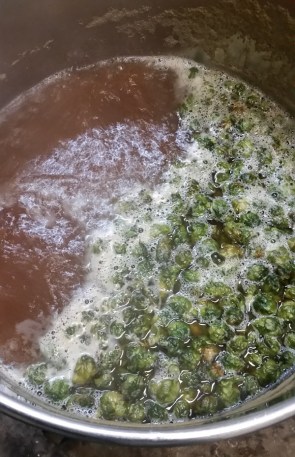
20161112_211553

Fade to Black IPA

  • 11 lbs. California Select 2-row malt (Great Western Malting Co.)
  • 1 lb. 80°L caramel 6-row malt (Briess)
  • 1 lb. special roast malt (Briess)
  • 0.25 lb. chocolate dark 6-row malt (Briess)
  • 0.25 Midnight Wheat malt (Briess)
  • 0.5 oz. Galena hop pellets (13.8% alpha), 60 minute boil
  • 1 oz. Chinook hop pellets (13.1% alpha), 30 minute boil
  • 2 oz. Cascade whole hops (5.1% alpha), 10 minute boil
  • 1 Whirlfloc tablet, 10 minute boil
  • 0.25 tsp. yeast nutrient, 10 minute boil
  • California Ale Yeast (WLP001, White Labs), prepared in starter
  • 1 oz. Cascade whole hops (5.1% alpha), dry hop
  • 1 oz. Chinook hop pellets (13.1% alpha), dry hop
  • 1 oz. Galena hop pellets (13.8% alpha), dry hop

Target Parameters

  • 154° mash, 60 minutes
  • 1.067 o.g., 1.016 f.g., 6.7% abv, 67 IBU, 28 SRM, 5.5 gallons into the fermenter

Procedure

  • I prepared a 1.75L starter with 175g of extra light DME, three days in advance. After two days, I decanted 0.6L to save for later. The remainder was cold crashed, decanted, and pitched at the start of fermentation. This was the second round for this yeast.
  • I mashed in with 4.5 gallons of water at 167.7°, to hit a mash temperature of 154°.
  • After 60 minutes, I added 0.6 gallons of water at 160°, let sit 10 minutes, vorlaufed, and collected the first runnings. Then, I added another 3.5 gallons of water at 180° to hit a mash temperature of 160°, let sit for 10 minutes, vorlaufed, and collected the remainder of the wort.
  • I collected 6.8 gallons of wort with a gravity of 1.057, for 79% efficiency.
  • I brought the kettle to a boil and added hops and other ingredients per the schedule above.
  • After 60 minutes of boiling, I turned off the flame and chilled the wort to 78°. At this point, I transferred to the primary fermenter with aeration, and then pitched the yeast.
  • Starting gravity was 1.065, and I will be fermenting at 66°. I brewed this beer on 12 November 2016.

Beer Tasting: Decoction Envy Vienna Lager

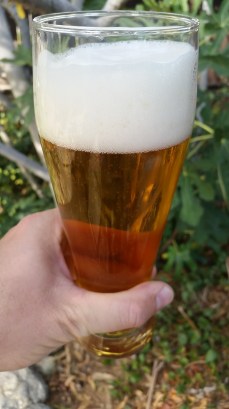
20161106_140947My first attempt at a Vienna lager has nicely cleared and conditioned, turning into one delicious beer! My overall evaluation is below.

  • The Basics
    • Original gravity = 1.055; final gravity = 1.014; abv = 5.4%; estimated IBU = 29
  • Aroma
    • Spicy hop note, really delicious, with a slight crackery aroma behind that for the malt.
  • Appearance
    • Light gold, crystal clear, with frothy white head that is incredibly persistent. The beer is definitely paler than a Vienna lager should be, though.
  • Flavor
    • Bready and crackery maltiness at the forefront; really, really nice. This is balanced against a decent bitterness. It comes across as a somewhat dry beer, which is within line for a Vienna lager. The finish is very clean; no abnormal esters or phenols on this thing!
  • Mouthfeel
    • Medium body, moderately dry on the finish, with moderate carbonation that seems about right for this beer.
  • Would I brew this again?
    • On its own merits as a beer, I’d give it a 9.5/10, but in terms of color it misses the mark for a true Vienna lager as defined by BJCP. If I do this again, I would add a slight bit of dark malt for coloration (maybe 2-3 oz. of debittered black malt), but maintain the overall process of decoction. The head and head retention are pretty amazing (almost too amazing–it’s hard to get a good pour!), and I would bet that is the result of the decoction process. I’m quite surprised that the beer didn’t darken up more during the decoction–maybe I should have boiled long enough, or didn’t boil intensely enough? The yeast I used on this one worked out really well, and the water build also seems to have been just the ticket.
  • Overall: 
    • 8/10

Update: Olde Persica Porter

My smoked porter has been in the primary fermenter for 13 days, coasting along at around 66°. So, I kegged it tonight. Final gravity was 1.016, down from 1.060, for 5.8% abv. The aroma and flavor are pretty darned delicious! The level of smokiness is just about perfect for my palate, too. Everything is carbonating and conditioning now at 40°.

Olde Persica Porter

I’m getting that itch again, to brew with new styles and new ingredients. With winter on the horizon, I want to stock up on some beers that will serve well on a chilly night next to the fire. I also recently realized I haven’t brewed with smoked malt before. So, a smoked porter seemed like just the thing to try.

In assembling the recipe, I drew heavily upon an Alaskan Smoked Porter clone from the American Homebrewers Association website. This was augmented with a Smoked Robust Porter recipe, also from AHA. Because I wanted this to be a fairly rich base porter that would stand up to the smoke, I elected to go with Vienna malt for the majority of the grist. Conveniently, I also have a decent bit still in stock. To add an American emphasis, I’m going to use whole Cascade hops from South Dakota as the bittering hops, with a charge of Willamette at the very end.

Once I got to the homebrew shop, I discovered that they had several different kinds of smoked malt in stock. I had been planning on using a beechwood-smoked rauch malt, but the owners suggested trying a peachwood-smoked malt instead. I was intrigued!

The malt itself is from Copper Fox Distillery, a Virginia-based operation that specializes in small-batch whiskeys and such. They have also started a brew malt operation, with a handful of products. Because the maltster is so new and so small, it is very difficult to find any specific information on the malts. Their website didn’t have any real information, but Southern Hills Homebrew Supply did. I also learned a bit in chatting with a local person who is helping to distribute Copper Fox malts in California. The bottom line is that this is a floor malted, smoked 2-row barley malt. The aroma and flavor profile are supposed to be a bit gentler than in traditional beechwood-smoked malt. Based on what I tasted and smelled during the brew, this very much seems to be the case. The aroma is delightfully aromatic and smoky, but the flavor in the wort is not at all overpowering.

As for the name of this recipe? Well, because I am using peach wood malt, I wanted to honor peaches. The scientific name for a peach is Prunus persica, reflecting its close kinship with plums (and thus prunes) as well as the fact that domesticated peaches entered Europe via Persia. However, peaches themselves have a deeper origin in China; the oldest fossil peaches clock in at around 2.6 million years old. As a frame of reference, our genus Homo was just getting started around that time, and the modern Homo sapiens was still 2.4 million years away!

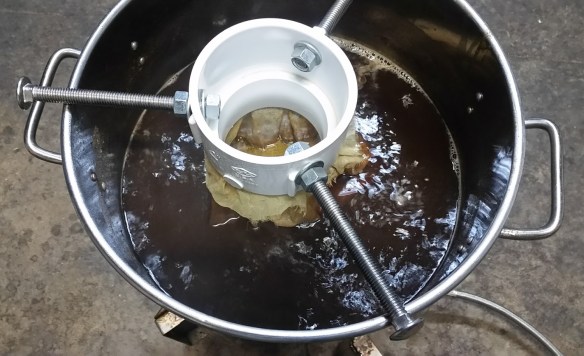
Olde Persica Porter, just into the primary fermenter

Olde Persica Porter, just into the primary fermenter

Olde Persica Porter

  • 7 lbs. Vienna malt (Weyermann)
  • 3 lbs. peach wood smoked 2-row malt (Copper Fox Distillery)
  • 1 lb. 80° crystal malt
  • 1 lb. 40° crystal malt
  • 0.5 lb. black (patent) malt
  • 0.5 lb. chocolate malt
  • 2 oz. Cascade whole hops (5.1% alpha), 60 minute boil
  • 1 oz. Willamette hop pellet (4.1% alpha), 10 minute boil
  • 1 oz. Willamette hop pellet (4.1% alpha), 1 minute boil and 5 minute steep after flame-out
  • 1 Whirlfloc tablet, 10 minute boil
  • 0.25 yeast nutrient, 10 minute boil
  • White Labs California Ale yeast (WLP001)

Target Parameters

  • 1.065 o.g., 1.017 f.g., 6.3% abv, 37 IBU, 36 SRM, 5.5 gallons into the fermenter

Procedure

  • Five days before brewing, I made a 2L starter. After two days, I split the starter (to create a yeast culture with 100 billion cells for later), and cold crashed the remainder in the flask for pitching on brew day.
  • I mashed in with 4.3 gallons of water at 166.7°, to hit a mash temperature of 154.5°. After 60 minutes, the mash was down to 151°. At this point, I added 0.75 gallons of water at 165°, to raise the mash to 152°.
  • I let the mash rest for 10 minutes, vorlaufed, and collected the first runnings. I then added 3.5 gallons of water at 175°, let everything sit for 10 minutes, and then collected the second runnings.
  • Altogether, I collected 6.75 gallons of wort with a gravity of 1.054, for a mash efficiency of 77%.
  • I brought the runnings to a boil, and added hops and other stuff per the schedule. After 60 minutes, I turned off the heat and chilled the wort to 80°. Our groundwater is still too warm to get much below that!
  • Starting gravity is 1.060. This is a bit below my target (1.065), most likely because I didn’t have the boil as vigorous as it usually is. I pitched the yeast, and will be fermenting at 68°.
  • This beer was brewed on 22 October 2016, with vigorous fermentation underway within 24 hours.

Gingerbread Winter Warmer Kegged

Today (October 16, 2016), I kegged my Gingerbread Winter Warmer. It has been fermenting for just about a month, so it seemed like a good time to keg it. I roused the yeast three or four times during primary fermentation (about once a week), to keep things moving along. Even so, the brew was a bit underattenuated–it had a final gravity of 1.030, or 10.3% abv. I think two factors might explain the relatively high gravity. First would be the high mash temperature, which should limit overall fermentability. Second, and probably most important, was the high gravity of the beer. I aerated as best I could, but am guessing that a shot of oxygen would have helped out. Now that the beer has been agitated on the ride over to the keg, I might expect a little more fermentation (but probably not much). For now, I’ll let the 2 gallons of beer in my mini-keg condition and carbonate at room temperature for about a month before tapping.