Festbier Head-to-Head

I’ve been wanting to do a head-to-head comparison of my festbier versus commercial examples, and finally got the chance to do so tonight. My buddy Steve stopped by, and I poured out three sampler glasses for each of us. Steve didn’t know which was which, other than that one was homebrew and two were commercial beers.

For my commercial comparison, I chose Ayinger’s October Fest-Märzen and Sierra Nevada’s Oktoberfest. Both were available at local stores, and are reasonably well regarded. I sampled the beers before and after brewing, to give me a bit of an idea what to expect in a festbier.

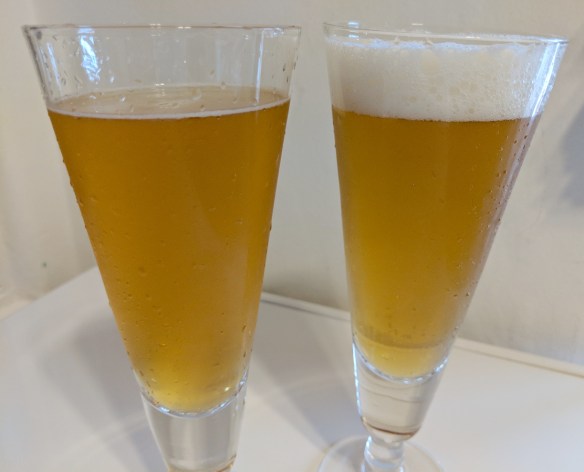
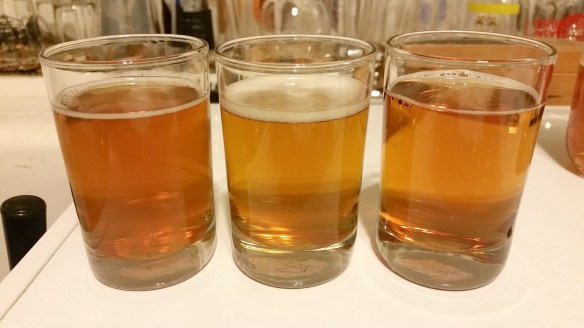
festbiers

Three festbiers (from left): Ayinger’s October Fest-Märzen, my Festivus Simplex, and Sierra Nevada’s Oktoberfest.

Steve and I tasted simultaneously, but I tried to avoid giving him any leading comments or critiques that might sway his opinion. Our observations are below; I transcribed his comments, but wrote down my personal observations without telling him, so as to avoid that avenue of bias.

  • We noticed that my beer has an ever so slightly lighter color, as well as a taller and more persistent head. All of the beers are quite clear.
  • Steve noted that the Ayinger version had a more prominent malty aroma. We both perceived malty sweetness and a hint of ginger in the flavor (the latter likely from the hops). I think that the maltiness is potentially from mild oxidation, which wouldn’t be a huge surprise for a beer that might have sat on a store shelf for some time after import. The malty character had that slightly cloying aspect from oxidized beers, as I experienced in an excellent seminar at the 2017 Homebrew Con.
  • The Sierra Nevada version came across as a little less carbonated to me, and Steve remarked that the flavor was a little flatter on the tongue. We both noted that the taste was less complex, and its head was not very persistent relative to the other two beers.
  • Steve described my homebrew as having a more complex taste than the Sierra Nevada version, and he preferred that mine had a less distinct after taste than the other two beers. For me, the hop aroma on mine was a touch more pronounced than in the Sierra Nevada and maybe a shade more than in the Ayinger, which I liked.
  • When asked to guess which was the homebrew, Steve guessed mine, based on the slight color difference and some intangibles in flavor. When asked which he preferred, he ranked my homebrew and the Ayinger pretty closely, with the Sierra Nevada in third place. I am biased, but I preferred my homebrew by a slight margin (although perhaps a fresh example of Ayinger would perform better), and agreed that the Sierra Nevada came in third place.

Overall, I think my festbier is definitely a contender against the two commercial varieties I sampled. It captures the style quite well, and in some ways (especially appearance, via head and head retention) exceeds the commercial examples. As I noted in my earlier tasting, I could up the maltiness just a shade. But overall, I’m pretty thrilled with how my version of a fall favorite turned out! This exercise in comparison was really educational–I’ll be trying it again for selected beers.

Beer Tasting: Dark Helmet Schwarzbier

My schwarzbier has been kegged for over a month, and seems to be at its peak. Tasting time!

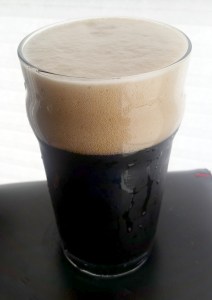
20170903_151314Dark Helmet Schwarzbier

  • The Basics
    • 1.046 o.g., 1.014 f.g., 4.2% abv, 26 estimated IBU, 28 SRM
  • Appearance
    • Clear brown beer with a slight ruby tinge. The head is a light tan color and persistant.
  • Aroma
    • Light chocolate aroma with a slight roastiness; very nice!
  • Flavor
    • Clean and smooth, with a nice bready maltiness backed up with a bit of roasty chocolate and slight coffee notes. There is a modest bitterness, which melds quite well with the malt.
  • Mouthfeel
    • Smooth, light, and crisp; moderate carbonation and a gentle bitterness to the moderately dry finish.
  • Would I brew this again?
    • Indeed! This beer has matured into a delicious and very drinkable lager. I feel like I nailed the style pretty well. Although we are squarely in the heat of summer, this is one dark beer that I don’t mind having around. It’s surprisingly refreshing! Overall, there is very little I would change about this beer. It’s nice to have another reliable session beer in my portfolio, too.
  • Overall
    • 10/10

Beer Tasting: Countdown IPA

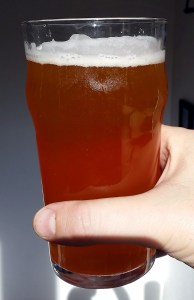
20170827_131705This recipe isn’t my best IPA, but it’s a pretty darned good IPA.

  • The Basics
    • 1.064 o.g., 1.011 f.g., 7.1% abv, 68 estimated IBU, 9 SRM
  •  Appearance
    • Light copper color with a slight haze, pouring with a dense white head that leaves lacing on the side of the glass as it subsides to a persistent ivory colored blanket.
  • Aroma
    • Moderately prominent dank, piney aroma; quite nice and classic! I could up the aroma a touch, but it’s generally OK.
  • Flavor
    • This beer is dominated by a smooth, piney bitterness, backed up by a smooth and doughy malt profile.
  • Mouthfeel
    • Moderately dry, with a smooth and extended bitter finish. Carbonation is moderate and appropriate for the style.
  • Would I brew this again?
    • Probably. This is a nice, middle-of-the-road American IPA. The hops are nice, although I should I say I don’t find the CryoHops notable one way or another. I was perhaps expecting a bit more hop character from them, given they were touted as providing twice the aroma for a given mass of hop. Maybe it’s more like 1.5x? I might up the aroma a touch, with perhaps a bit more Simcoe. As usual, the general base recipe is pretty solid.
  • Overall
    • 8.5/10

Citra Blonde Ale 1.1

I desperately needed to get my taps fully filled before a new baby arrived (I was down to only two armed and operational faucets, and one of those was ready to give out at any moment!). I had a schwarzbier and an IPA spooling up within the next few weeks, but wanted to have a light and drinkable beer to replace my wheat ale once that keg kicked. Something with fast turn-around and tasty, interesting drinkability.

Time for another batch of my Citra blonde ale! This beer turned out excellent last time (nearly two years ago), and is worth another go.

Compared to my last batch, I made some very minor edits for my ingredient stockpile (different brands of malt, etc.). I also went with a single infusion, rather than multiple infusions to hit different temperature rests.

Citra Blonde Ale 1.1

  • 5 lbs. Château Pilsen malt (Castle Malting)
  • 5 lbs. 2-row pale malt (Rahr)
  • 0.75 lb. Munich II malt (Weyermann)
  • 0.5 lb. caramel malt 20L (Briess)
  • 1 Whirlfloc pellet, 10 minute boil
  • 0.5 oz. Citra hop pellets (14.1% alpha), 10 minute boil
  • 0.5 oz. Citra hop pellets (14.1% alpha), 5 minute boil
  • 1 oz. Citra hop pellets (14.1% alpha), 5 minute whirlpool
  • 1 package American ale dry yeast (US-05, Safale)

Target Parameters

  • Full volume infusion mash to hit target of 152°, 60 minutes, no sparge
  • 1.050 o.g., 1.011 f.g., 5.1% abv, 20 IBU, 5 SRM, 5 gallons into fermenter
  • Water adjusted to hit 83 ppm Ca, 5.4 ppm Mg, 5.6 ppm Na, 79.4 ppm SO4, 87 ppm Cl, 50.7 ppm HCO3

Procedure

  • For the mash water, I mixed 1.8 gallons of Claremont tap water with 6 gallons of RO water, in addition to 3 g gypsum, 1 g epsom salt, and 5 g calcium chloride. I also added 3.1 mL of 75% phosphoric acid, to adjust the calculated pH.
  • I heated the sparge water to 160°, added it to the mash tun, and added the grain when the water hit 156.6°.
  • After 60 minutes, I vorlaufed and then collected 6.25 gallons of runnings. These had a gravity of 1.047 (a bit higher than expected), so I added 0.25 gallons of RO water to bring the gravity down to 1.045 and increase the overall volume a bit.
  • I boiled for 60 minutes, adding ingredients per the schedule.
  • After flame-out and the whirlpool addition, I chilled to 80° and finished the rest of the chilling in my fermentation chamber. Once the wort hit 66°, I pitched the dry yeast directly.
  • I brewed this beer on 15 July 2017, and fermented at 66° for two weeks. Starting gravity was 1.052.
  • I kegged the beer on 29 July 2017. It had a final gravity of 1.008, which works out to 5.8% abv. Then, I force carbonated.

Tasting

  • The Basics
    • O.G. = 1.0542; f.g. = 1.008; 5.8% abv; 5 SRM; 20 estimated IBU
  • Appearance
    • Light gold and beautifully clear. The beer pours with a thick white head that settles to an even blanket.
  • Aroma
    • Lightly grainy and slightly sweet malty aroma; a hint of citrus behind that.
  • Flavor
    • Light, very slightly sweet and candy-like aspect, with gentle maltiness; there is a bit of orange citrus behind that. Very clean flavor, with a mild and smooth bitterness.
  • Mouthfeel
    • Moderate carbonation, light body, with a gentle and moderately dry finish.
  • Would I brew this again?
    • As always, this is a very nice beer! I slightly prefer Great Western 2-row as a base malt, but Rahr is also respectable. I target mash-in a touch higher if doing a single infusion mash, or else follow the multi-rest schedule, because the beer ended up a bit more attenuated than expected, but that’s a minor point. The late-hopped Citra comes across really nicely, and this is a winner. As an additional variant for next time, I might follow the original Gordon Strong recipe a bit more closely and mix some Galaxy hops in with the Citra.
  • Overall
    • 8.5/10

Beer Tasting: Lemondrop Wheat Ale

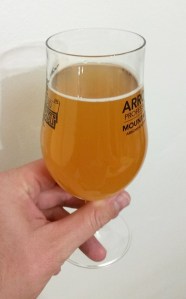
20170704_155850I am absolutely thrilled with this beer! In fact, a little too thrilled…the keg is nearly dry. Time for a tasting, then!

Lemondrop Wheat Ale

  • The Basics
    • O.G. = 1.047; f.g. = 1.011; 4.8% abv; 4 SRM; 34 estimated IBU
  • Appearance
    • Hazy light straw color, with firm and persistent white head. When poured well, it’s like a topping of meringue. Gorgeous!
  • Aroma
    • Light citrus (slightly lemony) and slightly bready aroma
  • Flavor
    • Citrusy forefront, with a smooth and doughy middle, fading then into a lingering but pleasant bitterness.
  • Mouthfeel
    • Light body and moderate carbonation, with a medium-dry finish
  • Would I brew this again?
    • In a second! This is solidly in the running for favorite beer of 2017 so far. It’s just about the perfect summer beer–light, refreshing, and ridiculously drinkable. I’m burning through this keg at a pretty quick pace! The Lemondrop hops are a fun addition, too. Although I wouldn’t call them distinctly “lemon” in all aspects of their character (i.e. it’s not “lemon oil” or “Lemon Pledge”), they definitely have a citrus note that contributes nicely to the overall character of this beer. The only, very minor, flaw in this batch is that the finish has gotten just a touch harsh over time, likely due to the extended keg dry hopping. That’s easily fixed in the next iteration, though. I am quite pleased with just about every other aspect of this recipe; the balance between pilsner and wheat malt is perfect, and the yeast is also a true winner. WLP320 has just a touch of character, but it’s not overwhelming like European wheat beer yeasts. Also, it stays in suspension forever, which also helps with appearance and presentation. I don’t think this would be as good of a beer with a Chico strain yeast. I also think my water adjustments paid off; it’s not overly minerally in character like some of my past lighter beers.
  • Overall
    • 9.5/10