English IPA

I’ve done soooo many American-style IPAs (especially tending towards the citrusy/fruity variety) that I’ve lost sight of what else an IPA can be. I wanted to get back to the style’s roots roots, with an English-style recipe. Creatively, I decided to call it…English IPA. It’s modified from a recipe on the AHA website, which won gold in the NHC during 2016.

English IPA

  • 12 lbs. Maris Otter malt (Bairds)
  • 0.5 lb. biscuit malt (Dingemans)
  • 0.5 lb. red wheat malt (Briess)
  • 6 oz. crystal 120 malt (Great Western)
  • 6 oz. crystal 40 malt (Great Western)
  • 1 oz. Magnum hop pellets (13.2% alpha), 60 minute boil
  • 1 Whirlfloc pellet, 10 minute boil
  • 1 oz. Fuggles hop pellets (5.6% alpha), 10 minute boil
  • 2 oz. East Kent Goldings hop pellets (6.0% alpha), 10 minute whirlpool
  • 2 pkg. Nottingham dry yeast (Lallemand)
  • 3 oz. East Kent Goldings hop pellets (5.0% alpha), dry hop in keg

Target Parameters

  • 1.064 s.g, 1.015 f.g., 6.5% abv, 49 IBU, 11 SRM
  • Infusion mash with batch sparge
  • Water built from Claremont tap water with mineral additions.

Procedure

  • Starting with Claremont tap water, I added 9 g gypsum, 5 g epsom salt, and 4 g CaCl to 4.6 gallons of water with a partial Campden tablet. I heated it to 166° and added the grains along with .5 tbs. of 88% lactic acid, to hit a mash temperature of 152° for 60 minutes. Then, I added 0.7 gallons of water at 185°, let sit for 10 minutes, vorlaufed, and collected first runnings.
  • Next, I added 3.6 gallons of water at 185° with 0.3 tbs. of 88% lactic acid for the sparge. After 10 minutes, I vorlaufed and collected second runnings.
  • In total, I collected 6.9 gallons of runnings with a gravity of 1.055 and 75% efficiency.
  • I brought everything to a boil and added the various kettle ingredients per the recipe. After 60 minutes, I turned off the flame and cooled to 85°. Finally, I transferred to the fermenter (with aeration) and cooled to 66°.
  • I brewed this and pitched the yeast on 7 November 2018.
  • I kegged the beer on 19 November 2018 and added the dry hops.
  • Original gravity was 1.063, and final gravity was 1.015, for 6.4% abv.

Tasting Notes
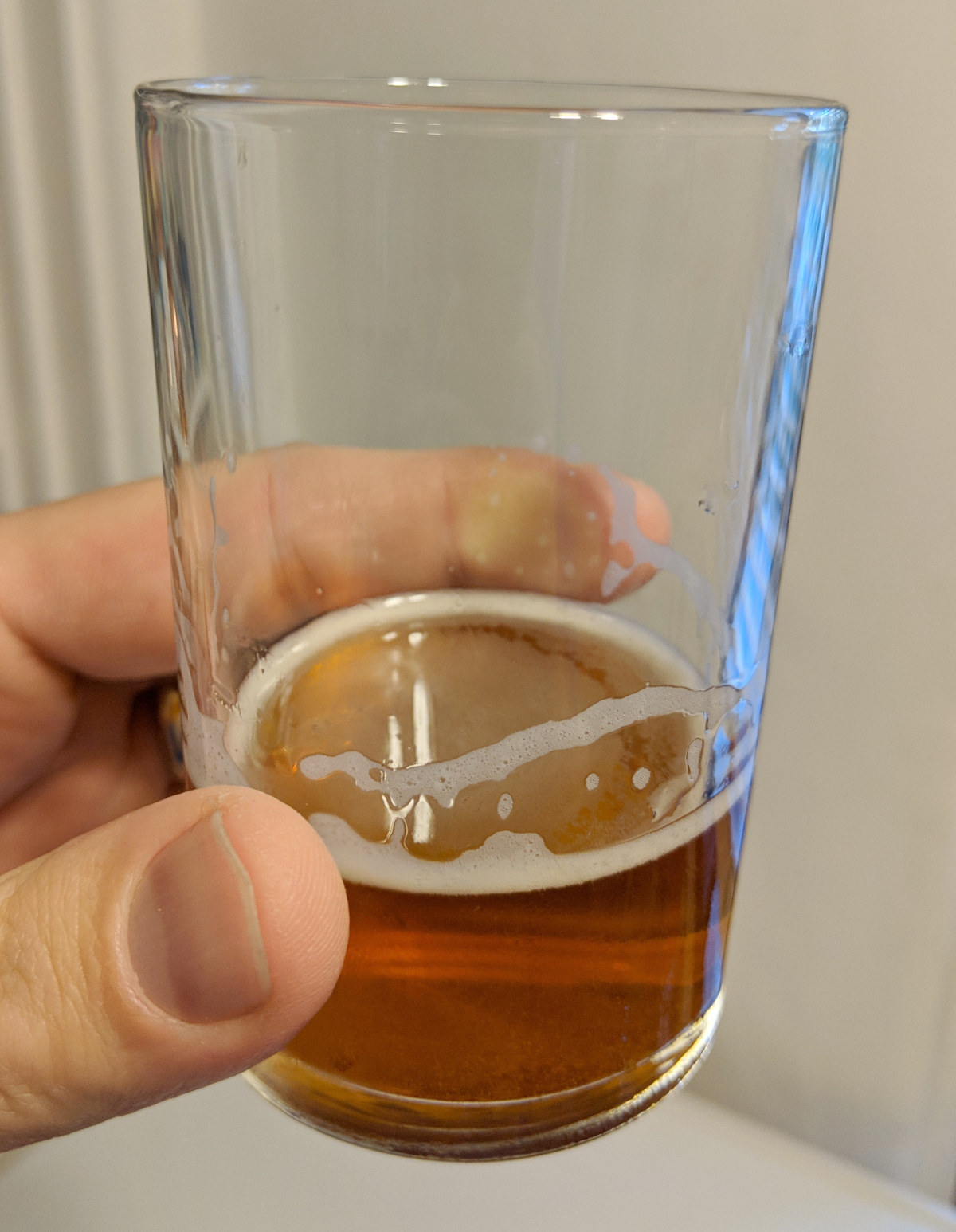
I drank this beer fairly quickly, because it was so tasty, and unfortunately I kicked the keg before I could do a full, formal tasting. Nonetheless, I kept a few brief notes on my last glass…

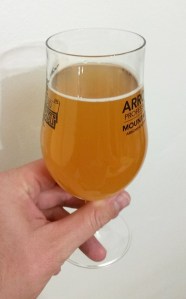
The beer had a hop-forward, nicely earthy aroma, with a slight caramel malt character behind that. On the taste, the malt and bitterness were well balanced. Hop character was pretty smooth on the finish, against the caramel malt qualities. Color was a gorgeous medium amber, with a slight haze.

Overall, I give this beer a 9 out of 10. I could perhaps round out the body a bit more (maybe with some oats or flaked barley), but overall this beer is pretty close to exactly what I wanted. The hops in particular are a treat–this feels like something Bilbo Baggins might enjoy next to the fire on a cold night in the Shire.

Beer Tasting: Cerveza de Jamaica

IMG_20180706_162520I kegged this batch on 12 May 2018. It has been on tap for awhile now, and I’ve really been enjoying it. Better do a tasting before it’s all gone.

Cerveza de Jamaica

  • The Basics
    • 1.048 s.g., 1.011 f.g., 4.8% abv, 11 IBU, 3 SRM
  • Appearance
    • Pours with a tall and dense pink head, which persists wonderfully as the beer is consumed. The beer itself is a purplish pink color and slightly hazy. The beer has cleared up considerably since it first went on tap.
  • Aroma
    • Hibiscus, with a bit of tartness and spice behind that.
  • Flavor
    • Tart, with a slight hibiscus note next to a smooth and subtle maltiness.
  • Mouthfeel
    • Fairly light-bodied and highly carbonated, with a medium dry finish.
  • Would I brew this again?
    • Yes! This is a wonderful beer, and perfectly refreshing for the current warm weather. In tasting opinions from other folks, it was suggested to up the hibiscus just a touch (to help it come through more distinctly in the taste) and also to add a bit more citrus character. To this end, I’m going to increase the amount of hibiscus in my next batch, and also up the citrus peel.
  • Overall
    • 9/10

Beer Tasting: Try Again Bohemian Pilsner

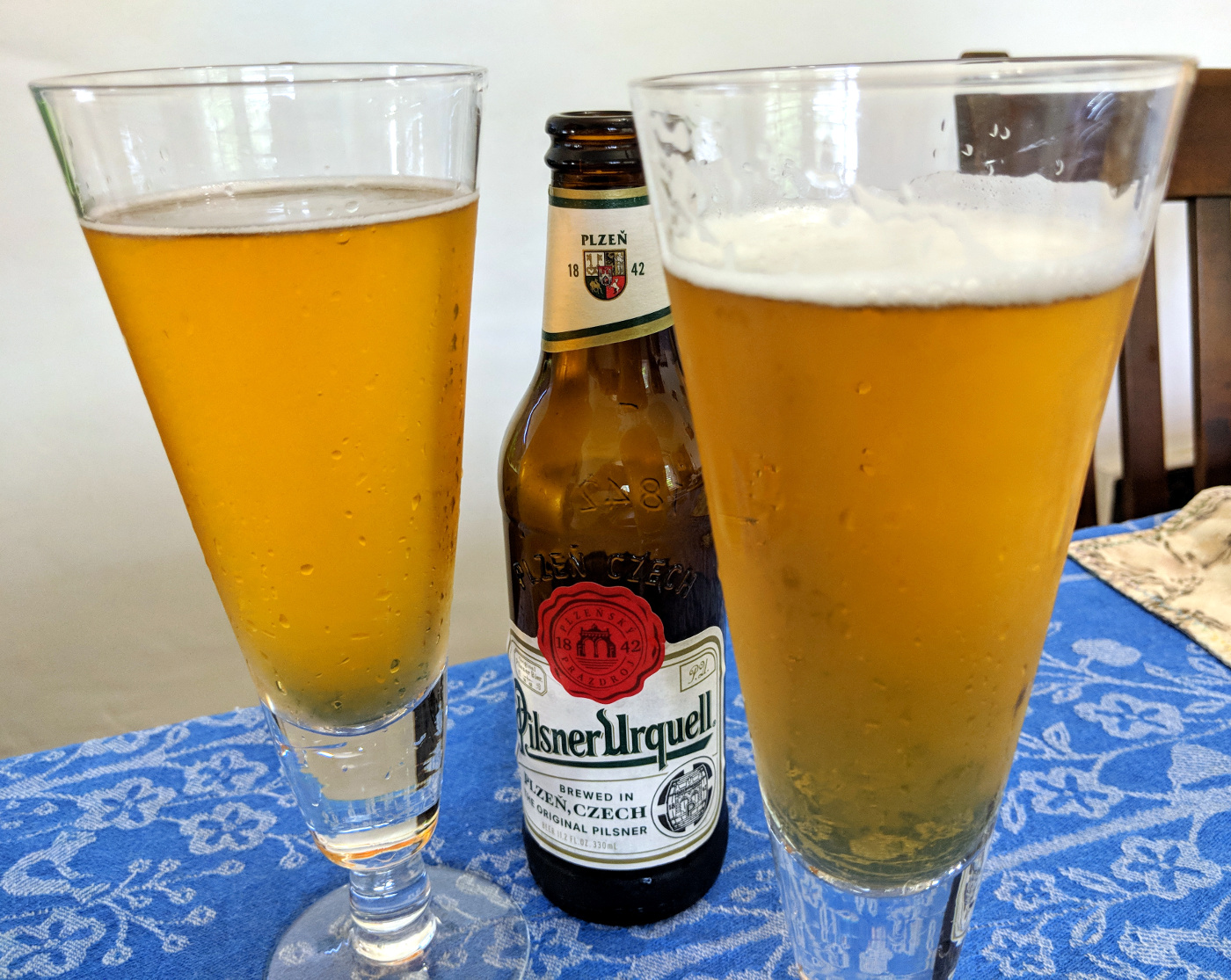
My recent version of a Bohemian pilsner has been on tap for a few weeks, and is at its peak for enjoyment. Today, I did a head-to-head with the classic flagship for the style, Pilsner Urquell.

IMG_20180707_160451

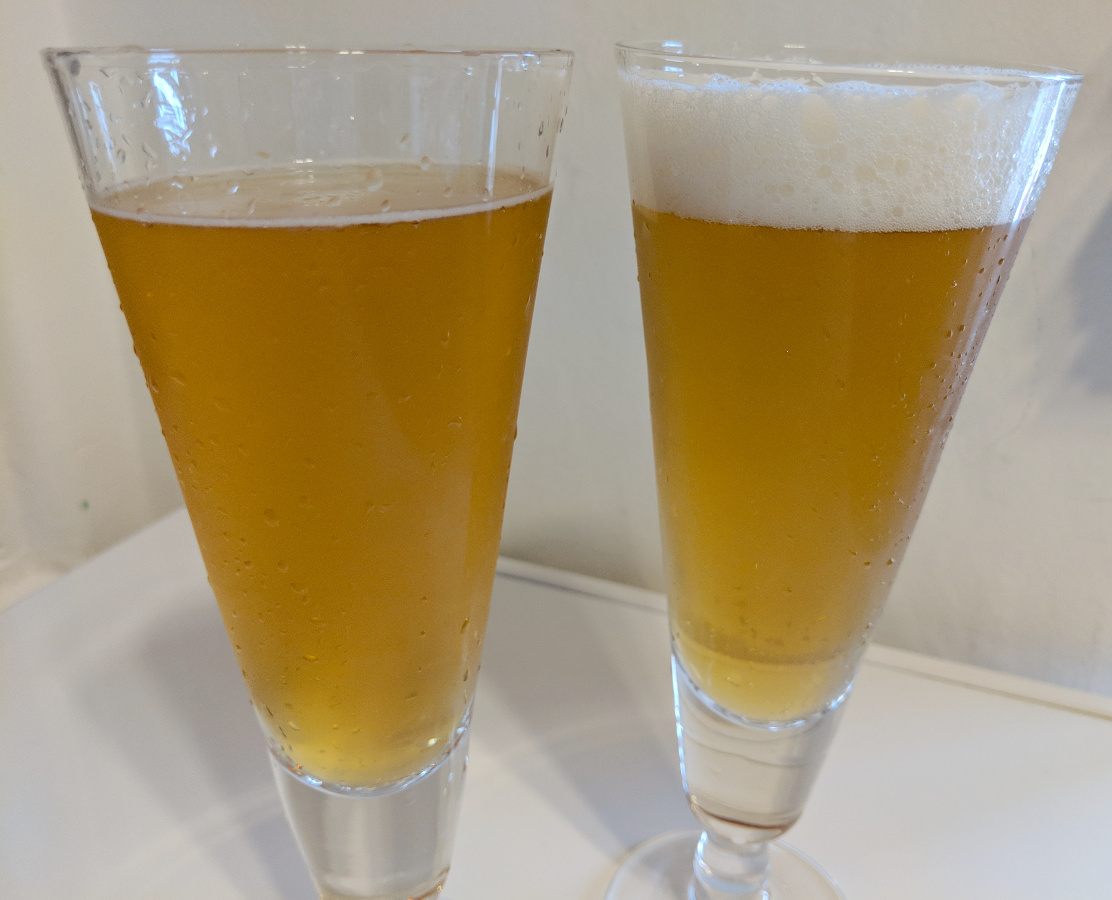
Head-to-head Bohemian pilsners! Pilsner Urquell is in the glass on the left, and my homebrew version is at right.

Try Again Bohemian Pilsner

  • The Basics
    • 1.053 s.g., 1.014 f.g., 4.2% abv, 36 IBU, 5 SRM
  • Appearance
    • Pours with a fine white head with excellent persistance. The beer itself is a golden hue, nearly an exact match for Pilsner Urquell but perhaps just a notch lighter. It is very clear, but not quite brilliant (Urquell has a slight edge here). In terms of appearance, mine is equal in color, better in head (and head retention), and needs slight improvement in clarity.
  • Aroma
    • My beer tips a little bit more towards malt prominence; there is a very slight spice note from the Saaz hops, but that’s still not quite where it should be. Urquell has the hop note perfectly, so I give it a slight edge on this count.
  • Flavor
    • Bitterness levels are not quite evenly matched between Urquell and mine; Urquell comes across as a bit more bitter. Mine has a nice malt character, but this is slightly at the expense of the hops. The malt on my homebrew is rich and bready, and the bitterness stands well against that. The finish is balanced well. Relative to Urquell, it tips more towards the malt than bitterness on the finish, and I prefer the hoppier Urquell version a bit more.
  • Mouthfeel
    • My brew has a medium body and moderate carbonation. Urquell is definitely drier than my beer, with a more extended and more bitter finish. The finish on mine is smoother yet I prefer the Urquell “bite” just a touch.
  • Would I brew this again?
    • Yes, with a few minor modifications! There is lots I like about my beer, such as the appearance and malt character. I do feel like it could be a bit drier and crisper (relative to Urquell), because the hops are just a tiny bit “flabby”. My main adjustment would be to increase the hopping, and mash at a slightly lower temperature to dry out the beer a bit. I might also try halving the melanoidin contribution; I think it might be contributing some unfermentables that keep the beer from being as dry as it might be. The Barke pilsen malt that I used in this recipe has plenty of character on its own, anyhow!
  • Overall
    • 7.5/10

IMG_20180707_155837

Evaluating my first hard cider

A few weeks back, I wrote about my first attempt at a cider. The recipe was dead simple (in fact, I called it Dead Simple Hard Cider), and the whole thing had fermented out in around two weeks. It clocked in at 5.4% abv; not too much, but not too flimsy, either.

ciderThe cider has maintained a consistent haze throughout its serving lifespan, and has a very thin and not terribly persistent head (unsurprising for a cider). It’s somewhat copper/gold in color, and has a nice apple aroma (with maybe a hint of something like diacetyl?). On the flavor end of things, it’s pretty dry, but not puckeringly so. I like the crispness that this brings. The flavor is…well, apple. It’s fairly tart, like the sorts of apples you would expect for a cider. More Granny Smith than Golden Delicious.

I put this cider squarely in the win column. It hit all of the marks I was hoping for, and is surprisingly drinkable. I might try backsweetening a future batch, but not by a lot. I like my ciders tart and dry! A different yeast variety, perhaps something with a bit more character, is also in the cards. A 3 gallon batch was about perfect, too. Cider is a nice treat, but not something I really want 5 gallons of. As the keg nears its end, I’m still enjoying it! And that’s a good state to be in.

Beer Tasting: Session Stout

stoutI’ve had this beer on tap for about a month; it has been really enjoyable!

Session Stout

  • The Basics
    • 1.042 s.g., 1.012 f.g., 3.9% abv, 31 IBU, 42 SRM
  •  Appearance
    • Clear, black beer, with a fine tan head that is moderately persistent. It looks awesome!
  • Aroma
    • The aroma has a prominent roasted character, with a tiny hint of chocolate behind that.
  • Flavor
    • The beer has a forward roasted/slightly burnt character with a dark coffee tone, as expected from the roast barley. The hop bitterness is smooth, in the background behind the malt.
  • Mouthfeel
    • The beer is fairly light bodied with moderate carbonation. The finish is dry, but smooth.
  • Would I brew this again?
    • I think so! It’s a very drinkable beer, both in terms of its flavor/mouthfeel as well as the low alcohol. I’ve been enjoying it quite a bit. If I were to make any minor changes, I would probably up the body just a little (it can tend to slightly thin after awhile). I might also experiment with a version that has more chocolate malt, to richen the  profile and make it a bit more complex than just roast barley.
  • Overall
    • 8/10