Bierstadt Pils Clone 1.1

I brewed this recipe nearly a year ago, and found the result to be super enjoyable. Why not give it another try? I made a few modifications for hopping rate, and ditched the whirlpool hops, which were apparently a mistake in the originally published recipe (now corrected at the link).

Bierstadt Pils Clone 1.1

  • 9.75 lbs. Barke Pilsner malt (Weyermann)
  • 0.5 lb. Acidulated malt (Bestmalz)
  • 1.25 oz. Hallertauer Mittelfrueh hop pellets (3.0% alpha), first wort hopping, 90 minute boil
  • 1.5 oz. Hallertauer Mittelfrueh hop pellets (3.0% alpha), 70 minute boil
  • 1.25 oz. Hallertauer Mittelfrueh hop pellets (3.0% alpha), 5 minute boil
  • 1 Whirlfloc tablet, 10 minute boil
  • 1 tsp. Fermax yeast nutrient, 10 minute boil
  • 2 pkg. Saflager lager yeast (W34/70)

Target Parameters

  • 1.048 s.g, 1.007 f.g., 5.4% abv, 34 IBU, 3.4 SRM
  • Infusion step mash with decoction
  • Water built from 8.75 gallons of RO water, with 4.3 g CaCl, 3.4 g gypsum, 2.7 g epsom salts, to achieve -47 RA, 59 ppm Ca, 8 ppm Mg, 89 ppm SO4, 63 ppm Cl

Procedure

  • I mashed in with 12 quarts of water at 140°, to hit 132°. After 10 minutes, I added 3.5 quarts of water just below boiling, to hit 145°. I let it rest here for 30 minutes. Finally, I added 5.5 quarts just below boiling, to hit 158°. After 40 minutes, I pulled 1.66 gallons of thin decoction and boiled it for 10 minutes. I added it back to the mash, which raised the temperature to 164°.
  • Next, I let the mash sit for 10 minutes, vorlaufed, and collected the first runnings. I added the first hop charge to the kettle at this time.
  • Next, I added the remaining sparge water (3.5 gallons) at ~170°, to hit a 164° mash temperature. I let it sit for 10 minutes, vorlaufed, and collected the second runnings.
  • In total, I collected 7 gallons at a gravity of 1.041, for 77% mash efficiency. I added 0.25 gallons of RO water to raise the volume to 7.25 gallons.
  • I brought everything to a boil, adding hops and other ingredients per the schedule.
  • After a 90 minute boil, I chilled and transferred. Gravity at this point was 1.052, a bit above my target. So, I added 7 cups of water heated to near boiling to top up and hit a gravity of 1.049.
  • I chilled in the fermenter down to 48°, before oxygenating and pitching the yeast.
  • I brewed this beer on 14 September 2019, fermenting at 50°.
  • I raised the beer to 60° on 30 September 2019. I cooled down to 50° on 4 October 2019, and down to 35° on 5 October 2019.
  • I kegged the beer on 11 October 2019, with a partially closed transfer. Gravity at this point was 1.010, for 5.2% abv.

Tasting

  • The Basics
    • 1.049 o.g., 1.010 f.g., 5.2% abv
  • Appearance
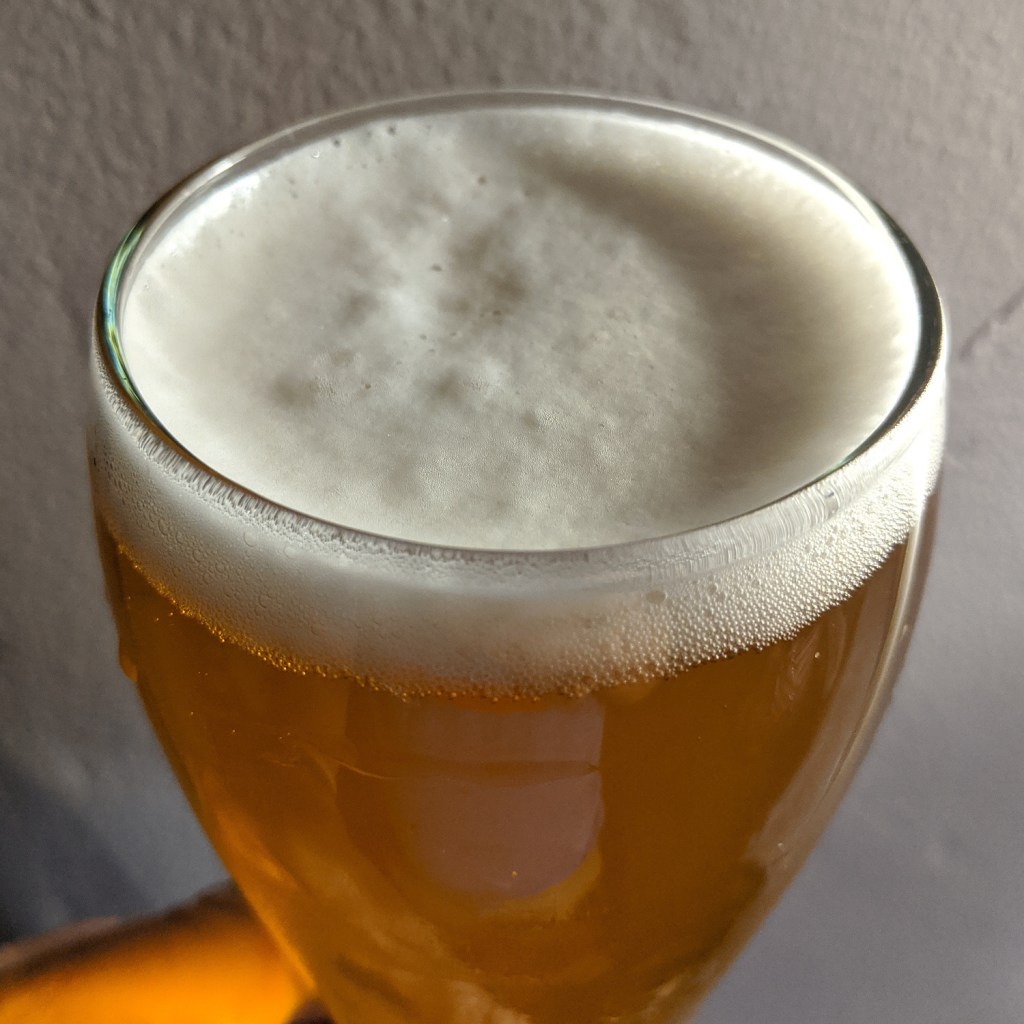
    • Clear, nearly brilliantly so, light yellow beer, with a fine, white, and persistent head.
  • Aroma
    • Clean, lightly malty aroma, with slight floral hop presence.
  • Flavor
    • Light, slightly sweet, and grainy malt character, with a crisp bitterness against that. The balance tilts slightly towards bitter, but not overly so.
  • Mouthfeel
    • Crisp and light-bodied, with moderate carbonation and a smooth finish.
  • Would I brew this again?
    • This is a great recipe. It’s a really smooth and drinkable beer, and was worth repeating from last time. I enjoy the grainy malt character, and the pleasant German hops alongside that. The head isn’t quite as firm and frothy as I might like (that honor belongs to the last German pils I did), but I’m not sure if that is a recipe flaw or something else. I think it will be worth playing with malts some more to see what happens when I switch those up. This recipe lacks some of what makes my other recent pils great, but in all it’s pretty decent.
  • Overall
    • 8/10

Stygimoloch Bock

I have a Thanksgiving tradition of crafting a new “fancy” beer for our holiday get-together. After consulting with my friend Justin, we settled on a dunkles bock. It’s rich, malty, and eminently drinkable–a perfect beer for a late fall celebration. I don’t think I’ve ever brewed this style before, either, although I certainly have enjoyed drinking it!

The recipe is a modified version of Gordon Strong’s traditional bock, from Modern Homebrew Recipes. The base grist of dark and light Munich malts is basically the same, although I had to substitute in Briess’s Caramel Munich and some melanoidin malts instead of Caramunich III. Also, I used Magnum hop pellets instead of whole Hallertauer cones. In terms of techniques, I used a straight infusion mash rather than a double decoction.

As an extra special treat, I wanted custom glassware with a unique logo for the beer. So, I commissioned the wonderfully talented Charon Henning to create a design. Bock labels often feature goats as part of a linguistic pun, but hey, I’m a paleontologist. Why not go with a prehistoric goat analog? The bone-headed dinosaur Stygimoloch*, with its goat-like spikes and potential butting behavior, seemed like a perfect fit. Charon did a superb rendering that pays homage to many old bock labels. Even better, she worked some leaves of prehistoric hops into the background!

StygiLoRes

Stygimoloch Bock

  • 9 lbs. Munich II malt (Weyermann)IMG_20191019_150917
  • 5 lbs. Munich I malt (Weyermann)
  • 8 oz. Caramel Munich 60L (Briess)
  • 4 oz. melanoidin malt (Weyermann)
  • 1 oz. Carfa Special III malt (Weyermann)
  • 0.65 oz. Magnum hop pellets (13.2% alpha), 60 minute boil
  • 1 Whirlfloc tablet, 10 minute boil
  • 1 tsp. Fermax yeast nutrient, 10 minute boil
  • 4 pkg. Bavarian lager dry yeast (Mangrove Jack’s M76)

Target Parameters

  • 60 minute infusion mash, 154°, batch sparge
  • 1.070 o.g., 1.017 f.g., 7.0% abv, 25 IBU, 15 SRM
  • Blend of Claremont tap water and RO water, with 3 g CaCl, to produce target water of 4 ppm Ca, 5 ppm Mg, 13 ppm Na, 22 ppm SO4, 53 ppm Cl, 119 ppm HCO3, RA=56 ppm.

Procedure

  • I mashed in with 5 gallons of Claremont tap water and 1/4 of a Campden tablet at 164°, to hit a 154.4° mash temperature.
  • After 60 minutes, I added 0.5 gallons of RO water blend (3 g of CaCl added to 4.5 gallons of water) at 185°. I let it sit for 10 minutes, vorlaufed, and collected first runnings.
  • I next added 4 gallons of the RO water blend at 185°, let sit for another 10 minutes, vorlaufed, and collected the second runnings.
  • In total, I collected 7.25 gallons of runnings with a gravity of 1.055, for 72% mash efficiency.
  • To up the gravity a touch, I boiled the wort for 15 minutes before adding the hops (a total of 75 minute boil). I figured this longer boil time would work well to add additional character.
  • After boiling for a total of 75 minutes, I turned off the heat, and chilled down to 80° before transferring into the fermenter and cooling overnight in the fermentation chamber. I oxygenated for 60 seconds, and added 4 packages of yeast. I used four packages because they were around 9 months past “best by” date. Nonetheless, they took off pretty well.
  • Starting gravity was 1.066, on 30 August 2019.
  • I fermented at 52°, until raising the temperature to 60° on 30 September 2019. I cooled back to 50° on 4 October 2019, and then down to 35° on 5 October 2019.
  • I kegged the beer on 9 October 2019. Final gravity was 1.020, for 6.1% abv.

IMG_20191021_185030Tasting

  • Appearance
    • Color is a gorgeous deep copper, and the beer has become brilliantly clear in the keg. The tan head is quite persistent.
  • Aroma
    • Amazing malty, bready aroma, with a touch of caramel.
  • Flavor
    • Rich, bready flavor, with some toastiness–it is very reminiscent of a hearty bread crust. The beer is a touch more bitter than appropriate for the style. (note: the bitterness had mellowed a bit when I tasted it again on November 24)
  • Mouthfeel
    • Medium-full body, nice rounded finish.
  • Would I brew this again?
    • Yes! This is a really nice beer, with a phenomenal maltiness and drinkability that approaches slightly dangerous. Color and clarity are exceptional, and it’s only going to get better as it matures towards a Thanksgiving official launch date (I did the tasting in mid-October). It is maybe a touch more bitter than I would like for the style, so if I brew it again I’ll dial back the hops slightly.
  • Overall
    • 8/10

*Yes, I mostly agree with the hypothesis that Stygimoloch is probably a younger form of something like Pachycephalosaurus, so the name itself may or may not be valid. Even so, let’s just agree that we shouldn’t let nomenclatural pedantry overrule the fact that “Stygimoloch Bock” rolls off the tongue more easily than Pachycephalosaurus Bock”.

Schell’s Pils Clone

It’s always lager season, and especially so during the warm opening days of fall here in SoCal. I’m continuing to explore the morphospace of pilsners, with my latest foray following a recipe in Craft Beer for the Homebrewer: Recipes from America’s Top Brewmasters. I was particularly interested by a clone recipe for a pilsner from Schell’s Brewing, based out of Minnesota. One notable thing about the provided recipe is that it used American 2-row instead of European pilsner malt. They’re not too far off each other in terms of color, so I thought it would be a neat test of malt character.

The recipe itself closely matches that in the book; my main adjustment was to modify the hop schedule slightly for amounts and time to account for the hops I had on hand.

Close-up of pilsner beer foam in conical glass

Schell’s Pils Clone

  • 10.5 lb. 2-row pale malt (Rahr)
  • 0.25 lb. Carapils malt (Briess)
  • 1.9 oz. Mt. Hood hop pellets (4.6% alpha), 60 minute boil
  • 1 Whirlfloc tablet, 10 minute boil
  • 1 tsp. Fermax yeast nutrient, 10 minute boil
  • 1.1 oz. Mt. Hood hop pellets (4.6% alpha), 5 minute boil
  • 1 oz. Sterling hop pellets (7.9% alpha), 5 minute boil
  • 1 pkg. Harvest liquid yeast (Imperial Yeast #L17), prepared in 1.5L starter
  • 1 oz. Sterling hop pellets (7.4% alpha), 7 day dry hop

Target Parameters

  • 1.050 o.g., 1.013 f.g., 4.8% abv, 38 IBU, 3 SRM
  • 60 minute infusion mash, 152°, batch sparge
  • Water built up from RO, to hit target water profile of 59 ppm Ca, 8 ppm Mg, 89 ppm SO4, 63 ppm Cl; RA=-47ppm

Procedure

  • I made a 1.5L starter a few days in advance, let it run for 48 hours, and then cold crashed it (and decanted the spent wort).
  • To create my brewing water, I added 3.3 g gypsum, 2.7 g epsom salt, and 4.2 g calcium chloride to 8.5 gallons of RO water.
  • I mashed in with 3.5 gallons of water at 162°, to hit a mash temperature of 152.2°. I added 7.5 mL of 88% lactic acid to the mash, to help hit a target pH of ~5.3.
  • After 50 minutes, I added 1.25 gallons of water at 185°, in order to raise the mash temperature o 156°. I let the mash sit for 10 more minutes, vorlaufed, and collected first runnings. Then, I added 3.75 gallons of water at 185°, let sit for 10 minutes, vorlaufed, and collected second runnings.
  • In total, I collected 6.9 gallons of wort with a gravity of 1.042, for 74% efficiency.
  • I brought the runnings to a boil, adding hops and other kettle additions per the schedule. After 60 minutes, I turned off the flame and chilled down as far as I could (~80°) before transferring.
  • I chilled the wort down to 57°, before pitching the yeast and continuing to chill down to 52°. I completed the fermentation at 52°.
  • A good krausen was built within 24 hours.
  • I brewed the beer on 11 August 2019.
  • On 18 August 2019, I raised the temperature of the beer to 56°.
  • On 21 August 2019, I raised the temperature of the beer to 66°.
  • I added the dry hops on 24 August 2019.
  • I cold crashed the beer to 33° on 29 August 2019.
  • I kegged the beer on 1 September 2019. Final gravity was 1.008 (via refractometer), for 5.5% abv.

IMG_20191009_171317

Tasting

  • Appearance
    • Pours with a thick, fine, frothy head, that is quite persistent. The beer itself is light yellow and fairly clear (but just a touch away from brilliant clarity).
  • Aroma
    • Light grainy aroma, with a nice spicy hop note alongside it. Very clean!
  • Flavor
    • Grainy and ever-so-slightly sweet malt profile, with a firm, clean, and slightly spicy bitterness. Balance is tilted modestly in the hoppy direction.
  • Mouthfeel
    • Crisp, with a slightly dry finish. Moderately high carbonation.
  • Would I brew this again?
    • YES! This is a really nice German-American pilsner, all the more interesting because I got such a nice malt flavor profile using American 2-row rather than European pilsner malt. The Rahr 2-row is pretty light (1.8 SRM), not too far from typical pilsner malt (Weyermann Barke pilsner is actually 1.9 SRM), so I guess it shouldn’t be too surprising, at least on the basis of color. I’m particularly pleased with the head retention on this beer; it pours with a beautiful foam that sticks around for quite awhile. If I had a little more patience, I would let it condition a bit longer to clarify to brilliant, but that’s pretty much the only (minor) flaw in this beer.
  • Overall
    • 9.5/10

Polacanthus Porter

IMG_20190829_193848Dark beers! They’re seemingly banished from the summer months, and yet I often have a craving for one even on the hottest days. Not a triple imperial barrel aged chocolate stout, of course–that’s best dumped in the sink during the month of December. I’m thinking of those more drinkable dark beers, a bit lower on the alcohol but still robust on flavor.

An end-of-summer porter seemed like a good way forward. They’re flavorful, but not necessarily gut bombs. They’re relatively easy to brew, and turn around fairly quickly. Also, they’re a “traditional” style that’s just a bit harder to find, overwhelmed by trendier beers on tap lists. If I want a mediocre hazy IPA, I don’t need to make my own; there is no shortage in area breweries!

This recipe is based on the American porter from Gordon Strong’s Modern Homebrew Recipes. My version fairly closely follows that by Strong, with the modifications primarily on the hopping and malt brands. The name recognizes the combination of American and English ingredients, because Polacanthus is a type of armored dinosaur that had relatives on both sides of the Atlantic.

Polacanthus Porter

  • 11 lb. 2-row pale malt (Rahr)
  • 12 oz. 1823 Heritage Crystal Malt (Bairds), 75°
  • 10 oz. chocolate malt (Bairds), 500°
  • 5 oz. roasted barley (Bairds), 600°
  • 0.65 oz. Magnum hop pellets (13.2% alpha), 60 minute boil
  • 1 Whirlfloc tablet, 10 minute boil
  • 1 oz. Cascade whole hops (~5.5% alpha), 10 minute boil
  • 1 oz. Cascade whole hops (~5.5% alpha), 5 minute boil
  • 1 pkg. Safale American Ale Yeast (US-05)

Target Parameters

  • 1.058 o.g., 1.014 f.g., 5.8% abv, 36 IBU, 34 SRM
  • 60 minute infusion mash, 154°, batch sparge
  • Claremont tap water

Procedure

  • I mashed in with 4.25 gallons of water at 164.5°, to his a mash temperature of 155°. After 45 minutes, I added 1 gallon of water at 185°, and collected first runnings after a 10 minute rest and vorlauf. I then added 3.5 gallons of water, let rest for 10 minutes, vorlaufed, and collected second runnings.
  • In total, I collected 7.1 gallons of runnings with a gravity of 1.048, for 73% efficiency.
  • I brought the runnings to a boil, adding hops and such per the recipe.
  • After 60 minutes, I turned off the flame, chilled, and transferred to the fermenter (with aeration). I had to let the wort rest in the fermenter for a few hours, to chill down to the fermentation temperature of 66°.
  • I brewed this beer on 13 July 2019. Starting gravity was 1.057.
  • I kegged the beer on 14 August 2019. Final gravity was 1.013, for 5.8% abv. This was exactly on the dot for my targets!

Tasting

  • Appearance
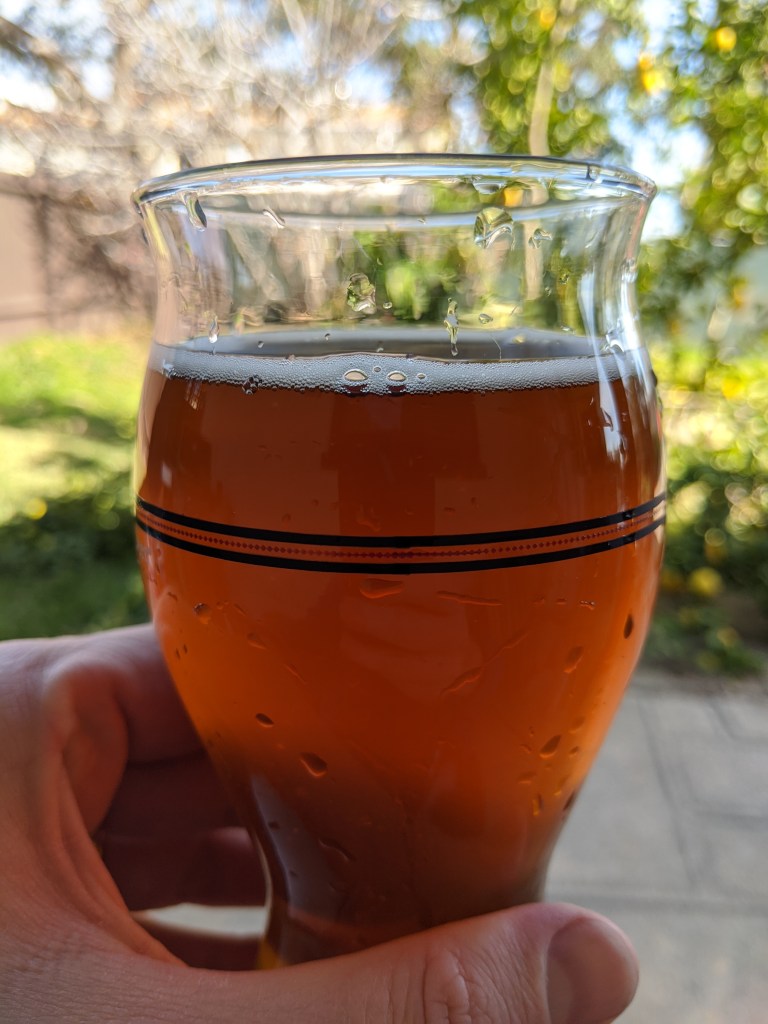
    • Deep brown, with garnet tones when illuminated from behind; clear; persistent tan head
  • Aroma
    • Roasty, chocolately aroma; very nice.
  • Flavor
    • Roast malt character at the front, with a slight chocolate and coffee tinge; slight citrus aspect; moderately bitter, with a finish that tilts towards the bitter rather than the malty side.
  • Mouthfeel
    • Medium body, medium carbonation; off-dry finish (probably due to the roast character). It could maybe have a touch more body, but I think overall it’s okay on this end. Too much body would make this harder to drink.
  • Would I brew this again?
    • Yes! This is a nice and simple recipe, with a pleasant flavor. As porters go, this definitely is towards the roasted and bitter side, but I’m okay with that. This is really drinkable as a summer porter! I would add it to my regular repertoire.
  • Overall
    • 9/10

Czech Pilsner

My homebrew club recently had a competition centered around Bohemian-style pilsners. I’ve done a few iterations, but haven’t quite hit where I want to yet. The primary issue concerns hop aroma–it’s really, really hard to get good Saaz as a homebrewer. Gotta keep trying.

Czech Pilsner

  • 10.5 lbs. Barke Pilsner malt (Weyermann)
  • 2.4 oz. melanoidin malt (Weyermann)
  • 0.3 oz. Carafa Special III malt (Weyermann)
  • 2 oz. Saaz hop pellets (3.0% alpha), 60 minute boil
  • 1 oz. Saaz hop pellets (3.5% alpha), 60 minute boil
  • 1 Whirlfloc tablet, 10 minute boil
  • 1 tsp. Fermax yeast nutrient, 10 minute boil
  • 2 oz. Saaz whole hops (2.8% alpha), 5 minute boil
  • 1 pkg. WLP800 Pilsner Lager yeast, prepared in starter

Target Parameters

  • 1.050 o.g., 1.010 f.g., 5.2% abv, 35 IBU, 5 SRM
  • 60 minute infusion mash, 150°, batch sparge
  • Water built from RO, to hit target of 20 ppm CA, 8 ppm Na, 15 ppm SO4, 35 ppm Cl, -61 ppm RA

Procedure

  • I made a 2L yeast starter a few days in advance, and cold crashed it, followed by decantation of the spent wort.
  • I built up the mash water using 0.6 g baking soda, 0.4 g CaCl, 0.4 g gypsum, added to 8.5 gallons of RO water.
  • I mashed in with 3.5 gallons of water at 161°, to hit a mash temperature of 150.2°. I added 7 mL of 88% lactic acid, to adjust the pH of the mash.
  • After a 60 minute mash, I batch sparged in two steps (first of 1.25 gallons, second of 3.6 gallons). At each step, I let the mash sit for 10 minutes, vorlaufed, and collected the runnings.
  • In total, I collected 6.9 gallons of runnings with a gravity of 1.043, for 75% mash efficiency. Right on target!
  • I boiled for 60 minutes, adding stuff per the recipe, and then chilled after flame-out.
  • I transferred the wort to my fermenter, and put it in the fermentation chamber to drop down to 48°. This took a few hours. Then, I oxygenated for 30 seconds and pitched the yeast.
  • I fermented the brew at 50°. The brew date was 25 May 2019.
  • After three weeks, I raised the temp to 65° for a few days, then cold crashed. After a few more days, I kegged the beer using a semi-closed transfer (CO2-flushed keg, but just air-pushed the beer into the keg). Alas, I neglected to take a final gravity!

Tasting

  • I didn’t get to do a formal tasting before the keg kicked, but did get a few quick observations.
  • The beer flavor was a bit too forward on the melanoidin; I will just ditch that in the future! I am still in search of good hop aroma…overall, the beer is just OK with good clarity, decent head; not quite there yet. Bitterness level is about right. Malt body is about right.
  • Overall, 6/10.