
Today, after two weeks in the primary fermenter, I kegged my Vienna Brown Ale. Final gravity was at 1.013, down from 1.048, for 4.6% abv. I am hoping this one mellows a bit in the keg; right now it has a little acidity at the backend, and my fingers are crossed that’s not an infection in the making!
Equinox IPA
I have been seeing a fair bit about Equinox…err, HBC 366…hops during the past year, and wanted to try them for myself. Like many of the recent American varieties, it is supposed to pack quite an aroma and flavor punch. Even if it’s totally stereotypical for a homebrewer, I do like big, aroma-rich hops, so a batch with Equinox made it onto my “brewing goals” list.
This was also an opportunity to continue my exploration of Vienna malt, so I crafted a SMaSH-ish recipe that had a decent late-hopping dose of Equinox. The only minor deviation from a true SMaSH is that I threw in a touch of de-bittered black malt for color.
Finally, I am using this batch to recalibrate some of my brewing parameters. For a few batches now, I have noticed that my wort volumes and starting gravities are a touch off, so I am going to adjust the mash and boil-off assumptions accordingly in BeerSmith. Additionally, the night before brewing, I completely disassembled and cleaned my mill (a Monster Mill 2). There was some grain dust worked into places, and as a result it wasn’t holding the gap as well as it should (hence my low mash efficiency on some previous batches). After reassembly, I set the gap to around 0.039″. As noted below, I had incredible mash efficiency (84%!), but the mash itself was a little slow to drain. So, after this brew I widened my gap to 0.041″.
Equinox IPA
- 12 lbs. Vienna Malt (Weyermann)
- 1 oz. de-bittered black malt (Dingemans)
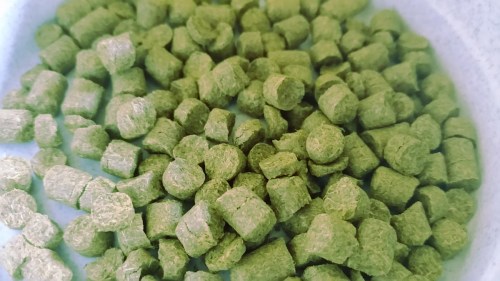
- 0.5 oz. Equinox (HBC 366) hop pellets (14.2% alpha), first wort hop
- 0.5 oz. Equinox (HBC 366) hop pellets (14.2% alpha), 60 minute boil
- 1 oz. Equinox (HBC 366) hop pellets (14.2% alpha), 5 minute boil
- 1 oz. Equinox (HBC 366) hop pellets (13.4% alpha), whirlpool
- 0.5 tsp. gypsum, added to boil
- 1 Whirlfloc tablet, 10 minute boil
- 2 pkg. Safale American dry yeast (US-05)
Brewing Targets
- Mash temperature = 149°
- Original gravity = 1.067 (actual = 1.062)
- Color = 8.5 SRM
- IBU = 63
- Note that I originally targeted this for a lower gravity, ~1.058. Because I ended up with very high mash efficency (~84%), I had to adjust the recipe per the above. If I brew this again, after adjusting my mill gap, I’ll need to tweak the malt bill to reach the same gravity.
Procedure
- I mashed in with 4.6 gallons of water at 159°, to hit a mash temperature of 151°. The mash was down to 147° after 30 minutes, and 146.5° by 60 minutes.
- After 60 minutes, I added 0.7 gallons of water at 190°, to raise the mash bed to 148°. After 10 minute, I vorlaufed and collected the first runnings. Due to the fine crush, it took awhile to drain the mash bed.
- I then added 3.75 gallons of water at 182°, to raise the mash temperature to 160°. I let it sit for 10 minutes, vorlaufed, and collected the second runnings.
- Wow! I collected 7 gallons of wort at a gravity of 1.055, for 84% efficiency. As a result, I adjusted my original recipe to the one above.
- As soon as the wort was on the flame, I added hops. At the boil, I added the second addition, and everything else was dropped in at the appropriate time.
- After flame-out, I chilled the wort to 84°. This wasn’t quite cool enough to pitch the yeast, so I transferred into my fermenter and put it all into the fermentation chamber for a few hours. Once the overall temperature had come down, I pitched in the two packets of yeast.
- Starting gravity was 1.062, a little lower than expected (probably due to a slightly lower boil-off rate than assumed by BeerSmith). I brewed this on 27Aug2016, and am fermenting at 66°.
Welcome, Zymurgy readers!
 If you are a reader of Zymurgy and/or member of the American Homebrewers Association, you may have found my website from the link in my recent article (“Homebrew for Dinosaurs,” September/October 2016 issue). Thank you for stopping by!
It was a real privilege to share some of my experiences as a homebrewing paleontologist with a broader audience. Of course, there wasn’t nearly enough room to talk about everything I wanted to discuss, and who wants to read 15 pages of my navel-gazing, anyhow? Here, I have included a few links for the curious that expand on some of the things I touched on in the article.
- Want to learn more about Aquilops, the dinosaur that inspired “Eagle Face Oatmeal Stout”? Check out its Wikipedia page, or read the original technical publication. You can even download files to 3D print your own Eagle Face!
- I made a beer for Aquilops; my buddy Matt got a tattoo. Read that story at Matt’s blog post here.
- The artistic rendering of the animal that you saw in Zymurgy was done by the incredibly talented Brian Engh. Check out his website and be amazed!
- Want the recipe for my Eagle Face Oatmeal Stout? I’ve got it here! Other recipes mentioned in the article include Thumbspike Saison and The Celtic Elk Stout.
- Interested in one of my favorite connections between brewing and paleontology? Read this post on a real Jurassic beer.
- My homebrew club is Horse Thief Brewers Association, based in San Dimas. If you are in the area, join us for a meeting sometime!
- If you want some of the highlights from this website, check out my “Classic Posts,” “About Me,” and “Recipe Favorites” pages.
- If you are into the Twitter thing, check out my feed @andyfarke for the latest on paleontology, homebrewing, and other things that interest me.
- Finally, a shout-out to fellow paleontologist Gabe Santos for the awesome photo of me (with Smilodon skull and stout) that is in the article. Thanks, Gabe!
Citra Wit Kegged
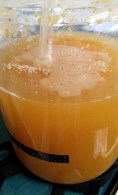 Today I kegged my Citra Wit, after 10 days in the primary fermenter. The beer has fermented out really nicely, down to a final gravity of 1.010, equating to 4.3% abv. Hey, I can call it a session beer! The taste and aroma are exactly where I wanted them–citrusy and lightly tart, with just a hint of that grapefruit coming at the end. I have a feeling that this is going to be one awesome beer.
Vienna Brown Ale
 Many of my recent brews have explored styles that are new to me–saison, Bohemian pilsner, witbier, and altbier, to name a few. This has been a ton of fun (and produced some tasty results), and I am ever-searching for new ways to expand my brewing repertoire further. For the next round of exploration, I want to really delve into Vienna malt. My standard base malt has been American 2-row, and last winter I spent a bit of time playing with Maris Otter too. I’ve certainly brewed with Vienna malt as a minor ingredient, but still don’t feel like I have a good handle on its flavor characteristics. Time to change that!
Descriptors for Vienna malt are typically vague–phrases like “full-bodied” and “golden colored” don’t really tell me much about the flavor itself. “Toast” and “biscuit” aromas are also supposed to be present. I’m not yet confident what this means within this particular malt, so I need to find out firsthand.
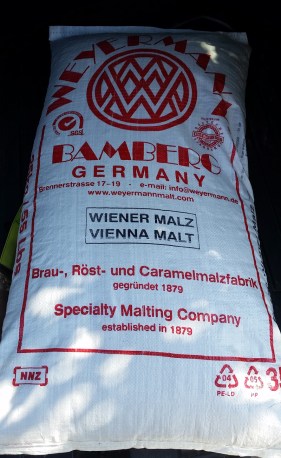
Thus, I recently purchased a 55 pound bag of Weyermann Vienna Malt from my local homebrew shop. I plan to do a whole series of brews with it during the rest of 2016. First up is a brown ale, then an IPA, and after that a classic Vienna lager (because it would be a shame not to!).
My brown ale recipe for this time around is fairly simple, veering towards the malty side (which I like in a brown ale). I have a good feel for what the various crystal and chocolate malts taste like, so this batch makes a solid first chance to get my brain cells around the overall properties of Vienna malt.
Vienna Brown Ale
- 9.5 lbs. Vienna malt (Weyermann)
- 0.5 lb. chocolate malt (Briess)
- 0.25 lb. crystal 40 malt
- 0.15 lb. de-bittered black malt (Dingemans)
- 0.5 oz. Nugget hops pellets (13% alpha), 60 minute boil
- 1 tablet Whirlfloc, 10 minute boil
- 1 pkg. Nottingham dry yeast (Danstar)
Target Parameters
- 1.051 o.g., 1.012 f.g., 5.1% abv, 24 IBU, 23 SRM, 5.5 gallons into the fermenter
Procedure
- I mashed in with 4.1 gallons of water at 163°, to hit 154°. This was down to 151° after 45 minutes. After 60 minutes, I added 1 gallon of water at 190°, to hit a mash temperature of 155°. I waited 10 minutes, vorlaufed, and collected 3.3 gallons of first runnings. Then, I added 3.7 gallons of water at 182°, to hit 166°. After 10 minutes, I vorlaufed and drained the mash tun.
- In total, I collected 7.1 gallons of wort with a gravity of 1.039, for 71% efficiency.
- I boiled the wort for 60 minutes, adding hops and Whirlfloc per the schedule. The wort had boiled down to around 6.25 gallons (unchilled) by the end of the time.
- After 60 minutes, I turned off the flame and chilled the wort to 80°. I transferred the wort into the fermenter (5.5 gallons total), and pitched the dry yeast directly. I sealed up the fermenter, and will begin fermentation at 68°.
- Starting gravity was 1.048, slightly below my target of 1.051. I brewed this batch on 20 August 2016.
 Andy's Brewing Blog