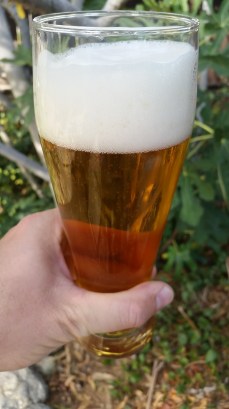
Beer Tasting: Lithographica Pilsner

The keg for my Bohemian pilsner is long past kicked, but better late than never, right?

  • The Basics
    • Original gravity = 1.053; final gravity = 1.011; abv = 5.5%; estimated IBU = 39
  •  Aroma
    • Light bready aroma, with a moderate spicy hops note. I might detect a very, very faint fruitiness, but this seems to come and go, so I’m not certain it is really there.
  • Appearance
    • Clear, but not brilliant, with a moderate yellow color. The head pours rather high when first poured, but settles down to a low head with good coverage. The head is fine and white.
  • Flavor
    • A moderate hoppiness is at the fore, moderately balanced against a decent but not overwhelming maltiness. The malt has a bready/grainy character. As I drink this, the hoppiness fades out nicely on the finish.
  • Mouthfeel
    • This is a beer with modest body and a medium rather than dry finish. Carbonation is moderately high.
  • Would I brew this again?
    • This beer is a pretty respectable first go at a Bohemian pilsner. It’s quite drinkable, and there isn’t anything I would call a major flaw. If I do this recipe again, I would up the maltiness a touch, darken the color to more gold than yellow, and work on improving the clarity just a little. Clarity could be fixed by more careful racking, and a little bit more time lagering before initial tapping. For increased maltiness, I might add another grain or two to the malt bill (e.g., Carapils), or else boil the decoctions for a longer stretch. This would also help burnish the color to the golden sheen that is more appropriate for the style.
  • Rating
    • 6/10

Hell Creek Amber Ale

bottleGimmick beers can be a fun way to liven up familiar styles, especially when there is a good pun involved. A friend recently located some wild (or more likely, feral) hops growing on an old homestead in eastern Montana. This happens to be right on top of the Hell Creek Formation, a ~66 million year old package of rocks that preserves some of the last dinosaurs to live on the planet. It also yields fossil amber…and a pun was born!

Hell Creek Amber Ale makes a great name–but could I capitalize on it any further? How could I build a recipe around the concept?

Early on, I made a decision to use ingredients primarily from the home region of the Hell Creek Formation (Montana, South Dakota, and North Dakota). I had a small quantity of wild Hell Creek hops on-hand, and supplemented them with a few ounces of my dad’s Cascade hops from South Dakota. Malt presented a bit of a challenge, though. After some research, I learned about MaltEurop’s Montana malting facility. Fortuitously, one of their flagship products is billed as being malted from barley “grown in and around Montana.” The recipe was rounded out with a few non-thematic malts, to produce a nice American amber ale.

The base recipe is a modification of the American Amber Ale from Zainasheff and Palmer’s Brewing Classic Styles. However, I used American malt instead of English malt, and substituted Special B malt for some of the darker crystal malts suggested by the recipe. The latter gambit was to create a slightly richer flavor, evoking the deep color of fossil amber as well as the rich aromas that must have permeated the ancient Hell Creek landscape. I also modified the hop additions a bit–the only late addition was that of the wild hops, with a steeping to allow any interesting aromas and flavors to come to the forefront. The dried hops had a moderate herbal aroma, which I expect should play nicely with the caramel qualities of the specialty malts.

Hell Creek Amber Ale

  • 9 lbs. 2-row American pale malt (MaltEurop)
  • 1 lb. Munich malt
  • 0.8 lb. 40° crystal malt
  • 0.5 lb. Special B malt
  • 0.5 lb. Victory (biscuit) malt
  • 2 oz. Cascade whole hops (5.1% alpha), 60 minute boil
  • 0.44 oz. wild Hell Creek hops, 10 minute steep after boil
  • 1 Whirlfloc tablet, 10 minute boil
  • 1 pkg. California Ale Yeast (White Labs, WLP001), in 1L starter

Target Parameters

  • 1.059 o.g., 1.014 f.g., 5.9% abv, 33 IBU, 14 SRM, 5.5 gallons into the fermenter

Procedure

  • I mashed in with 4.75 gallons of water at 167.5°, to hit a mash temperature of 156°. It was down to 153° after 40 minutes.
  • I added 1 gallon of water at 185°, stirred, let it rest for 10 minutes, vorlaufed, and then collected the first runnings. Subsequently, I added 3.5 gallons of water at 180°, let it rest for 10 minutes, vorlaufed, and collected the remainder of the wort.
  • In total, I collected 6.6 gallons of wort with a gravity of 1.050, for 77% mash efficiency.
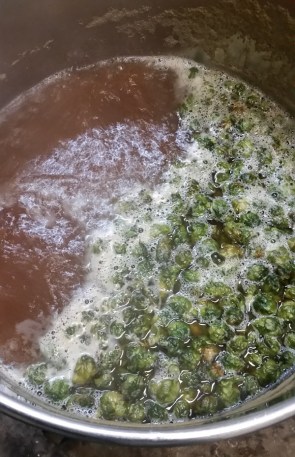
  • I brought the wort to a boil, adding hops per the schedule above. At flame-out, I added the wild hops and then let them steep for 10 minutes before chilling the wort down to 80°.
  • Approximately 5.5 gallons went into the fermenter, and I pitched the yeast immediately. I’ll be fermenting the beer at 66°.
  • This beer was brewed on 10 October 2016.

Beer Tasting: Citra Wit

Citra WitMy Citra Wit has come and gone, but luckily I was able to squeeze in an “official” tasting in before the keg kicked!

  • The Basics
    • Original gravity = 1.043; final gravity = 1.010; abv = 4.3%; estimated IBU = 13
  • Aroma
    • Light citrus aroma (reflecting the Citra hops) with a slight bready character. There is surprisingly little obvious yeast character (in terms of a spice note).
  • Appearance
    • Thick, white head with fine bubbles, that pours high and settles down to a broad blanket across the top of the beer. It leaves some lacing across the side of the glass. The beer itself is light yellow and beautifully cloudy.
  • Flavor
    • A definite bready character to the malt, with only the lightest of bitterness and a smooth finish. A gentle coriander comes through across the taste, but the grapefruit is surprisingly absent. This is a marked contrast to when I first brewed and transferred the beer.
  • Mouthfeel
    • This is probably more lightly carbonated than is true to style, but I’m OK with that. This beer has a really nice, light body and a fairly smooth finish that tends towards the delicate malt side rather than the hoppy side. The finish feels a little “flabby,” though, and I wonder if that might be resolved with some water adjustments.
  • Would I brew this again?
    • This is a nice, refreshing beer, which hits most of the notes I am aiming for. I might try dry-hopping with fresh grapefruit peel on the next round, if I wanted a bigger grapefruit character (which I do). The appearance of the beer is dead-on for what I had in mind, and stayed that way until the end of the keg. I might play with the water profile a bit, to perk up the mouthfeel.
  • Rating
    • 7/10

Gingerbread Winter Warmer

We’ve only barely hit fall, but I do need to start looking ahead to winter beverage selections. For the past two years, I’ve done a pumpkin ale, both of which turned out fairly nice. Although I was tempted to rebrew a new version of last year’s recipe, I instead decided to switch course altogether. This meant: winter warmer!

The recipe is pretty much entirely my own,with an aim towards creating a rich, flavorful sipping beer that evokes gingerbread cookies. This should be something to enjoy by the fireplace, while the California winter rains pour down outside. (I know, it should be snowfall in some quaint northeastern town, but I much prefer my California winters.) I kept the hops on the lower end, because I figured that the extensive spice roster would up the perceived bitterness sufficiently.

For the yeast, I ended up using two freebie dry yeast packets from the 2015 San Diego homebrewers convention. They were both Belgian Abbaye / Abbey yeasts, one from Danstar and the other from Fermentis. The packets were a few months past their expiration dates, so I upped the yeast pitching rate accordingly. The Danstar variety is supposed to tend towards the clove and fruit end of the spectrum, whereas the Fermentis strain is a little more subtle. So, I elected to pitch a greater quantity of the Danstar, in hopes that its yeast character will dominate.

Because this is such a high alcohol beer, and a very experimental recipe, I didn’t really want five gallons worth. So, I elected for a 2.5 gallon batch. And with that small size, it really lent itself well to brew-in-a-bag. My plan is to ferment for 4-6 weeks, and then keg, with a few weeks of additional conditioning before serving.

honey, molasses, cinnamon, ginger, and yeast, with mortar & pestle, for the winter warmer

Spices, sugars, and yeast, ready to go for a winter warmer.

Gingerbread Winter Warmer

  • 7 lbs. Vienna malt (Weyermann)
  • 1.28 lbs. honey malt
  • 0.6 oz. de-bittered black malt (Dingemans)
  • 6.4 oz. dark brown sugar (added to wort before boil)
  • 0.5 oz. Nugget hop pellets (13.3% alpha acid), 60 minute boil
  • 1 cup molasses (Grandma’s brand, 1/3 cup of this original, 2/3 cup of this robust), 60 minute boil
  • 0.5 Whirlfloc tablet, 10 minute boil
  • 1 tsp. yeast nutrient (Fermax), 10 minute boil
  • 1 lb. 4 oz. honey, 1 minute boil
  • Spice blend, 10 minute steep after boil
    • 4.75 oz. crystallized ginger, chopped finely
    • 1 cinnamon stick (0.35 oz.), ground
    • 5 g (0.17 oz.) of ground nutmeg
    • 2.5 g (0.085 oz.) of ground mace
    • 2.5 g (0.085 oz.) of ground allspice
  • 1 pkg. Abbaye Belgian dry yeast (Danstar)
  • 0.5 pkg. Safebrew Abbey Ale dry yeast (Fermentis)

Brewing Targets

  • 60 minute mash at 156°
  • Brew-in-a-bag, no sparge
  • Original gravity = 1.110 (actual = 1.107)
  • Color = 22 SRM
  • IBU = 35
  • 60 minute boil

Procedure

  • I mashed in with 4.75 gallons of water at 169°, to hit a mash temperature of 159°. This was down to 152° after 30 minutes, so I added a bit of heat to raise the mash up to 154° during the last 15 minutes.
  • Once I removed the grains in their bag from the kettle, the gravity was 1.056. This was a bit lower than I wanted, so I added 0.4 lbs. of dark brown sugar. This raised the gravity up to 1.064.
  • I boiled per the schedule above, with hops and other items added at the appropriate time. After 60 minutes, I turned off the heat and added the spices, letting it all sit for 10 minutes before chilling.
  • I chilled the wort down to 80°, and then transferred it to the fermenter. I aerated with the in-line Venturi pump as well as the line-end wort sprayer during the transfer. Then, I capped the carboy and sloshed it all around for about 5 minutes, to aerate further.
  • I brewed this beer on 17 September 2016. Starting gravity was 1.107, and I did the first 5 days of fermentation at 68°. I roused the yeast three times during the first five days, to ensure steady fermentation. Because I needed to use my fermentation chamber for cold-crashing of my Vienna lager, I removed the gingerbread ale on 22 September 2016, and let it sit at ambient temperature (around 72°). I’ll leave it here for at least two more weeks, before kegging and letting the beer condition for at least a month. As of this writing, the main evidence of fermentation seemed to have wrapped up. I gave it an additional shake today (24 September 2016), to rouse the yeast one last time.

Equinox IPA Kegged

Today I kegged the Equinox IPA. It had been in the primary fermenter since 27 August, just a little over two weeks. After the first week, on 3 September, I moved the beer out of my fermentation chamber (which was getting switched over for a lager), and let it ride at ambient temperature for a week or so. I figured this would be OK, because the main run of the yeast had presumably wrapped up by this point, so the risk of getting off-flavors from a hot fermentation was quite low.

Final gravity was 1.010, down from 1.062, equating to 6.8% abv. I added the dry hops (3 oz. of Equinox hop pellets) at this time; they’re in a bag, weighted down with some stainless steel washers and suspended in the keg via unwaxed and unflavored dental floss. I will leave it at ambient temperature for a few days, before tossing it into the keezer to carbonate at the lagering temperatures.