2016’s Homebrew Highlights

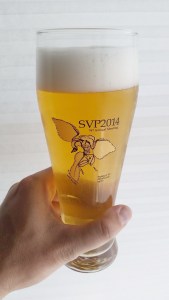
An Archaeopteryx-linked beer requires the appropriate glassware.I’ve really enjoyed the past year of homebrewing–lots of fun recipes, techniques, and achievements. Here’s are some of the highlights:

  • Favorite Batch
    • Olde Persica Porter
      • This was my first time brewing with smoked malt, and wow! It ended up as a deliciously balanced and flavorful beer, definitely in my personal Top 10 list.
  • Least Favorite Batch
    • Gingerbread Winter Warmer
      • This was one of those “good in concept, not as good in results” brews. Thankfully, I only had two gallons of the stuff (even if my spouse really likes it). I did bottle up a few for aging, so we’ll try again in a year.
  • Experimental Recipe with Most Potential
    • Citra Wit
      • I enjoyed so much about this beer, but it missed out a bit in the areas of mouthfeel and citrus aroma. A little more fine-tuning, and this should be an awesome recipe.
  • Most Fun New Style/Recipe to Try
    • Thumbspike Saison
      • This was my first attempt at a saison, and the results were pretty fine. My dry hopping was maybe a little out of style, but another saison is definitely in the cards for next year.
  • Best Technique Added to Repertoire
    • Lagering
      • I’ve brewed a few lagers and pilsners this year, and really like the new challenges and opportunities that these styles bring. Lagering my beer has opened up a whole new world of styles, and I want to make the the focus of 2017 for me! I’ve already acquired an additional fermentation chamber to be devoted just to lagering.
  • Most Frustrating Technique/Tool to Master
    • Decoction mashing
      • I initially had this on the “best technique” category, but decided to place decoction mashing here instead. The main issue is mastering the temperature rests–there is enough fall-off in temperature as I remove the decoction that it has been tough to hit the target temperatures later! I’m getting closer, but still have some work to do here.
  • Best Ingredient Added to Repertoire
    • Vienna Malt
      • I bought a bulk sack of this earlier this fall, and have made it the centerpiece of a few brews (including, of course, Vienna lager).  It’s really grown on me as a flavorful base malt, particularly for pale ales and IPAs. After American 2-row, this is my new favorite!
  • Favorite Book
    • Brewing Classic Styles
      • This book by Zainasheff and Palmer is becoming a really handy reference guide whenever I build recipes. The recipes in here are simple, don’t generally use crazy ingredients or techniques, and have both extract and all-grain versions. The broad variety of recipes is pretty handy, too. I’ve been referencing this one a lot since it arrived at my house!
  • Other Milestones
    • First Zymurgy article
      • At the beginning of the year, I had a “Brew Year’s Resolution” to pitch an article for a major homebrewing publication. Success! (and another article on the way in a few months)
    • First homebrew medals
      • Although my first few competition entries didn’t hit the mark, I achieved gold earlier this year. I can’t say I’ll enter every competition that heads my way, but the learning experience up to this point encourages me to try some more.
    • Planting hops
      • I planted four hop bines (two each of Cascade and Nugget), and got some good leafy growth. Hopefully cones are in the cards for year two!
  • Overall Stats
    • I brewed 29 batches this year–not too shabby!

Beer Tasting: Fade To Black IPA

20161226_211618My first-ever black IPA has been kegged for about a month. So, it’s tasting time!

  • The Basics
    • Original gravity = 1.065, final gravity = 1.016, abv = 6.5%, estimated IBU = 67
  •  Aroma
    • Herbal/piney hop aroma, with a touch of toastiness behind that for the malt. Hop aroma has definitely diminished substantially over time. I probably should have dry-hopped it a few more days before cooling.
  • Appearance
    • This is a very clear, black beer that is chocolaty brown (with a slight reddish tinge) when viewed edge-on. The head is full when first poured, subsiding to an exceptionally persistent, fine beige blanket, with excellent lacing on the sides of the glass. Absolutely beautiful in appearance overall!
  • Flavor
    • Hop-forward, and the hops are primarily earthy/piney in flavor. The malt is grainy and toasty in flavor, with a slight roasty coffee note behind that; the roastiness comes through a bit more prominently over time as the beer lingers on the palate.
  • Mouthfeel
    • A medium-bodied beer with moderate carbonation and a medium-dry finish. Mouthfeel overall is about right where I want it.
  • Would I brew this again?
    • It’s a good enough beer, but needs a bit more hop aroma to really satisfy me as a black IPA. I might up the late hop and dry-hop percentages so that they stand out a bit more. The types of hops are in the right ballpark; tropical/fruity ones would be completely inappropriate. I wonder if Simcoe wouldn’t make a nice addition to the hop bill, to up the piney qualities. The malt character is maybe a bit strong on the toast and roast. Not a bad first go at a black IPA, but I’ll probably try a different recipe the next time around that I want to aim for this particular style. All that said, this batch is an absolutely delicious winter beer on its own merits. I don’t mind a glass or two on cold nights!
  • Overall
    • 7/10

Good Riddance Pale Ale

Time to line up another hoppy beer for the fermenter! This particular American pale ale is named in honor of the end of 2016; the year can’t end soon enough for many fans of pop culture! At least in the USA, there is a general opinion that a few too many notable folks have died this year–so, hopefully 2017 will be a bit better in that regard (even if it likely won’t be any better in terms of broader world events). Good riddance to 2016, here’s hoping for better things on the horizon. The name also matches the “clean-out-the-brewing-supplies” nature of my recipe. I’m using this as an opportunity to use up a few ingredients (specifically, crystal 45, some more of my Magnum hops, and a lingering pack of Falconer’s Flight hop blend that dates back to 2015). The core recipe is modified from a recipe in Brewing Classic Styles, “American Pale Ale with Caramel.” The gist in mine is the same; I’ve just switched up the hops and hopping schedule (and swapped crystal 45 for crystal 40).

20161228_161456

Good Riddance Pale Ale

  • 9 lbs. California Select 2-row Brewer’s malt (Great Western Malting Co.)
  • 0.75 lbs. 45°L crystal light malt (Crisp)
  • 0.75 lbs. 10°L Munich I malt (Weyermann, 7.1 SRM)
  • 0.58 oz. Magnum hop pellets (13.2% alpha), 60 minute boil
  • 1 oz. Cascade whole hops (5.5% alpha), 10 minute boil
  • 1 oz. Amarillo hop pellets (7.0% alpha), 5 minute whirlpool
  • 1 oz. Falconer’s Flight 7C’s Blend hop pellets (10.3% alpha), 5 minute whirlpool
  • 1 Whirlfloc tablet, 10 minute boil
  • 1 tsp. Fermax yeast nutrient, 10 minute boil
  • 1 pkg. California ale yeast (White Labs WLP001)
  • 1 oz. Amarillo hop pellets (7.0% alpha), 5 day dry hop
  • 1 oz. Falconer’s Flight 7C’s Blend hop pellets (10.3% alpha), 5 day dry hop

Target Parameters

  • 154° mash, 60 minutes
  • 1.053 o.g., 1.013 f.g., 5.3% abv, 41 IBU, 7 SRM, 5.5 gallons into the fermenter

Procedure

  • Four days in advance, a I prepared a 1.5L starter from a culture of WLP001 that I had saved from the last time I used it (this is the third round for this particular culture). I set aside a portion (calculated as approximately 100 billion cells), and the remainder (0.9 L) was cold-crashed in the flask until brew day.
  • I changed my mash procedure a bit here — instead of adding water to the grains, I added my strike water first, let it cool (down to around 170°, as indicated roughly by BeerSmith), and then added the grains. This seemed to work reasonably well, although I wasn’t as precise with my temperature as I would have liked. I set the mash tun temperature to 60°, which was probably a mistake. I should have set it to match the strike water temperature I wanted. What I will do next time is to iterate my mash tun temperature until the calculated strike water temp and mash tun temperature match within a degree or two. I’ll then use that as the strike water temperature, and hopefully land a bit closer. The overall idea with this is to avoid preheating my mash tun with a separate volume of water (especially as I have done more with reverse osmosis water these days).
  • For this recipe, I adjusted my water by diluting the carbonate-heavy Claremont water approximately 50/50 with reverse osmosis water.
  • I mashed in with 3.5 gallons of water at 170°. This hit a mash temperature of 156° or so. I let the mash tun sit open for a few minutes until the mash temperature dropped down to 154°. Just for “fun”, I measured the mash pH on this batch–this ended up around 5.2 or 5.3.
  • The overall mash was down to 152 after 55 minutes. At this point, I added 1.25 gallons of water at 180°, let sit 10 minutes, vorlaufed, and collected the first runnings. I then added 3.5 gallons of water at 180°, let the mash sit for 10 minutes, vorlaufed, and collected the second runnings.
  • In total, I collected 6.7 gallons of wort at 1.048 gravity — 83% efficiency!
  • Once the boil was started, I added hops and other items per the schedule.
  • I checked the gravity about 40 minutes in, and found that it was already at the target of 1.053. Rather than overshoot my target, I added a quarter gallon of RO water to bring things back into alignment.
  • After a 60 minute boil, I added the final charge of hops, let things sit for a few minutes, and then started cooling. I was able to get the wort down to about 75°.
  • I transferred the wort to my primary while aerating, and pitched the yeast.
  • Starting gravity was 1.053, right on the nose for my target (thanks to that extra bit of RO water). I brewed this on 28 December 2017, and will be fermenting at 66°.

Lager / Pils Update

vienna_lagerThings have been moving along on my latest Vienna lager (Take Two Vienna Lager) and German pils (Palaeotis Pils). The two beers are in the same fermentation chamber; because the pils was brewed most recently, the temperature control regimen has been dictated by that batch.
For these brews, I elected to use a fast lager schedule. The pils was brewed on 9 December, with a starting gravity of 1.048. When I checked the beer on 16 December, the gravity was down to 1.020. At 57% apparent attenuation, this exceeded the recommended 50% threshold for temperature ramp-up, so I was clear to go. I didn’t bother to check on the Vienna lager, because it had been in there for a week extra and high krausen had long since passed. So, I figured it was more than safe to ramp that one up too.

At this point, I turned off the fermentation chamber to let things free-rise for the first day. Because my garage temperature was fairly cool, the temperature in the fermentation chamber hadn’t exceeded 55° after 24 hours. So, I added the heating pad and set the temperature for 68°. The temperature probe was loose, so that it would sense ambient temperature in the chamber, for a slower rise in the fermenters themselves than if the probe was attached to a fermenter directly.

I checked the pils again on 24 December, at which point the gravity was 1.011, and this was unchanged two days later (5% abv, with the 1.048 starting gravity). The Vienna lager (depicted in the photo) was at a final gravity of 1.013 (5.1% abv, following a starting gravity of 1.052). So, on 26 December I set the fermentation chamber to 34°, still leaving the temperature probe loose so as to ensure a slower temperature drop in the fermenters. I filled the airlocks with vodka, to avoid having the sanitizer water sucked in as things cooled.

After 24 hours of cold-crashing, I added gelatin, with 1/2 tsp. in a half cup of water for each batch. I’ll let things settle for a few more days before kegging and carbonating.

Palaeotis Pils

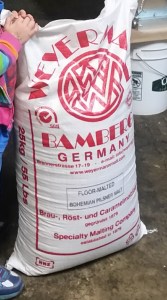
pilsner_maltOn my continued quest to learn brewing grains in depth, I recently purchased a 55 lb. sack of Weyermann’s floor-malted Bohemian pilsner malt. This is the same stuff I used for my Lithographica Pilsner, and is cool on a scientific level because the grains are malted on floors made of Solnhofen Limestone (more details here).

For my first brew with this sack of malt, I elected on doing a German pils. That’s a new style for me, and also can be brewed with a minimum complexity of ingredients (I’m really gravitating towards those sorts of simple recipes).

The name for the batch honors an important fossil bird from the Messel pits of Germany, around 47 million years old. Palaeotis is potentially an early ratite, a member of the group of birds including ostriches and emus.

Palaeotis Pils

  • 8.5 lbs. floor-malted Bohemian pilsner malt (Weyermann)
  • 0.21 lb. acidulated malt
  • 0.6 oz. Magnum hop pellets (13.2% alpha), 60 minute boil
  • 1 oz. German Hallertau hop pellets (3.2% alpha), 5 minute boil
  • 1 tsp. Fermax yeast nutrient, 10 minute boil
  • 1 Whirlfloc tablet, 10 minute boil
  • German lager yeast (White Labs WLP830), prepared in 1.7L starter

Target Parameters

  • Double decoction mash, 10 minute rest at 122°, infusion to hit 60 minute rest at 148°, thick decoction to raise temperature to 154°, 10 minute rest, thin decoction to mash out at 168°. Batch sparge.
  • Water built from R.O., to hit 59.1 ppm Ca, 8.2 ppm Mg, 89 ppm SO4, and 62.9 ppm Cl.
  • 1.045 o.g., 1.008 f.g., 4.9% abv, 34 IBU, 3 SRM, 5 gallons into fermenter

Procedure

  • Five days in advance (4 December 2016), I made a 1.75 L starter for my yeast culture. After two days on the stir plate, I cold-crashed the starter.
  • For this recipe, I built my water to match the “Pilsner Water” profile on Braukaiser. For the 3.6 gallons of mash water, I added 1.4 g of gypsum, 1.1 g of epsom salt, and 1.8 g of calcium chlorie. For the 5 gallons of sparge water, I added 1.9 g of gypsum, 1.6 g of epsom salt, and 2.5 g of calcium chloride.
  • I mashed in with 2.25 gallons of water at 134° to hit 126°, and left it for a 10 minute protein rest.
  • Next I added 5.25 quarts of water at 197°, to hit a mash temperature of 149° (after a bit of stirring).
  • After 50 minutes, I pulled a thick decoction of 7 quarts. I heated it to 154°, let it rest for 10 minutes, and brought to a boil for 10 minutes. The decoction addition brought the mash up to 156. I let the mash rest for 10 more minutes.
  • Next, I pulled 1 gallon of wort for a thin decoction, boiled it for 10 minutes, and returned it to the mash. This raised the temperature up to around 168°.
  • I pulled the first runnings, and added the 5 gallons of sparge water. After 10 minutes and a vorlauf, I collected the remainder of the wort. I had around 7 gallons, so added 0.25 gallons of water to bring up the volume to my target.
  • In total, I had 7.25 gallons of mash runnings at a gravity of 1.038, for 84% efficiency.
  • I brought the kettle to a boil, and added the hops and other ingredients per the schedule. I added 0.25 gallons of RO water during the boil, to top things up and keep the gravity from getting too high.
  • After 60 minutes, I chilled the wort down to 70°, transferred the wort while aerating, put the fermenter into the fermentation chamber, and pitched the yeast.
  • Starting gravity was 1.048, a touch above my target of 1.045. I will be fermenting this at 52°. I brewed the beer on 9 December 2016.