Schell’s Pils Clone

It’s always lager season, and especially so during the warm opening days of fall here in SoCal. I’m continuing to explore the morphospace of pilsners, with my latest foray following a recipe in Craft Beer for the Homebrewer: Recipes from America’s Top Brewmasters. I was particularly interested by a clone recipe for a pilsner from Schell’s Brewing, based out of Minnesota. One notable thing about the provided recipe is that it used American 2-row instead of European pilsner malt. They’re not too far off each other in terms of color, so I thought it would be a neat test of malt character.

The recipe itself closely matches that in the book; my main adjustment was to modify the hop schedule slightly for amounts and time to account for the hops I had on hand.

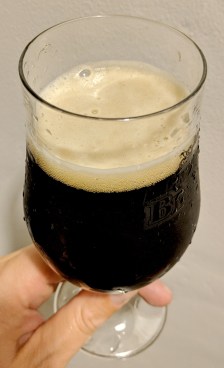
Close-up of pilsner beer foam in conical glass

Schell’s Pils Clone

  • 10.5 lb. 2-row pale malt (Rahr)
  • 0.25 lb. Carapils malt (Briess)
  • 1.9 oz. Mt. Hood hop pellets (4.6% alpha), 60 minute boil
  • 1 Whirlfloc tablet, 10 minute boil
  • 1 tsp. Fermax yeast nutrient, 10 minute boil
  • 1.1 oz. Mt. Hood hop pellets (4.6% alpha), 5 minute boil
  • 1 oz. Sterling hop pellets (7.9% alpha), 5 minute boil
  • 1 pkg. Harvest liquid yeast (Imperial Yeast #L17), prepared in 1.5L starter
  • 1 oz. Sterling hop pellets (7.4% alpha), 7 day dry hop

Target Parameters

  • 1.050 o.g., 1.013 f.g., 4.8% abv, 38 IBU, 3 SRM
  • 60 minute infusion mash, 152°, batch sparge
  • Water built up from RO, to hit target water profile of 59 ppm Ca, 8 ppm Mg, 89 ppm SO4, 63 ppm Cl; RA=-47ppm

Procedure

  • I made a 1.5L starter a few days in advance, let it run for 48 hours, and then cold crashed it (and decanted the spent wort).
  • To create my brewing water, I added 3.3 g gypsum, 2.7 g epsom salt, and 4.2 g calcium chloride to 8.5 gallons of RO water.
  • I mashed in with 3.5 gallons of water at 162°, to hit a mash temperature of 152.2°. I added 7.5 mL of 88% lactic acid to the mash, to help hit a target pH of ~5.3.
  • After 50 minutes, I added 1.25 gallons of water at 185°, in order to raise the mash temperature o 156°. I let the mash sit for 10 more minutes, vorlaufed, and collected first runnings. Then, I added 3.75 gallons of water at 185°, let sit for 10 minutes, vorlaufed, and collected second runnings.
  • In total, I collected 6.9 gallons of wort with a gravity of 1.042, for 74% efficiency.
  • I brought the runnings to a boil, adding hops and other kettle additions per the schedule. After 60 minutes, I turned off the flame and chilled down as far as I could (~80°) before transferring.
  • I chilled the wort down to 57°, before pitching the yeast and continuing to chill down to 52°. I completed the fermentation at 52°.
  • A good krausen was built within 24 hours.
  • I brewed the beer on 11 August 2019.
  • On 18 August 2019, I raised the temperature of the beer to 56°.
  • On 21 August 2019, I raised the temperature of the beer to 66°.
  • I added the dry hops on 24 August 2019.
  • I cold crashed the beer to 33° on 29 August 2019.
  • I kegged the beer on 1 September 2019. Final gravity was 1.008 (via refractometer), for 5.5% abv.
IMG_20191009_171317

Tasting

  • Appearance
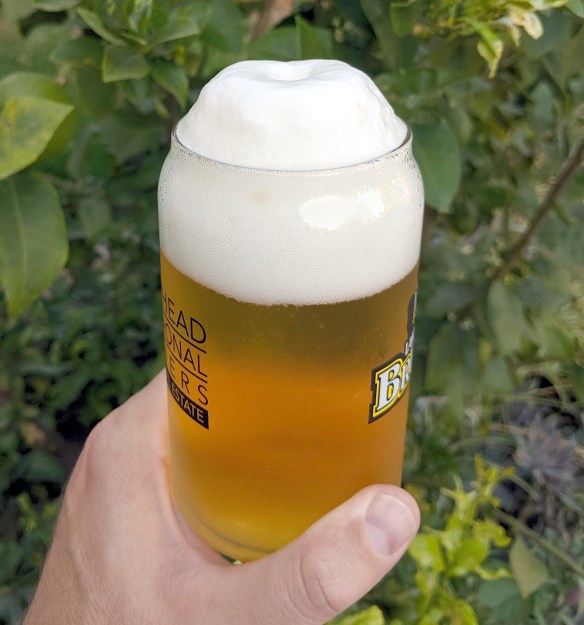
    • Pours with a thick, fine, frothy head, that is quite persistent. The beer itself is light yellow and fairly clear (but just a touch away from brilliant clarity).
  • Aroma
    • Light grainy aroma, with a nice spicy hop note alongside it. Very clean!
  • Flavor
    • Grainy and ever-so-slightly sweet malt profile, with a firm, clean, and slightly spicy bitterness. Balance is tilted modestly in the hoppy direction.
  • Mouthfeel
    • Crisp, with a slightly dry finish. Moderately high carbonation.
  • Would I brew this again?
    • YES! This is a really nice German-American pilsner, all the more interesting because I got such a nice malt flavor profile using American 2-row rather than European pilsner malt. The Rahr 2-row is pretty light (1.8 SRM), not too far from typical pilsner malt (Weyermann Barke pilsner is actually 1.9 SRM), so I guess it shouldn’t be too surprising, at least on the basis of color. I’m particularly pleased with the head retention on this beer; it pours with a beautiful foam that sticks around for quite awhile. If I had a little more patience, I would let it condition a bit longer to clarify to brilliant, but that’s pretty much the only (minor) flaw in this beer.
  • Overall
    • 9.5/10

Polacanthus Porter

IMG_20190829_193848Dark beers! They’re seemingly banished from the summer months, and yet I often have a craving for one even on the hottest days. Not a triple imperial barrel aged chocolate stout, of course–that’s best dumped in the sink during the month of December. I’m thinking of those more drinkable dark beers, a bit lower on the alcohol but still robust on flavor.
An end-of-summer porter seemed like a good way forward. They’re flavorful, but not necessarily gut bombs. They’re relatively easy to brew, and turn around fairly quickly. Also, they’re a “traditional” style that’s just a bit harder to find, overwhelmed by trendier beers on tap lists. If I want a mediocre hazy IPA, I don’t need to make my own; there is no shortage in area breweries!

This recipe is based on the American porter from Gordon Strong’s Modern Homebrew Recipes. My version fairly closely follows that by Strong, with the modifications primarily on the hopping and malt brands. The name recognizes the combination of American and English ingredients, because Polacanthus is a type of armored dinosaur that had relatives on both sides of the Atlantic.

Polacanthus Porter

  • 11 lb. 2-row pale malt (Rahr)
  • 12 oz. 1823 Heritage Crystal Malt (Bairds), 75°
  • 10 oz. chocolate malt (Bairds), 500°
  • 5 oz. roasted barley (Bairds), 600°
  • 0.65 oz. Magnum hop pellets (13.2% alpha), 60 minute boil
  • 1 Whirlfloc tablet, 10 minute boil
  • 1 oz. Cascade whole hops (~5.5% alpha), 10 minute boil
  • 1 oz. Cascade whole hops (~5.5% alpha), 5 minute boil
  • 1 pkg. Safale American Ale Yeast (US-05)

Target Parameters

  • 1.058 o.g., 1.014 f.g., 5.8% abv, 36 IBU, 34 SRM
  • 60 minute infusion mash, 154°, batch sparge
  • Claremont tap water

Procedure

  • I mashed in with 4.25 gallons of water at 164.5°, to his a mash temperature of 155°. After 45 minutes, I added 1 gallon of water at 185°, and collected first runnings after a 10 minute rest and vorlauf. I then added 3.5 gallons of water, let rest for 10 minutes, vorlaufed, and collected second runnings.
  • In total, I collected 7.1 gallons of runnings with a gravity of 1.048, for 73% efficiency.
  • I brought the runnings to a boil, adding hops and such per the recipe.
  • After 60 minutes, I turned off the flame, chilled, and transferred to the fermenter (with aeration). I had to let the wort rest in the fermenter for a few hours, to chill down to the fermentation temperature of 66°.
  • I brewed this beer on 13 July 2019. Starting gravity was 1.057.
  • I kegged the beer on 14 August 2019. Final gravity was 1.013, for 5.8% abv. This was exactly on the dot for my targets!

Tasting

  • Appearance
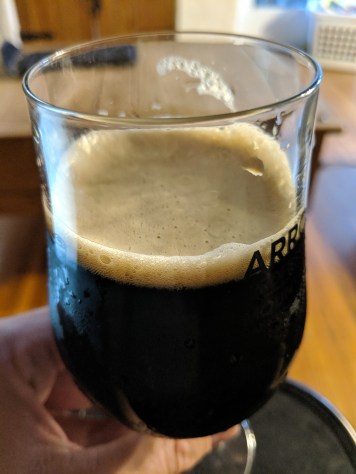
    • Deep brown, with garnet tones when illuminated from behind; clear; persistent tan head
  • Aroma
    • Roasty, chocolately aroma; very nice.
  • Flavor
    • Roast malt character at the front, with a slight chocolate and coffee tinge; slight citrus aspect; moderately bitter, with a finish that tilts towards the bitter rather than the malty side.
  • Mouthfeel
    • Medium body, medium carbonation; off-dry finish (probably due to the roast character). It could maybe have a touch more body, but I think overall it’s okay on this end. Too much body would make this harder to drink.
  • Would I brew this again?
    • Yes! This is a nice and simple recipe, with a pleasant flavor. As porters go, this definitely is towards the roasted and bitter side, but I’m okay with that. This is really drinkable as a summer porter! I would add it to my regular repertoire.
  • Overall
    • 9/10

No Latitude Tropical Stout

IMG_20190519_191408Summer fun doesn’t mean I have to be limited to light lagers (and I do love light lagers!). I think there is a place for dark beers in the warm weather, given the right recipe and the right mindset. So, a “tropical stout” seemed like a good ticket. I had initially thought I would make something with coconut, but realized I didn’t necessarily want a full batch of a coconut beer. Why not just a simple, clean(ish), flavorful stout? So, I checked out Gordon Strong’s Modern Homebrew Recipes book and found his Jamaican Eclipse recipe. The general concept is to take a stout recipe and ferment it with lager yeast at ale temperatures. In my reading, there seems to be a lot of lore around tropical/Caribbean stouts and yeast type, and I wonder to what extent any of it is true. Either way, even a “Fantasy Island” version of the recipe is intriguing to me.
I followed Strong’s grain bill only loosely, making many substitutions and adjustments. I had no idea how much I might like this, so I scaled it for a 3 gallon batch. The result? Pretty flavorful, and a definite re-brew candidate!

No Latitude Tropical Stout

  • 6.25 lb. Maris Otter malt (Bairds)
  • 8 oz. crystal 80° malt
  • 6 oz. roasted barley
  • 4 oz. chocolate malt (Briess)
  • 2 oz. Blackprinz malt, 2-row (Briess)
  • 10 oz. corn sugar (dextrose), added to kettle before boil
  • 0.5 oz. Warrior hop pellets (15.8% alpha), 60 minute boil
  • 1 Whirlfloc tablet, 10 minute boil
  • 1 tsp. Fermax
  • 2 pkg. Saflager (W34/70) lager yeast, Fermentis

Target Parameters

  • 60 minute infusion mash, 152°, batch sparge
  • 1.064 o.g., 1.011 f.g., 7.1% abv, 39 IBU, 32 SRM
  • Claremont water, treated with Campden tablet

Procedure

  • I mashed in with 2.75 gallons of water at 163°, to hit a mash temperature of 153°. It was down to 149° after 20 minutes, likely due to the smaller thermal mass involved here.
  • After 60 minutes, I added 0.75 gallons of water at 185°, let sit for 10 minutes, vorlaufed, and collected the first runnings. I then added 2.5 gallons of water at 185°, let sit for 10 minutes, vorlaufed, and collected the second runnings.
  • In total, I collected 4.65 gallons of runnings with a gravity of 1.044, for 75% mash efficiency. I added the corn sugar prior to the boil.
  • I brought the runnings to a boil, adding hops and other ingredients per the schedule.
  • After 60 minutes, I turned off the flame and chilled down to 67°. I transferred to the fermenter and pitched the yeast.
  • I fermented the beer at 67°. Starting gravity was 1.060.
  • I brewed the beer on 15 April 2019 and cold crashed on 28 April 2019, kegging on 29 April 2019.
  • Final gravity was 1.013, which works out to 6.3% abv.

Tasting

  • Aroma
    • Roasty, chocolatey malt aroma, but not much in the way of hops. Really nice! As it warms up, I pick up a slight alcohol note, but this is permitted within the bounds of the BJCP style description.
  • Appearance
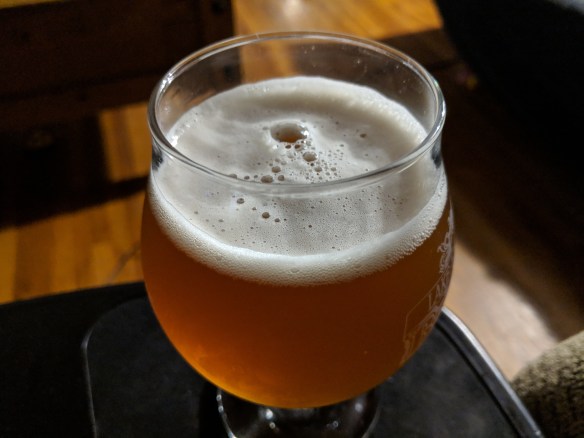
    • Thick and persistent brown head; the beer itself is fairly clear, and brown with a faint reddish tinge
  • Flavor
    • Chocolate-forward, with a bit of roast behind that. The bitterness is moderate and clean, but not over the top. Not much in the way of hop flavor. The finish is evenly balanced between hoppiness and maltiness. This is a very smooth, highly drinkable beer.
  • Mouthfeel
    • Moderate body, but not so much as to kill drinkability. Moderate carbonation.
  • Would I brew this again?
    • Yes! Maybe it’s a bit of a psychological thing, but this definitely does seem like a good warm-weather stout. It’s smooth, quite drinkable, and doesn’t taste like it is 6.3% alcohol. I don’t see much in the way of improvement needed, although I could kick the fruitiness and body up a notch. A bit of crystal 120 might help with that.
  • Overall
    • 8/10

Classico Pale Ale

Following on my series of IPAs and pale ales, I recently worked on a “classic” American pale ale. Again, I wanted to avoid the really tropical notes (which I like, but have been getting burned out on), and elected to highlight the Falconer’s Flight blend here. It was a good success!

Classico Pale Ale

  • 5 lb. Maris Otter Malt (Bairds)
  • 5 lb. 2-row malt (Rahr)
  • 8 oz. crystal 40 malt (Great Western)
  • 8 oz. crystal 60 malt (Great Western)
  • 0.7 oz. Warrior hop pellets (15.8% alpha), 60 minute boil
  • 1 Whirlfloc tablet, 10 minute boil
  • 1 oz. Cascade whole hops (~4% alpha), 5 minute boil
  • 1 oz. Falconer’s Flight 7C’s hop pellets (9.8% alpha), 5 minute whirlpool
  • 1 pkg. Safale US-05 American Ale dry yeast
  • 1 pkg. Mangrove Jack’s M44 US West Coast Yeast
  • 3 oz. Falconer’s Flight 7C’s hop pellets (9.5% alpha), dry hop in keg

Target Parameters

  • 60 minute infusion mash, 152°, batch sparge
  • 1.055 o.g., 1.012 f.g., 5.7% abv, 44 IBU, 8 SRM
  • Claremont water with 1 tsp. of gypsum added during boil

Procedure

  • I mashed in with 3.75 gallons of water at 164°, to hit a mash target of 152°. After 60 minutes, I added 1 gallon of water at ~185°, let sit for 10 minutes, vorlaufed, and collected first runnings. Then, I added 3.3 gallons of water at 185°, let sit for 10 minutes, vorlaufed, and collected second runnings.
  • In total, I collected 6.5 gallons of runnings with a gravity of 1.046, for 76% mash efficiency.
  • I brought the runnings to a boil, adding everything per the recipe. After 60 minutes of boiling, I added the whirlpool hops, waited 5 minutes, and then began to chill the wort.
  • I transferred the wort to the fermenter, pitched the yeast, and set it to ferment at 67°.
  • I brewed this beer on 1 April 2019. Starting gravity was 1.054, and final gravity was 1.012 when I kegged it on 14 April 2019. This works out to 5.5% abv.

IMG_20190508_202711

Tasting Notes

  • Aroma
    • Hop-forward aroma, with light citrus and pine together, and a mild caramel quality behind that.
  • Appearance
    • Light copper color, hazy, with a persistent off-white head.
  • Flavor
    • The hops are at the front of the flavor, but aren’t overpowering. The hop flavor profile is a combination of citrus and tropical fruit with a hint of pine behind that. The malt flavor is slightly grainy/bready, with a faint caramel note. Really nice!
  • Mouthfeel
    • Medium-light body, with appropriate level of carbonation. The finish is smooth and off-dry.
  • Would I brew this again?
    • Yes! I really like this particular recipe, and think it pretty well represents what an American pale ale should be. The only minor concern (were I brewing this for competition) is the haze, which would undoubtedly settle out given more time. Otherwise, what a great beer!
  • Overall
    • 9/10

Warrior’s IPA

IMG_20190216_213732

Transferring the wort into the fermenter

Today’s American IPAs are awesome–I love hops like Mosaic and Citra, to the point where I have been starting to hit fruity hop fatigue. The antidote? Make a beer with the most piney, resiny, harshest old school hops I could find.

Warrior’s IPA

  • 12 lb. 2-row malt (Rahr)
  • 1.5 lb. rye malt (Viking)
  • 0.5 lb. crystal 60 malt
  • 4.4 oz. crystal 80 malt
  • 4 oz. rice hulls
  • 1 oz. Warrior hop pellets (15.8% alpha), 60 minute boil
  • 1 Whirlfloc tablet, 10 minute boil
  • 2 oz. East Kent Goldings hop pellets (6.0% alpha), 5 minute boil
  • 1.5 oz. Cascade whole hops (~3.5% alpha), 5 minute whirlpool
  • 2 pkg. Safeale American Ale yeast (US-05)
  • 3 oz. Columbus hop pellets (14.0% alpha), dry hop in keg

Target Parameters

  • 60 minute infusion mash, 154°, no sparge
  • 1.065 o.g., 1.016 f.g., 6.5% abv, 61 IBU, 9 SRM
  • Claremont tap water, augmented with 1 tsp. gypsum

Procedure

  • I mashed in with 7.75 gallons of water at 162°, to hit a mash temperature of 151.7°. After 60 minutes, I vorlaufed and collected 5.75 gallons of runnings with a gravity of 1.055. This equated to a fairly miserable measured mash efficiency of 60%. (After this, I re-aligned my mill, in case that was the problem–I also figure the percentage of rye might be partly to blame, too).
  • I brought the runnings to a boil, adding hops and finings per the recipe. After 60 minutes, I turned off the heat, added the whirlpool hops, let sit for 5 minutes, and then chilled.
  • I transferred the beer to the fermenter, and fermented at 66°.
  • I brewed the beer on 16 February 2019, and kegged on 9 March 2019.
  • Starting gravity was 1.065, and final gravity was 1.011, for 7.2% abv.

Overall Impressions

I served this beer for a party, and it kicked before I could really get a good tasting. I didn’t even get a good picture! It was really popular with the hopheads, definitely delivering on the hop flavors and aromas that I wanted–rich, resiny, and piney. I felt like it needed a bit more time to mature, because the malt flavors weren’t quite there yet. Another few weeks might have helped. Oh well…I guess that means I have to brew this again!