Beer Tasting: Try Again Bohemian Pilsner

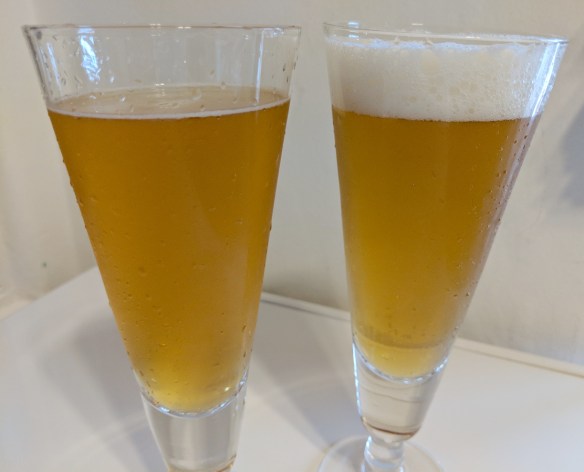
My recent version of a Bohemian pilsner has been on tap for a few weeks, and is at its peak for enjoyment. Today, I did a head-to-head with the classic flagship for the style, Pilsner Urquell.

IMG_20180707_160451

Head-to-head Bohemian pilsners! Pilsner Urquell is in the glass on the left, and my homebrew version is at right.

Try Again Bohemian Pilsner

  • The Basics
    • 1.053 s.g., 1.014 f.g., 4.2% abv, 36 IBU, 5 SRM
  • Appearance
    • Pours with a fine white head with excellent persistance. The beer itself is a golden hue, nearly an exact match for Pilsner Urquell but perhaps just a notch lighter. It is very clear, but not quite brilliant (Urquell has a slight edge here). In terms of appearance, mine is equal in color, better in head (and head retention), and needs slight improvement in clarity.
  • Aroma
    • My beer tips a little bit more towards malt prominence; there is a very slight spice note from the Saaz hops, but that’s still not quite where it should be. Urquell has the hop note perfectly, so I give it a slight edge on this count.
  • Flavor
    • Bitterness levels are not quite evenly matched between Urquell and mine; Urquell comes across as a bit more bitter. Mine has a nice malt character, but this is slightly at the expense of the hops. The malt on my homebrew is rich and bready, and the bitterness stands well against that. The finish is balanced well. Relative to Urquell, it tips more towards the malt than bitterness on the finish, and I prefer the hoppier Urquell version a bit more.
  • Mouthfeel
    • My brew has a medium body and moderate carbonation. Urquell is definitely drier than my beer, with a more extended and more bitter finish. The finish on mine is smoother yet I prefer the Urquell “bite” just a touch.
  • Would I brew this again?
    • Yes, with a few minor modifications! There is lots I like about my beer, such as the appearance and malt character. I do feel like it could be a bit drier and crisper (relative to Urquell), because the hops are just a tiny bit “flabby”. My main adjustment would be to increase the hopping, and mash at a slightly lower temperature to dry out the beer a bit. I might also try halving the melanoidin contribution; I think it might be contributing some unfermentables that keep the beer from being as dry as it might be. The Barke pilsen malt that I used in this recipe has plenty of character on its own, anyhow!
  • Overall
    • 7.5/10

IMG_20180707_155837

Try Again Bohemian Pilsner

I’m craving a good Bohemian pilsner…especially that nice flavor and aroma of Saaz. My last effort was fairly disastrous, thanks to a bum batch of hops. Pro-tip: if it smells way too grassy before throwing them into the wort, throwing them into the wort won’t improve things.

In any case, I’ve got new hops, new grains, and a new recipe. I’ve cheated a bit with the grain bill, kicking in some melanoidin and Carafa III for a bit of extra malt flavor and color, respectively. For my interpretation I’ve amped up the Saaz a bit on the late-hop side, too.

Try Again Bohemian Pilsner

  • 10 lbs. Barke Pilsner malt (Weyermann)
  • 0.25 lb. Melanoidin malt (Weyermann)
  • 0.2 oz. Carafa III malt (Weyermann)
  • 2 oz. Saaz hop pellets (3.0% alpha), 60 minute boil
  • 1 oz. Saaz hop pellets (2.2% alpha), 20 minute boil
  • 2 oz. Saaz hop pellets (3.0% alpha), 10 minute boil
  • 1 oz. Saaz hop pellets (3.0% alpha), 5 minute whirlpool
  • 1 Whirlfloc tablet, 10 minute boil
  • 1 tsp. Fermax, 10 minute boil
  • 2 pkg. Bohemian lager dry yeast (Mangrove Jack’s M84)

Target Parameters

  • Infusion mash to hit target of 149°, 60 minutes, batch sparge.
  • 1.052 o.g., 1.011 f.g., 5.5% abv, 36 IBU, 5 SRM
  • Water built from RO with 0.5 g CaCl, 0.5 g epsom salts, with 6.5 mL of 88% lactic acid added to mash to adjust pH

Procedure

  • I mashed in with 3.5 gallons of water at 160°, to hit a mash temperature of 150°. The mash was down to 145° after 65 minutes. I added 1.25 gallons of water at 185°, let sit for 10 minutes, vorlaufed, and collected the first runnings. I then added 3.5 gallons of water, let sit for 10 minutes, vorlaufed, and collected the remainder of the runnings.
  • In total, I collected 6.8 gallons of runnings with a gravity of 1.046, for 83% mash efficiency!
  • I started the boil, adding hops and various finings and nutrients per the schedule above. After 60 minutes of boiling, I turned off the flame and added the final charge of hops.
  • After 5 minutes of whirlpooling, I chilled down to 75° or so. Then, I transferred the wort to the fermenter, and let it chill overnight (~10 hours), down to 48°.
  • I brewed the beer on 12 May 2018. On the morning of 13 May 2018, I oxygenated the wort for 45 seconds and pitched the yeast (rehydrated in 1 cup of boiled and cooled water).
  • Starting gravity was 1.053, nearly exactly on target.
  • After pitching, I set the temperature on the fermentation chamber to 52°, letting the beer free-rise from 48°.
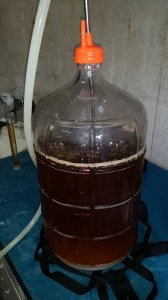
  • One day after pitching (14 May 2018), no fermentation activity was yet visible, but the fermenter gave off bubbles when I agitated it gently. By the morning of 15 May 2018 (48 hours post-pitching), visible krausen was forming.
  • On 20 May (7 days after pitching the yeast), I raised the fermentation temperature to 54°.
  • On 23 May, I raised the fermentation temperature to 56°.
  • On 25 May, I raised the fermentation temperature to 58°.
  • On 27 May, I raised the fermentation temperature to 60°. At this point, the gravity was 1.014.
  • On 2 June, I cold crashed down to 33°.

Beer Tasting: Palaeotis Pils 1.1

This batch was all gone last week; luckily, I got my tasting in before it was all gone.

20170702_143220Palaeotis Pils 1.1

  • The Basics
    • O.G. = 1.048; f.g. = 1.011; 4.7% abv; 4 SRM; 34 estimated IBU
  • Appearance
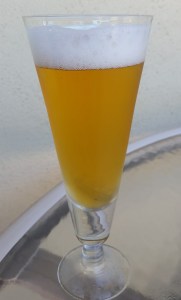
    • Light gold and crystal clear, with a thick white head on the pour that settles to a persistent blanket as I drink the beer. In the image, the condensation on the outside of the glass doesn’t do the beer’s appearance justice!
  • Aroma
    • Light and bready maltiness predominates, with a hint of slightly spicy hops behind that.
  • Flavor
    • Bready maltiness, with a restrained bitterness that builds as I drink the beer. Bitterness is persistent; it is maybe a touch harsh, and I wonder if that is because I used Warrior as the bittering addition?
  • Mouthfeel
    • Moderate body with a slightly dry finish. Carbonation is moderate–as it is pouring at the moment, with a fair bit of foam, I think I am losing some of the carbonation. This will hopefully settle down as the keg matures, as happened with my last keg of this style.
  • Would I brew this again?
    • This is decent, but I think I prefer my previous iteration of the recipe. The aroma on that one seemed a little more pronounced–both on the hops and malt side–and I feel like the flavor was just a notch better. I wonder if that was due to the decoction on the first batch? I will probably return to Magnum hops for the bittering addition in the next version of this pilsner; the Warrior hops have an ever so slight harsh edge that is out of place for a delicate pilsner. I’m also going to use a German pilsner malt–I have 10 pounds of Barke Pilsner Malt that might be perfect for this task. The malt character came up as a critique in a recent competition, so I think that’s a fairly easy fix. I’ll also return to WLP830 for the yeast.
  • Overall
    • 7/10

The Session #125 — Pale European Lagers: The Ultimate SMaSH beers

thesessionNote: This is my first time contributing to The Session, a monthly blogging challenge for beer aficionados. For The Session #125, Mark Linder chose the topic of SMaSH (single malt and single hop) beers.

SMaSH beers–those brews marrying a Single Malt variety and a Single Hop variety–are often promoted as something that’s interesting to try but not particularly versatile. As a homebrewer, I’ve usually thought of them as a tool to explore ingredients, perhaps fun as a technical gimmick but not necessarily a pathway to truly exceptional beer. Sure, you could get some good stuff, but it would lack complexity and get boring after a few pints. SMaSH beers were a way to turn out some pale ales with funky new hop varieties, but these were only a brief stop along the journey to a more worthy recipe. Don’t even bother entering them in a BJCP competition, because they won’t hold up well relative to their rivals with a longer ingredient list.

Then I discovered the Bohemian pilsner.

When I first sampled American-style craft beer, the cheap American lagers of my early days faded into mental oblivion. Why even bother with a watery fizz-drink, when you could blast your taste buds with a triple imperial IPA touting 190 IBUs, 12 percent alcohol, and five varieties of hops? Or what about a delightful English porter, with its malty backbone and slightly fruity yeast character? Clear beers were for quitters and college students. European lagers were mildly intriguing, but typified by badly aged and skunky six packs in green bottles. Why bother with that, when there was a world of fresh local craft brew and homebrew to explore?

An Archaeopteryx-linked beer requires the appropriate glassware.

My first homebrewed Bohemian pilsner (made with genuine Jurassic ingredients!)

Not too long ago, though, I decided to dip my homebrewing toes into the lagered waters. Bohemian pilsner (a.k.a., Czech pilsner, a.k.a., Czech premium pale lager in the 2015 BJCP guidelines) caught my attention early on…it was the original pilsner, after all! What better way to learn what this beer is all about?

Yet, I was shocked by the simplicity of the classic recipes! Bohemian pilsner malt. Czech-sourced Saaz hops. Soft water. Clean lager yeast. The rest is just up to technique–in particular, a good decoction mash was apparently the key to success.

My first attempt at a Bohemian pilsner wasn’t perfect, but wow, it was pretty darned good. This was the first time I consciously experienced Saaz hops, finally getting a name to match with that distinctive aroma and flavor. It was also the first time I experienced a genuinely fresh European-style lager in the United States, and I finally knew what the big deal was all about.

This spurred a realization. SMaSH beers weren’t just for pale ales. In fact, pale lagers are the most reliable ticket to SMaSH success. Quality malt. Quality hops. Careful water chemistry. A clean fermenting lager yeast. A bit of skill. All of this combines to a memorable and surprisingly complex brew. Of course, Czech pilsner isn’t the only lager style with a simple recipe. Munich helles, German pils, and others jostle alongside in the running. Any of these can be done quite well with a short shopping list. This is what makes them so hard to do exceptionally well, perhaps–any flaws can’t hide behind crystal malt and yeast esters.

So, what’s the style best suited to a SMaSH beer? I love all of my European pale lagers, but Bohemian pilsner wins for me every time.

Beer Update: Palaeotis Pils & Gondwana Pale Ale

Gondwana Pale Ale 1.5

I kegged the latest iteration of my Gondwana Pale Ale on 7 June 2017, adding two ounces of dry hops in a baggie at that time. Final gravity was 1.012, down from 1.053, for 5.4% abv.

Initial tastings show that this should be a pretty decent beer. It has a bit to mature yet, in that the yeast haven’t totally settled out and that seems to impart a harshness to the bitterness. I expect this should be much improved by the time I get back from Homebrew Con.

20170611_131001Palaeotis Pils 1.1

After brewing this beer on 20 May 2017, I started it at 50° and then let it ferment at 54° after a few days. I raised the temperature to 64° on 1 June, and then cold-crashed to 33° on 7 June 2017.

I kegged this beer today (11 June 2017). It has a final gravity of 1.011, down from 1.048, for 4.7% abv. At the time of kegging, I also added 1 tsp. of gelatin dissolved in 3/4 cup of water and heated to 152°, as a fining agent.

This beer tastes and smells amazing–I anticipate that it’s going to be a fine brew once it is clear and carbonated! Everything is on-point, and it’s a nice change after the disappointment on my Bohemian pilsner.