Dunkel-Osteus

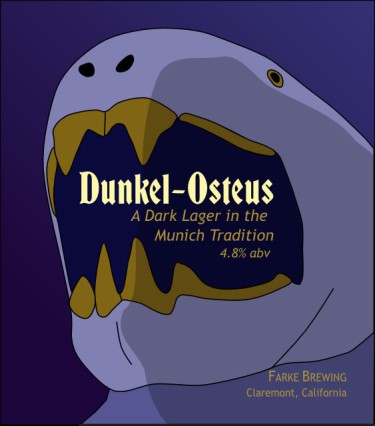
labelI love brewing new styles, and I also love a bad beer pun. The unholy marriage between the two: Dunkel-Osteus!

For this batch, I’m making a Munich dunkel. It’s a reasonably dark, malt-forward lager, in a style that I’ve not brewed previously. Musing over what to call this batch, I remembered a famous prehistoric fish, Dunkleosteus. Dunkel-Osteus was a match made in prehistoric pun heaven!

Dunkleosteus lived around 375 million years ago, during the Devonian (also known as “The Age of Fishes”). It was a giant animal, with sharp bony plates lining its jaws rather than teeth. The largest species were huge, clocking in at around 20 feet in length and a ton in body mass. These were top-tier marine predators, and are a popular exhibit in many museums today. Dunkleosteus and its close kin were an early side branch in vertebrate evolution–nothing exactly like them is around today. However, we humans inherited a common feature from the way-way-way-back ancestor we share with Dunkleosteus: our jaw bones! The open-and-shut jaw arrangement and the major bones that make up our mouth had their origins in some humble fish back before even Dunkleosteus (see this scientific paper on the evolutionary relationships of these organisms). Although the extent to which the jaws of Dunkleosteus and its kin are directly tied to our own has been debated, the latest evidence strongly suggests that they have the same essential bones and are based on the same genetic blueprints, with some evolutionary tweaks. So, next time you open wide for a tasty lager, think about how amazing it is that you are using some of the same skull bones that Dunkleosteus had!

Evolutionary Tree

A highly pruned evolutionary tree for jawed fish and kin. Everything is approximately to scale. Silhouettes via phylopic.org. Humans by Mike Keesey (public domain, right figure) and Sarah Werning (CC-BY, left figure), elephant by Mike Keesey (public domain), tyrannosaur by Emily Willoughby (CC-BY-SA), Dunkleosteus by Dmitry Bogdanov and converted to silhouette by Mike Keesey (CC-BY), tuna by Stuart Humphries (public domain).

The fossil fish Dunkleosteus was named in honor of David Dunkle, a paleontologist at the Cleveland Museum of Natural History way back in the 1950s. As such, the prehistoric organism has nothing to do with the Munich Dunkel style (and indeed, Dunkle and Dunkel are spelled differently). Nonetheless, I couldn’t pass up a good pun!

The recipe is modified slightly from a dunkel presented in Modern Homebrew Recipes, by Gordon Strong. I love the simplicity of Strong’s version–a base malt, two specialty malts, one variety of hops, and a yeast. I elected to use a single infusion mash rather than a decoction mash schedule, and upped the gravity a point or two (while still keeping it at the lower end of the style). I also replaced German Tettnang hops with American-grown Liberty, based on availability, and used dry yeast for simplicity. One major recommendations I retained from Strong’s book was to add the dark grains at vorlauf (in this case, the Carafa Special II), rather than leaving them in the mash for the whole duration. My goal was to have the Carafa just be for coloration, rather than for adding much flavor, and a short steep seemed like the best way to achieve this.

Dunkel-Osteus

  • 9 lbs. Munich II malt (Weyermann)
  • 5 oz. melanoidin malt (Weyermann)
  • 6 oz. Carafa Special II malt (Weyermann), added at vorlauf
  • 1.5 oz. Liberty hops (3.9% alpha), 60 minute boil
  • 1 tsp. Fermax yeast nutrient, 10 minute boil
  • 1 Whirlfloc tablet, 10 minute boil
  • 2 pkg. Saflager Lager yeast (Fermentis W34/70)

Target Parameters

  • 60 minute infusion mash, 154°
  • 1.050 o.g., 1.013 f.g., 4.9% abv, 22 IBU, 20 SRM

Procedure

  • I adjusted my water slightly, to fall within the “malty dark lager” profile in the Palmer and Kaminski water book. I used 5 gallons of Claremont tap water with 3 gallons of RO water and 5 g of calcium chloride. The resulting water profile should approximate 82 ppm Ca, 7 ppm Mg, 15 ppm Na, 31 ppm SO4, 94 ppm Cl, 131 ppm HCO3, and residual alkalinity of 44 ppm.
  • I added 3.25 gallons of water to my mash tun (1 gallon of RO, 2.25 gallons of tap water, and 5 g calcium chloride), at a temperature of 172° or so. I swirled it around the mash tun for a bit, and let it cool down over a period of 5 minutes or so until it hit a temperature of 166°. I mashed in at this point, to hit a temperature of 154.5°.
  • The mash cooled to around 150° after 50 minutes.
  • After 60 minutes in the mash, I added 1.5 gallons of sparge water, let it sit for 10 minutes, added the dark grains, and vorlaufed before collecting the first runnings. My sparge water was made of a blend of 2 gallons RO water and the remainder with tap water. I added ~3.25 gallons of water for the second batch sparge, stirred, let it sit for 10 minutes, and collected the second runnings.
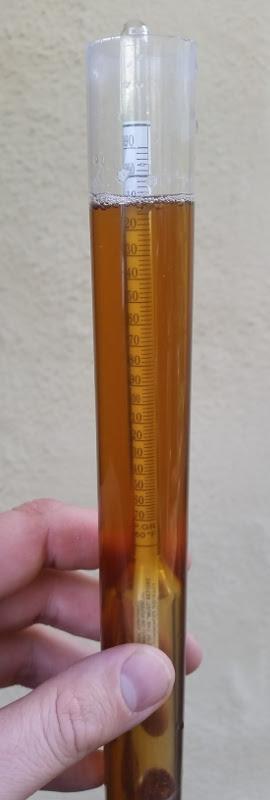
  • I collected 6.5 gallons of wort, a touch below my target of 6.75. So, I added 0.25 gallons of RO water, to reach the target volume. The resulting wort gravity was 1.041–pretty much exactly on target, with an efficiency of 76%.
  • I started the boil, and added the hops, Whirlfloc, and yeast nutrient per the schedule. After 60 minutes, I turned off the flame and chilled the wort down to 70°.
  • Around 5.25 gallons of wort went into the fermenter, with a gravity of 1.050. It’s nice to hit the brewing targets!
  • I pitched the dry yeast immediately, and put the beer in the fermentation chamber. I’ll be fermenting this at 54° for at least two weeks. I’m in no rush with this beer (there are three other beers in the queue ahead of it), so there is no urgency to do a fast lager schedule. I brewed this beer on 10 February 2017.
Beer Tasting: Palaeotis Pils

20170128_124227My Palaeotis Pils, falling within the German pils style, has been on tap for a few weeks now, and seems to be reaching a peak in quality. Time for a tasting!

  • The Basics
    • Original gravity = 1.048, final gravity = 1.011, abv = 5.0%, estimated IBU = 34
  • Appearance
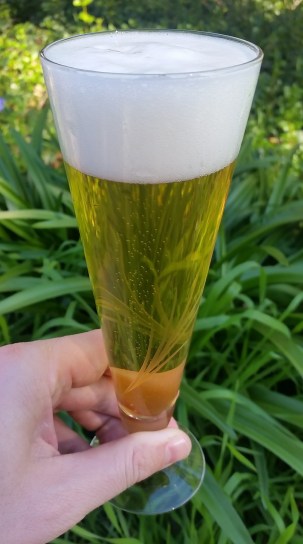
    • Pale straw appearance, brilliantly clear, with a tall, fine, white head that settles to a persistent blanket across the top of the beer.
  • Aroma
    • A very gentle malty sweetness with a spicy hop note behind that.
  • Flavor
    • Bready malt profile, with a firm bitterness that lingers after each sip. It’s definitely a bitter beer, but not out of balance for what I wanted.
  • Mouthfeel
    • Carbonation is appropriately high for the style, and it has a crisp, medium-dry finish.
  • Would I brew this again?
    • Absolutely! This is an exceptionally nice beer; it nails pretty much every point of the style, and is easy drinking, too. German pils is probably a little hoppier than I would always want in a pale lager, but that’s more of a stylistic thing than a flaw in this particular recipe. The other night, I ordered a glass of Bitburger, often considered a “classic” German pils. Although I didn’t taste them side-by-side, I can say that mine hits many of the same notes as this commercial example. I have my pils entered in an upcoming competition, so we’ll see how my assessment compares to that of the BJCP judges.
  • Overall
    • 10/10

Holy Helles

After years of avoiding lagers, I’m diving into the deep end. In the past two months alone, I’ve done a German pils and a Vienna lager, and these were hard on the heels of a Bohemian pilsner and another Vienna lager. I’ve generally used a faster fermentation and lagering schedule for my lagers, but for this batch I wanted to A) take my time a bit; and B) try out a style I haven’t brewed previously. The idea of a Munich helles is appealing because it is supposed to be a very malt-forward style with minimal bitterness, so it’s likely to be of broad interest to more people than something more bitter. Also, by slowing down the process I also can clarify without gelatin, which also means strict vegetarian/vegan types can drink it without complaint. Overall, a Munich helles seemed like a nice change from my most recent batches, and I figured it would make a nice brew to serve with Easter dinner. So, I’m calling this batch “Holy Helles”. I’ll note I’m not the first brewer to think themselves so clever, but I’m sticking with it anyhow.

The recipe isn’t based on anything in particular; I read across a number of sources to come up with the combination of malt, yeast, and hops. This should hit the “sweet spot” for the particulars of the Munich helles style.

20170107_103335

Holy Helles

  • 8.25 lb. floor-malted Bohemian pilsner malt (Weyermann)
  • 1.25 lb. Munich I malt (Weyermann)
  • 3 oz. BEST acidulated malt (BESTMALZ)
  • 2 oz. Carapils malt (Briess)
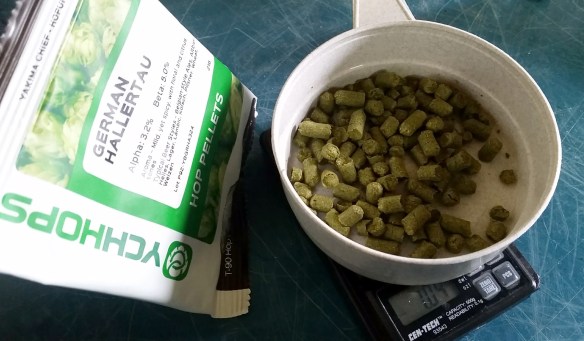
  • 1.5 oz. German Hallertau hop pellets (3.2% alpha), 60 minute boil
  • 0.5 oz.German Hallertau hop pellets (3.2% alpha), 10 minute boil
  • 1 Whirlfloc tablet, 10 minute boil
  • 1 tsp. Fermax yeast nutrient, 10 minute boil
  • 1 pkg. Southern German Lager yeast (WLP838, White Labs)

Target Parameters

  • Multiple infusion and single decoction mash, 20 minute rest at 130°, infusion to hit 45 minute rest at 148°, thick decoction to raise temperature to 168°. Batch sparge.
  • Water built from R.O., to hit 44 ppm Ca, 2 ppm Mg, 22 ppm SO4, 68 ppm Cl, and 5 ppm bicarbonate.
  • 1.046 o.g., 1.010 f.g., 4.8% abv, 19 IBU, 4 SRM, 5.5 gallons into fermenter

Procedure

  • Several days in advance, I made a 2L starter, let it run for 2 days, and then cold-crashed.
  • I calculated that I would need 9.2 gallons of water, so weighed out 1 g of gypsum, 0.7 g of epsom salt, 5.4 g CaCl, and 0.3 g baking soda for my mineral additions. I split these into 2 parts. Half of the mass will go into the strike water and half into the sparge water.
  • I added 2.45 gallons of water at 148° to my mash tun, and let the mash tun warm up until it hit 143°. Then, I added my grains, and achieved my target acid rest temperature of 143°.
  • After 20 minutes, I added 1.5 gallons of water at 186°, to hit a mash temperature of 146°. It was down to 143° after 35 minutes, and at more or less the same temperature after 45 minutes total. I decocted 1.5 gallons of a medium-thick mash, brought it to a boil, boiled for 10 minutes, and added it back in to the mash to hit a mash-out temperature of 163°. I let this sit for 10 minutes before draining the mash tun to collect the first runnings.
  • I added 5.25 gallons of water at 180°, let the mash sit for 10 minutes, vorlaufed, and collected the second runnings.
  • In total, I collected 7.6 gallons of wort with a gravity of 1.044–that’s 90% mash efficiency! I chalk it up to the decoction, and that’s awesome, but the end result would be too high in gravity. So, I added 1 gallon of RO water to dilute everything down to 1.040 and get 8.6 gallons.
  • I targeted a 90 minute boil time. Once I started the boil, I thus waited 30 minutes before adding the first round of hops. Other hops and additions were made per the schedule in my recipe.
  • Nine minutes before flame-out, I checked gravity again and saw that it was at 1.048, a touch higher than my target. So, I added another 0.5 gallon of RO water.
  • After flame-out, I chilled the wort down to 72°, and got ready for the transfer.
  • There was a lot of wort, so I drained the first gallon of trub off in order to keep the portion going into the fermenter fairly clean. Even with this, I ended up with just under 6 gallons of wort in the fermenter.
  • I popped the fermenter into my fermentation chamber, and set it for the final chill down to 45°. Once I hit this (about 6 hours later), I pitched the yeast and set the temperature to 50°.
  • I brewed this beer on 7 January 2017. It had a starting gravity of 1.047 (just a touch above target).
  • I had minor signs of fermentation within 24 hours and fairly good krausen within 48 hours. Three days into fermentation, we lost power for ~16 hours. The fermentation was thus unregulated for that stretch. I wasn’t able to check on the beer (being laid up in bed with a bad cold), but presumably the temperature went up just a touch (although the ambient temperature remained around 60°).
  • I did a check on the beer on 15 January 2017. There was a strong sulfur aroma coming from the fermenter. The gravity was 1.020, for 56% apparent attenuation. On this day, I raised the fermentation temperature to 52°. Fortunately, I didn’t detect any off (e.g., fruity) flavors in the beer, so I am satisfied that the brief power loss wasn’t too detrimental.
  • My planned fermentation schedule is 7 days at 50°, 7 days at 52°, 7 days at 54°, 4 days at 68°, and then a week or so at 32° before transferring to the keg for long-term lagering. This will allow me about 2 months of dedicated lagering before I serve this at Easter.

Lager / Pils Update

vienna_lagerThings have been moving along on my latest Vienna lager (Take Two Vienna Lager) and German pils (Palaeotis Pils). The two beers are in the same fermentation chamber; because the pils was brewed most recently, the temperature control regimen has been dictated by that batch.
For these brews, I elected to use a fast lager schedule. The pils was brewed on 9 December, with a starting gravity of 1.048. When I checked the beer on 16 December, the gravity was down to 1.020. At 57% apparent attenuation, this exceeded the recommended 50% threshold for temperature ramp-up, so I was clear to go. I didn’t bother to check on the Vienna lager, because it had been in there for a week extra and high krausen had long since passed. So, I figured it was more than safe to ramp that one up too.

At this point, I turned off the fermentation chamber to let things free-rise for the first day. Because my garage temperature was fairly cool, the temperature in the fermentation chamber hadn’t exceeded 55° after 24 hours. So, I added the heating pad and set the temperature for 68°. The temperature probe was loose, so that it would sense ambient temperature in the chamber, for a slower rise in the fermenters themselves than if the probe was attached to a fermenter directly.

I checked the pils again on 24 December, at which point the gravity was 1.011, and this was unchanged two days later (5% abv, with the 1.048 starting gravity). The Vienna lager (depicted in the photo) was at a final gravity of 1.013 (5.1% abv, following a starting gravity of 1.052). So, on 26 December I set the fermentation chamber to 34°, still leaving the temperature probe loose so as to ensure a slower temperature drop in the fermenters. I filled the airlocks with vodka, to avoid having the sanitizer water sucked in as things cooled.

After 24 hours of cold-crashing, I added gelatin, with 1/2 tsp. in a half cup of water for each batch. I’ll let things settle for a few more days before kegging and carbonating.

Palaeotis Pils

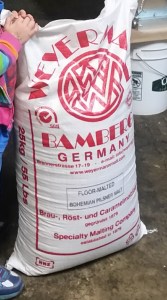
pilsner_maltOn my continued quest to learn brewing grains in depth, I recently purchased a 55 lb. sack of Weyermann’s floor-malted Bohemian pilsner malt. This is the same stuff I used for my Lithographica Pilsner, and is cool on a scientific level because the grains are malted on floors made of Solnhofen Limestone (more details here).

For my first brew with this sack of malt, I elected on doing a German pils. That’s a new style for me, and also can be brewed with a minimum complexity of ingredients (I’m really gravitating towards those sorts of simple recipes).

The name for the batch honors an important fossil bird from the Messel pits of Germany, around 47 million years old. Palaeotis is potentially an early ratite, a member of the group of birds including ostriches and emus.

Palaeotis Pils

  • 8.5 lbs. floor-malted Bohemian pilsner malt (Weyermann)
  • 0.21 lb. acidulated malt
  • 0.6 oz. Magnum hop pellets (13.2% alpha), 60 minute boil
  • 1 oz. German Hallertau hop pellets (3.2% alpha), 5 minute boil
  • 1 tsp. Fermax yeast nutrient, 10 minute boil
  • 1 Whirlfloc tablet, 10 minute boil
  • German lager yeast (White Labs WLP830), prepared in 1.7L starter

Target Parameters

  • Double decoction mash, 10 minute rest at 122°, infusion to hit 60 minute rest at 148°, thick decoction to raise temperature to 154°, 10 minute rest, thin decoction to mash out at 168°. Batch sparge.
  • Water built from R.O., to hit 59.1 ppm Ca, 8.2 ppm Mg, 89 ppm SO4, and 62.9 ppm Cl.
  • 1.045 o.g., 1.008 f.g., 4.9% abv, 34 IBU, 3 SRM, 5 gallons into fermenter

Procedure

  • Five days in advance (4 December 2016), I made a 1.75 L starter for my yeast culture. After two days on the stir plate, I cold-crashed the starter.
  • For this recipe, I built my water to match the “Pilsner Water” profile on Braukaiser. For the 3.6 gallons of mash water, I added 1.4 g of gypsum, 1.1 g of epsom salt, and 1.8 g of calcium chlorie. For the 5 gallons of sparge water, I added 1.9 g of gypsum, 1.6 g of epsom salt, and 2.5 g of calcium chloride.
  • I mashed in with 2.25 gallons of water at 134° to hit 126°, and left it for a 10 minute protein rest.
  • Next I added 5.25 quarts of water at 197°, to hit a mash temperature of 149° (after a bit of stirring).
  • After 50 minutes, I pulled a thick decoction of 7 quarts. I heated it to 154°, let it rest for 10 minutes, and brought to a boil for 10 minutes. The decoction addition brought the mash up to 156. I let the mash rest for 10 more minutes.
  • Next, I pulled 1 gallon of wort for a thin decoction, boiled it for 10 minutes, and returned it to the mash. This raised the temperature up to around 168°.
  • I pulled the first runnings, and added the 5 gallons of sparge water. After 10 minutes and a vorlauf, I collected the remainder of the wort. I had around 7 gallons, so added 0.25 gallons of water to bring up the volume to my target.
  • In total, I had 7.25 gallons of mash runnings at a gravity of 1.038, for 84% efficiency.
  • I brought the kettle to a boil, and added the hops and other ingredients per the schedule. I added 0.25 gallons of RO water during the boil, to top things up and keep the gravity from getting too high.
  • After 60 minutes, I chilled the wort down to 70°, transferred the wort while aerating, put the fermenter into the fermentation chamber, and pitched the yeast.
  • Starting gravity was 1.048, a touch above my target of 1.045. I will be fermenting this at 52°. I brewed the beer on 9 December 2016.