Equinox IPA Kegged

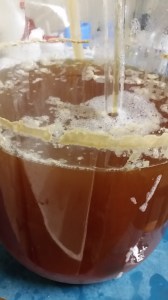
Today I kegged the Equinox IPA. It had been in the primary fermenter since 27 August, just a little over two weeks. After the first week, on 3 September, I moved the beer out of my fermentation chamber (which was getting switched over for a lager), and let it ride at ambient temperature for a week or so. I figured this would be OK, because the main run of the yeast had presumably wrapped up by this point, so the risk of getting off-flavors from a hot fermentation was quite low.

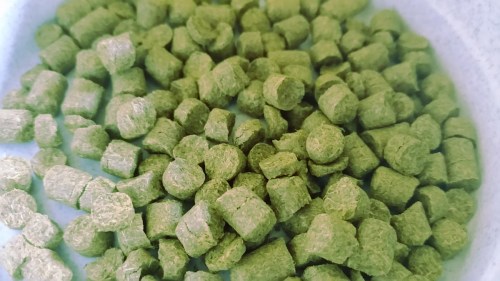
Final gravity was 1.010, down from 1.062, equating to 6.8% abv. I added the dry hops (3 oz. of Equinox hop pellets) at this time; they’re in a bag, weighted down with some stainless steel washers and suspended in the keg via unwaxed and unflavored dental floss. I will leave it at ambient temperature for a few days, before tossing it into the keezer to carbonate at the lagering temperatures.

Equinox IPA

I have been seeing a fair bit about Equinox…err, HBC 366…hops during the past year, and wanted to try them for myself. Like many of the recent American varieties, it is supposed to pack quite an aroma and flavor punch. Even if it’s totally stereotypical for a homebrewer, I do like big, aroma-rich hops, so a batch with Equinox made it onto my “brewing goals” list.

This was also an opportunity to continue my exploration of Vienna malt, so I crafted a SMaSH-ish recipe that had a decent late-hopping dose of Equinox. The only minor deviation from a true SMaSH is that I threw in a touch of de-bittered black malt for color.

Finally, I am using this batch to recalibrate some of my brewing parameters. For a few batches now, I have noticed that my wort volumes and starting gravities are a touch off, so I am going to adjust the mash and boil-off assumptions accordingly in BeerSmith. Additionally, the night before brewing, I completely disassembled and cleaned my mill (a Monster Mill 2). There was some grain dust worked into places, and as a result it wasn’t holding the gap as well as it should (hence my low mash efficiency on some previous batches). After reassembly, I set the gap to around 0.039″. As noted below, I had incredible mash efficiency (84%!), but the mash itself was a little slow to drain. So, after this brew I widened my gap to 0.041″.

equinox

Equinox IPA

  • 12 lbs. Vienna Malt (Weyermann)
  • 1 oz. de-bittered black malt (Dingemans)
  • 0.5 oz. Equinox (HBC 366) hop pellets (14.2% alpha), first wort hop
  • 0.5 oz. Equinox (HBC 366) hop pellets (14.2% alpha), 60 minute boil
  • 1 oz. Equinox (HBC 366) hop pellets (14.2% alpha), 5 minute boil
  • 1 oz. Equinox (HBC 366) hop pellets (13.4% alpha), whirlpool
  • 0.5 tsp. gypsum, added to boil
  • 1 Whirlfloc tablet, 10 minute boil
  • 2 pkg. Safale American dry yeast (US-05)

Brewing Targets

  • Mash temperature = 149°
  • Original gravity = 1.067 (actual = 1.062)
  • Color = 8.5 SRM
  • IBU = 63
  • Note that I originally targeted this for a lower gravity, ~1.058. Because I ended up with very high mash efficency (~84%), I had to adjust the recipe per the above. If I brew this again, after adjusting my mill gap, I’ll need to tweak the malt bill to reach the same gravity.

Procedure

  • I mashed in with 4.6 gallons of water at 159°, to hit a mash temperature of 151°. The mash was down to 147° after 30 minutes, and 146.5° by 60 minutes.
  • After 60 minutes, I added 0.7 gallons of water at 190°, to raise the mash bed to 148°. After 10 minute, I vorlaufed and collected the first runnings. Due to the fine crush, it took awhile to drain the mash bed.
  • I then added 3.75 gallons of water at 182°, to raise the mash temperature to 160°. I let it sit for 10 minutes, vorlaufed, and collected the second runnings.
  • Wow! I collected 7 gallons of wort at a gravity of 1.055, for 84% efficiency. As a result, I adjusted my original recipe to the one above.
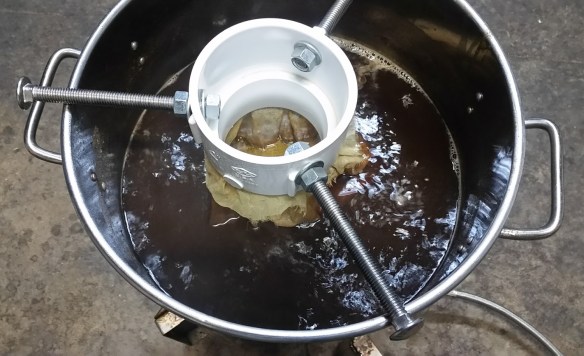
  • As soon as the wort was on the flame, I added hops. At the boil, I added the second addition, and everything else was dropped in at the appropriate time.
  • After flame-out, I chilled the wort to 84°. This wasn’t quite cool enough to pitch the yeast, so I transferred into my fermenter and put it all into the fermentation chamber for a few hours. Once the overall temperature had come down, I pitched in the two packets of yeast.
  • Starting gravity was 1.062, a little lower than expected (probably due to a slightly lower boil-off rate than assumed by BeerSmith). I brewed this on 27Aug2016, and am fermenting at 66°.

Beer Tasting: Centennial IPA

20160714_204030My Centennial IPA has been in the keg and cold conditioning/dry-hopping for nearly a month. Because I’m taking off soon for a few weeks, and because IPA’s are best fresh, now is as good of a time as any to do a tasting.

Centennial IPA

  • The Basics
    • Original gravity = 1.063; final gravity = 1.010; abv = 7.0%; estimated IBU = 59
  • Aroma
    • Very lightly sweet malt aroma, with a moderate hop aroma that is citrusy (slightly orange-hinted) and lightly floral.
  • Appearance
    • A hazy beer with a moderately deep gold color. The off-white head is fine and persistent, with modest lacing.
  • Flavor
    • As it should be, this is a hop-forward beer, with a smooth but assertive bitterness that fades in and then gently fades out. The bitterness has a piney note to it. The modest malt flavor tends toward the grainy side.
  • Mouthfeel
    • This is a fairly dry beer, with a relatively light body. Carbonation is moderate, as is appropriate for the style.
  • Would I brew this again?
    • This is a solid traditional American IPA–I would characterize it as squarely middle of the road; not in a bad way, just that it is tasty but not adventurous. In the original recipe, Gordon Strong noted that the recipe would be a solid base for any single hop American IPA; I agree! For this particular run, I feel like I’m getting a nice feel for what Centennial is as a hop. Compared to recent varieties such as Mosaic or Citra, Centennial is so “yesterday.” But, it has a character all its own that deservedly places it in the great pantheon of hops. I can’t say I’ll change much (other than hop variety) when I brew this again; it would definitely be OK with other American yeast varieties, but in terms of malt bill and brewing technique it’s spot-on.
  • Rating
    • 9/10

Beer Tasting: Transatlantic IPA 1.1

TIPAI kicked the keg for this batch a few weeks back, but luckily did a tasting before that happened. Results are below.

  • The Basics
    • Original gravity = 1.060; final gravity = 1.015; abv = 5.9%; estimated IBU = 60
  • Aroma
    • Light fruity background, with the hint of peach that I would expect for Conan. Slightly citrusy with minor floral hint, too. Very nice aroma, but not overpowering.
  • Appearance
    • A decent but not overwhelming haze to the beer; this has definitely cleared up over the past few weeks, from the initially murky impression. The head pours fairly high and fine, but settles down to a moderate but uniform, ivory-colored blanket across the top of the beer. The beer is a medium-amber in color.
  • Flavor
    • This is hops-dominated, with a notable bitterness at the forefront of each sip. This persists on the finish. The hops character is fairly piney, with a bit of citrus and faint earthiness behind that. The malt character has a slight breadiness to it, but is definitely at the background (which is fine for this beer).
  • Mouthfeel
    • The beer has medium-light body and a dry finish, with moderate carbonation as appropriate for the style. The bitter finish carries through smoothly. It is maybe a touch thinner than I like, but that’s fairly minor.
  • How does it compare to version 1.0?
    • This is a pretty good beer, but I think I liked the first version just a bit better in terms of its hops character. The main difference, to me, is probably the swapping out of Simcoe and Columbus for Falconer’s Flight 7C’s and Fuggle. It’s not flawed by any means, but I think my preference tips towwards the initial combination. Simcoe just does a bit better here, for what I have envisioned in my head. Once again, the Vermont Ale yeast rocks out. I do like this strain! I can fairly safely say this recipe is a solid one. I sampled it first when it was very young–within a week or two of kegging–and can say that a few extra weeks in the keg have been a good thing. The beer is at its peak!
  • Overall rating
    • 8.5 / 10