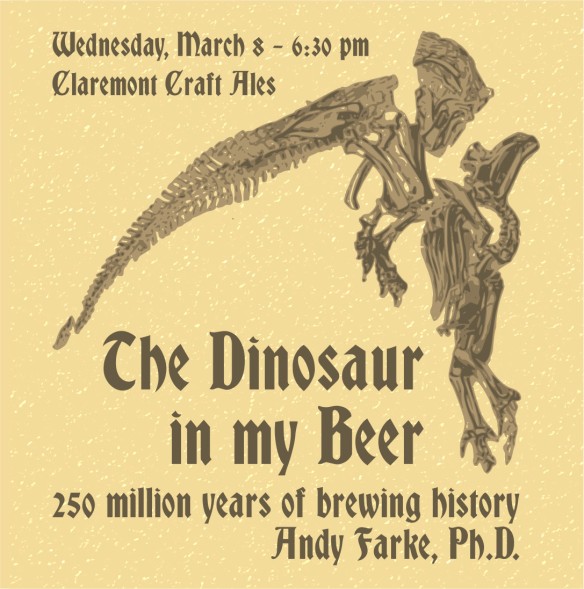
The Dinosaur in My Beer: March 8 at Claremont Craft Ales

Beer and science are a natural fit…even more so than beer and pretzels, in my opinion. As a homebrewer, I absolutely love geeking out over the scientific facets of the hobby. The usual history of beer starts a few thousand years ago with the rise of agriculture. But, there is so much more to the story. Every brewing ingredient–water, barley, yeast, and hops–has its own tale to tell. In many cases, the narrative extends back to the time of the dinosaurs!

So, if you are in Claremont, California, on Wednesday, March 8, swing by Claremont Craft Ales and catch my talk on the prehistory of brewing ingredients! The event starts at 6:30 pm, but you can swing by before or hang around after for some great beer and also a chance to chat with me about anything you like.

talk_logo

The basic talk will be a preview of my seminar for HomebrewCon in June. I’ll be posting more about that in the upcoming months, too.

If you haven’t been to Claremont Craft Ales (CCA) before, it’s a really great venue. A few things you can look forward to:

  • Their beer is great! I highly recommend the Jacaranda IPA as well as the Raspberry Gose (both are also available in cans).
  • CCA has plenty of options for non-beer-drinkers. In addition to a nice selection of canned dry sodas (the tasty fancy stuff, not just a bunch of Coke products), various food trucks are also there most afternoons and evenings.
  • It’s a very friendly space — kids and dogs are quite welcome. (note relevant to my talk: although dinosaurs have a reputation as a “kids topic”, my talk isn’t really geared for kids. That’s not to say it’s “adult content”–just that the presentation will be at a level where the typical 12 year old might get a little bored, because the combined topic of beer and paleontology probably isn’t in their wheelhouse, or at least it shouldn’t be.)

Interested in having me talk for your event? Drop a line via the contact form!

Image credit: Dinosaur skeleton from Iguanodon rendering by Gustave Lavalette in the public domain.

Beer Tasting: Take Two Vienna Lager

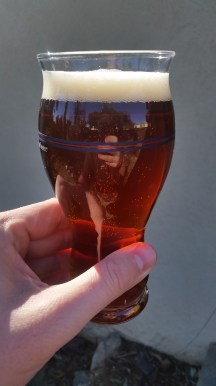
20170128_132534My latest Vienna lager ran out just a few days ago, but not before I worked in a beer tasting as well as a submission to a local beer competition. This batch earned an honorable mention (i.e., 4th out of 15 entries) in a combined Amber and Dark Euro Beers table at the 2017 Romancing the Beer competition. Tasting notes below were completed before competition results were announced, and I have not yet been able to compare my impressions with those of the judges.

  • The Basics
    • O.g. = 1.052; f.g. = 1.013; 5.1% abv; 12 SRM; 25 estimated IBU
  • Appearance
    • Deep amber, brilliantly clear beer, with a persistent ivory head.
  • Aroma
    • Slightly toasty, with a spicy and mildly floral hop note.
  • Flavor
    • Toasty maltiness, with the slightest hint of a caramel note at the very end of the finish. Hoppiness is subdued but noticeable.
  • Mouthfeel
    • Slightly dry, medium-light body.
  • Would I brew this again?
    • This is a good Vienna lager, but not a great Vienna lager (in my opinion). The slight touch of caramel on the taste throws it a bit out of style for me, and also isn’t quite what I wanted in the beer. The color is apparently within the bounds of the BJCP style guidelines, but darker than I really desire for this kind of beer. I suppose it falls within the realm of “North American Craft Vienna Lager.” For the next time around, I would reduce the melanoidin and Carafa II malts to lighten the beer and reduce any caramel notes. All that said, if I set aside stylistic preferences this is an exceptionally drinkable brew, and it was quite popular at a recent get-together.
  • Overall
    • 7/10

Beer Tasting: Good Riddance Pale Ale

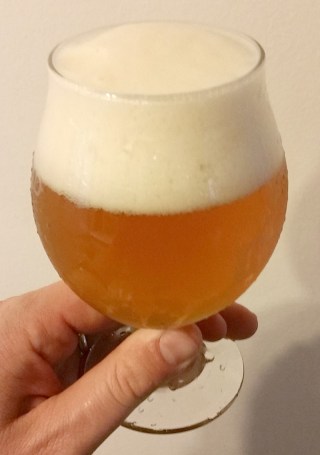
20170218_163101This pale ale has disappeared surprisingly quickly; with only a little bit left in the keg, it’s a good time to do a quick tasting.

  • The Basics
    • O.g. = 1.053; f.g. = 1.011; 5.6% abv; estimated IBU = 41; 7 SRM.
  • Aroma
    • Orange and grapefruit, with a hint of tropical fruit at the background — a nice, medium-strong hop aroma.
  • Appearance
    • When poured, I get a tall, off-white head that is pretty persistent and medium-fine. The beer itself is a burnished gold color and fairly hazy (but not opaque like a NEIPA).
  • Flavor
    • The balance is towards the hops (which have a definite grapefruit character), but the malt character is still pretty nice–slightly grainy.
  • Mouthfeel
    • Bitterness is moderately high, but not over the top. The finish is a touch thinner and drier than I care for, which could be corrected by mashing a degree or two higher or adding in an extra quarter pound of crystal 20. That said, the finish is also nicely balanced between hops and malt, and isn’t puckeringly bitter like some other beers I’ve made.
  • Would I brew this again?
    • This beer was a real surprise! I like it much more than I thought I would. Considering that the main aroma hops were coming up on two years of ago, they held their own really well. I suppose the combination of vacuum seal+deep freeze paid off! This is definitely encouraging for other hops in long-term storage. Overall, the base recipe is another good one to add to my repertoire of American pale ales, with just a few minor modifications for mash temp and hops.
  • Score
    • 7/10

Dunkel-Osteus

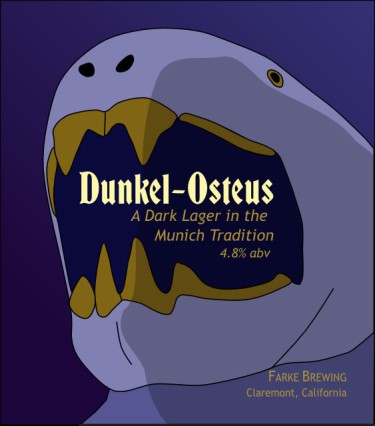
labelI love brewing new styles, and I also love a bad beer pun. The unholy marriage between the two: Dunkel-Osteus!

For this batch, I’m making a Munich dunkel. It’s a reasonably dark, malt-forward lager, in a style that I’ve not brewed previously. Musing over what to call this batch, I remembered a famous prehistoric fish, Dunkleosteus. Dunkel-Osteus was a match made in prehistoric pun heaven!

Dunkleosteus lived around 375 million years ago, during the Devonian (also known as “The Age of Fishes”). It was a giant animal, with sharp bony plates lining its jaws rather than teeth. The largest species were huge, clocking in at around 20 feet in length and a ton in body mass. These were top-tier marine predators, and are a popular exhibit in many museums today. Dunkleosteus and its close kin were an early side branch in vertebrate evolution–nothing exactly like them is around today. However, we humans inherited a common feature from the way-way-way-back ancestor we share with Dunkleosteus: our jaw bones! The open-and-shut jaw arrangement and the major bones that make up our mouth had their origins in some humble fish back before even Dunkleosteus (see this scientific paper on the evolutionary relationships of these organisms). Although the extent to which the jaws of Dunkleosteus and its kin are directly tied to our own has been debated, the latest evidence strongly suggests that they have the same essential bones and are based on the same genetic blueprints, with some evolutionary tweaks. So, next time you open wide for a tasty lager, think about how amazing it is that you are using some of the same skull bones that Dunkleosteus had!

Evolutionary Tree

A highly pruned evolutionary tree for jawed fish and kin. Everything is approximately to scale. Silhouettes via phylopic.org. Humans by Mike Keesey (public domain, right figure) and Sarah Werning (CC-BY, left figure), elephant by Mike Keesey (public domain), tyrannosaur by Emily Willoughby (CC-BY-SA), Dunkleosteus by Dmitry Bogdanov and converted to silhouette by Mike Keesey (CC-BY), tuna by Stuart Humphries (public domain).

The fossil fish Dunkleosteus was named in honor of David Dunkle, a paleontologist at the Cleveland Museum of Natural History way back in the 1950s. As such, the prehistoric organism has nothing to do with the Munich Dunkel style (and indeed, Dunkle and Dunkel are spelled differently). Nonetheless, I couldn’t pass up a good pun!

The recipe is modified slightly from a dunkel presented in Modern Homebrew Recipes, by Gordon Strong. I love the simplicity of Strong’s version–a base malt, two specialty malts, one variety of hops, and a yeast. I elected to use a single infusion mash rather than a decoction mash schedule, and upped the gravity a point or two (while still keeping it at the lower end of the style). I also replaced German Tettnang hops with American-grown Liberty, based on availability, and used dry yeast for simplicity. One major recommendations I retained from Strong’s book was to add the dark grains at vorlauf (in this case, the Carafa Special II), rather than leaving them in the mash for the whole duration. My goal was to have the Carafa just be for coloration, rather than for adding much flavor, and a short steep seemed like the best way to achieve this.

Dunkel-Osteus

  • 9 lbs. Munich II malt (Weyermann)
  • 5 oz. melanoidin malt (Weyermann)
  • 6 oz. Carafa Special II malt (Weyermann), added at vorlauf
  • 1.5 oz. Liberty hops (3.9% alpha), 60 minute boil
  • 1 tsp. Fermax yeast nutrient, 10 minute boil
  • 1 Whirlfloc tablet, 10 minute boil
  • 2 pkg. Saflager Lager yeast (Fermentis W34/70)

Target Parameters

  • 60 minute infusion mash, 154°
  • 1.050 o.g., 1.013 f.g., 4.9% abv, 22 IBU, 20 SRM

Procedure

  • I adjusted my water slightly, to fall within the “malty dark lager” profile in the Palmer and Kaminski water book. I used 5 gallons of Claremont tap water with 3 gallons of RO water and 5 g of calcium chloride. The resulting water profile should approximate 82 ppm Ca, 7 ppm Mg, 15 ppm Na, 31 ppm SO4, 94 ppm Cl, 131 ppm HCO3, and residual alkalinity of 44 ppm.
  • I added 3.25 gallons of water to my mash tun (1 gallon of RO, 2.25 gallons of tap water, and 5 g calcium chloride), at a temperature of 172° or so. I swirled it around the mash tun for a bit, and let it cool down over a period of 5 minutes or so until it hit a temperature of 166°. I mashed in at this point, to hit a temperature of 154.5°.
  • The mash cooled to around 150° after 50 minutes.
  • After 60 minutes in the mash, I added 1.5 gallons of sparge water, let it sit for 10 minutes, added the dark grains, and vorlaufed before collecting the first runnings. My sparge water was made of a blend of 2 gallons RO water and the remainder with tap water. I added ~3.25 gallons of water for the second batch sparge, stirred, let it sit for 10 minutes, and collected the second runnings.
  • I collected 6.5 gallons of wort, a touch below my target of 6.75. So, I added 0.25 gallons of RO water, to reach the target volume. The resulting wort gravity was 1.041–pretty much exactly on target, with an efficiency of 76%.
  • I started the boil, and added the hops, Whirlfloc, and yeast nutrient per the schedule. After 60 minutes, I turned off the flame and chilled the wort down to 70°.
  • Around 5.25 gallons of wort went into the fermenter, with a gravity of 1.050. It’s nice to hit the brewing targets!
  • I pitched the dry yeast immediately, and put the beer in the fermentation chamber. I’ll be fermenting this at 54° for at least two weeks. I’m in no rush with this beer (there are three other beers in the queue ahead of it), so there is no urgency to do a fast lager schedule. I brewed this beer on 10 February 2017.
Ophidia IPA

I “needed” to brew another IPA, and was in the mood for something a bit lower in alcohol. The November 2014 issue of Brew Your Own magazine had a clone recipe for Suicide Squeeze IPA, from Fort George Brewery. It was a nice session-ish beer (4.7% abv), and the recipe called for stuff I had pretty much entirely on hand. With just a few minor modifications, my recipe was all set! The name for my personal take on this (Ophidia) refers to a scientific name for snakes, because the original Fort George product had a snake on the label for the can.

Ophidia IPA

  • 8 lbs. 3 oz. 2-row malt (California Select, Great Western Malting Co.)
  • 1 lb. Munich I malt (Weyermann)
  • 0.5 lb. caramel 40° malt (Briess)
  • 0.5 lb. flaked oats
  • 0.25 lb. Carafoam malt (Weyermann)
  • 0.45 oz. Warrior hop pellets (15% alpha), 60 minute boil
  • 1 oz. Citra hop pellets (14.1% alpha), 5 minute boil
  • 1 oz. Mosaic hop pellets (11.3% alpha), 5 minute boil
  • 2 oz. Mosaic hop pellets (11.3% alpha), 5 minute steep
  • 1 Whirlfloc tablet, 10 minute boil
  • 1 tsp. Fermax yeast nutrient, 10 minute boil
  • 2 oz. Mosaic hop pellets (11.3% alpha), dry hop in keg
  • 1 oz. Citra hop pellets (14.1% alpha), dry hop in keg

Target Parameters

  • 156° mash, 45 minutes
  • 1.053 o.g., 1.019 f.g., 4.4% abv, 52 IBU, 6 SRM, 5.5 gallons into the fermenter

Procedure

  • 24 hours in advance of brewing, I made a 1.5L starter. This is the second use for the culture–I set aside 0.55L for later use.
  • My water was 5.25 gallons of Claremont water mixed with 3 gallons of RO water and 5 g of gypsum. For the strike/first round of sparge water, I used 1.5 gallons of RO and 3.25 gallons of Claremont water, with the gypsum added directly into the mash tun. For the rest of the sparge water, I used 1.5 gallons of RO with 2 gallons of Claremont tap water.
  • I mashed in with 4.75 gallons of water 167°, to hit a mash temperature of 153°. This was a bit below my target, but I figure I’ll roll with it. I did only a 45 minute mash, before vorlaufing and collecting the first runnings.
  • I sparged with 3.5 gallons of water at 185°, to hit a mash temperature of 168° for the mash-out.
  • I collected 6.75 gallons of wort at a gravity of 1.044, for 77% efficiency.
  • I started the boil, and added the various ingredients per the schedule. After a 60 minute boil, I chilled the wort to 68° and pitched the yeast.
  • Starting gravity was 1.055, slightly above my target but not by too much.
  • I brewed this beer on February 6, 2017, and fermented at 66° for the first four days. Then, I removed it from the fermentation chamber (to make room for another beer), and fermented it at ambient room temperature with a heating pad beneath the carboy, to maintain ~68° in the fermenter.