Beer Tasting: Palaeotis Pils

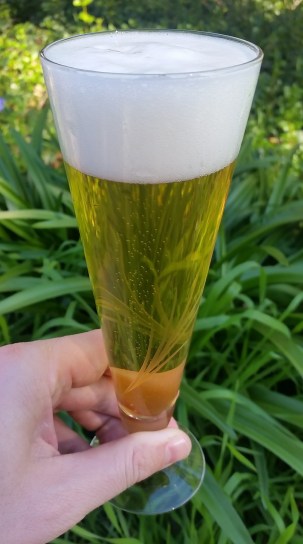
20170128_124227My Palaeotis Pils, falling within the German pils style, has been on tap for a few weeks now, and seems to be reaching a peak in quality. Time for a tasting!

  • The Basics
    • Original gravity = 1.048, final gravity = 1.011, abv = 5.0%, estimated IBU = 34
  • Appearance
    • Pale straw appearance, brilliantly clear, with a tall, fine, white head that settles to a persistent blanket across the top of the beer.
  • Aroma
    • A very gentle malty sweetness with a spicy hop note behind that.
  • Flavor
    • Bready malt profile, with a firm bitterness that lingers after each sip. It’s definitely a bitter beer, but not out of balance for what I wanted.
  • Mouthfeel
    • Carbonation is appropriately high for the style, and it has a crisp, medium-dry finish.
  • Would I brew this again?
    • Absolutely! This is an exceptionally nice beer; it nails pretty much every point of the style, and is easy drinking, too. German pils is probably a little hoppier than I would always want in a pale lager, but that’s more of a stylistic thing than a flaw in this particular recipe. The other night, I ordered a glass of Bitburger, often considered a “classic” German pils. Although I didn’t taste them side-by-side, I can say that mine hits many of the same notes as this commercial example. I have my pils entered in an upcoming competition, so we’ll see how my assessment compares to that of the BJCP judges.
  • Overall
    • 10/10

What I Wish I Knew When I Started Extract Brewing

a5e74-20150515_223348Nowadays, I’m mostly an all-grain brewer. But, like many brewers, I started out using malt extract, perfecting basic fermentation, sanitation, and packaging techniques that I still apply. I wasn’t always happy with the results, and like many people “blamed” it on malt extracts. Additional experience and some distance in time, though, make me realize many of the problems were the result of faulty techniques, not faulty ingredients. So, I put together this brief list of suggestions to help out other extract brewers, particularly those who don’t have time, space, or money to create an all-grain setup.

  • Read the ingredients list. Most malt extract manufacturers provide stats on their product, including details on the grains that went into producing the particular extract. Think carefully about what you’re putting into your beer–are you unintentionally using an inappropriate extract for your recipe? For instance, some amber extracts might use a significant chunk of Munich malt. This is great for some styles, but might give you an unexpected flavor for others. On a related note…
  • For most beers, use the lightest extract available, and build up from there with steeping grains. When I started brewing, I thought, “Oh, I’ll use the stuff labeled as ‘amber DME’ to make an amber ale! And add a few other grains to improve the complexity.” This was a mistake! I mean, the result wasn’t bad necessarily, but it wasn’t as good as it could have been. I didn’t think about what was in the DME, and as a result I added some unnecessary grains and ended up with a slightly muddled product. One way around this is to start with a very simple light extract, and then build up using crystal malts and other ingredients to get the result you want.
  • Avoid overly concentrated boils. If you are doing a partial volume boil, adding all of the extract at the start can result in lower-than-expected hop utilization (due to the relationship between bitterness and wort specific gravity) or some funky twang. One strategy is to add a certain amount of extract at the beginning of the boil, and then add the rest for a few minutes at the end, before chilling, transferring to the fermenter, and diluting.
  • Don’t bother with liquid malt extract unless you absolutely have to. In my experience, it’s harder to handle, is rather messy, and the container is difficult to clean out. Dry malt extract ain’t perfect, but for me at least it’s easier to get into the brew kettle. Additional comment added after publication: Dry malt extract also is way easier to measure and store with if you have “odd” amounts–e.g., it is way easier to save a half bag of DME than it is to save a half container of LME.
  • Don’t mess with the water too much. Water chemistry can be important, but your extract batch will include the minerals that were in the malt extract as well as the minerals with whatever water you are using to reconstitute the extract. If you add too much, you can end up with an overmineralized mess! I would recommend careful experimentation over a few batches to see what works best, erring on the side of “less is more”. Or, you might try contacting the maltster to see if they can tell you a little more about the water used in their extract production process.
  • Don’t fear the mini-mash. It sounds complicated, but it isn’t nearly that bad (especially after you’ve had a few other batches under your belt). And, it adds a whole host of new possibilities to your recipes! You can easily do it in your kettle with a small steeping bag–no mash tun required. Don’t feel like doing a mini-mash? Don’t worry! You can brew a whole ton of stuff (including most IPA’s, porters, stouts, blonde ales, and the like) with just extract and steeping grains.
  • Fermentation temperature control matters. Perhaps 75% of the time, issues that people blame on extract brewing are actually the result of poor temperature control (the remainder are either due to poor sanitation or poor extract technique). If your beer rises to 80 degrees while fermenting, it’s going to develop some off-flavors, no matter how you derive your wort. It’s fair to say more all-grain brewers have temperature control, and hence the perception that all-grain brewing methods result in better beer. A freezer or refrigerator with a temperature controller unit is easiest (but also most expensive and most space-hogging), but workable alternatives exist.

I plan to brew up an extract batch in the near future–it’s been quite awhile since I’ve done one, and it seems like a good idea to try out these techniques again!

Equipment Review: Mash Paddle by Abbey Cat Brewing

My wife got me a mash paddle for Christmas! I had a nice plastic brewing spoon already, and awhile back I had also purchased a plastic mash paddle. The spoon is great, but the plastic mash paddle was fairly worthless. It had a little too much flexibility and was just a little too small to be effective in breaking up dough balls or stirring decoctions. As a result, my arms would be quite sore after even a brief decoction, so I mainly just ended up using the plastic spoon. A new, sturdier mash paddle was a welcome addition to my brew house.

20161228_164521

This particular mash paddle was made by Abbey Cat Brewing–it’s their 36″ maple version. The construction is high quality–there is a beautiful grain on the wood, the piece is shaped nicely, and all of the edges were cleanly sanded. This particular version has my brewery name engraved into it, which is a nice touch.

I’ve used the paddle for a few batches now, on tasks including dough-in, stirring of the mash, and decoction stirring. The paddle works pretty much as advertised, and is head-and-shoulders above my old plastic paddle. I could probably have gotten away with the smaller (24″) version, but overall it’s probably better to have a paddle that’s too big than too small. When it comes to decoctions, the paddle is way easier to work with than my spoon, too. It moves more of the decoction around, with less effort. Clean-up is easy, too — just a quick rinse and I’m done!

So, I give this piece of equipment a solid A, for quality of construction and utility. I’d recommend it for anyone who is doing regular all-grain brewing, and say it is a “must have” for anyone doing decoctions.

Mash paddle in action for a decoction

Mash paddle in action for a decoction

First Amendment Blonde Ale

This batch is a slight rework of my favorite blonde ale recipe. I upped the base malt a slight bit, and have switched to just Warrior as a bittering addition. I recently bought a pound of the stuff–my intention is to use it for the bulk of my bittering additions in various recipes going forward. Warrior’s bittering properties are supposed to be fairly gentle (attributed to its low cohumulone values), so I figured I would try it out as an alternative to some other hopping strategies I have used in the past.

The name honors the Women’s Marches that took place across the country on the day I brewed this (I was there with my family at the Los Angeles one)–and of course, it honors all who peacefully and proudly exert their constitutional rights, regardless of where they fall on the political spectrum.

Overall, I was quite pleased with how the brew session went. Other than a high-than-expected efficiency (which is not the worst thing on the planet), I hit my temperatures and brew numbers quite effectively.

First Amendment Blonde Ale

  • 9.5 lbs. 2-row brewer’s malt (California Select, Great Western Malting Co.)
  • 0.5 lb. 20° caramel malt (Briess)
  • 0.4 oz. Warrior hop pellets (15.8% alpha), 60 minute boil
  • 1 Whirlfloc table, 10 minute boil
  • 1 tsp. Fermax yeast nutrient, 10 minute boil
  • 1 pkg. California Ale yeast (WLP001, White Labs)

Target Parameters

  • 152° mash, 60 minutes
  • 1.051 o.g., 1.011 f.g., 5.2% abv, 24 IBU, 5 SRM, 5.5 gallons into the fermenter

Procedure

  • Three days in advance, I made a 1.5L starter. It ran on the stir plate for two days, before I split it up and cold-crashed it. I set aside 0.64L for another batch, and the remainder will be used in this batch.
  • I built up my water from RO for this batch, adding all of the minerals to the strike water (3.375 gallons). I used 4.9g gypsum, 0.9g epsom salts, and 4.6g calcium chloride. I also added 2 tsp. of phosphoric acid (10% concentration), to acidify the mash. The final target brewing water profile will be 75 ppm Ca, 100 ppm S04, and 75 ppm Cl. This profile, based on one in the Palmer and Kaminski water book, will hopefully avoid the “flabby” taste I have been getting in my blonde ales brewed with local tap water.
  • I warmed up my mash tun with 3.375 gallons of water at 170°. Once it hit 164°, I added the grains, to hit my target mash temperature of 152° on the dot.
  • I mashed for 60 minutes. I checked the pH, and it was around 5.4.
  • After 60 minutes, I added 1.3 gallons of water at 185°, let it sit for 10 minutes, vorlaufed, and collected the first runnings.
  • Next, I added 3.5 gallons of water at 185°, let it sit for 10 minutes, vorlaufed, and collected the second runnings.
  • I total, I collected 6.8 gallons of wort with a gravity of 1.044–82% efficiency! I’ll aim for a lower boil in order to ensure I don’t overshoot my target gravity.
  • Once I brought the brew to a boil, I added the hop pellets in a bag and boiled for 60 minutes, adding the Whirlfloc and Fermax with 10 minutes to go.
  • After 60 minutes of boiling, I chilled the wort to 70°, transferred to the fermenter while aerating, pitched the yeast, and sealed it up.
  • I brewed this beer on 21 January 2017. Starting gravity was 1.051, precisely on target. I plan to ferment this batch at 66°.

Holy Helles

After years of avoiding lagers, I’m diving into the deep end. In the past two months alone, I’ve done a German pils and a Vienna lager, and these were hard on the heels of a Bohemian pilsner and another Vienna lager. I’ve generally used a faster fermentation and lagering schedule for my lagers, but for this batch I wanted to A) take my time a bit; and B) try out a style I haven’t brewed previously. The idea of a Munich helles is appealing because it is supposed to be a very malt-forward style with minimal bitterness, so it’s likely to be of broad interest to more people than something more bitter. Also, by slowing down the process I also can clarify without gelatin, which also means strict vegetarian/vegan types can drink it without complaint. Overall, a Munich helles seemed like a nice change from my most recent batches, and I figured it would make a nice brew to serve with Easter dinner. So, I’m calling this batch “Holy Helles”. I’ll note I’m not the first brewer to think themselves so clever, but I’m sticking with it anyhow.

The recipe isn’t based on anything in particular; I read across a number of sources to come up with the combination of malt, yeast, and hops. This should hit the “sweet spot” for the particulars of the Munich helles style.

20170107_103335

Holy Helles

  • 8.25 lb. floor-malted Bohemian pilsner malt (Weyermann)
  • 1.25 lb. Munich I malt (Weyermann)
  • 3 oz. BEST acidulated malt (BESTMALZ)
  • 2 oz. Carapils malt (Briess)
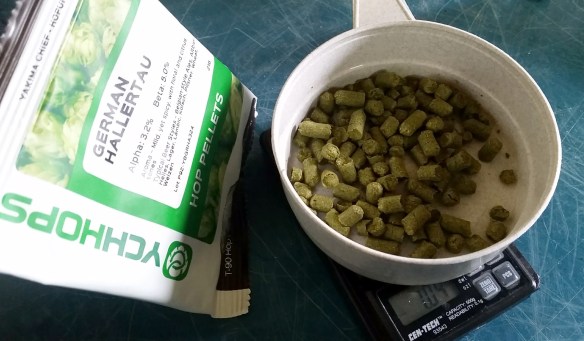
  • 1.5 oz. German Hallertau hop pellets (3.2% alpha), 60 minute boil
  • 0.5 oz.German Hallertau hop pellets (3.2% alpha), 10 minute boil
  • 1 Whirlfloc tablet, 10 minute boil
  • 1 tsp. Fermax yeast nutrient, 10 minute boil
  • 1 pkg. Southern German Lager yeast (WLP838, White Labs)

Target Parameters

  • Multiple infusion and single decoction mash, 20 minute rest at 130°, infusion to hit 45 minute rest at 148°, thick decoction to raise temperature to 168°. Batch sparge.
  • Water built from R.O., to hit 44 ppm Ca, 2 ppm Mg, 22 ppm SO4, 68 ppm Cl, and 5 ppm bicarbonate.
  • 1.046 o.g., 1.010 f.g., 4.8% abv, 19 IBU, 4 SRM, 5.5 gallons into fermenter

Procedure

  • Several days in advance, I made a 2L starter, let it run for 2 days, and then cold-crashed.
  • I calculated that I would need 9.2 gallons of water, so weighed out 1 g of gypsum, 0.7 g of epsom salt, 5.4 g CaCl, and 0.3 g baking soda for my mineral additions. I split these into 2 parts. Half of the mass will go into the strike water and half into the sparge water.
  • I added 2.45 gallons of water at 148° to my mash tun, and let the mash tun warm up until it hit 143°. Then, I added my grains, and achieved my target acid rest temperature of 143°.
  • After 20 minutes, I added 1.5 gallons of water at 186°, to hit a mash temperature of 146°. It was down to 143° after 35 minutes, and at more or less the same temperature after 45 minutes total. I decocted 1.5 gallons of a medium-thick mash, brought it to a boil, boiled for 10 minutes, and added it back in to the mash to hit a mash-out temperature of 163°. I let this sit for 10 minutes before draining the mash tun to collect the first runnings.
  • I added 5.25 gallons of water at 180°, let the mash sit for 10 minutes, vorlaufed, and collected the second runnings.
  • In total, I collected 7.6 gallons of wort with a gravity of 1.044–that’s 90% mash efficiency! I chalk it up to the decoction, and that’s awesome, but the end result would be too high in gravity. So, I added 1 gallon of RO water to dilute everything down to 1.040 and get 8.6 gallons.
  • I targeted a 90 minute boil time. Once I started the boil, I thus waited 30 minutes before adding the first round of hops. Other hops and additions were made per the schedule in my recipe.
  • Nine minutes before flame-out, I checked gravity again and saw that it was at 1.048, a touch higher than my target. So, I added another 0.5 gallon of RO water.
  • After flame-out, I chilled the wort down to 72°, and got ready for the transfer.
  • There was a lot of wort, so I drained the first gallon of trub off in order to keep the portion going into the fermenter fairly clean. Even with this, I ended up with just under 6 gallons of wort in the fermenter.
  • I popped the fermenter into my fermentation chamber, and set it for the final chill down to 45°. Once I hit this (about 6 hours later), I pitched the yeast and set the temperature to 50°.
  • I brewed this beer on 7 January 2017. It had a starting gravity of 1.047 (just a touch above target).
  • I had minor signs of fermentation within 24 hours and fairly good krausen within 48 hours. Three days into fermentation, we lost power for ~16 hours. The fermentation was thus unregulated for that stretch. I wasn’t able to check on the beer (being laid up in bed with a bad cold), but presumably the temperature went up just a touch (although the ambient temperature remained around 60°).
  • I did a check on the beer on 15 January 2017. There was a strong sulfur aroma coming from the fermenter. The gravity was 1.020, for 56% apparent attenuation. On this day, I raised the fermentation temperature to 52°. Fortunately, I didn’t detect any off (e.g., fruity) flavors in the beer, so I am satisfied that the brief power loss wasn’t too detrimental.
  • My planned fermentation schedule is 7 days at 50°, 7 days at 52°, 7 days at 54°, 4 days at 68°, and then a week or so at 32° before transferring to the keg for long-term lagering. This will allow me about 2 months of dedicated lagering before I serve this at Easter.