Alstadt Alt

German brewing is more than lagers and wheat ales, although I’ve certainly had fun with those lately. For my latest foray, I’m exploring the world of altbiers. I’ve brewed an Americanized version of this amber-colored ale previously, with moderately good results. However, I felt like it was time to delve once more into the classic style.
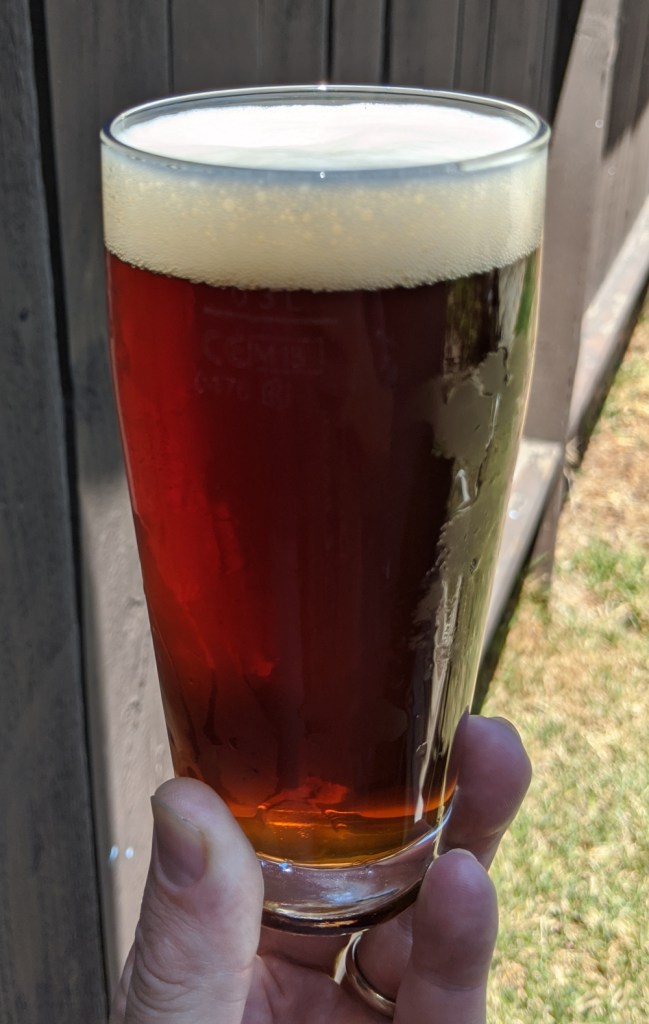
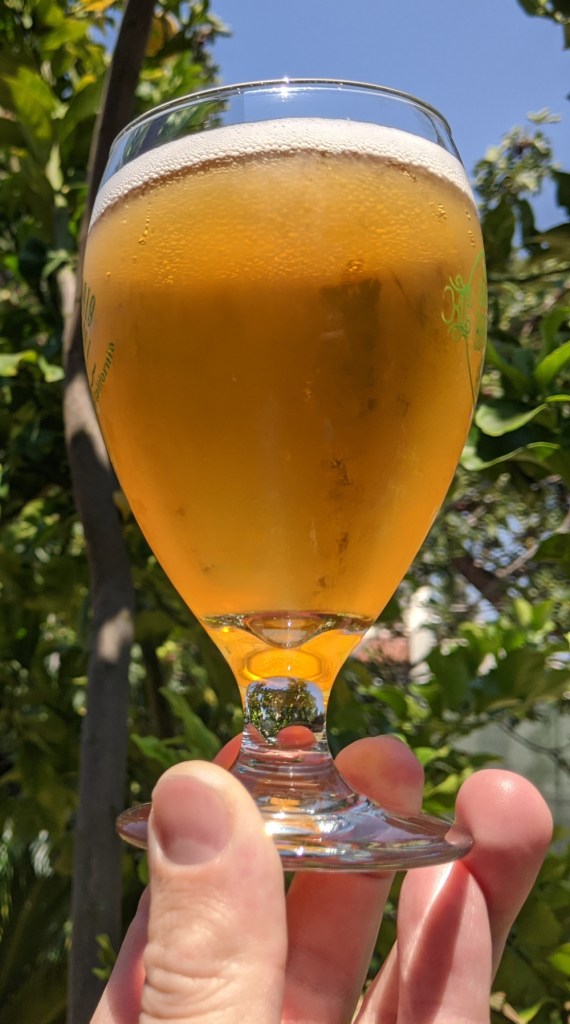
copper-colored beer with off-white head in clear glass, held aloft in hand

I started with the book on altbier by Horst Dornbusch. This volume is part of the Classic Beer Style series from Brewers Publications–I really love them because they are compact, informative, and full of recipes. Some of the books (like the altbier one) are over 20 years old now, which does make me wish for a minor polish to reflect advances in malts and yeasts available to homebrewers nowadays. Nonetheless, the series provides a really nice way to cut straight to the point of a style.

The altbier book has nine recipes of varying grain bills and starting gravities, so I started with something of lower alcohol and straightforward composition. This recipe was Alstadt Alt (p. 100 of the book), described as being typical of the style served in Düsseldorf. The recipe clocks in at 1.048 o.g., 4.8% abv, and 40 IBU. Its grain bill is fairly simple, with 60% “two-row malt,” 15% Munich, 15% Vienna, and 10% crystal 60. This is an area where I think a modern update would be most needed, so I had to punt a bit on malt varieties. I settled on a pilsner malt (consistent with recommendations from elsewhere in the book), with light Munich, Vienna, and American crystal 60. I suspect a German crystal equivalent (maybe CaraMunich II) would also work for the latter, and might produce something truer-to-style (whatever that means).

Curiously, my initial formulation came a bit short of the color in the book’s recipe, at 10 SRM vs. 18 SRM. As I played around in BeerSmith, substituting Munich II for Munich I barely kicked up the color (maybe by 0.5 SRM), and same for substituting in American 2-row for the pilsner malt. I have no idea why this is; perhaps a calculation error by the author? So, I added a touch of Carafa Special III to bring the color more closely to style (14 SRM). This is still a tiny bit lighter than the original recipe (18 SRM), but I thought would be just fine.

In any case, this was a fun batch to brew and a fun style to drink. I’ll be making more altbiers in the future!

Alstadt Alt

  • 6.25 lb. Superior Pilsen malt (Great Western)
  • 1.75 lb. Munich I malt (Weyermann)
  • 1.75 lb. Vienna malt (Great Western)
  • 1.25 lb. Crystal 60 malt (Great Western)
  • 2 oz. Carafa Special III
  • 0.75 oz. Magnum hop pellets (13.2% alpha), 60 minute boil
  • 0.5 oz. Mt. Hood hop pellets (4.6% alpha), 5 minute boil
  • 1 tsp. Fermax, 10 minute boil
  • 1 Whirlfloc tablet, 5 minute boil
  • 1 pkg. German Ale/Kolsch yeast (White Labs WLP029), repitched slurry from my kölsch

Target Parameters

  • 60 minute infusion mash, 152°, batch sparge
  • 1.049 o.g., 1.011 f.g., 5.0% abv, 34 IBU, 14 SRM
  • Claremont tap water

Procedure

  • I mashed in with 3.75 gallons at 162°, to hit a mash temperature of 151°. It was down to 149° after 30 minutes.
  • After a 60 minute mash, I added 1.3 gallons of water at 185°, let sit for 10 minutes, vorlaufed, and collected first runnings.
  • Next, I added 3.75 gallons of water at 185°, let it sit for 10 minutes, vorlaufed, and collected the second runnings.
  • In total, I collected 7.1 gallons of runnings with a gravity of 1.039, for 68% efficiency. This was a touch lower than expected, but we’ll just roll with it!
  • I brought the kettle to a boil, boiling for 60 minutes and adding hops and finings per the schedule.
  • After 60 minutes, I chilled down to 75°, transferred to the fermenter, and chilled down to 65° in the fermentation chamber.
  • Once the wort was at temperature, I pitched a slurry of yeast I had saved from my kölsch-style ale. Fermentation kicked off pretty quickly.
  • I brewed the beer on 9 May 2020, and it had a starting gravity of 1.047.
  • Fermentation was at 65° for around the first two weeks, and then I pulled it out to ambient for the rest of the fermentation.
  • I kegged the beer on 11 June 2020, adding 2.9 oz. of corn sugar in 1 cup of water. I had nearly a full keg, which was nice.
  • Final gravity was 1.012, for 4.6% abv.
  • I kept the keg at 66° until 20 June 2020, when I put it into the lagering chamber to cold crash at 33°. I also hooked it up to CO2 gas directly, to finish out carbonation to the desired level (~2.6 volumes of CO2).
  • As expected for the German ale yeasts, flocculation was pretty minimal, so on 22 June 2020, I added 1/2 tsp. of gelatin dissolved in 1/2 cup of water and held at 150° to pasteurize. In other circumstances, I might have been more patient, but I had a tap open up on my keezer, and wanted to fill the space!

Tasting

  • Appearance
    • Deep copper in color and clear, with an ivory-colored and relatively persistent head. The head starts pretty tall, but settles to a thin blanket as the beer warms up.
  • Aroma
    • Lightly bready aroma, slightly crusty, with a touch of caramel; maybe a hint of hop spice, but the aroma is decidely on the malty side. I don’t really pick up anything in the realm of yeast character.
  • Flavor
    • Bready malt character, very nice; moderate and firm bitterness, but the balance of the beer is nicely balanced between malt and hop (maybe slightly tilted towards the hoppy side). The beer is surprisingly light and quaffable. Hop character is pretty clean, with a spicy character. The finish is smooth, with an extended yet pleasant bitterness.
  • Mouthfeel
    • Moderately light body, moderate carbonation; finish is moderately dry but not overly so. This beer drinks very smoothly, especially as it has conditioned.
  • Would I brew this again?
    • This is a nice recipe…I’d definitely give it a try again! I would like to try it with an all-German grain bill, especially to substitute in CaraMunich II for the crystal 60. I like that this beer has plenty of malt character, without being cloying. It’s a pretty solidly drinkable summer amber beer. My perceptions of the beer match up partially with how it is described in the recipe. The beer is described as medium-coppper in color, and I perceive mine as a deep copper (there is no way their color value of 18 SRM isn’t amber!). Hop character is maybe a bit lower on mine (I don’t perceive much, and the recipe is described as having “a light hoppy nose”). In terms of the BJCP guidelines, it hit those pretty darned well. It could maybe have a touch more hop character in the aroma, but there is very little I would change about this beer otherwise. It’s a winner!
  • Overall
    • 9/10

Adalatherium Pale Ale

This is another kitchen sink beer, clearing out some malt and hops. In terms of overall goals, I aimed for a session beer with a bit of malt character, and hops that were present but not overpowering. The recipe is a mix of English and American ingredients, with Windsor yeast and citrusy American hops. I did a “Short and Shoddy” approach (ala Brulosophy), with a 30 minute full volume mash and 30 minute boil.

The name honors the recently named Adalatherium–an unusual mammal that lived in Madagascar around 70 million years ago. The skeleton used to sit across the hall from my office in grad school, and I spent more than a bit of time in the original field area as a student. In Malagasy, “adala” means “crazy”, and that also seemed to match up with the scattershot blend of ingredients here.

Adalatherium Pale Ale

  • 6.75 lb. Maris Otter malt (Crisp)
  • 2.75 lb. Superior Pilsen malt (Great Western)
  • 0.5 lb. Vienna malt (Great Western)
  • 0.5 lb. crystal 40 2-row (Great Western)
  • 0.85 oz. Warrior hop pellets (15.8% alpha), 30 minute boil
  • 1 Whirlfloc tablet, 5 minute boil
  • 0.5 oz. Simcoe hop pellets (13.6% alpha), 5 minute whirlpool
  • 2 pkg. Windsor yeast (Lallemand)
  • 1 oz. Citra hop pellets (12% alpha), dry hop in keg
  • 1 oz. Mosaic hop pellets (10.9% alpha), dry hop in keg

Target Parameters

  • 1.048 o.g., 1.013 f.g., 4.5% abv, 36 IBU, 7 SRM
  • Infusion mash, 156° for 30 minutes, full volume
  • Claremont tap water adjusted with lactic acid and mineral additions, to achieve calculated water profile of 56 ppm Ca, 24 ppm Mg, 94 ppm Na, 107 ppm sulfate, 110 ppm Cl, 210 ppm bicarbonate, 172 ppm Alkalinity

Procedure

  • I mashed in with 8 gallons of unadjusted tap water at 161° and 0.5 tbs. of 88% lactic acid, to hit a mash temperature of 155°. After 30 minutes, it was down to 154°.
  • I vorlaufed, and collected the runnings, with 6.6 gallons into the kettle and a gravity of 1.046, for 77% efficiency.
  • As I brought the runnings to a boil, I added 3 g of epsom salt and 2 g of gypsum.
  • I boiled for 30 minutes, adding hops and finings as in the recipe.
  • At the end of the boil, I added the Simcoe hops and whirlpooled for 5 minutes, before chilling.
  • I chilled down to 75° or so, and transferred to the fermenter (with aeration). Once the fermenter was down to 66°, I pitched the yeast.
  • Starting gravity was 1.052. I brewed this beer on 3 May 2020.
  • After 6 days at 66°, I pulled out the fermenter and let it finish at ambient temperature.
  • I kegged the beer on 30 May 2020, adding the dry hops in a baggie and 3 oz. of corn sugar (in a cup of boiling water). I sealed the keg, added a bit of CO2, and let it condition at room temperature for 2 weeks.
  • Final gravity was 1.013, down from 1.052, for 5.1% abv.

Tasting

  • Appearance
    • Medium gold in color; after about 2 weeks on tap, it has dropped clear. The head is off-white and modestly persistent.
  • Aroma
    • Plenty of yeast character, with some definite pear ester alongside the hop aroma. The hops have a bit of tropical fruit character.
  • Flavor
    • Hop bitterness is moderately high, but well balanced against the malt. The malt comes through with a bit of biscuity flavor, which is pretty nice. I get a lot of the pear-like yeast esters, which almost swamp out the citrus note on the hops.
  • Mouthfeel
    • Medium body, smooth finish without being biting. Moderate carbonation.
  • Would I brew this again?
    • If I did, I would steer clear of Windsor, and use US-05 or a similarly clean yeast. The yeast character on Windsor is interesting, but the esters clash with the citrusy, tropical notes on the hops. The malt bill is good, and I think makes a nice base otherwise. I would try this recipe pretty close to what it is, just with different yeast. I’m also disappointed by how Windsor clears, or doesn’t clear. It was a hazy mess when first on tap, and took two weeks to really clear up. I expected a bit more to drop out in the fermenter, and that just didn’t happen. The esters are super interesting, and I might poke at them for some other recipes, but as a whole I think I prefer Nottingham for my English ale needs.
  • Overall
    • 5.5/10

The Celtic Elk Stout 1.1

Nearly five years ago, I made an Irish stout that tasted great and did well in competition. I gave another go this year, seeking a dark beer with lots of flavor but not a lot of booziness. It was a success!

The recipe is basically the same as last time, just with some minor ingredient adjustments.

The Celtic Elk Stout 1.1

  • 6 lb. Maris Otter malt (Crisp)
  • 1.5 lb. flaked barley
  • 13.6 oz. crystal 75 malt (Great Western)
  • 12 oz. roasted barley (Briess)
  • 10 oz. chocolate malt (Briess)
  • 4 oz. crystal 10 malt (Briess)
  • 3 oz. Blackprinz malt (Briess)
  • 3 oz. Carafa Special III malt (Weyermann)
  • 3 oz. rice hulls
  • 0.65 oz. Warrior hop pellets (15.8% alpha), 60 minute boil
  • 1 Whirlfloc tablet, 5 minute boil
  • 1 pkg. Irish Ale Yeast (WLP004)

Target Parameters

  • 1.045 o.g., 1.014 f.g., 4.1% abv, 35 IBU, 39 SRM
  • Infusion mash, 156° for 60 minutes, batch sparge
  • Claremont tap water

Procedure

  • The night before brewing, I made a 0.75 L starter, and let it run on the stir plate.
  • I mashed in with 3.5 gallons of water at 168°, to hit a mash temperature of 156°.
  • After 60 minutes of mashing, I added 1.5 gallons of water at 185°, let sit for 10 minutes, vorlaufed, and collected the first runnings. Next, I added 3.75 gallons of water at 185°, let sit for 10 minutes, vorlaufed, and collected the second runnings.
  • In total, I collected 7.5 gallons of runnings with a gravity of 1.045, for 87% efficiency! This was way too high, so I removed 0.5 gallons of runnings and added 0.5 gallons of tap water, to hit 1.041. This was much better. I saved 2 cups of this to use in bread (and it made tasty bread!).
  • I brought the kettle to a boil, adding hops and finings per the schedule. After 60 minutes, I turned off the flame and chilled the wort.
  • Once the wort was down to around 75°, I transferred to the fermenter and chilled the rest of the way down to 66°. Finally, I pitched the yeast.
  • I brewed this beer on 18 April 2020. Starting gravity was 1.050.
  • I fermented the beer at 66°, and kegged the beer on 25 April 2020. To save some CO2 and try keg conditioning, I primed the keg with 2.1 oz. of corn sugar in boiling water.
  • Final gravity was 1.019, for 4.1% abv.

Tasting

  • Appearance
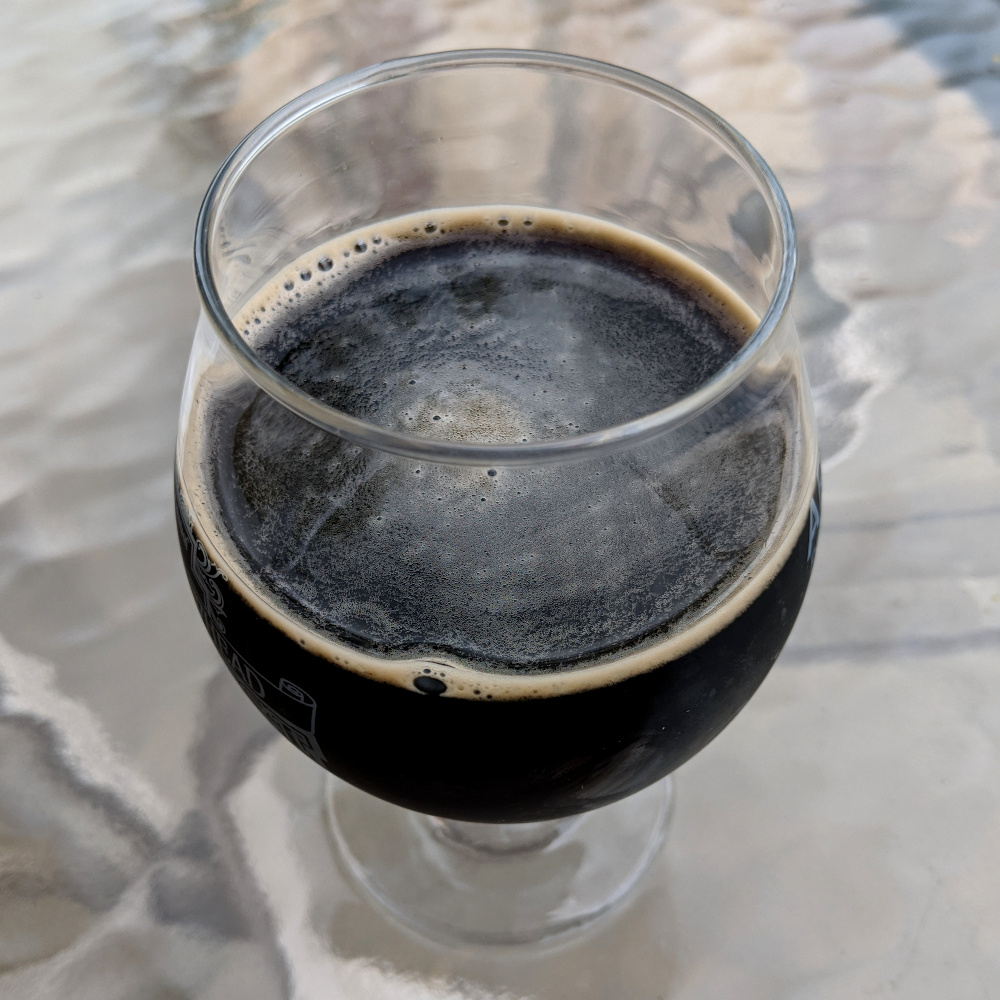
    • Dark! Black in the glass, and a deep, dark brown if you get a thin sliver of beer. Thin but persistent brown head.
  • Aroma
    • Rich aroma of chocolate with a touch of roasted coffee. There are hints of dried cherry behind that; I don’t think it’s esters (because the flavor of the beer is pretty clean in terms of yeast character), but a synergistic effect of the dark malts. I like it!
  • Flavor
    • Roasted coffee character at the outset, with a touch of dark chocolate behind that. There is a really nice coffee-type bitterness from the malt than creeps in alongside the hop bitterness. Hop bitterness is clean. The flavor is malt forward, with hops secondary, until the finish. There is an extended, slightly bitter (but not unpleasant) finish.
  • Mouthfeel
    • Dry, medium-light body, moderate carbonation.
  • Would I brew this again?
    • This is a great recipe, and a fine interpretation of the style. I think my modifications were okay overall, although I’ll replace the Carafa III with all debittered black malt next time, and use pale chocolate instead of regular chocolate malt, because the malt was just a little too much chocolate and not enough roast. As the beer matures, it has really come into its prime. I rushed it just a touch to get it on-tap, and so it had a hint of sweetness at first from the corn sugar used for priming (at least I think that’s what I was experiencing). That’s gone away now. This recipe produces a really quaffable beer, and the low alcohol level (4.1% abv) isn’t really a flavor/mouthfeel detriment thanks to the malt character.
  • Overall
    • 9/10

Humboldt’s Hefeweizen

It has been a loooooong time since I’ve brewed a German hefeweizen / weissbier. In fact, my records show that I’ve only done it once, over five years ago. That attempt was all-extract, and turned out reasonably well.

I’ve been thinking about this style because I wanted something that turns around quickly, has a ton of character, and is low alcohol enough to be enjoyed as a session beer on warm days. Plus, I’ve really been into German styles lately–what’s not to like?

The recipe more or less follows Gordon Strong’s weissbier recipe from the March/April 2020 issue of Brew Your Own magazine (recipe here, behind paywall). I liked its simplicity, and that it could be done fairly well with an infusion step mash. I added in a touch of melanoidin malt, to use up a lingering handful, and used up some extra wheat malt, too. The recipe called for a ferulic acid rest (to maximize clove character), and I was willing to give that a try in the interest of science.

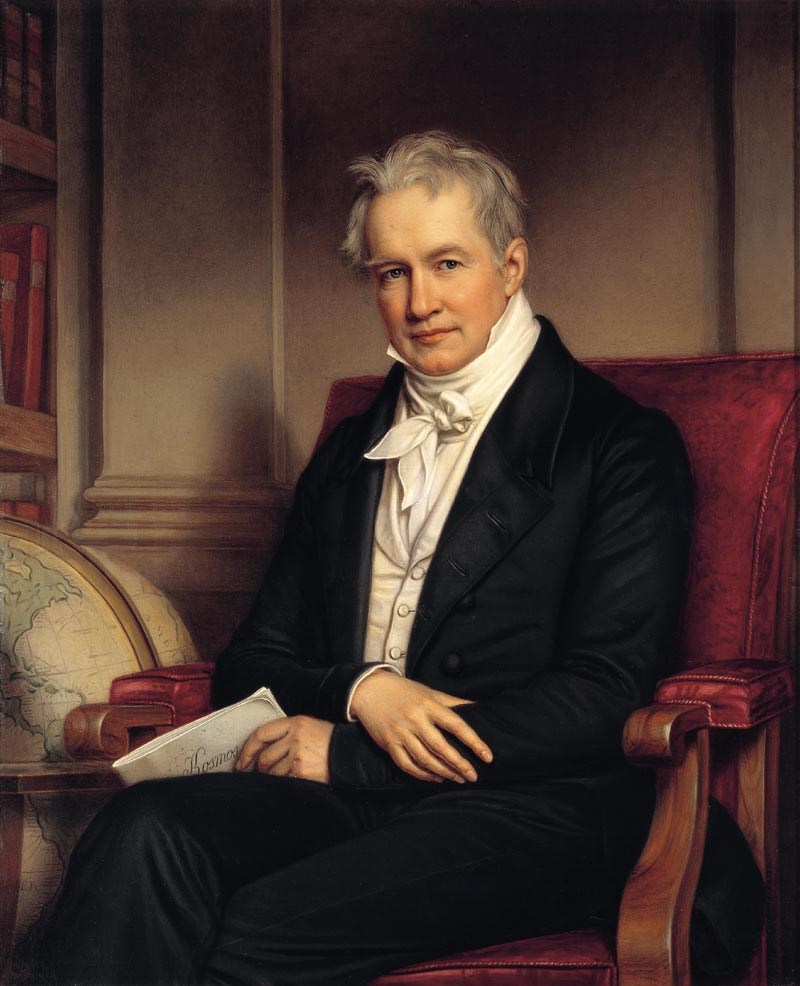
The name–Humboldt’s Hefeweizen–honors German scientist Alexander von Humboldt. I recently finished a biography about him (Andrea Wulf’s Invention of Nature–highly recommended!), and I was fascinated by his intellectual and cultural influence, as well as his incredible dedication to documenting knowledge. This dude has a ton of animals and plants bearing his name, bestowed by the scientific community. There’s a Humboldt Penguin, and a Humboldt Squid, and a Humboldt’s Sapphire Hummingbird. Why not a Humboldt’s Hefeweizen? I don’t know that he necessarily drank much of the stuff when he was alive, but he probably didn’t eat many penguins, either.

Humboldt’s Hefeweizen

  • 4.75 lb. Superior Pilsen Malt (Great Western)
  • 4 lb. white wheat malt (Briess)
  • 1.25 lb. white wheat malt (Great Western)
  • 1.6 oz. melanoidin malt (Weyermann)
  • 0.25 oz. Magnum hop pellets (13.2% alpha), 60 minute boil
  • 1 pkg. Hefeweizen Ale yeast (WLP300, White Labs)

Target Parameters

  • 1.047 o.g., 1.010 f.g., 4.9% abv, 11 IBU, 4 SRM
  • Infusion mash; 15 minute acid rest at 116°; 30 minute saccharification rest at 149°; 30 minute saccharification rest at 158°, batch sparge
  • Claremont tap water with mineral additions, to hit target water profile of 80 ppm Ca, 9 ppm Mg, 23 ppm Na, 58 ppm SO4, 50 ppm Cl, 220 ppm HCO3; RA=118 pm

Procedure

  • The night before brewing, I spooled up a 1.25L starter for the yeast.
  • On brew day, I mashed in with 2 gallons of water at 129°, to hit 119° for the acid rest. This is a touch higher than I wanted, but still within the acceptable parameters for an acid rest.
  • After 15 minutes, I added 1.6 gallons of water at 202°, to hit a 149° mash temperature. I added 4.5 mL of lactic acid at this time, and let it rest for 30 minutes.
  • Next, I added 1.6 gallons of water at 185°, to raise the mash temperature to 152°. I had been hoping for a little warmer (158°), but will settle for this. After 30 minutes, I collected the first runnings.
  • I added 3.6 gallons of water at 185°, let it rest for 10 minutes, and collected the second runnings.
  • In total, I collected 7.2 gallons of runnings with a gravity of 1.040, for 75% mash efficiency.
  • I brought the runnings to a boil, adding the hops per the schedule. After 60 minutes, I turned off the flame and began chilling.
  • I transferred the wort into the fermenter, and chilled it further in my fermentation chamber. Once I hit 62°, I pitched the yeast.
  • I brewed this beer on 26 April 2020, and kept the 62° temperature for the first four days of fermentation. I ramped up to 67° on 30 April.
  • On 3 May 2020, I brought the beer out to ambient temperature, which was around 72°, to finish out fermentation.
  • I kegged the beer on 5 May 2020, adding 3.61 oz. of corn sugar. This should hit a target carbonation volume of ~3.4 volumes. After a week, I hooked it up to the gas in my keezer, carbonating the last little bit in there.
  • Starting gravity was 1.045, and final gravity was 1.013, for 4.3% abv.
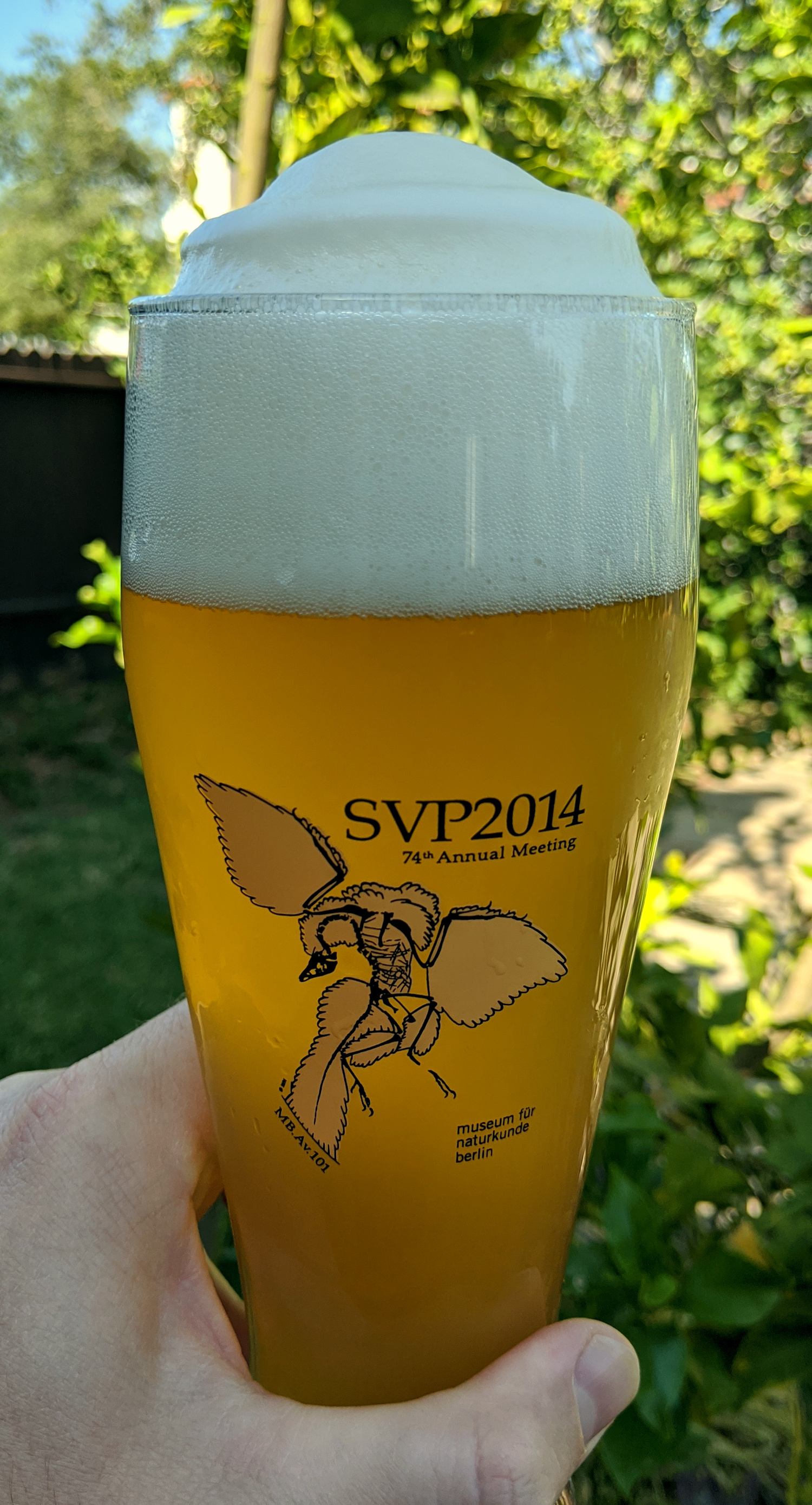
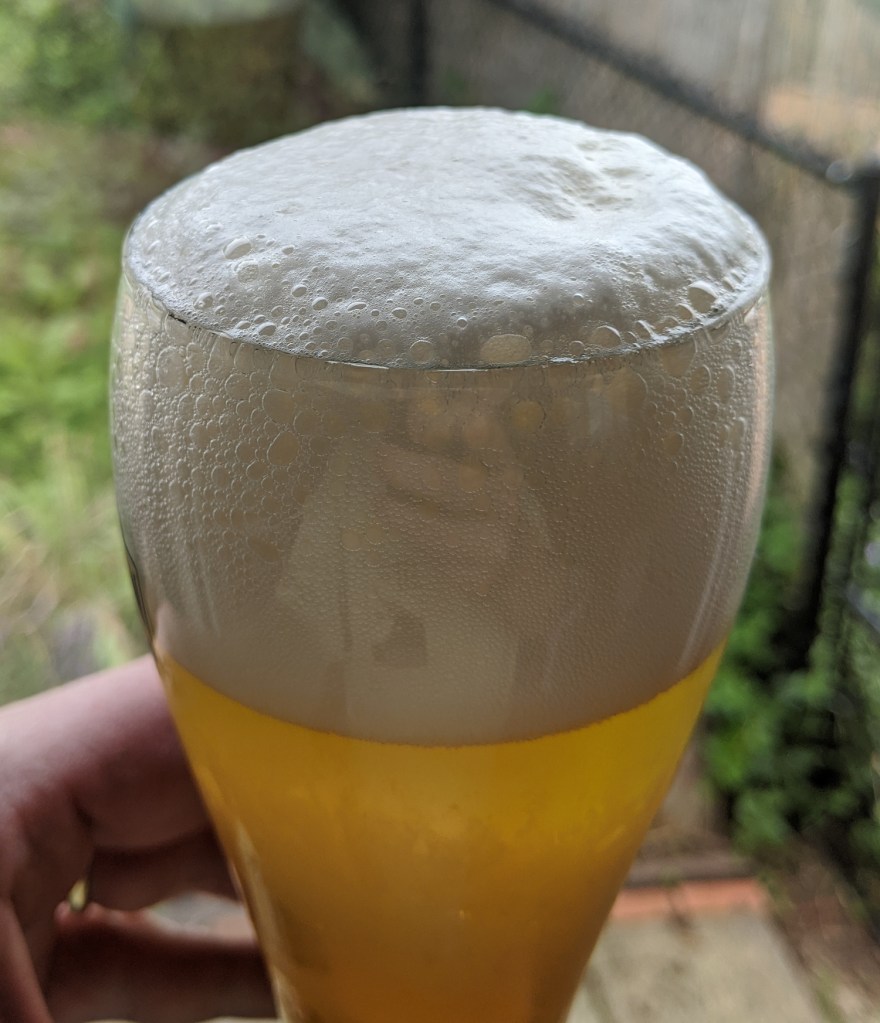
yellow beer with fluffy white head, in weizen glass with SVP2014 on front with picture of fossil Archaeopteryx, held by hand in green yard

Tasting

  • Appearance
    • Creamy white head, persistent; doesn’t always pour consistently tall, though (gotta work on the head factor). I seem to do better if I let the beer line rest for 10 minutes between pours, to let CO2 out of solution and encourage some foam. Very hazy light gold beer.
  • Aroma
    • Tart aroma, with light bubblegum and clove. (no banana) Lots of yeast character!
  • Flavor
    • Light and smooth, with very low, subtle hop flavor. Slightly tart, with a mild bite coming from high level of carbonation that offsets the malt. Moderate clove, slight banana, very slight bubblegum in the yeast character. Malt character is light and somewhat bready, with a residual sweetness.
  • Mouthfeel
    • Medium-light body, creamy on tongue, with high carbonation, very slightly dry finish.
  • Would I brew this again?
    • This is a really nice weissbier! I think the freshness, malt balance, and high carbonation come together pretty well. I like that I dodged the super-banana (sometimes to the level of stomach-churning) character of wheat beers fermented at higher temperatures, so there’s not much I would change on that end. The yeast character is pretty nice here, too. My one disappointment concerns the level of head; depending on my pour (and how long the beer has sat in the lines between pours, with a greater length of time encouraging more foam), I don’t get quite as tall of a head as consistently as I would like. I wonder if the low temperature initial mash rest had a detrimental effect in this regard (in terms of breaking down the relevant proteins just a bit too much). Or maybe it’s how I’m pouring? Or maybe I am expecting more head than is realistic in a typical setting? I might add in a touch of flaked wheat to address head character next time.
    • As a style, I’m definitely coming back to this one. It’s super flavorful, packing in a ton of character without a ton of alcohol. That’s perfect for enjoying on a summer afternoon!
  • Overall
    • 8.5/10

Schell’s Pils Clone 1.1

Last year, one of my favorite recipes was a clone of Schell’s Pils, a German-style pilsner from Minnesota using 2-row malt rather than pilsner malt. I decided to have another go at this recipe, but with a few minor modifications in the ingredients.

Schell’s Pils Clone 1.1

  • 11.5 lb. 2-row malt (Great Western)
  • 0.25 lb. Carapils malt (Briess)
  • 1 oz. Mt. Hood hop pellets (4.6% alpha), first wort hopping and 60 minute boil
  • 0.75 oz. Mt. Hood hop pellets (4.6% alpha), 60 minute boil
  • 0.75 oz. Mt. Hood hop pellets (4.6% alpha), 20 minute boil
  • 0.5 oz. Sterling hop pellets (7.4% alpha), 5 minute boil
  • 1 tsp. Fermax yeast nutrient, 10 minute boil
  • 1 Whirlfloc tablet, 5 minute boil
  • 1 repitch of German lager yeast (White Labs WLP830)

Target Parameters

  • 1.052 o.g., 1.011 f.g., 5.4% abv, 38 IBU, 4 SRM
  • 60 minute infusion mash, 152°, batch sparge
  • Water built up from RO, to hit target water profile of 59 ppm Ca, 8 ppm Mg, 89 ppm SO4, 63 ppm Cl; RA=-47ppm

Procedure

  • I built up my RO water with 1.86 g CaCl, 1.45 g gypsum, and 1.2 g Epsom salt in total with 8.5 gallons of RO water.
  • I mashed in with 4 gallons of water at 163.5°, to hit a mash temperature of around 152°. After 60 minutes, I added 1.1 gallons of water at ~185°, let sit for 10 minutes, vorlaufed, and collected the first runnings.
  • I next added ~3.6 gallons of water, let sit for 10 minutes, vorlaufed, and collected the second runnings.
  • In total, I collected 7.25 gallons of runnings with a graviy of 1.045, for 77% mash efficiency.
  • I brought the kettle to a boil, adding the hops, nutrient, and finings per the schedule.
  • After a 60 minute boil, I chilled the wort down to ~75°, and transferred to the fermenter.
  • I chilled the wort in my fermentation chamber down to 49°, oxygenated with 30 seconds of pure O2, and pitched a culture of yeast from a previous batch (my Crystal Pils, harvested about 6 weeks prior).
  • I fermented at 52°, for just under a month.
  • Starting gravity was 1.053, on 7 March 2020.
  • I didn’t change the temperature at all during the duration of fermentation, figuring that any lingering off-flavors would be cleaned up during this time.
  • I kegged the beer on 4 April 2020. Final gravity was 1.010, for 5.7% abv.

Tasting

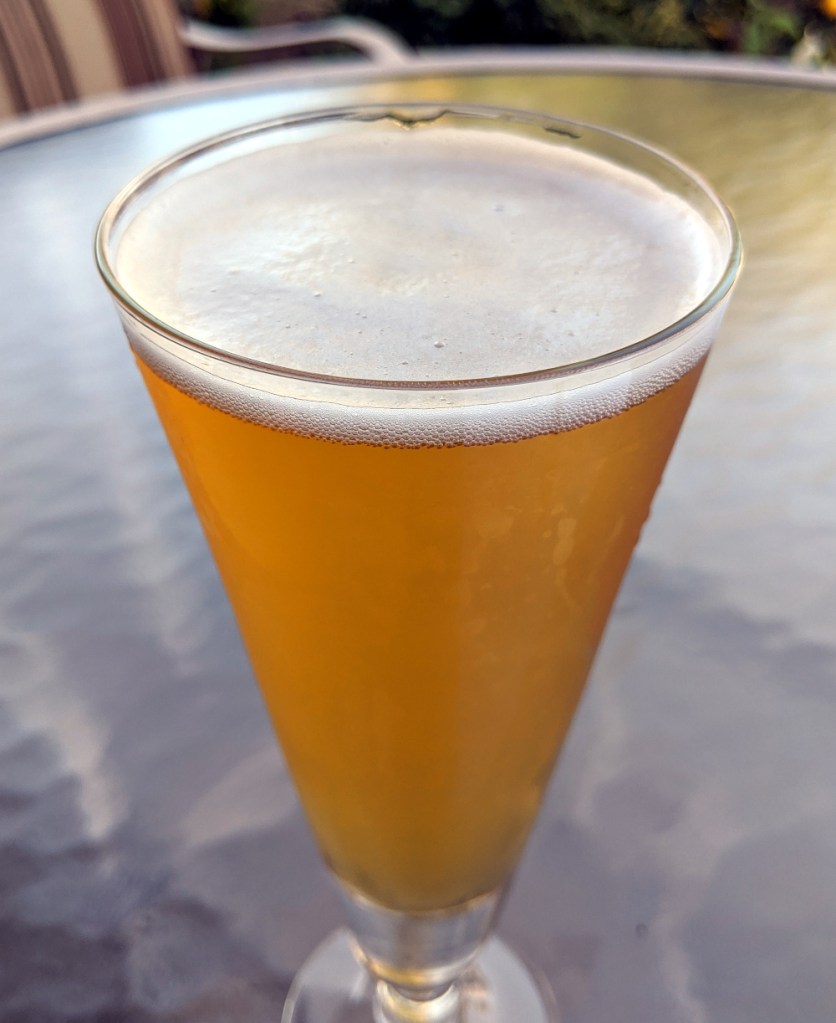
golden beer with white head in conical pilsner glass
  • Appearance
    • Thick white head, pretty persistent. It pours well, and sticks around, too. The beer itself is light yellow and pretty clear (but not quite brilliant).
  • Aroma
    • Lightly spicy hop character, slight grainy-sweet malt character.
  • Flavor
    • Definitely hop dominant, with an assertive hop presence that is on the tongue well after finishing the sip. Malt character is smooth and slightly doughy, but definitely in the background…almost too much so.
  • Mouthfeel
    • Off-dry, moderately high carbonation, with a lingering bitter finish.
  • Would I brew this again?
    • For my tastes, I liked the first batch much better. This version is still a pretty good German pils, but definitely a touch more bitter than I care for in this style. It just overwhelms the malt too much. I think I’ll go back to my hopping schedule from the previous version. The hop/malt balance was just better in that one. I’ll still keep the dry-hop out, though. I also wonder if changing from Rahr to Great Western for the malt made a difference?
  • Overall: 6.5/10