AquiloPils

Concept beers are fun–building a recipe around a story has a mix of constraint and creativity that scratches the brewer’s itch for me. A new opportunity for such a beer popped up recently, when a little dinosaur with which I am very familiar unexpectedly wandered into the spotlight. Aquilops (pronounced “uh-QUILL-ops), a raven-sized cousin of Triceratops that lived in Montana around 106 million years ago, is somehow going to make an appearance in the upcoming Jurassic World movie! As lead author on the original Aquilops publication (along with colleagues Rich Cifelli, Des Maxwell, and Matt Wedel), this was quite a surprise. The 12 year old me who watched Jurassic Park in the theater is pretty geeked out that one of “my” dinosaurs is joining the cast of a Hollywood blockbuster franchise. This dino is in Lego kits, FunkoPops, action figures, Dr. Pepper cans, and even a Scarlett Johansson ASMR video. That’s cool, but what about a beer? I can only guess that the cute dinosaur aimed selling merchandise to kids is not going to be showing up on beer cans anytime soon, so I had to take matters into my own hands.

Aquilops is no stranger to beer recipes–back when we named it, I brewed “Eagle Face Oatmeal Stout” (referencing the translation of the name from its Greek and Latin roots). The beer was served in our club booth at AHA, and even graced the pages of Zymurgy magazine. The oatmeal stout is pretty tasty, but we’re not really in oatmeal stout weather at the moment. I wanted a crisp and quaffable lager to put on tap, and thus AquiloPils was born.

The original fossil skull of Aquilops was found in Montana, and its closest known relative lived in Japan, so a pilsner with nods to classic American lagers and Japanese lagers evolved naturally. Plus, these kinds of beers are a fun technical challenge and always a crowd pleaser. I sourced Montana-grown barley malt, and Sorachi Ace hops were a perfect fit for the recipe (the ones I got from my LHBS were American-grown, which followed the theme nicely). This kind of beer needed an adjunct, so I used 10% flaked rice in the grist. I wanted a perfectly crisp and dry beer, and thus incorporated a long and low mash rest. Finally, because this is supposed to have a very clean yeast profile, I chose Novalager. The brewing process went smoothly, and after some time cold conditioning as well as a dose of Biofine Clear, the beer was brilliantly clear and incredibly tasty.

Matt–one of my co-authors on the paper, a good friend, Aquilops enthusiast, and the person who brought me on to the project in the first place–celebrated a milestone birthday recently, so I was proud to provide a keg for his party. What better way to enjoy AquiloPils than with good friends, co-authors, and a whole ton of paleontologists? It was a crowd pleaser! To celebrate, I also drafted a logo for this beer, of a little Aquilops clutching a glass of the beer. This project was fun from start to finish!

Me (left) and the birthday boy, with our cups of AquiloPils (photo courtesy Matt Wedel). Check out Matt’s musings on our critter in the movies over at the SV-POW! blog.

AquiloPils

  • 9 lb. pilsner malt (Montana Craft Malting Co.)
  • 1 lb. flaked rice (Briess)
  • 2 oz. rice hulls
  • 0.5 tsp. BrewTanB, added to mash
  • 0.4 oz. Sorachi Ace hop pellets (9.7% alpha), 60 minute boil
  • 0.5 tsp. BrewTanB, 10 minute boil
  • 1 Whirlfloc tablet, 5 minute boil
  • 2 pkg. Novalager yeast (Lallemand)
  • 1 pkg. Biofine Clear

Target Parameters

  • 90 minute infusion mash at 146°, full volume mash, with 10 minute mash-out at 168°
  • 1.044 o.g., 1.004 f.g., 5.3% abv, 15 IBU, 3.5 SRM
  • Water profile built with RO water to hit 59 ppm Ca and 105 ppm Cl.

Procedure

  • I built the water up from scratch, using 7.25 gallons of RO water and 6 g of calcium chloride to hit my target water parameters.
  • I heated the strike water to 151°, added the grains, and also added 20 mL of 10% phosphoric acid, holding the mash at 146° for 90 minutes. Then, I raised the temperature to 168° for 10 minutes, before pulling the grains.
  • In total, I collected 6.5 gallons of runnings with a gravity of 1.040, for 72% mash efficiency.
  • I brought the kettle to a boil, adding hops and finings per the recipe.
  • After a 60 minute boil, I turned off the heat and chilled the wort to 70°, before transferring it to the fermenter. I chilled the beer the rest of the way to 50° in the fermentation chamber.
  • I brewed this beer on 15 March 2025, with a starting gravity of 1.049 – well above my target!
  • Fermentation started at 52°; I increased the temperature to 54° on 17 March, and 60° on 20 March. I cold crashed the beer to 33° on 26 March and held it there until I kegged the beer using a closed transfer on 19 April.
  • Final gravity was 1.004, for 5.9% abv.
  • On 15 May 2025, the beer was still fairly hazy, so I added a package of Biofine Clear. Within a day or two, haze had almost entirely dropped out, and within three weeks the beer was brilliantly clear.

Tasting

  • Appearance
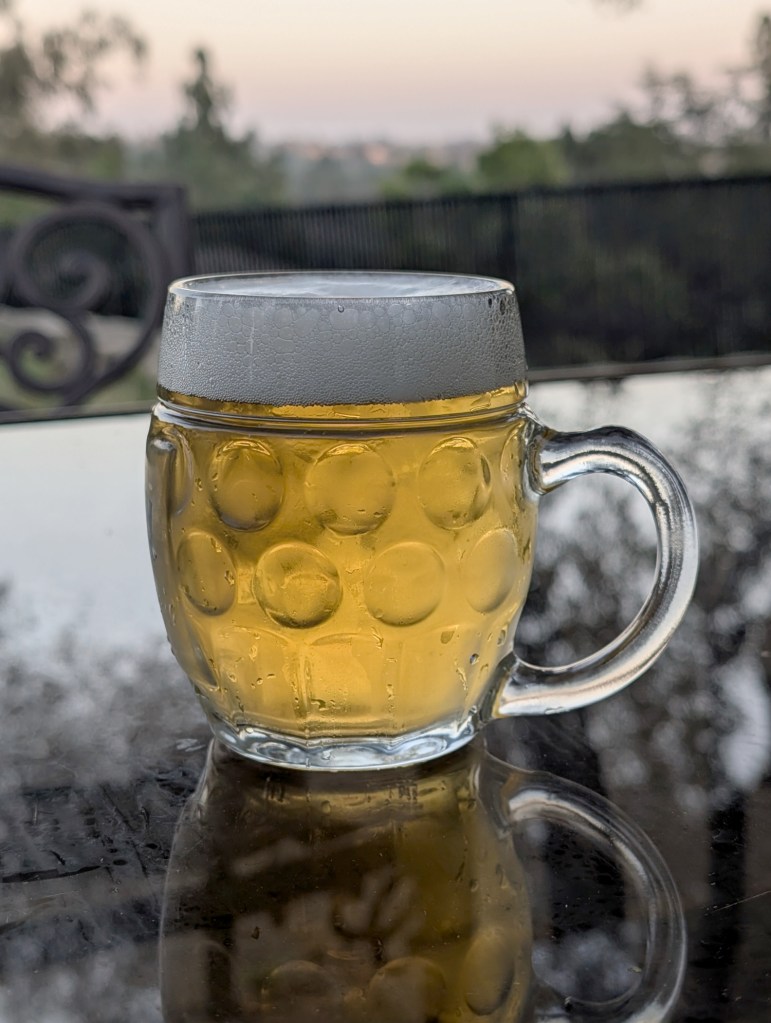
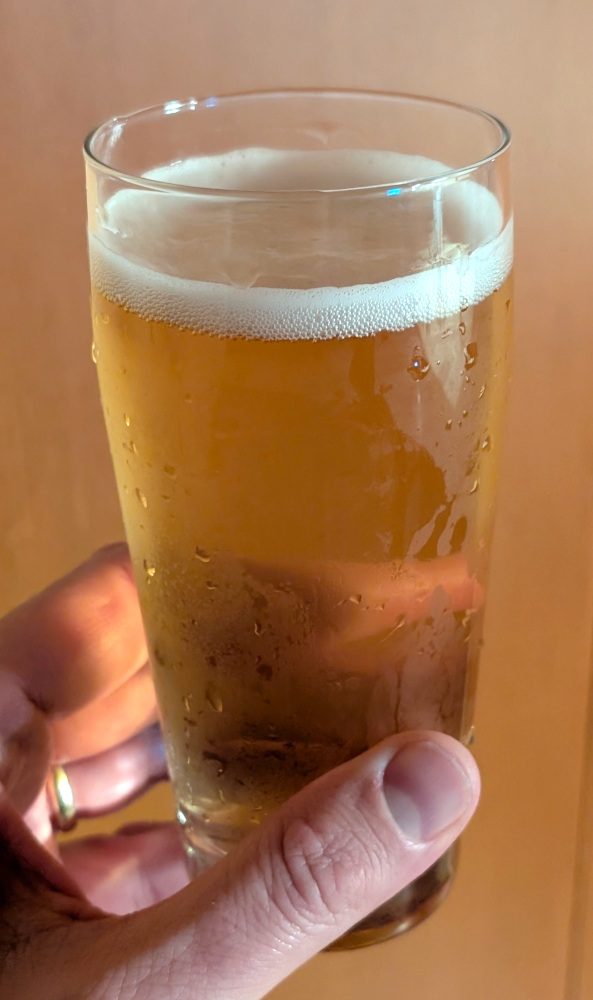
    • Brilliantly clear, straw colored beer with thin white head of low persistence.
  • Aroma
    • Medium-light sweet malty aroma, no hop or yeast character to speak of.
  • Flavor
    • Medium malty character, low bitterness, a bit of that light red apple yeast character.
  • Mouthfeel
    • Medium-high carbonation, light body, dry and crisp finish.
  • Would I Brew This Again?
    • This is pretty close to what I envisioned! It hits the gimmick well and is also super drinkable. The batch yielded a little too high on starting gravity (I was just too efficient in the mash!), so it would be good to notch that back a touch. Otherwise, it’s a perfect beer. I might also try W34/70 for a future iteration, to get more of that apple-like American lager flavor. Finally, I could up the rice percentage some to around 20%, if I wanted a better match with “typical” American lager recipes.
  • Overall
    • 9/10

Pfriem Pilsner 2024

I have done a version of this three times previously, usually with some minor variations for hops or yeast. This time, I decided to do the hop varieties and timings exactly as written (with adjustments for alpha acid), to follow the original Pfriem Pilsner clone recipe from Dave Carpenter’s Lager book. Without further ado, here’s what I did.

Pfriem Pilsner 2024

  • 9.75 lb. pilsner malt (Rahr)
  • 6 oz. Carafoam malt (Weyermann)
  • 0.5 tsp. BrewTanB, in mash
  • 0.75 oz. Perle hop pellets (6.3% alpha), 60 minute boil
  • 0.5 oz. Tettnang hop pellets (2.4% alpha), 60 minute boil
  • 0.5 oz. Tettnang hop pellets (2.4% alpha), 10 minute boil
  • 0.75 oz. Saphir hop pellets (2.3% alpha), 10 minute boil
  • 0.5 oz. Spalt Spalter hop pellets (4.3% alpha), 10 minute boil
  • 0.5 tsp. BrewTanB, 10 minute boil
  • 1 Whirlfloc tablet, 5 minute boil
  • 1.5 oz. Tettnang hop pellets (2.4% alpha), 10 minute whirlpool
  • 0.75 oz. Saphir hop pellets (2.3% alpha), 10 minute whirlpool
  • 0.5 oz. Spalt Spalter hop pellets (4.3% alpha), 10 minute whirlpool
  • 2 pkg. Diamond dry lager yeast (Lallemand)

Target Parameters

  • 1.046 s.g., 1.007 f.g., 5.1% abv, 4 SRM, 38 IBU
  • Full volume step mash, with 45 minutes at 142°, 45 minutes at 156°, and 10 minutes at 168°; 70 minute boil
  • Water built up from RO, to hit target parameters of 62 ppm Ca, 11 ppm Mg, 121 ppm SO4, and 51 ppm Cl, with RA=-50 ppm

Procedure

  • I built up my mash water from 7.5 gallons of RO water, with 3 g calcium chloride, 3 g epsom salt, and 4 g gypsum. Then, I heated it to 146° before adding the grains and holding at 142° for 45 minutes, with recirculation. Then, I raised the mash to 156° for 45 minutes and finished up at 168° for 10 minutes.
  • After the mash, I pulled the grains. I collected 6.8 gallons of runnings with a gravity of 1.041, for 74% mash efficiency.
  • I brought the runnings to a boil, boiling for 10 minutes before adding the first round of hops and proceeding with the rest of the recipe as written. In total, this was a 70 minute boil.
  • At the end of the boil, I turned off the heat, added the whirlpool hops, and whirlpooled for 10 minutes before continuing with the rest of the chill.
  • Once the beer was down to 72°, I transferred to the fermenter and chilled down to 46° in my fermentation chamber, before pitching the yeast.
  • I brewed this beer on 28 October 2024, and the starting gravity was 1.049.
  • The starting fermentation temperature was 48°, and I held it here until 3 November 2024, when I raised the temperature to 52°. On 17 November, I raised the temperature to 54°, and then to ambient (~62°) on 24 November 2024.
  • I kegged the beer on 25 November 2024. Final gravity was 1.009, for 5.3% abv.

Tasting

  • Appearance
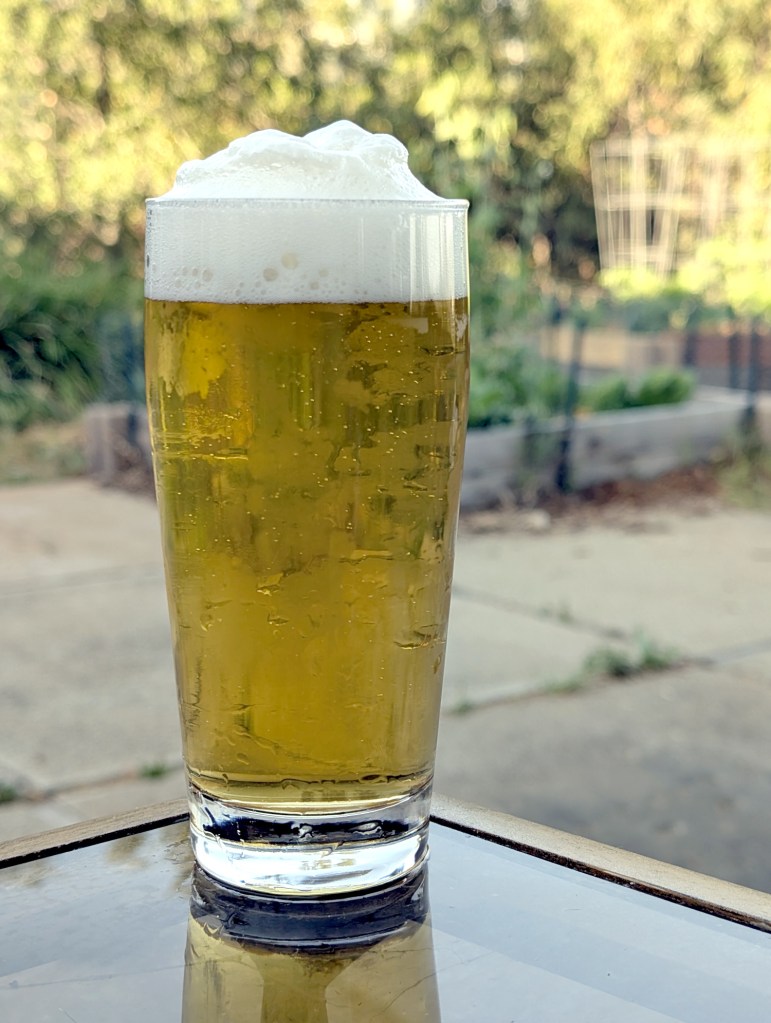
    • Clear, but short of brilliant; there is just a tiny touch of barely visible haze. It is a straw-colored beer that pours with a fine and persistent white head, which leaves some nice lacing on the glass.
  • Aroma
    • Light notes of cracker and honey in the malt, and a pleasant light floral hop aroma, with a touch of fresh hay. This beer smells awesome!
  • Flavor
    • Medium-high bitterness, grainy sweet malt character; hop flavor is lightly herbal. Minerally feel to finish out the flavor.
  • Mouthfeel
    • Medium carbonation, medium light body, dry finish. Minerally, but not unpleasantly so.
  • Would I Brew This Again?
    • I am feeling pretty good about this recipe overall. It is perhaps a touch more bitter than I prefer in all of my pils, but I like the hop aroma and malt character; the overall aroma is amazing! I wouldn’t mind a touch taller head (but that may be in the pour), and I also must ding the beer a bit for its clarity. I wonder if the persistent light haze is from the large dose of whirlpool hops? I could have used some finings, and might do that next time for a pilsner-type beer, because clarity is something important to me for these.
  • Overall
    • 8/10

Collaboration Brews – Citra Blonde Ale and Andy’s Pilsner

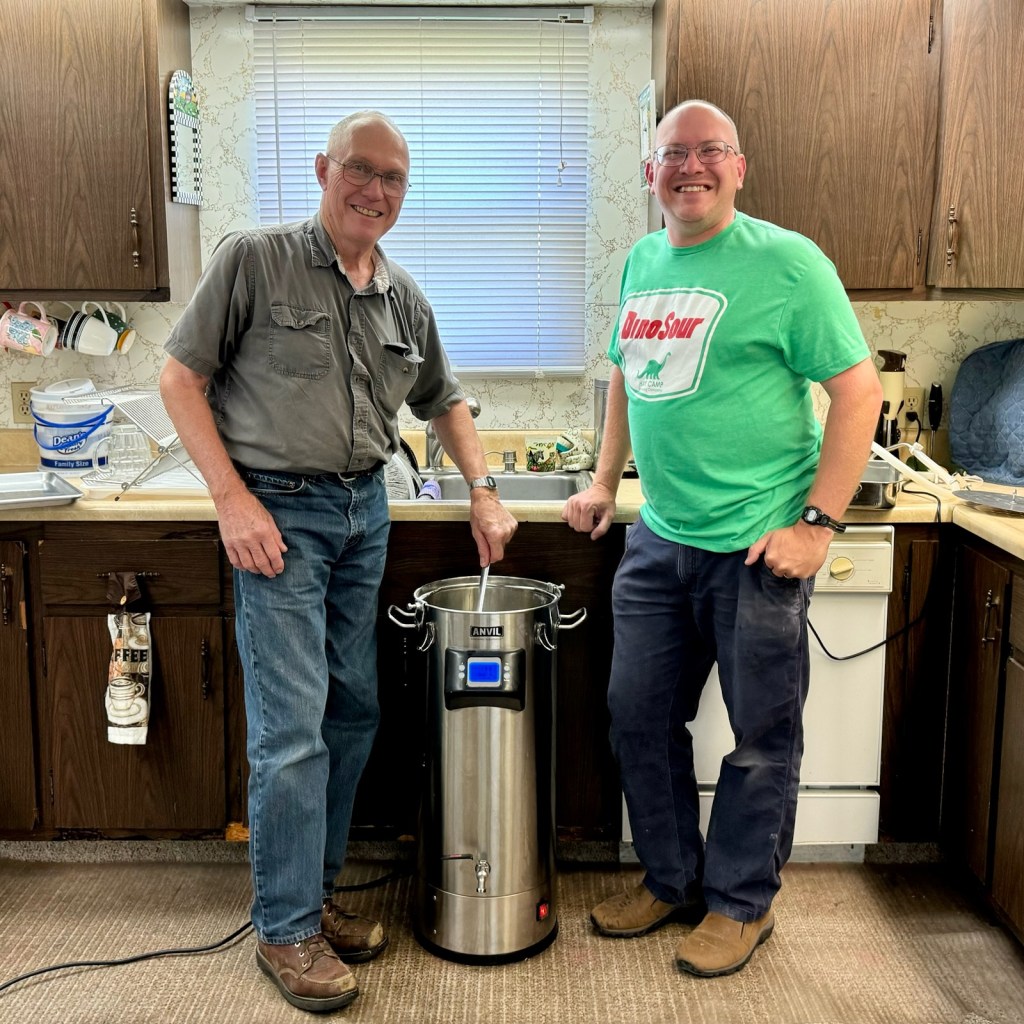
This past summer, I got to brew with my dad, who first got me thinking about brewing many years ago (I remember helping him way back as a teenager, even if I couldn’t enjoy the product at the time). He started as an extract brewer decades ago, took a break, got back into it, and then eventually switched to all-grain brewing (alongside wine making). Dad makes almost exclusively lagers, with his regular rotation including a Pre-Prohibition PIlsner and a Vienna Lager.

Dad currently brews on an Anvil Foundry 10.5 (gifted by us kids a few years back), doing a handful of batches annually to keep his cellar stocked. Awhile back, I shared my Citra Blonde Ale recipe with him, and he liked it enough to add a version into his repertoire. I also helped him put together a simple German pils, which is made with hops he grows himself.

We’ll usually brew something when I’m visiting, but I almost never get to sample the results due to the distance. So, it was extra nice to get a shipment with a bottle of each of the beers we made this summer. I was also able to get my hands on the notes (thanks, Dad!), which are presented in only lightly edited format.

Citra Blonde Ale

  • 5.25 lb. Briess Pilsen malt
  • 5 lb. Briess 2-row malt
  • 0.75 lb. Munich malt
  • 0.5 lb. Vienna malt
  • 0.5 lb. Carapils malt
  • 0.5 oz. Citra hops (boil 10 min.)
  • Whirlfloc tablet (boil 1- min.)
  • 0.5 oz. Citra hops (boil 5 min.)
  • 1.0 oz. Citra hops (steep for 5 min. after shutting the heat off).
  • BRY-97 American West Coast Ale (dry) and Safale US-05 (dry) yeast, 1 packet each

Procedure

Double-milled grains with 0.035 in. gap.  Steeped grains at 152 degrees.  Mashed out at 168 degrees for 10 minutes.  Boiled for 50 minutes.  Added 0.5 oz. Citra hops, Whirlfloc.  Boiled for 5 minutes.  Added 0.5 oz. Citra hops. Boiled for 5 minutes.  

Shut off heat.  Added 1.0 oz. Citra hops.  Steeped for 5 minutes.  Removed hops and cooled to 69 degrees.  S.G.=1.054.  Added American West Coast Ale yeast BRY-97 (best by 08-2024) and Safale US-05 (best by 01-24).

Fermented in the basement at approx. 65 degrees for 12 days.  S.G.=1.006.  Continued to ferment in the basement for 3 more weeks, then moved to 34-degree fridge.  Chilled for about 3 weeks, then filtered, force carbonated and bottled.

Brewed July 18, 2024.

Tasting

  • Appearance
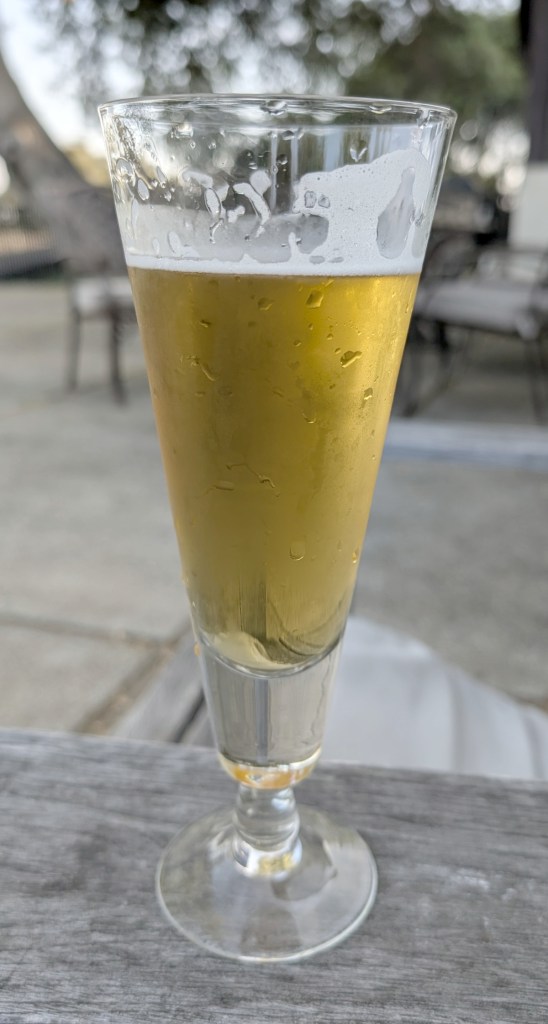
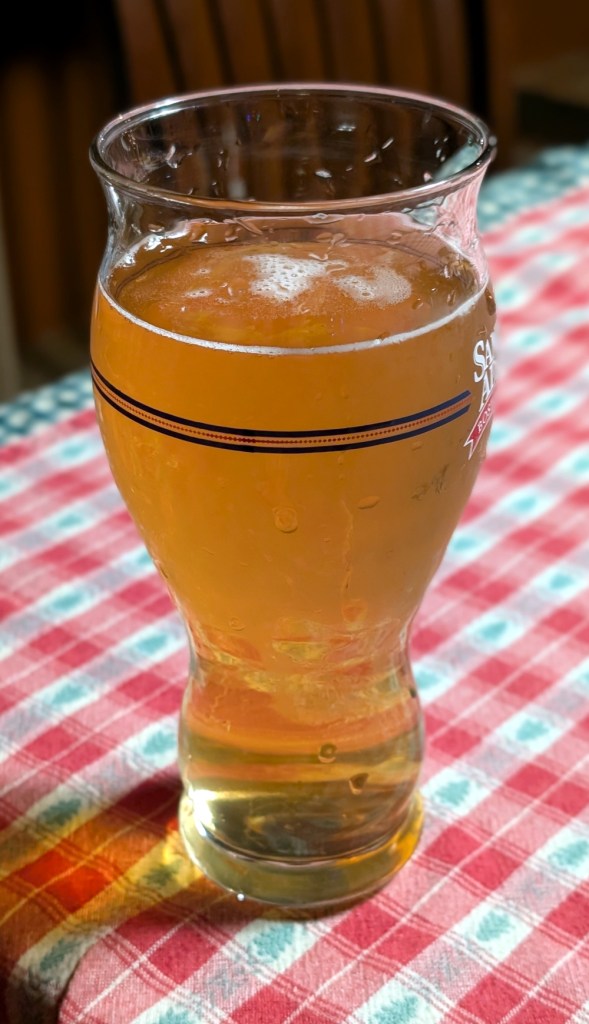
    • Medium yellow color, relatively clear. A touch of chill haze. Thin white head that subsides after pouring.
  • Aroma
    • A nice orange/ citrus hop aroma at a moderate level; moderate/low malty aroma
  • Flavor
    • Citrus hop flavor, low bitterness level, grainy malt character, no yeast to speak of. Nice round maltiness.
  • Mouthfeel
    • Medium-light body, moderate carbonation, smooth finish.
  • Would I Brew This Again?
    • This is a great recipe, even after a few months. Clean, drinkable, interesting but not overpowering.
  • Overall
    • 8/10

Andy’s Pilsner

This is a SMaSH-esque recipe, based on various SMaSH pilsners that I have made over the years. The closest equivalent would be Farke’s Best Pils.

  • 10 lb. Briess Pilsen malt
  • 1.0 oz. Saaz (2023) hops in boil (60 minute boil)
  • 1.0 oz. Mt. Hood (2023) hops (10 minute boil)
  • Whirlfloc tablet, 10 minute boil
  • 2 pkg. DIamond Lager dry yeast (Lallemand)

Procedure

Double-milled grain at 0.035 in. gap.  Steeped grain at 150 degrees for 50 minutes.  Mashed out at 168 degrees for 10 minutes.  Brought to a boil and added Saaz hops.  

Boiled for 60 minutes.  Added Whirlfloc tablet and Mt. Hood hops.  Boiled for 10 minutes.  Cooled to 70 degrees.  S.G.=1.051.  Added 1-1/2 qts. tap water.  S.G.=1.047.

Chilled to 52 degrees.  Added 2 packages of Diamond Lager yeast (BB 08-2024 & 09-2023).  Fermented for 10 days.  S.G.=1.006.  Racked to 5 gal. carboy.   Continued to ferment at 52 degrees for 12 days.  Warmed to 74 degrees for diacetyl rest for 4 days.  Chilled to 34 degrees for approximately one month, then cold filtered, force carbonated and bottled.

Brewed July 18, 2024.

Tasting

  • Appearance
    • Very clear, straw color, with thin white head that subsides fairly quickly.
  • Aroma
    • A bit of spicy hop at the forefront, and some grainy maltiness behind that. Very nice!
  • Flavor
    • Malty sweetness at the front, and medium level of spicy hopping. Clean fermentation profile.
  • Mouthfeel
    • Medium-low carbonation level; medium mouthfeel; smooth and slightly dry finish.
  • Would I Brew This Again?
    • This is a great recipe! Carbonation might help with giving a touch more head. Malt and hop levels are perfect. This is a nice pilsner.
  • Overall
    • 8/10

Dad’s 3P 2024

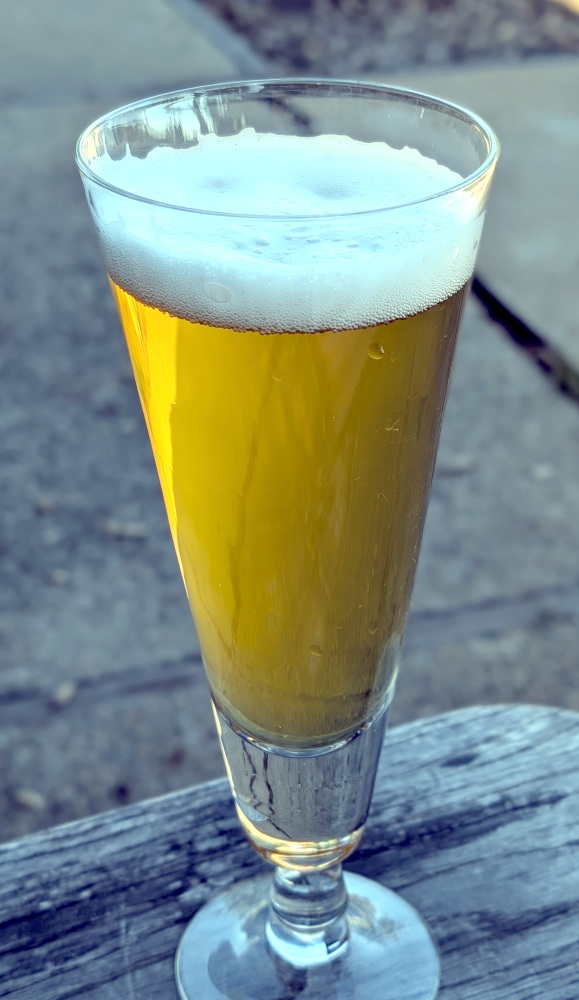
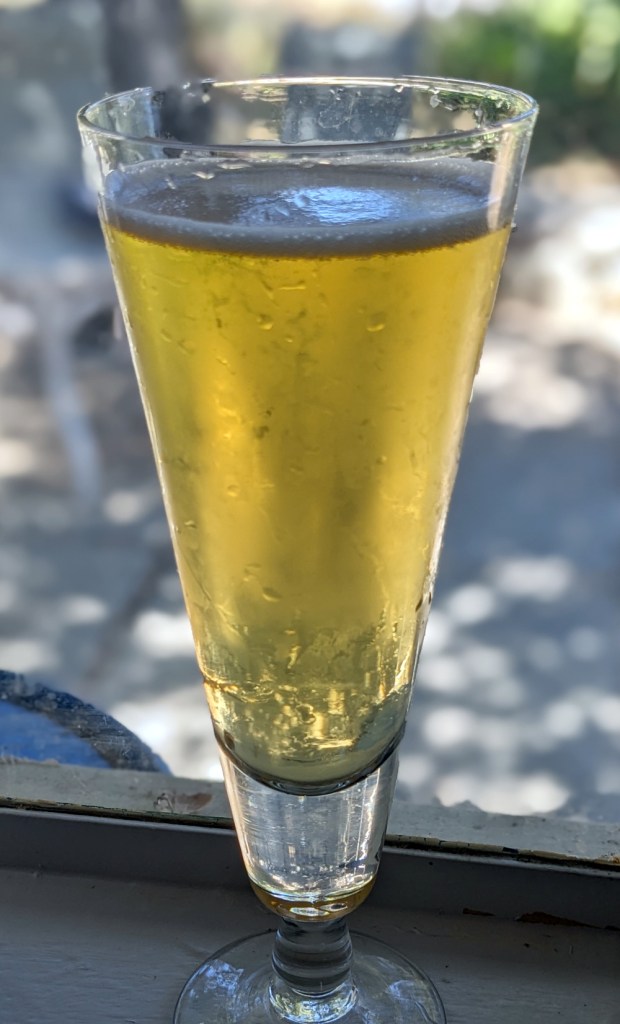
pale yellow beer with white head in conical pilsner glass

I’ve made two previous versions of Pre-Prohibition Pilsners, distinguished as such by having a bit more body and malt character than a typical American macro lager, and distinguished from European pilsners by adjuncts and the frequent use of American hops. My dad’s version originally comes from the April 1999 issue of BYO; it stands out in having a bit of flaked rye in it. Additionally, 6-row malt is nowhere to be seen in my version of this recipe.

This year’s edition is broadly inspired by the 2016 version, but you can check out the last version for differences. I used all American hops (Mt. Hood) instead of German ones, and brought Novalager into the mix, too. The main goal is to have something drinkable for the dog days of summer, but not so inoffensive as to be boring.

Dad’s 3P 2024

  • 6.75 lb. 2-row malt (Briess)
  • 2.25 lb. pilsner malt (Rahr)
  • 1 lb. yellow corn, flaked (Briess)
  • 0.5 lb. rye, flaked (Briess)
  • 0.5 lb. Carafoam (Weyermann)
  • 0.25 lb. rice hulls
  • 0.5 tsp. BrewTanB, in mash
  • 1 oz. Mt. Hood hop pellets (6.0% alpha), 60 minute boil
  • 1 oz. Mt. Hood hop pellets (6.0% alpha), 10 minute boil
  • 0.5 tsp. BrewTanB, 10 minute boil
  • 1 Whirlfloc tablet, 5 minute boil
  • 2 pkg. Novalager yeast (Lallemand)

Target Parameters

  • 1.050 s.g., 1.009 f.g., 30 IBU, 5.5% abv, 4 SRM
  • Full volume mash with recirculation for 60 minutes at 152°, 10 minute mash-out at 168°
  • Water blended from RO and Claremont tap water to hit target of 52 ppm Ca, 10 ppm Mg, 64 ppm Na, 82 ppm SO4, 113 ppm Cl, 5 ppm bicarbonate, alkalinity=4 ppm, RA=-39.

Procedure

  • I built my water the night before with 4 gallons of distilled water and 3.5 gallons of Claremont tap water, adding a Campden tablet and 3.2 mL of 88% lactic acid to drop out the carbonates.
  • I mashed in by heating the strike water to 158°, and then adding the grains and 2.4 mL of 88% lactic acid for pH adjustment.
  • I held the mash, with recirculation, at 152° for 60 minutes, before raising the temperature to 168° for a 10 minute mash-out.
  • At the conclusion of the mash, I removed the grains and let them drain. In total, I collected 6.6 gallons of runnings with a gravity of 1.043, for 69% mash efficiency.
  • As the runnings came to a boil, I added 2.5 g of calcium chloride. Once the runnings boiled, I added the hops and finings per the recipe.
  • After the full 60 minute boil, I chilled the wort to 78° before transferring to the fermenter and letting it chill to 46° in the fermentation chamber.
  • I pitched the yeast at 46°, and then let the fermenter free rise to 52° for fermentation.
  • I brewed the beer on 19 May 2024. Starting gravity was 1.049.
  • I let the beer free rise to 60° on 25 May 2024, and then to 65° on 29 May 2024.
  • The beer was kegged using a closed transfer on 3 June 2024. Final gravity was 1.009, for 5.2% abv.

Tasting

  • Appearance
    • Brightly clear, straw yellow beer, which pours with a fine and persistent white head. It just looks nice!
  • Aroma
    • Grainy sweet malt aroma; no appreciable yeast character or hop character apparent.
  • Flavor
    • Medium-high bitterness at the forefront, with a slightly herbal quality. Malty notes and a light hint of corn sweetness are behind that, but the beer definitely tilts toward bitter. Clean fermentation character, Crisp finish.
  • Mouthfeel
    • Medium body with a rounded feel. Dry finish. Medium carbonation.
  • Would I Brew This Again?
    • This is an interesting American lager, and highly drinkable. It’s a great summer beer! I’ve never done a six-row version of this, and might have to try it sometime in the pursuit of historical accuracy. Relative to the BJCP guidelines for Pre-Prohibition Lager (Category 27, Historical Beer), it hits most of the notes but should have perhaps a bit more hop aroma and a slightly taller head. Overall, though, this is a solid beer and recipe! It’s really enjoyable to drink on a hot afternoon, which is really all I demand from such a beer.
  • Overall
    • 9/10

No. 11 Bohemian Pilsner

According to my records, I have made 18 batches of German pils over the years (starting in 2016), but only five batches of the original pilsner beer, Bohemian (Czech) pils. After a more than four year hiatus, it was time!

Taking lessons learned from previous recipes, I went for very fresh Saaz hops (from Yakima Valley Hops). Furthermore, I built the malt bill to have a touch of melanoidin malt, to avoid messing with a decoction but also not overwhelming with the honey-character that melanoidin brings at higher percentages. I used the Rahr pilsner malt as a base–although it is not “traditional,” I have found it to be an absolutely excellent malt for my tastes.

This isn’t my 11th batch, but I brewed it on 11/11 (Nigel Tufnel Day!), so the name was unavoidable.

No. 11 Bohemian Pilsner

  • 10 lb. pilsner malt (Rahr)
  • 0.5 lb. Carafoam malt (Weyermann)
  • 0.25 lb. melanoidin malt (Weyermann)
  • 0.5 tsp. BrewTanB, added to mash
  • 3.5 oz. Saaz hop pellets (2.4% alpha), 60 minute boil
  • 1.5 oz. Saaz hop pellets (2.4% alpha), 10 minute boil
  • 0.5 tsp. BrewTanB, 10 minute boil
  • 1 Whirlfloc tablet, 5 minute boil
  • 1 oz. Saaz, 5 minute boil
  • 1 tsp. tsp. WLN1000 yeast nutrient, 5 minute boil
  • 2 pkg. Diamond Lager yeast (Lallemand)

Target Parameters

  • 1.049 s.g., 1.014 f.g., 4.7% abv, 37 IBU, 5 SRM
  • Full volume infusion mash, held at 154° for 60 minutes and 168° for 10 minutes
  • RO water built to hit target of 6 ppm Ca, 5 ppm Na, 6 ppm SO4, 6 ppm Cl, 14 ppm HCO3, RA=7 ppm

Procedure

  • To 7.5 gallons of RO water, I added 0.3 g gypsum, 0.3 g calcium chlorie, and 0.5 g baking soda, to hit my water target parameters.
  • I heated the water to 160°, and added the grains to hit a mash target of 154°. I added 4 mL of 88% lactic acid to adjust the mash pH, and recirculated for 60 minutes.
  • Next, I heated the mash to 168° for 10 minutes, before pulling the grains and starting the ramp-up to the boil.
  • In total, I collected 6.75 gallons of runnings with a gravity of 1.042, for 71% mash efficiency.
  • I boiled for 60 minutes, adding hops and finings per the schedule. Finally, I turned off the heat and chilled to 75° before transferring to the fermenter.
  • Once in the fermenter, I chilled the wort to 52° before pitching the yeast.
  • I brewed this beer on 11 November 2023. Starting gravity was 1.049, exactly on target!
  • I held the fermentation temperature at 52° until 2 December 2023, when I moved the beer to ambient (~60°).
  • I kegged the beer on 26 December 2023. Final gravity was 1.014, for 4.7% abv.
  • Because I’ve been a bit slow to finish kegs lately, this beer ended up lagering for a full three months before tasting.

Tasting

  • Appearance
    • Beautiful medium gold color, brilliant clarity, pouring with a long-lasting, creamy white head that leaves nice tracks on the side of the glass.
  • Aroma
    • A whiff of spicy Saaz at the front, at some maltiness (slightly bready) back of that.
  • Flavor
    • Bitterness-forward, which lingers on the tongue, followed by a subtle maltiness. Clean fermentation profile. Tiny bit of caramel. I feel like the melanoidin is perhaps too much in the background–I would like a tiny touch more.
  • Mouthfeel
    • Medium body, medium carbonation, off-dry mouthfeel.
  • Would I brew this again?
    • Yes! It’s probably the best Bohemian pilsner I have made to date! It has a nice mix of malt/hops….It maybe could be a bit deeper gold in color, and I wouldn’t complain with a touch more melanoidin character. It was well worth the (not entirely intentional) extended aging, too.
  • Overall
    • 9/10 (for color)