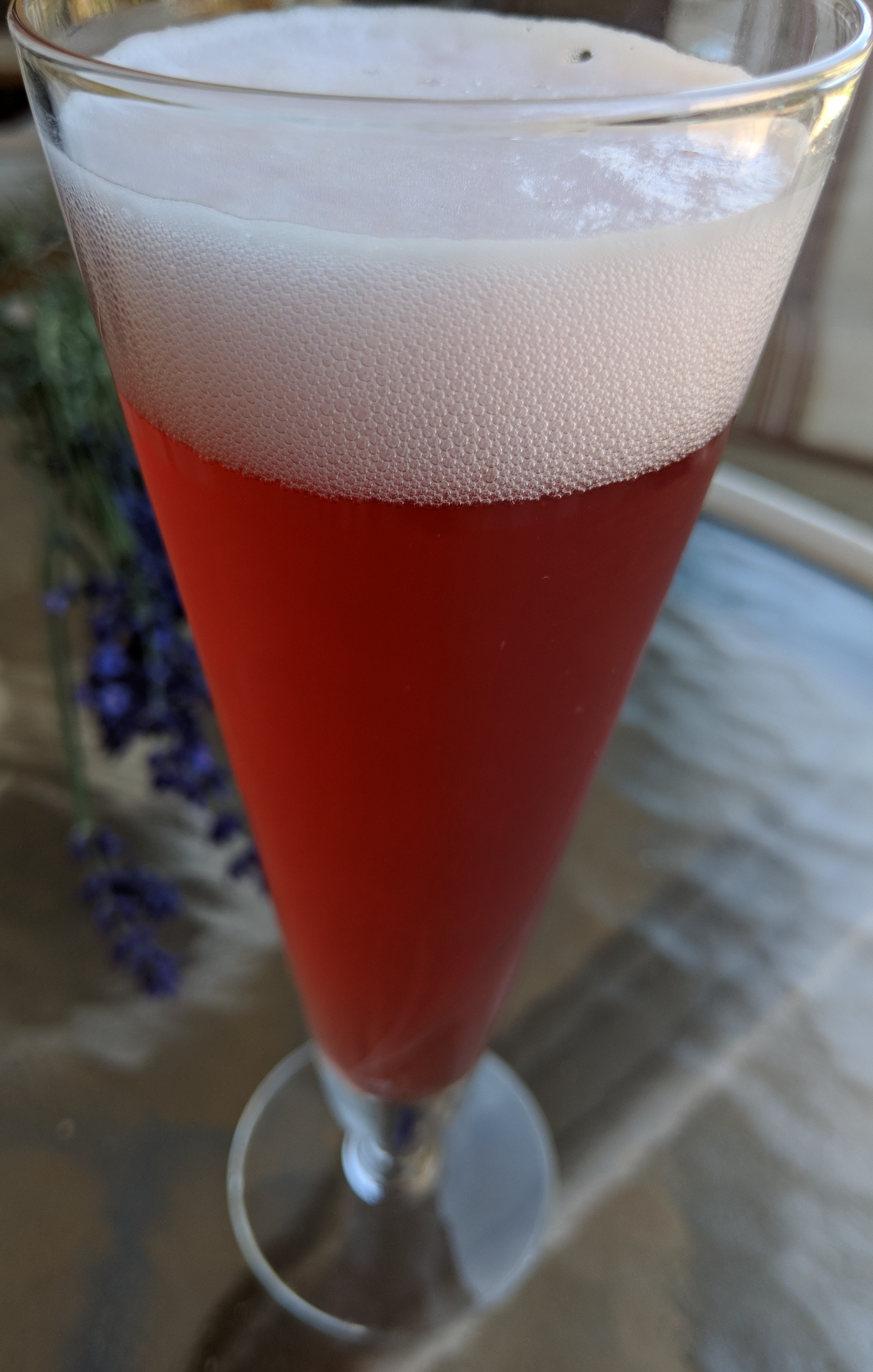
In another brew for the Lake Arrowhead Event, I’m doing a second attempt at my Raspberry Belgian. The first version turned out reasonably well, although I felt like it needed a bit more tartness as well as a bit more body. I thought the body could be augmented by doing a batch sparge instead of a no-sparge technique; the latter consistently leads to low efficiency on my system and thus a lower starting gravity. As for the tartness…I elected to do a kettle sour instead of improvising with acid malt.
Recently, one of my fellow homebrew club members presented on kettle souring, particularly his approach with using a yogurt-based culture. Now, I’ve done kettle souring once before–with incredible results–but in that case I used a commercial lacto strain specifically for homebrewers. I was intrigued by the thought of souring more cheaply, and thought this was a great batch in which to give it a try.
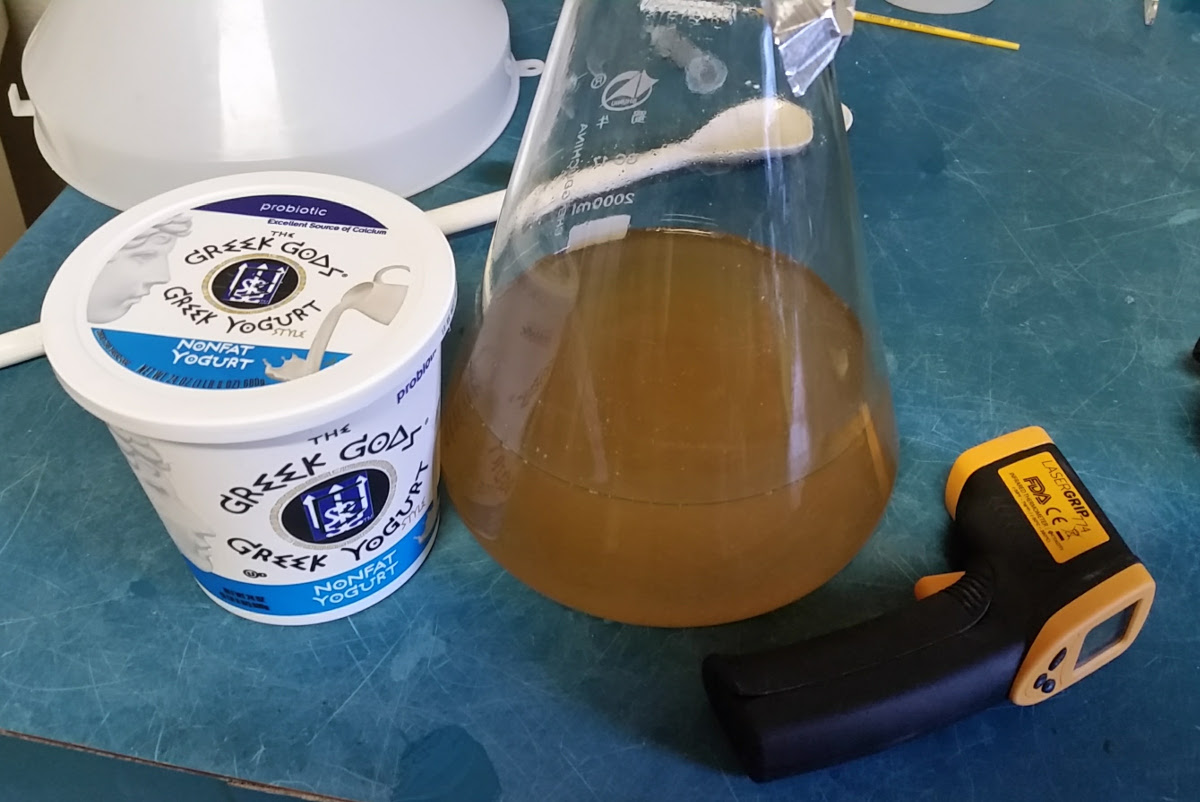
Sour culture ingredients and tools
For my culture, I chose The Greek Gods’ brand nonfat Greek yogurt–other homebrewers have reported success with it, and it has a nice blend of various lacto strains. So, 24 hours before my planned brew session, I made a 1L starter (1 L water, 100 g extra light DME, and a pinch of Fermax yeast nutrient) with 3 tsp. of yogurt. Because I’m not using a stir plate, next time I’ll want to break up the yogurt a bit; I noted that the first clump I put in never really broke up well, even with some gentle swirling. Greek yogurt is thick! I let the starter sit overnight on a heating pad set for 100° (I taped the sensor on the side of the flask). By the next day, it had a nice sour aroma, so I deemed it ready to go.
Raspberry Belgian 1.1
- 5 lbs. Château Pilsen malt (Castle Malting)
- 2 lbs. white wheat malt (Great Western Malting)
- 0.5 lb. carapils (Briess)
- 0.5 lb. flaked oats (store brand quick oats)
- 0.5 lb. flaked wheat
- 0.20 oz. Warrior hop pellets (15.8%), 60 minute boil
- 0.15 oz. Willamette hop pellets (4.9%), 15 minute boil
- 1 Whirlfloc tablet, 10 minute boil
- 0.5 tsp. Fermax, 10 minute boil (added before souring)
- 1 tsp. Fermax, 10 minute boil (added after souring)
- 1 pkg. Belgian Wit Ale yeast (WLP400), prepared in 1L starter
- 4.25 cups (1 L) raspberry puree (Vintner’s Harvest brand)
Target Parameters
- 156° mash, 60 minutes
- 10 minute boil and 24 hour kettle sour prior to 60 minute boil
- 1.044 o.g., 1.012 f.g., 4.2% abv, 14 IBU, 3 SRM, 5 gallons into the fermenter
Procedure
- I prepared the sour culture as specified above, 24 hours in advance.
- On brew day (part I), I mashed in with 3 gallons of water at 166.5°, to hit my mash target temperature of 156° right on the nose!
- I added 1.6 gallons of water to sparge, vorlaufed, collected first runnings, and then added 3.5 gallons of water for the second sparge.
- In total, I collected 6.75 gallons of wort at a gravity of 1.038–81% efficiency!
- Using 3.5 tsp. of 88% lactic acid, I adjusted the pH of the wort to around 4.2. This was a slight overshoot of my target, but I figured I would be OK.
- I boiled the wort for 10 minutes, adding the first bit of Fermax. After 10 minutes, I chilled the wort to ~100° and then added the yogurt culture. I left the kettle on a heating pad, with the temperature controller set to 100°.
- After ~21 hours, the temperature had settled to around 94°, and the pH was down to ~3.1 (a bit too sour for my tastes!). I added 1.5 tsp. of chalk to the kettle to raise things up a bit.
- I boiled the wort for 60 minutes, adding the various ingredients per the schedule in the recipe. At the end, I chilled the wort down to 80° and then transferred it into my fermenter. Six gallons of wort made it in. I then did the remaining chill to 66° in my fermentation chamber. I pitched the yeast, and let things move along.
- The final pH prior to the yeast pitching was 3.39; much more reasonable. It may even be a bit too tart yet, but we’ll see. Starting gravity was 1.044, right where I wanted it to be!
- I brewed the beer and pitched the yeast on 27 June 2017. Initial fermentation was at 66°. After 4 days, on 1 July 2017, I added 4.25 cups of raspberry puree and raising the temperature to 68°.