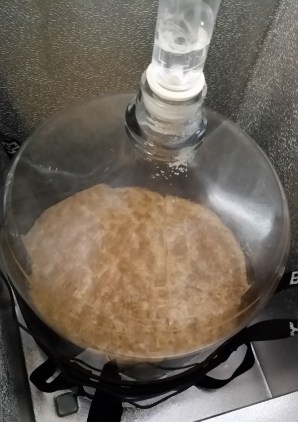
Thumbspike Saison 2.0

I’ve only brewed a saison once before, and it turned out pretty decent. Not perfect, but decent. I dry hopped just a touch too much last time, and so the hop aroma overwhelmed the yeast character. Thus, I decided to ditch the dry hops entirely on this batch. My recipe is similar to what I used before, with a few differences on several fronts. First, I added a touch of Carafa II for color, and ditched the honey in favor of a lower mash temperature to dry things out a bit. Also, I had some wild hops left, and a saison seemed like a good place to let those meld with a strong yeast. Finally, I decided to try Mangrove Jack dry yeast, and see what that does for everything.
20170512_192441

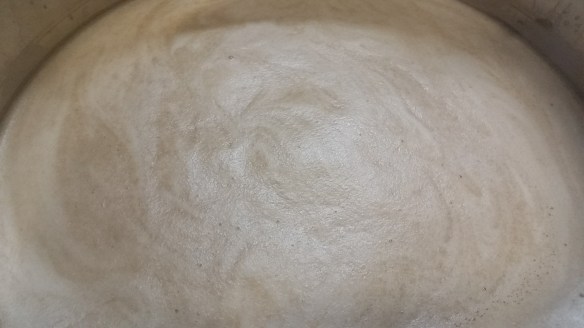
A view of the brew kettle, just prior to the start of the boil

Thumbspike Saison 2.0

  • 9.25 lbs. floor-malted Bohemian pilsner malt (Weyermann)
  • 0.75 lbs. Munich I malt (Weyermann)
  • 0.75 lbs. white wheat malt (Great Western Malting Co.)
  • 1 oz. Carafa Special II (Weyerman)
  • 1.1 oz. whole wild hops (5.8% alpha), 60 minute boil
  • 1.15 oz. whole wild hops (5.8% alpha), 10 minute boil
  • 1 Whirlfloc tablet, 10 minute boil
  • 2 pkg. French Saison Ale dry yeast (Mangrove Jack’s M29)

Target Parameters

  • 1.057 o.g., 1.003 f.g., 7.0% abv, 29 IBU, 7 SRM, 5.5 gallons into the fermenter

Procedure

  • To use up my RO water and thin out the Claremont waters a bit, I added 1.25 gallons with 2.42 gallons of tap water for my mash water. I heated it up to 165°, added the water to the mash tun, and let it slide to 158.3°, before adding the grains. This hit a mash temperature of 148.7°, which was down to 147.1° after 20 minutes. The temperature didn’t drop much beyond this, and was hovering around 147° when I checked 60 minutes later.
  • I aimed for a 75 minute mash duration. After 65 minutes, I added 1.3 gallons of water at 180°, to raise the mash temperature to 150.4°. I let it rest for 10 minutes, vorlaufed, and collected the first runnings. I then added 3.3 gallons of water at 165°, let it sit for 10 minutes, vorlaufed, and collected the remainder of the runnings.
  • In total, I collected 6.75 gallons with a gravity of 1.047, for 77% efficiency.
  • I aimed for a 60 minute boil, adding the various hops and finings per the schedule.
  • After 60 minutes, I turned off the flame and started chilling. Once I hit 85°, I transferred to the primary fermenter and pitched the yeast.
  • I plan to have 80° as my base temperature, and let it free-rise from there as needed. I’ll probably leave it in the fermenter for at least 10 days.
  • I brewed this beer on May 12, 2017. Starting gravity was 1.055, just a hair under my target gravity. A successful brew evening all around!

Hell Creek Amber Ale 1.1

What? It’s time for another batch of my Hell Creek Amber Ale? Count me in!

The latest version–incorporating wild hops that grew directly out of the world famous Hell Creek Formation (home to T. rex and Triceratops)–is only slightly modified based on my tasting of the previous version. For this time around, I replaced the Special B malt with crystal 120, to tone down the raisin-y notes of Special B. I also upped the biscuit malt just a touch. As before, the base malt was from Montana, and the Cascade hops were from South Dakota.

Hell Creek Amber Ale 1.1

  • 9 lbs. 2-row American pale malt (MaltEurop)
  • 1 lb. Munich I malt (Weyermann)
  • 0.75 lb. Victory (biscuit) malt (Briess)
  • 0.5 lb. 120° crystal malt (Briess)
  • 0.5 lb. 40° crystal malt (Briess)
  • 2 oz. Cascade whole hops (5.1% alpha), 60 minute boil
  • 2.05 oz. wild Hell Creek hops, 10 minute steep after boil
  • 1 Whirlfloc tablet, 10 minute boil
  • 1 pkg. California Ale Yeast (White Labs, WLP001), in 1L starter

Target Parameters

  • 1.059 o.g., 1.014 f.g., 5.9% abv, 36 IBU, 13 SRM, 5.5 gallons into the fermenter

Procedure

  • The day before my brew, I made a 2L starter, with a plan to set aside 0.6L. I note that the starter wasn’t quite going when I pitched it here. It probably could have used an additional day or two, and as a result it took two days for the beer to really get fermenting after I pitched the yeast.
  • I mashed in with 3.9 gallons of water at 168.5°, to hit a mash temperature of 156.5°. This was hotter than I wanted, so I stirred until it was down to 155°. It was down to 151° after 50 minutes. I added 1 gallon of water at 185°, to raise the mash temperature to 156° or so. I vorlaufed, and collected the first runnings. I sparged with 3.5 gallons of water at 180°, let it rest for 10 minutes, vorlaufed, and collected the remainder of the wort.
  • In total, I collected 6.5 gallons of wort with a gravity of 1.052, for 79% mash efficiency.
  • I brought the wort to a boil, adding hops per the schedule above. At flame-out, I added the wild hops and then let them steep for 10 minutes before chilling the wort.
  • Starting gravity was 1.060, and I fermented the beer at 68°.
  • This beer was brewed on 14 April 2017.
  • I kegged the beer on 7 May 2017. It had a final gravity of 1.016, for 5.8% abv. The beer was force carbonated.

Beer Tasting: Holy Helles

20170423_150736Time for another beer tasting! This Munich helles–my first attempt for the style–has been an enjoyable brew. I entered it into the first round for the NHC…it didn’t place, but I’ll be interested to see how the score sheets pan out. I should get those later this week, but until then, here are my own thoughts!

  • The Basics
    • O.G. = 1.047; f.g. = 1.012; 4.6% abv; 4 SRM; 19 estimated IBU
  • Aroma
    • Mild spicy hop note, with a moderate degree of slightly sweet maltiness behind that.
  • Appearance
    • Brilliantly clear and light gold in color. The beer pours with a thick off-white head that settles to a nice even and persistent blanket across the top of the beer.
  • Flavor
    • Nice malt character, with a bit of graininess to it. The bitterness level is subdued and definitely in the background
  • Mouthfeel
    • Relatively light bodied, moderately carbonated, with a medium-dry finish. The bitterness hangs around on the finish for awhile, although it is not overpowering.
  • Would I brew this again?
    • This is a good beer, and quite drinkable, but I think it falls down a bit in the malt character. To bring this a touch more into the Munich helles style, I might up the malt profile just a bit–it seems like it swings to the hops end on aroma just a bit more than I would prefer. One fellow homebrewer suggested using a German pilsner malt rather than the Bohemian pilsner malt I’ve been using as of late–this might be a good first step.
  • Overall: 6/10

Czech-ed Out Pilsner

My first attempt at a Bohemian pilsner turned out reasonably well, but it also had a few areas of potential improvement. The flavor was a little less well rounded than I hoped for, so I aimed for a brew that added in a small percentage of crystal malt. Additionally, the color on my previous batch was a touch paler than desired, so for this version I’m adding in a tiny percentage of Carafa II to deepen that up a bit.

20170409_125350

The recipe today is very loosely based on “Czech It Out” pilsner, published in the January/February 2017 issue of BYO. I’ve made some substitutions and adjustments for the malts and hops, but the overall gist is still there. Lots of Bohemian malt, lots of Saaz hops! Note that I did use a touch of Warrior for the bittering addition; my on-hand Saaz was low in alpha, so I needed to beef up the bittering with another hop. I also had to substitute in American crystal malt for Carahell, based on what was at my local homebrew shop.

I had a few members from my homebrew club over for the brew afternoon. Although I can do pretty much everything solo, it was nice to have the extra company!

Czech-ed Out Pilsner

  • 9.5 lbs. floor-malted Bohemian pilsner malt (Weyermann)
  • 0.5 lb. 10° crystal malt (Briess)
  • 0.25 lb. acidulated malt (Weyermann)
  • 0.2 oz. Carafa Special II malt (Weyermann)
  • 0.47 oz. Saaz hop pellets (5.6% alpha), 60 minute boil
  • 0.25 oz. Warrior hop pellets (15.8% alpha), 60 minute boil
  • 2 oz. Saaz hop pellets (3% alpha), 15 minute boil
  • 2 oz. Saaz hop pellets (3% alpha), 5 minute boil
  • 1 Whirlfloc tablet, 10 minute boil
  • 0.5 tsp Fermax yeast nutrient, 10 minute boil
  • 2 pkg. Pilsner Lager yeast (WLP800, White Labs)

Target Parameters

  • 1.053 o.g., 1.013 f.g., 5.3% abv, 40 IBU, 5 SRM, 5 gallons into the fermenter

Procedure

  • A week in advance, I prepared the yeast in a 2L starter. It ran for three days, and then I cold-crashed it in the fridge. Prior to pitching, I decanted off ~1L of spent starter.
  • I mashed in with 3.45 gallons of water at 163.7°, to hit a mash temperature of 152°. This was built up from RO water with 1 g of calcium chloride. After 60 minutes, I added an additional 1.5 gallons of RO water at ~160°, let sit for 10 minutes, and then vorlaufed. After collecting the first runnings, I added another 3.75 gallons of RO water at 180°, to raise the mash up to 165°. I let the mash sit for another 10 minutes, and collected the second runnings.
  • In total, I collected 7.3 gallons of wort at a gravity of 1.041–nearly right on my target, for ~76% mash efficiency.
  • This batch used a 90 minute boil, and I added all of the hops, etc., per the schedule. After a full 90 minutes, I turned off the flame and started chilling.
  • I’ll note that the hop pellets I used for the aroma additions (last 15 minutes of boil) had a strong herbal and almost “green” character. The latter component is maybe more than I care for, but we’ll see how it all ends up after fermentation.
  • I chilled the wort to 75°, transferred to the fermenter while aerating, and then put it in the fermentation chamber. Once everything was down to 54°, I pitched the yeast.
  • Starting gravity was. 1.054, and the beer was brewed on 9 April 2017. I’m fermenting the beer at 50°.

Olde Persica Porter 1.1

20170402_154913My homebrew club is serving at an upcoming regional festival, and I volunteered to provide a keg of beer. In order to highlight the stuff our group of brewers is doing, I figured something outside of the ordinary (i.e., a generic American IPA or whatever) would be best. What better than a smoked porter?

A few months back, I made a smoked porter that turned out pretty darned delicious (in fact, it was one of my favorite beers of 2016). So, it was an easy decision to bring that recipe back! Once again, I’m using the peachwood smoked malt from Copper Fox–it’s really delicious stuff. Try it out if you can! Otherwise, I made a few very small tweaks for ingredients–in particular, I made some minor adjustments to use up a half ounce of Willamette hop pellets, and I also used dry yeast instead of liquid because I didn’t quite have time this past week to spool up a starter.

Olde Persica Porter 1.1

  • 7 lbs. Vienna malt (Weyermann)
  • 3 lbs. peach wood smoked 2-row malt (Copper Fox Distillery)
  • 1 lb. 80° crystal malt
  • 1 lb. 40° crystal malt
  • 0.5 lb. black (patent) malt
  • 0.5 lb. chocolate malt
  • 2 oz. Cascade whole hops (5.1% alpha), 60 minute boil
  • 0.8 oz. Willamette hop pellets (5.1% alpha), 10 minute boil
  • 1 oz. Willamette hop pellets (4.1% alpha), 5 minute steep/whirlpool after flame-out
  • 1 Whirlfloc tablet, 10 minute boil
  • Safale American ale yeast (US-05), 1 package

Target Parameters

  • 1.065 o.g., 1.017 f.g., 6.3% abv, 37 IBU, 36 SRM, 5.5 gallons into the fermenter

Procedure

  • I added 4.3 gallons of water at 172°, and let it cool until it hit 166.5°. This was a little below my target (I got distracted by some other tasks in the brewery), so the mash temperature only hit 154°. Thus, I added 1 quart of boiling water to hit 154.5°. The mash was only down to 153° after an hour.
  • After 60 minutes of mashing, I collected the first runnings and then added 4 gallons of water at 190°, to hit a mash out temperature of 169°. I let it sit for 10 minutes, vorlaufed, and collected the second runnings.
  • Altogether, I collected 6.25 gallons of wort with a gravity of 1.052, for a mash efficiency of 69%. I’m not entirely sure why I was a bit below my target–maybe a volumetric issue when measuring out the mash and sparge water?
  • I brought the runnings to a boil, and added hops and other stuff per the schedule. After 60 minutes, I turned off the heat and chilled the wort to 75°. Just to see if the whole Cascade hops would create enough of a filter to keep the pelletized gunk out, I left the hop pellets loose rather than bagging them or using my hop spider. That was a mistake! The kettle screen ended up clogged, and I only got about 4 gallons into the fermenter. This lessened volume is OK in my view, because past experience shows that we generally use only 2-3 gallons of a typical beer during a typical festival pour.
  • After transferring to the fermenter, I pitched the yeast. Starting gravity is 1.061. I will be fermenting at 67°.
  • This beer was brewed on 1 April 2017, with vigorous fermentation underway within less than 24 hours.
  • Update: Final gravity was 1.018 on 23 April 2017, which works out to 5.5% abv.