Turtle Toe Porter

As the weather swings cooler, my tastes swing to darker beers–porters, stouts, and such. So, I found a clone recipe for Deschutes Black Butte Porter on the AHA website and made a few modifications for yeast (American ale instead of English ale) and hops (to use up on-hand varieties).

The name comes from a fossil specimen in the museum lab at the moment–it’s a ~67 million year old turtle from Wyoming, which unexpectedly had complete hands and feet. “Turtle Toe Porter” is a very alliterative title for a beer, so the name stuck!

beer label image, showing foot skeleton of turtle on left side, text saying "Turtle Toe Porter" on right side, and "Farke Brewing, Claremont, California" at the bottom.
(bone image from Williston’s 1925 Osteology of the Reptiles)

Turtle Toe Porter

  • 9.5 lb. California Select 2-row malt (Great Western)
  • 14 oz. chocolate wheat malt (Weyermann)
  • 10 oz. 80L crystal malt (Warminster)
  • 4 oz. carapils malt (Briess)
  • 0.75 oz. Magnum hop pellets (10.1% alpha), 90 minute boil
  • 1 oz. Cascade whole hops (5.5% alpha), 10 minute boil
  • 0.5 oz. Mt. Hood hop pellets (8.0% alpha), 5 minute boil
  • 1 Whirlfloc tablet, 5 minute boil
  • 1 pkg. US-05 American ale yeast (DCL/Fermentis)

Target Parameters

  • 1.050 s.g., 1.011 f.g., 5.2% abv, 39 IBU, 30 SRM
  • Full volume mash at 152° for 60 minutes, with 10 minute mash-out at 168°
  • Claremont tap water, treated with Campden tablet

Procedure

  • I mashed in with 7.5 gallons of water heated to 157°, to hit a target mash temperature of 152°. I added 5 mL of 88% lactic acid to bring down the mash pH. I recirculated the mash at this temperature for 60 minutes, before raising the mash to 168°. Then, I removed the grains and brought the runnings to a boil.
  • In total, I collected 6.4 gallons of runnings with a gravity of 1.044, for 69% mash efficiency.
  • I brought the kettle to a boil, adding hops and finings per the recipe. After a 90 minute boil, I turned off the heat and chilled to ~80°, before transferring to the fermenter. I chilled the wort the rest of the way in the fermentation chamber, before pitching the yeast.
  • I brewed this beer on 11 September 2021. Starting gravity was 1.051, and I fermented it at 66°.
  • On 18 September 2021, I pulled the beer out to ambient, around 70° to 72°, to finish out fermentation.
  • I kegged the beer on 24 September 2021. Final gravity was 1.014, which works out to 4.9% abv.

Tasting

  • Appearance
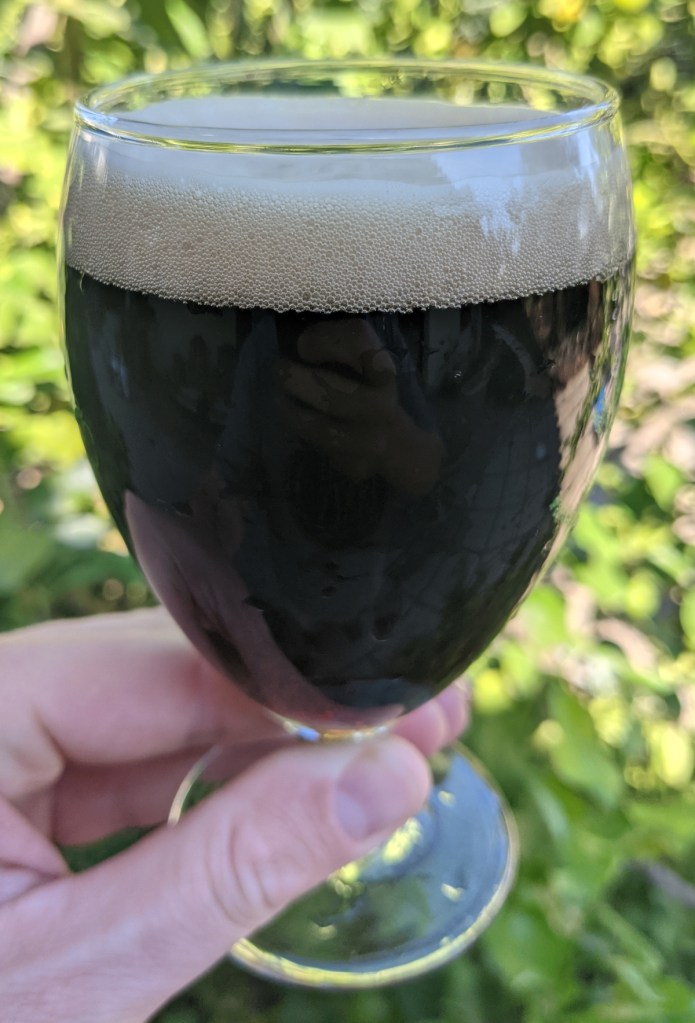
    • Brilliantly clear, deep brown beer with garnet highlights, that pours with a decently persistent tan head.
  • Aroma
    • Roasty aroma of coffee and chocolate at the front. No significant hop or yeast character evident.
  • Flavor
    • Roasty and cocoa notes dominate, with a touch of dark caramel behind that. The base malt profile has a slightly grainy character. Bitterness is moderate and fairly clean, with perhaps a slight woody character.
  • Mouthfeel
    • Medium body, moderate carbonation, dry finish.
  • Would I brew this again?
    • Yes! This is exactly the American porter that I wanted. It is flavorful, yet very drinkable. I like the roasted character in it, and it is a good beer to bridge the summer to fall transition. If brewed as a winter beer, I might add a bit more character by using Maris Otter, but that’s a fairly mild critique in the scheme of things.
  • Overall
    • 10/10

Cascade Pale Ale II

American pale ales are one of my favorite styles, if only because there are so many interpretations. You can get the classic almost-amber, slightly caramel versions with Cascade and other “legacy” hops, or you can get the fairly dry, almost IPA, pale and tropical hop versions loaded down with Mosaic and the latest fad hop, or any other number of versions in between. I love Sierra Nevada’s pale ale–it is such a consistently enjoyable and reliable beer, and also easy to find. For my next pale ale, I didn’t want a clone of Sierra Nevada, but I did want something in that general flavor sphere.

I turned to Brewing Classic Styles, which has two pale ale recipes. One is a bit drier and lighter in malt, and the other throws in some extra crystal malt and a bit of Munich malt to up the body and dark the color. I chose the latter version, but made some slight modifications. First, I used Maris Otter instead of American two-row as the base…I thought it would provide an even maltier backbone. Because I just got a shipment of this season’s Cascade hops from my dad in South Dakota, I used Cascade only for the late hop and dry hop regimens. Details are below!

Cascade Pale Ale II

  • 10 lb. Maris Otter malt (Crisp)
  • 0.75 lb. Munich Light (Chateau)
  • 0.75 lb. caramel 40 (Briess)
  • 1 oz. Magnum hop pellets (10.1% alpha), 60 minute boil
  • 1 oz. Cascade whole hops (est. 5.5% alpha), 10 minute boil
  • 1 Whirlfloc tablet, 10 minute boil
  • 1 pkg. Safale American Ale Yeast (US-05)
  • 2 oz. Cascade whole hops (est. 5.5% alpha), dry hop in keg

Target Parameters

  • 1.052 o.g., 1.011 f.g., 5.4% abv, 42 IBU, 8 SRM
  • Full volume mash at 152° for 60 minutes, with 10 minute mash-out at 168°
  • Claremont tap water adjusted with gypsum to hit water profile target of 102 Ca, 11Mg, 93 Na, 203 sulfate, 105 Cl, 156 bicarbonate, 49 RA, 128 alkalinity

Procedure

  • I mashed in with 7.3 gallons of water at 158°, to hit a mash temperature of 152°. I added 7 mL of 88% lactic acid as a pH adjustment, and recirculated the mash at 152° for 60 minutes.
  • Next, I raised the mash temperature to 168°, held it there for 10 minutes, and then removed the grains.
  • I collected 6.2 gallons of runnings at a gravity of 1.047, for 68% mash efficiency.
  • At this point, I added 2 tsp. of gypsum and brought the runnings to a boil. I added the hops and other ingredients per the recipe, boiling for 60 minutes.
  • After 60 minutes, I turned off the heat and chilled the wort to 80°. Next, I transferred it to the fermenter, and chilled to 66° in my fermentation chamber, before pitching the yeast.
  • My original gravity was 1.052–exactly on the mark! I brewed the beer on 4 September 2021, and fermented at 66°.
  • On 11 September 2021, I pulled the fermenter out to ambient (~70° to 75°) to finish out.
  • I kegged the beer on 17 September 2021, adding whole Cascade hops to the keg at this point. Final gravity was 1.012, for 5.3% abv.

Tasting

  • Appearance
    • This is a deep gold beer with slight haze; it pours with an ivory and modestly persistent head.
  • Aroma
    • Light caramel malt aroma, with a modest orange/citrus hop aroma and clean yeast character.
  • Flavor
    • Light caramel and moderately malt-forward beer; bitterness is moderately high yet clean, with an orange/citrus-type flavor.
  • Mouthfeel
    • Medium body, medium carbonation, pleasantly lingering bitterness on the finish.
  • Would I brew this again?
    • Yes? This is a very 1990s type of pale ale, and would be typical of what you might find in a brewpub during the late 1990s/early 2000s. I like less caramel-forward pale ales in general, but this is nice as a variant on my usual. Next time, I might ditch the Munich or else swap the Maris Otter for the 2-row malt, to moderate the maltiness just a touch.
  • Overall
    • 8/10

What’s Brewing? September 2021

After the summer brewing hiatus, I’ve been able to brew regularly lately. That is a good thing, because I’ll have another few weekends without brewing due to work obligations. Gotta build up the supply!

Beer Batch Updates

  • I brewed an American porter (Turtle Toes Porter) on September 11, roughly in the realm of Deschute’s Black Butte Porter. It has had a week of fermentation at 66°, and is now out at ambient to finish up.
  • I also brewed an American pale ale (Cascade Pale Ale II) on September 4, to celebrate the arrival of a bunch of this year’s Cascade hops from my dad. It’s a little more rich on the malt bill than many American pale ales, in that it has Maris Otter as the base, with a bit of Munich and crystal 40 to round things out. I kegged the beer the other day, and it’s currently carbonating.
  • Yesterday, I brewed a German pils (“Farke’s Best Pils”) using German-type hops that my dad grew, including Sterling, Hallertauer, and Saaz.

What’s On Tap?

  • Mow the Damn Lawn, Farke,” is the light offering on tap, and I’m drinking through it fairly steadily. It’s a decent beer, but not really my favorite at the moment.
  • Raspberry Belgian 2021 is another light offering, and is delicious as usual. It’s surprisingly clear now, because I used the floating dip tube.
  • Byzantium IPA is my final brew on-tap, and it’s nearly gone. I’m quite enjoying it.

What’s Coming Up?

  • It’s perhaps a little later than planned, but I am definitely doing a hefeweizen next weekend. It will be a slightly modified rebrew of Humboldt’s Hefeweizen, which turned out so well last time!
  • In a few week’s, I will brew a clone of Ill-Tempered Gnome, a winter seasonal beer from Oakshire Brewing. It’s a curious winter seasonal, in that it doesn’t have any spices added–which was a selling point for me! I plan to brew it in early October, so that it has a month or two to condition before the holidays.

Other Notes

  • I made another batch of spicy brown mustard this weekend, because the last batch turned out so well. So well that it’s long gone! I more-or-less use a recipe from The Spruce Eats, except I only use whole brown mustard instead of whole yellow mustard.

Byzantium IPA

With the summer months closing out, I wanted to do a final kveik batch. I targeted a 3 gallon yield, because I didn’t want to have a ton of higher-abv beer. Additionally, I made this a “quicker brew” session, by reducing the boil time to 45 minutes. I have no particular reason for the name, other than that it sounded cool.

Byzantium IPA

  • 8.25 lb. 2-row malt (California Select, Great Western)
  • 0.25 lb. 10L caramel malt (Briess)
  • 0.55 oz. CTZ (Columbus/Tomahawk/Zeus) hop pellets (15.8% alpha), first wort hop
  • 1 oz. Simcoe hop pellet (12.7% alpha), 5 minute boil
  • 0.65 oz. Centennial hop pellet (8.1% alpha), 5 minute boil
  • 1 tsp. yeast nutrient (WLN1000, White Labs), 5 minute boil
  • 1 Whirlfloc tablet, 5 minute boil
  • 1 pkg. Voss Kveik Ale Yeast (Lallemand)
  • 1 oz. Centennial hop pellets (8.1% alpha), 2 day dry hop
  • 1 oz. Simcoe hop pellets (12.7% alpha), 2 day dry hop

Target Parameters

  • 1.067 s.g., 1.013 f.g., 7.2% abv, 66 IBU, 5 SRM
  • 149° mash, 60 minutes, with 10 minute mash-out at 168°, and 1 gallon sparge
  • Claremont tap water with 3 g gypsum and 2 g epsom salt added at boil, to hit add 3 g gypsum, 2 g epsom salt to water just before boil, to hit 71 Ca, 21 Mg, 93 Na, 180 SO4, 105 Cl, 156 HC03, 65 RA, 128 ppm Alkalinity

Procedure

  • I mashed in with 4 gallons of water at 156°, adding 5 mL of 88% lactic acid. This hit a target mash temperature of 149°, and I held it here (with recirculation) for 60 minutes. After 60 minutes, I mashed out to 168°. I pulled the grain basket, and sparged with just under a gallon of hot water.
  • In total, I collected 4 gallons of runnings at a gravity of 1.057, for 73% mash efficiency. Nice!
  • I added gypsum, epsom salt, and the CTZ pellets, brought the wort to a boil, and added hops and such per the schedule. After 45 minutes, I turned off the heat and chilled to ~90°.
  • I transferred ~3.25 gallons of wort at a starting gravity of 1.064 into the fermenter, and pitched the yeast.
  • I brewed the beer on 21 August 2021, letting it sit at ambient, which was around 85°.
  • Fermentation took off quickly, overflowing the airlock (oops). I added the dry hops directly to the fermenter (with no bag) on 1 September 2021, and then kegged on 3 September 2021.
  • I kegged the beer using a semi-closed transfer, and the hops were quite a pain. I had some issues with clogged lines, etc. I probably should have cold-crashed to drop the hops out of the beer, or else bagged them in the first place. Ah well.
  • Final gravity was 1.014, for 6.6% abv.
  • To help clear the beer and hurry it towards serving, I added 0.5 tsp of gelatin in 0.75 cups water on 4 September 2021. At this time, I also agitated keg to finish carbonation.

Tasting

  • Appearance
    • This is a gold-colored beer with a slight haze; it pours with a quite persistent white head that leaves nice lacing on the side of the glass.
  • Aroma
    • The beer has a light citrus character for hops and a slight caramel malt aroma. There is no major yeast character, so the overall aroma is pretty clean. I would say it could use a little more hop character.
  • Flavor
    • The flavor is has a high level of bitterness, with a citrus pith character and a little bit of orange. The malt is in the background, with a slightly grainy aspect. There is a light…tartness?…in the yeast profile, that adds a bit of interest.
  • Mouthfeel
    • The beer has a medium-light body, moderate carbonation, and a dry finish.
  • Would I brew this again?
    • This is a worthy experiment…definitely better than the other kveik IPA I did, which suffered from clashing hops, malt, and yeast in initial tastings, and never quite came together even as it matured. I think the hop selection works better here, although as before I probably should use a more character-rich base malt such as Maris Otter. My hop handling also wasn’t great on this one, which I think dinged it a bit also. I should probably just add the hops in a bag next time. I lost volume as well as introduced a bit of O2 while messing around trying to clear clogs. That aside, it is a pretty beer.
  • Overall
    • 6.5/10

Mow the Damn Lawn, Farke

I brewed this American lager recipe last summer, and thought I’d give it another go to close out the warm months here. The 2021 version is nearly identical, just with a small hop swap as well as water built (mostly) from scratch.

Mow the Damn Lawn, Farke

  • 8.5 lb. 2-row malt (Great Western, California Select)
  • 2 lb. flaked rice
  • 4 oz. rice hulls
  • 0.6 oz. Vanguard hop pellets (6.5% alpha), 60 minute boil
  • 1 tsp. BruTanB, 10 minute boil
  • 1 Whirlfloc tablet, 5 minute boil
  • 1 tsp. yeast nutrient (WLN1000), 5 minute boil
  • 2 pkg. Saflager Lager Yeast (W34/70)

Target Parameters

  • 1.046 s.g., 1.008 f.g., 5.0% abv, 14 IBU, 4 SRM
  • 148° full volume infusion mash, 75 minutes, with 10 minute mash-out at 168°
  • Water built from 6 gallons RO and 1.5 gallons Claremont tap water, to produce a water of 7 ppm Ca, 2 ppm Mg, 19 ppm Na, 10 ppm sulfate, 21 ppm Cl, 31 ppm bicarbonate, 26 ppm alkalinity; 19 ppm RA

Procedure

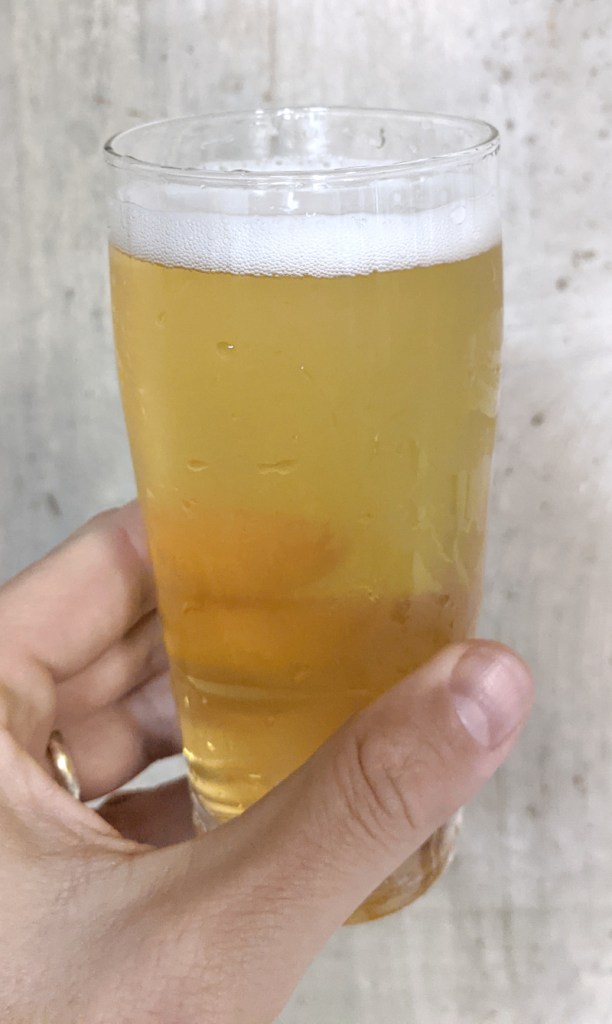
hand holding willi becher glass of yellow beer with white head
  • The night before brewing, I set in the water by mixing 1.5 gallon of tap water with 6 gallons of RO water and a quarter of a Campden tablet, to that it would all be ready to go in the morning.
  • I heated the strike water to 153°, and hit a mash temperature of 148°. I recirculated at this temperature for 75 minutes, noting that the top of the mash read at 147.5°; I was pretty happy with this.
  • After the mash, I heated to 168° for 10 minutes, and then pulled out the grain basket.
  • In total, I had 6.75 gallons of runnings with a gravity of 1.038, for 68% mash efficiency.
  • I brought the kettle to a boil, boiling for 30 minutes before adding the hops, in order to bring the gravity up a bit. Then, I boiled for another 60 minutes while adding hops and finings per the recipe.
  • After the full 90 minute boil, I chilled the wort to 75°, and transferred to the fermenter for the final chill to 48° in the fermentation chamber. Finally, I pitched the yeast directly and let it free rise to 52°.
  • I brewed the beer on 19 June 2021, fermenting at 52°. Starting gravity was 1.044.
  • I cold crashed the beer on 10 July 2021, and kegged it on 14 August 2021.
  • Final gravity was 1.009, which works out to 4.6% abv.
  • The beer was surprisingly hazy at the time of kegging, especially after over a month of lagering.
  • I tasted the beer on 17 August 2021, and it was an acetaldehyde bomb. Ugh. This was a surprise to me, because it had plenty of time to clean up (two months since brewing). I’m not sure why this was; maybe it hadn’t actually cleaned up because I skipped a diacetyl rest? I’ve gotten away without it before, though, and as mentioned it sat on the yeast for plenty of time. My other thought is that maybe if the airlock dried out a bit, this introduced some oxygen and created more acetaldehyde. In any case, I pulled the beer out to room temperature (~75°), and let it sit there for a few days, with occasional keg purges to outgas any unpleasantness, before re-chilling. It still had a decent bit of green apple when I tasted a week later, but it was much improved. After two more weeks, any acetaldehyde had faded to virtually nothing. In any case, a slight green apple quality is acceptable in the American lager style, so let’s just pretend that I meant to do this.

Tasting

  • Appearance
    • Very clear, nearly brilliantly so, with a light yellow color. It pours with a creamy and tall white head that subsides to a modestly persistent thin rim.
  • Aroma
    • Light malty sweetness with a very very slight green apple character (virtually imperceptible), and a crisp, faint hop spice note
  • Flavor
    • Low level of maltiness and light sweetness, and a moderately low and clean bitterness. As with the aroma, there is a very faint green apple character, which has faded considerably since the early days on tap. It is a very drinkable beer.
  • Mouthfeel
    • Light body, moderate carbonation, and slightly dry finish.
  • Would I brew this again?
    • This is a pretty good beer, which is fun as an experiment to see if I can pull off a light, high-adjunct beer. It’s certainly quite drinkable in decent quantity during a hot day, so I’ve hit that goal quite well. It’s not the most exciting beer ever, but then again that’s not what I was aiming for. I’m a bit disappointed by the heavy acetaldehyde in initial servings, and I don’t quite know what led to that. I suspect it was a combination of things, and will likely do a higher temperature fermentation rest on future batches.
  • Overall
    • 6.5/10