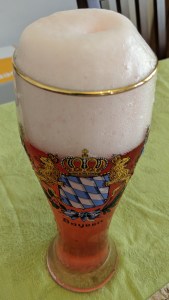
Beer Tasting: Cerveza de Jamaica

IMG_20180706_162520I kegged this batch on 12 May 2018. It has been on tap for awhile now, and I’ve really been enjoying it. Better do a tasting before it’s all gone.

Cerveza de Jamaica

  • The Basics
    • 1.048 s.g., 1.011 f.g., 4.8% abv, 11 IBU, 3 SRM
  • Appearance
    • Pours with a tall and dense pink head, which persists wonderfully as the beer is consumed. The beer itself is a purplish pink color and slightly hazy. The beer has cleared up considerably since it first went on tap.
  • Aroma
    • Hibiscus, with a bit of tartness and spice behind that.
  • Flavor
    • Tart, with a slight hibiscus note next to a smooth and subtle maltiness.
  • Mouthfeel
    • Fairly light-bodied and highly carbonated, with a medium dry finish.
  • Would I brew this again?
    • Yes! This is a wonderful beer, and perfectly refreshing for the current warm weather. In tasting opinions from other folks, it was suggested to up the hibiscus just a touch (to help it come through more distinctly in the taste) and also to add a bit more citrus character. To this end, I’m going to increase the amount of hibiscus in my next batch, and also up the citrus peel.
  • Overall
    • 9/10

Beer Tasting: Try Again Bohemian Pilsner

My recent version of a Bohemian pilsner has been on tap for a few weeks, and is at its peak for enjoyment. Today, I did a head-to-head with the classic flagship for the style, Pilsner Urquell.

IMG_20180707_160451

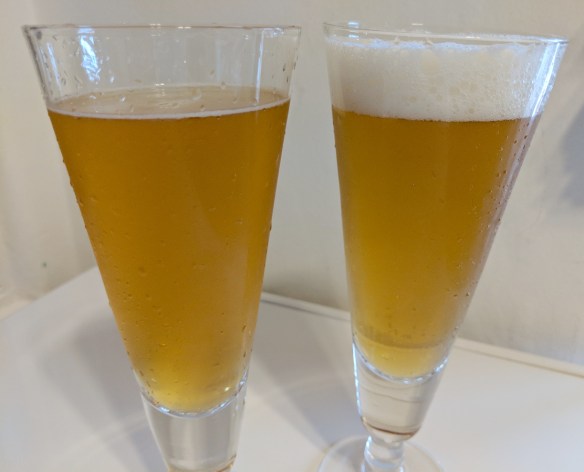
Head-to-head Bohemian pilsners! Pilsner Urquell is in the glass on the left, and my homebrew version is at right.

Try Again Bohemian Pilsner

  • The Basics
    • 1.053 s.g., 1.014 f.g., 4.2% abv, 36 IBU, 5 SRM
  • Appearance
    • Pours with a fine white head with excellent persistance. The beer itself is a golden hue, nearly an exact match for Pilsner Urquell but perhaps just a notch lighter. It is very clear, but not quite brilliant (Urquell has a slight edge here). In terms of appearance, mine is equal in color, better in head (and head retention), and needs slight improvement in clarity.
  • Aroma
    • My beer tips a little bit more towards malt prominence; there is a very slight spice note from the Saaz hops, but that’s still not quite where it should be. Urquell has the hop note perfectly, so I give it a slight edge on this count.
  • Flavor
    • Bitterness levels are not quite evenly matched between Urquell and mine; Urquell comes across as a bit more bitter. Mine has a nice malt character, but this is slightly at the expense of the hops. The malt on my homebrew is rich and bready, and the bitterness stands well against that. The finish is balanced well. Relative to Urquell, it tips more towards the malt than bitterness on the finish, and I prefer the hoppier Urquell version a bit more.
  • Mouthfeel
    • My brew has a medium body and moderate carbonation. Urquell is definitely drier than my beer, with a more extended and more bitter finish. The finish on mine is smoother yet I prefer the Urquell “bite” just a touch.
  • Would I brew this again?
    • Yes, with a few minor modifications! There is lots I like about my beer, such as the appearance and malt character. I do feel like it could be a bit drier and crisper (relative to Urquell), because the hops are just a tiny bit “flabby”. My main adjustment would be to increase the hopping, and mash at a slightly lower temperature to dry out the beer a bit. I might also try halving the melanoidin contribution; I think it might be contributing some unfermentables that keep the beer from being as dry as it might be. The Barke pilsen malt that I used in this recipe has plenty of character on its own, anyhow!
  • Overall
    • 7.5/10

IMG_20180707_155837

Blast from the Past: Gingerbread Winter Warmer 2016

winter_warmerLast night I pulled out a bottle of my 2016 Gingerbread Winter Warmer, and poured a snifter. Although I had kegged that beer way back in the day, I emptied the keg into a few bottles for extended aging. I figure I’ll open one a year, until the bottles are gone.

More than a year after brewing, this is a fairly enjoyable winter beer. It’s got a decent banana note, a rich, malty flavor, and a thin ivory head that disperses a few minutes after pouring. I think there might have been a little secondary fermentation in the bottle, because it seems a bit more carbonated than I remember.

We’ll do this again in a year or two!

Beer Tasting: Session Stout

stoutI’ve had this beer on tap for about a month; it has been really enjoyable!

Session Stout

  • The Basics
    • 1.042 s.g., 1.012 f.g., 3.9% abv, 31 IBU, 42 SRM
  •  Appearance
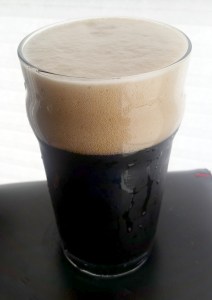
    • Clear, black beer, with a fine tan head that is moderately persistent. It looks awesome!
  • Aroma
    • The aroma has a prominent roasted character, with a tiny hint of chocolate behind that.
  • Flavor
    • The beer has a forward roasted/slightly burnt character with a dark coffee tone, as expected from the roast barley. The hop bitterness is smooth, in the background behind the malt.
  • Mouthfeel
    • The beer is fairly light bodied with moderate carbonation. The finish is dry, but smooth.
  • Would I brew this again?
    • I think so! It’s a very drinkable beer, both in terms of its flavor/mouthfeel as well as the low alcohol. I’ve been enjoying it quite a bit. If I were to make any minor changes, I would probably up the body just a little (it can tend to slightly thin after awhile). I might also experiment with a version that has more chocolate malt, to richen the  profile and make it a bit more complex than just roast barley.
  • Overall
    • 8/10

Thanksgiving IPA 2017: Recipe & Tasting

I wanted to have a nice IPA on-hand for Thanksgiving. So, I brewed up a recipe based on my Centennial IPA, first brewed last year. The base beer is a favorite of mine, so it seemed like an easy choice. I did modify it slightly to use crystal 20 and Victory malt instead of Caravienne and Carahell. I also mixed the hopping up a little bit, maintaining focus on the citrus/pine American hops. This was combined with Mandarina Bavaria hops, to add an interesting twist that I hoped would play well with everything else.

Thanksgiving IPA 2017

  • 10.5 lbs. California Select 2-row brewer’s malt (Great Western)
  • 1.75 lbs. Vienna malt (Great Western)
  • 0.5 lb. 20°L caramel malt (Briess)
  • 0.25 lb. Victory (biscuit) malt (Briess)
  • 1 oz. Centennial hop pellets (7.6% alpha), first wort hop with 60 minute boil
  • 1 oz. Centennial hop pellets (7.6% alpha), 15 minute boil
  • 1 oz. Cascade whole hops (5.5% alpha), 10 minute boil
  • 1 oz. Centennial hop pellets (7.6% alpha), 10 minute boil
  • 1 oz. Amarillo hop pellets (9.2% alpha), 5 minute whirlpool
  • 1 oz. Mandarina Bavaria hop pellets (9.5% alpha), 5 minute whirlpool
  • 1 oz. Centennial hop pellets (7.6% alpha), 6 day loose dry hop in primary
  • 1 oz. Amarillo hop pellets (9.2% alpha), 6 day loose dry hop in primary
  • 1 oz. Mandarina Bavaria hop pellets (9.5% alpha), 6 day loose dry hop in primary
  • 1 pkg. California Ale yeast (White Labs WLP001), prepared in starter

Procedure

  • I mashed in with 4.25 gallons of Claremont tap water at 161 degrees, to hit a 150° mash target. After 60 minutes, I added 0.75 gallons of water at 185°, let sit for 10 minutes, vorlaufed and drained. I then added 3.5 gallons of water at 185°, let sit for 10 minutes, vorlaufed, and drained.
  • In total, I collected 6.75 gallons of wort at a gravity of 1.050, for 71% efficiency.
    I brought the wort to a boil, and added hops per the schedule.
  • After a 60 minute boil, I chilled to pitching temperatures and added the yeast (which was prepared in a starter).
  • Original gravity was 1.062.
  • I brewed the beer on 7 November 2017, and fermented at 66° for 6 days. On 13 November, I added the dry hops directly to the primary fermenter. On 19 November, I cold crashed the beer.
  • On the morning of 20 November, I accidentally added 0.25L of lager yeast pitch intended for another beer. Oops.
  • On the evening of 20 November, I split the beer into two kegs (2.5 gallons each). The more full keg received 1 tsp. of gelatin in 1/4 cup of water, heated to 150 degrees. The other (less full) did not get gelatin. I force carbonated the kegs.
  • Final gravity was 1.008, for 7.1% abv.

20171123_131532Tasting

  • The Basics
    • 1.062 o.g., 1.08 f.g., 7.1% abv, 62 estimated IBU, 6 SRM
  • Appearance
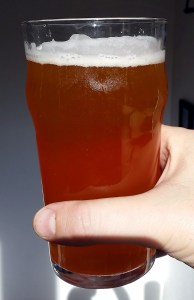
    • This beer is a deep gold, with a modest haze (it looks a bit darker in the photo due to the lighting). The head is exceptionally persistent and off-white, with beautiful lacing on the glass.
  • Aroma
    • Light yet rich citrus aroma from the hops, with a light malty aroma with a slight hint of caramel behind that
  • Flavor
    • The beer has a bready malty character, with a firm and persistent malt bitterness. The hop flavor is piney and citrusy, tending towards a grapefruit character. The bitterness is perfect, with a smooth quality and smooth finish.
  • Mouthfeel
    • The beer has a medium body and has a moderately dry finish with moderate carbonation.
  • Would I brew this again? 
    • Yes! This recipe once again satisfies, and I’m quite pleased with how the hops turned out. This is a classic west coast American IPA. The hop aroma could maybe be a touch stronger, but that’s a minor complaint overall.
  • Overall
    • 9/10