Winter Pils

I am continuing my quest for the perfect German pils, with numerous iterations (see these recent examples) and a continued presence on my Brew Year’s Resolution list. Through various iterations, I am finding that I like a beer in the lower end of the IBU range for the style (around 25 to 30), and a lower mineral water profile.

This new version focused on the Edelweiss hop blend, a really delicious blend of (mostly) US-grown varieties. I decided to do multiple additions, to layer up the flavor and aroma characteristics of the hop. Additionally, I wanted to give Diamond Lager yeast (from Lallemand) a spin…I have primarily used W34/70 up until this point, but have consistently noted a slight tartness that I didn’t really care for. Diamond has been really well regarded, so it’s time to give it a spin!

Winter Pils

  • 10 lb. Viking pilsner malt
  • 0.5 lb. acidulated malt (Weyermann)
  • 6 oz. dextrin malt (Viking)
  • 1 oz. Edelweiss hop blend pellets (5.1% alpha), 60 minute boil
  • 0.75 oz. Edelweiss hop blend pellets (5.1% alpha), 15 minute boil
  • 1 tsp. yeast nutrient WLN1000 (White Labs), 15 minute boil
  • 1 tsp. BruTanB, 10 minute boil
  • 1 Whirlfloc tablet, 5 minute boil
  • 0.75 oz. Edelweiss hop blend pellets (5.1% alpha), 5 minute boil
  • 2 pkg. Diamond Lager yeast (Lallemand)

Target Parameters

  • 1.049 o.g., 1.007 f.g., 5.5% abv, 28 IBU, 4 SRM
  • Water built from RO to hit target of 59 ppm Ca, 8 ppm Mg, 89 pm SO4, 63 ppm Cl, -47 ppm RA
  • Full volume Hochkurz mash, held at 144° for 45 minutes, 160° for 45 minutes, and 10 minute mash-out at 168°

Procedure

  • I added 2.7 g gypsum, 2.2 g epsom salt, and 3.4 g calcium chloride to 7 gallons of RO water, to hit a target of 59 ppm Ca, 8 ppm Mg, 89 pm SO4, 63 ppm Cl, and -47 ppm RA.
  • I mashed in at 150°, to hit a rest temperature of 144°, and held it there for 45 minutes. Then, I raised the mash to 160° (over a period of about 15 minutes), and held it at 160° for 45 minutes. Finally, I raised the mash to 168°, and held it there for 10 minutes before removing the grain basket.
  • In total, I had 6.35 gallons of runnings at a gravity of 1.047, for 74% mash efficiency.
  • I brought the runnings to a boil, adding hops and finings per the recipe. After a 60 minute boil, I chilled the wort, transferred to the fermenter, and chilled the rest of the way down to 50°.
  • I brewed the beer on 21 November 2021, and pitched the yeast on 22 November 2021.
  • I fermented the beer at 50° until 24 November 2021, when I let it free rise to 52°. I let the beer free rise to 54° on 28 November, 56° on 1 December, and 60° on 3 December 2021. On 6 December, I began to cycle the beer down to 34° by about 5° per day. I was down to 34° by 9 December 2021.
  • I kegged the beer on 26 December 2021, using a closed transfer into a purged keg. Final gravity was 1.014, for 5.0% abv.

Tasting

  • Appearance
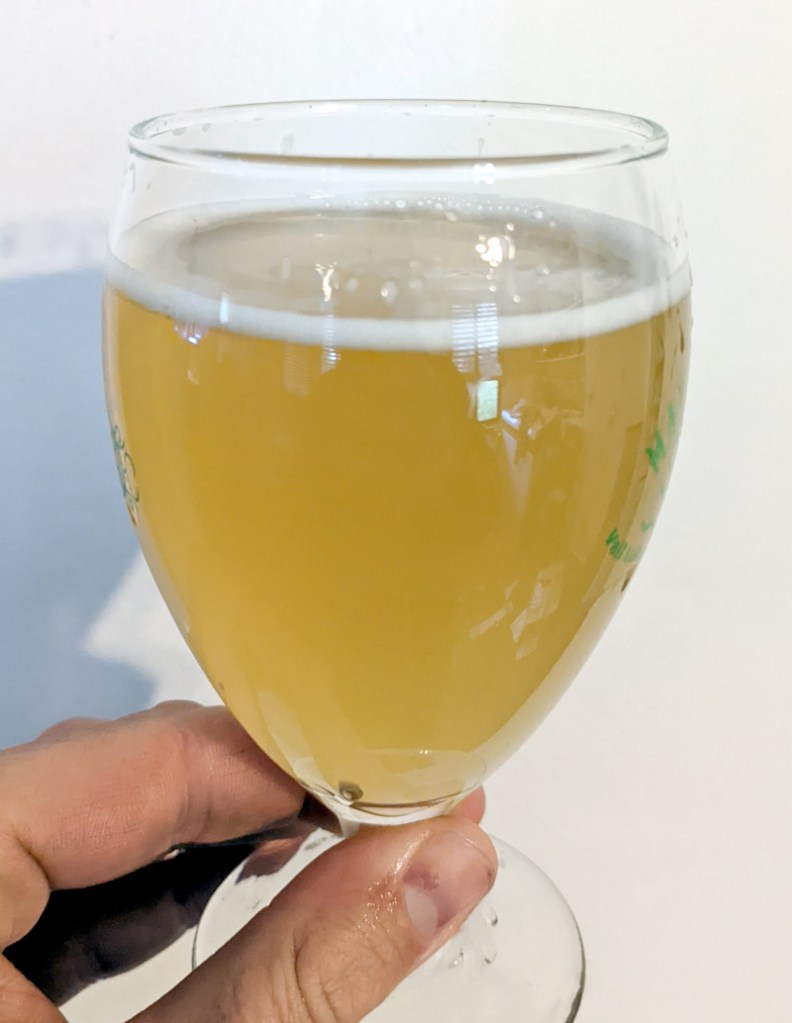
    • Brilliantly clear and straw-colored, with a white, creamy, and persistent head.
  • Aroma
    • Floral hop aroma, with a crackery sweet malt character. Very clean yeast profile.
  • Flavor
    • Malty sweet, with a moderate and clean bitterness that has a slightly floral quality. The bitterness level is perfect for my taste. It lingers a bit, but isn’t overwhelming as in some previous beers.
  • Mouthfeel
    • Medium light body and relatively crisp (but not quite perfectly crisp). The finish is off-dry, and carbonation is moderate.
  • Would I brew this again?
    • Absolutely! It took awhile to get to “brilliant” (around two months), but the wait was worth it. Bitterness level is right where I want it, and the malt and yeast character are great. Diamond lager yeast is worth the hype…I don’t get the slight tartness I sometimes got on W34/70, which is nice. Going forward, I think a 25 to 28 IBU German pils is about perfect. I’ll probably drop any dextrin or CaraPils malt, to crisp things up a bit, and I’ll also stick with my current water profile.
  • Overall
    • 9/10

Eagle Face Oatmeal Stout 2021

I have made this recipe a million times (okay, more like seven or eight times), and it’s still just so enjoyable. Here’s the latest!

Eagle Face Oatmeal Stout 2021

  • 8.5 lb. Finest Maris Otter Ale Malt (Crisp)
  • 1.5 lb. flaked oats
  • 1 lb. 80° caramel malt (Briess)
  • 1 lb. Victory malt (Briess)
  • 0.5 lb. roasted barley (Briess)
  • 6 oz. chocolate malt (Briess)
  • 6 oz. chocolate malt (Dingemans)
  • 0.5 lb. rice hulls
  • 1 oz. Magnum hop pellets (10.1% alpha), 60 minute boil
  • 1 Whirlfloc tablet, 5 minute boil
  • 2 pkg. Nottingham ale yeast (Lallemand)

Parameters

  • 1.059 o.g., 1.017 f.g., 5.6% abv, 34 IBU, 35 SRM
  • Full volume mash, no sparge, 156° mash for 60 minutes, 10 minute mash-out at 168°
  • Claremont tap water, treated with Campden tablet

Procedure

  • I heated ~7.5 gallons to 164°, and then mashed in to hit a target mash rest of 156°. I added 5 mL of 88% lactic acid, to adjust pH.
  • I held the mash at 156° for 60 minutes, and then raised it to 168°. I held it at this temperature for 10 minutes, and then pulled the grains.
  • In total, I collected 6.4 gallons of runnings with a gravity of 1.048. This was a bit below my target (1.052).
  • I brought the runnings to a boil, and boiled for 15 minutes before adding the hops. I then proceeded with an additional 60 minutes on the boil, before turning off the heat and

Tasting

  • Appearance
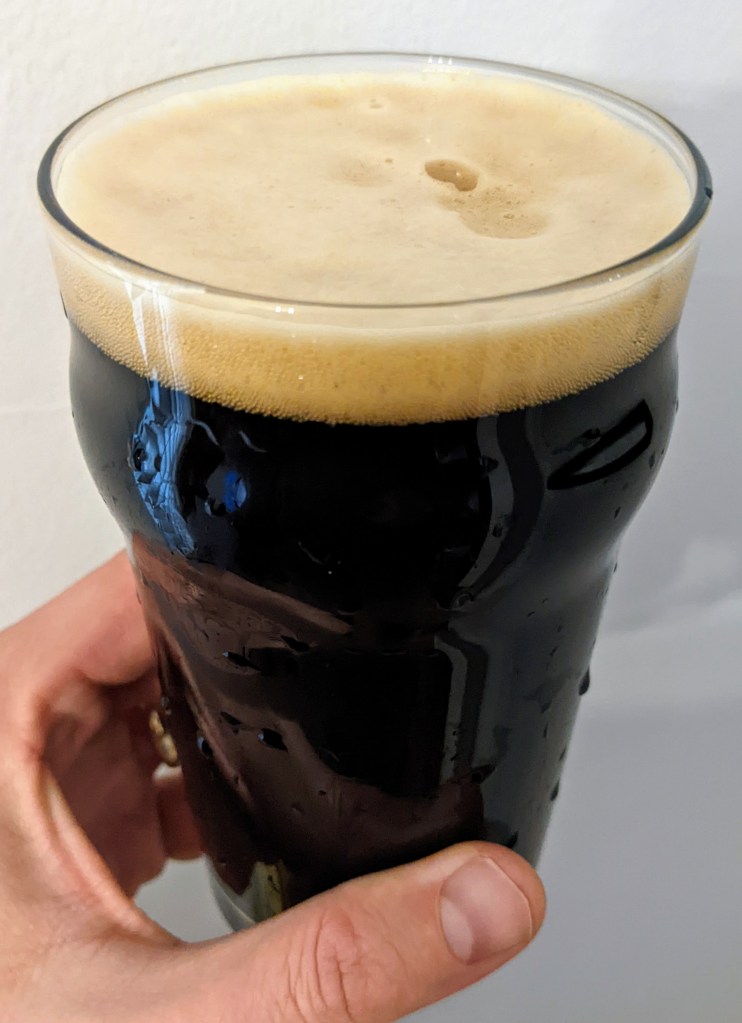
    • A black, clear beer, with a somewhat persistent tan head. The beer is a very dark brown when viewed on edge.
  • Aroma
    • Earthy aroma, with coffee and chocolate and roasted malt. There is a faint dried dark stonefruit aroma.
  • Flavor
    • Medium-high bitterness, and a coffee/chocolate, exceptionally malty flavor. This is a wonderfully rich beer! The yeast character is pretty clean, with a very faint fruitiness. There is an earthy background, perhaps from the hops.
  • Mouthfeel
    • Very full bodied, with a somewhat slick mouthfeel as would be expected from an oatmeal stout. It is very smooth, with a slightly dry finish.
  • Would I Brew This Again?
    • It’s interesting that I pick up earthy characteristics in the aroma, given that there is only a single hop addition as a 60 minute bittering charge of Magnum. That must be produced by the malt combination, but I can’t figure out whre.
  • Overall
    • 10/10

Pliny vs. Pliny

I recently brewed a Pliny clone, which turned out pretty well. By fortunate coincidence, a local store (the amazing Liquorama) regularly has Russian River products, including Pliny. As an aside, if you are in the general Claremont/Upland/Rancho area, and if you are a beer (or liquor) geek, I absolutely encourage you to check out Liquorama. They have an amazing local and regional craft beer selection, and they properly store their beer at cold temperatures. They very consistently have fresh Pliny (and other great RR beers like Blind Pig and STS Pils), which is an incredible treat. I always end up walking out with waaaay more than I intended to purchase.

In any case, I thought it would be fun to do a head-to-head comparison of my Pliny versus the actual Pliny. The real Pliny was bottled on February 4, which is three weeks before this tasting. My beer was kegged on 21 January, so mine is slightly older, but not by much.

So, let’s do a direct comparison!

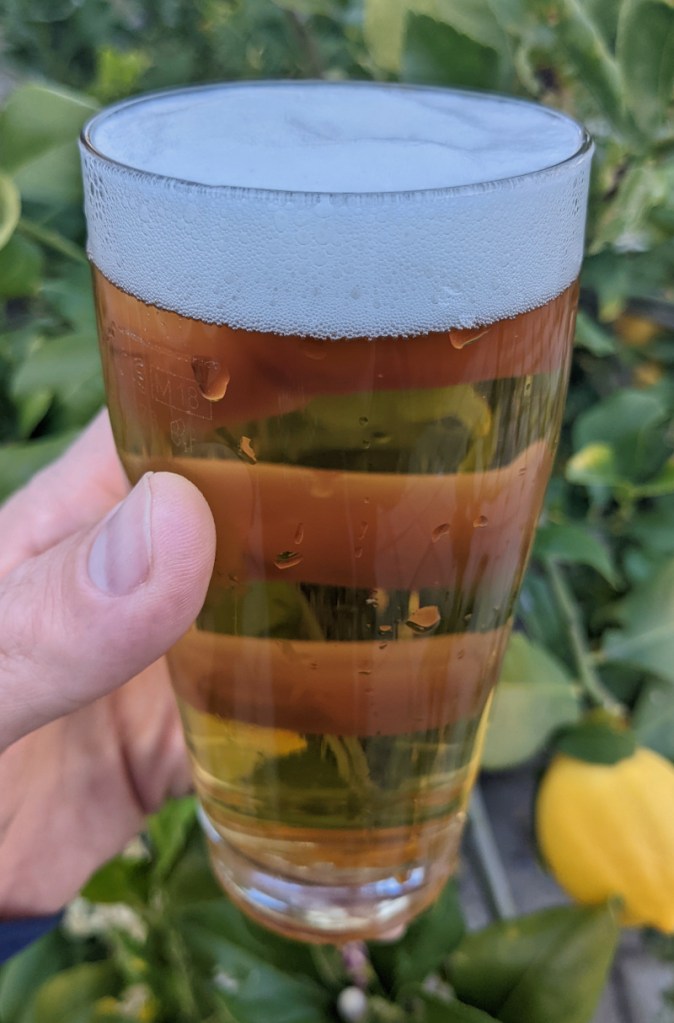
Pliny vs. Pliny — my clone version is on the left
  • Appearance
    • My version is very slightly darker, and clearer. The Russian River (RR) version had a slight bit of hop debris (a common issue with their bottled beer if it has been agitated, as happened when I transported it home). My version had a slightly more persistent head.
    • Appearance Winner: The Clone
  • Aroma
    • The RR version is absolutely better, with a more “fresh” orange/citrus hop aroma at the forefront. I definitely pick up the Simcoe hops, which I don’t get from my version.
    • Aroma Winner: RR
  • Flavor
    • Both beers are equally smooth. Mine has a touch more malt character, but the RR version has a touch more citrus/Simcoe flavor.
    • Flavor Winner: RR (but it’s very close)
  • Mouthfeel
    • Both are pretty equivalent, in terms of body, carbonation, and mouthfeel.
    • Mouthfeel Winner: A draw
  • Overall
    • RR’s authentic Pliny has just a touch better hop aroma and flavor, so I give a slight edge to the “real deal.” It’s most apparent in the aroma (and slightly in the flavor), where the Simcoe is more prominent. If I were to do mine again, I would swap the quantities of CTZ and Simcoe. My version had 1 oz. Simcoe, 3 oz. CTZ and 1 oz. Centennial; for a future version, I would do 3 oz. Simcoe, 1 oz. CTZ, and 1 oz. Centennial, to (hopefully) better match the original.

There is a reason why Pliny the Elder is a classic, and it’s super apparent when I do this tasting. It is just a nice beer! My clone comes close, but doesn’t quite hit the mark. Time to rebrew, I suppose!

Pliny the Elder Clone: The MoreBeer Edition

I don’t often get beer kits, because I usually find it easier and cheaper to assemble a recipe on my own and also because kits tend to sit around on store shelves with pre-milled grains and old hops. However, I couldn’t resist getting the Pliny the Elder clone kit from MoreBeer, when it went on sale recently. I did a “homegrown” Pliny clone awhile back, and it was OK but not outstanding. So, I decided to give this recipe family another try.

I augmented the kit slightly, because the provided packages of Magnum were ridiculously low alpha–only 2.3% according to the package! I didn’t know that this variety even came so low, and I needed some “real” Magnum from my personal stash to augment things.

For this batch, I also decided to really pay attention to my handling of the beer. Every transfer was closed, and everything was kept either cool or cold, depending on the stage of the process. The end results were definitely worth it!

Pliny the Elder Clone: The MoreBeer Edition

  • 13 lb. 2-row malt (Briess)
  • 1 lb. Carapils malt (Briess)
  • 4 oz. Caramel 40L malt (Briess)
  • 2 oz. Cascade hop pellets (7.3% alpha), added to mash
  • 2 oz. Magnum hop pellets (2.3% alpha), 90 minute boil
  • 2 oz. Magnum hop pellets (10.1% alpha), 90 minute boil
  • 1 oz. Simcoe hop pellets (12.9% alpha), 45 minute boil
  • 1 oz. CTZ hop pellets (14.4% alpha), 30 minute boil
  • 1 lb. corn sugar, 10 minute boil
  • 1 Whirlfloc tablet, 5 minute boil
  • 1 tsp. yeast nutrient (WLN1000), 50 minute boil
  • 2 oz. Centennial hop pellets (9.9% alpha), 5 minute whirlpool
  • 1 oz. Simcoe hop pellets (12.9% alpha), 5 minute whirlpool
  • 2 pkg. American West Coast ale yeast BRY-97 (Lallemand)
  • 3 oz. CTZ hop pellets (14.4% alpha), dry hop in keg
  • 1 oz. Centennial hop pellets (9.9% alpha), dry hop in keg
  • 1 oz. Simcoe hop pellets (12.9% alpha), dry hop in keg

Target Parameters

  • 1.073 o.g., 1.011 f.g., 8.3% abv, 165 IBU
  • Claremont tap water, adjusted to achieve target water profile of 66 ppm Ca, 22 ppm Mg, 91 ppm Na, 204 ppm SO4, 85 ppm
  • Full volume mash, with 90 minutes at 151°.

Procedure

  • I mashed in with 7.1 gallons of water at 159°, to hit a mash temperature of 151°. I added 8 mL of 88% lactic acid, to adjust the pH. I held at 151° and recirculated for 90 minutes, before mashing out at 168° for 10 minutes. Then, I pulled the grain basket and sparged with 1 gallon of hot water.
  • In total, I collected 7 gallons of runnings at a gravity of 1.055, for 74% mash efficiency. For high gravity beers, a small sparge really makes a difference on the Anvil.
  • I added 5 g of gypsum and 5 g of epsom salts to the kettle, to hit my target water profile.
  • I boiled the runnings for 90 minutes, adding hops and finings and such per the recipe.
  • After 90 minutes, I turned off the heat and chilled to 65°, before transferring to the fermenter.
  • I pitched the yeast, and set the beer to ferment at 66°.
  • I brewed the beer on 27 December 2021. I pulled it to ambient (58 to 60°) on 8 January 2022.
  • On 15 January 2022, I did a closed transfer of the beer into a purged keg for dry hopping quickly popping the lid to throw in the loose hops. I used a hop screen on the floating dip tube.
  • On 21 January 2022, I transferred from the dry hopping keg into a purged serving keg, and then carbonated. I lost probably close to a gallon of hop sludge.
  • The beer started out fairly hazy, but was reasonably clear within a few weeks.
  • Starting gravity was 1.070, and final gravity was 1.013, for 7.7% abv.

Tasting

  • Appearance
    • Pours with a creamy, off-white and persistent head with very nice lacing. The beer is gold, with a very slight haze.
  • Aroma
    • Citrus at the front, with a light herbal and grassy character behind that.
  • Flavor
    • Hops! Bitter! There is a real orange hop quality, with in-your-face bitterness. Hops are quite high (as expected), with not much for malt character against the hops. The yeast character is very clean; I’m happy with the fermentation on this one.
  • Mouthfeel
    • Medium body, off-dry extended finish with very slight astringency. Moderate carbonation.
  • Would I brew this again?
    • Yes! I am really pleased with this…it’s a great double IPA. The hop character is excellent. I could do without the slight chill haze, but otherwise the beer is awesome, and not a bad approximation of Pliny. I could probably reduce the dry hop length to only two or three days (rather than six), to hopefully reduce the slight astringency.
  • Overall
    • 8/10

Dark Mild 2021

As part of a general interest in brewing session beers, I recently tried my hand at a dark mild. Thanks to Ron Pattinson’s excellent work on historic English brewing, I’ve learned that the original dark milds were in fact beyond session strength, and have evolved to be low alcohol. Either way, the modern take is supposed to be a style that is full of flavor and light on ethanol.

My particular version was formulated after looking at a few other recipes, with consideration of what supplies I had on hand. Conveniently, I had some Maris Otter to finish out, and a few other English malts. I had planned on using a packet of English ale yeast from Cellar Science, but it just so happened that I kegged an oatmeal stout right before brewing the mild. Because the stout used Nottingham yeast, I decided to pitch the mild directly onto the yeast cake (after removing a cup or two, to reduce the potential effects of overpitching). I’ll admit this strategy also served my laziness, because then I didn’t have to completely clean and sanitize a new fermenter right in the midst of the brewing process.

To go for a more “authentic” cask-like serving style, I carbonated the beer to only 2.0 volumes. My keezer is set a bit cooler than ideal (~40°), so flavors don’t really start to pop until the beer warms.

Dark Mild 2021

  • 6.75 lb. Finest Maris Otter ale malt (Crisp)
  • 0.5 lb. crystal 75 (Bairds)
  • 0.25 lb. Carafa Special I (Weyermann)
  • 0.25 lb. coffee malt (Simpsons)
  • 2 oz. black malt (Briess)
  • 0.75 oz. East Kent Goldings hop pellets (5.0% alpha), 60 minute boil
  • 1 Whirlfloc tablet, 5 minute boil
  • Nottingham ale yeast (Lallemand), pitched onto partial yeast cake from previous batch

Target Parameters

  • 1.036 o.g., 1.010 f.g., 3.3% abv, 20 IBU, 20 SRM
  • Mash held at 156° for 60 minutes, and 10 minute mash-out at 168°
  • Claremont tap water, treated with Campden tablet

Procedure

  • I heated 6.75 gallons of water to 161°, and mashed in with the grains to hit a temperature of 156°. I added 5 mL of 88% lactic acid to hit ~5.35 pH (estimated), and held at 156° with recirculation for 60 minutes.
  • After 60 minutes, I raised the mash temperature to 168° for 10 minutes, and then removed the grains.
  • In total, I collected 6.1 gallons of runnings with a gravity of 1.035, for 73% mash efficiency.
  • I boiled for 60 minutes, adding hops and finings per the recipe. After 60 minutes, I turned off the heat and chilled down to pitching temperature (~68°).
  • Starting gravity was 1.040, a bit higher than targeted.
  • I transferred the beer onto the yeast cake from my previous batch of Eagle Face Oatmeal Stout. Prior to transfer, I removed ~2 cups of yeast in order to avoid overpitching.
  • Once the yeast was pitched, I sealed up the fermenter and moved it indoors to ferment at ambient of around 65°.
  • I brewed the beer on 11 December 2021, and kegged it on 26 December 2021
  • Final gravity was 1.020, for 2.6% abv. I carbonated to around 2.0 volumes. Within about a week of kegging, the beer had dropped completely clear.

Tasting

  • Appearance
    • Pours with a light tan head that rapidly disperses; the beer itself is pretty clear and a deep mahogany in color.
  • Aroma
    • Light chocolate and coffee on the nose, and no major yeast character.
  • Flavor
    • Coffee and dark chocolate and some faint roasted notes, and a bit of biscuit character in the malt. There is faint dried stone fruit quality in the yeast. Bitterness is low, and the finish very much tips towards the malt.
  • Mouthfeel
    • Light body, low carbonation, off-dry finish with very slight astringency.
  • Would I brew this again?
    • I really like this beer! For such a low alcohol brew, it packs a really punch of malt character. It is eminently drinkable, but also very interesting in flavor. I wouldn’t mind a little more yeast character, perhaps some extra fruity notes, but that is a fairly minor critique. I may well try this recipe again, and will certainly brew a dark mild again. It is a style with a fair bit of latitude, which is worth exploring.
  • Overall
    • 8/10