Rye Saison

I’ve been enjoying Belgian beers with an increased frequency, and saison has been a fun style to try within that family. This recipe was crafted to bring the simplicity of pilsner malt alongside a bit of Munich for character and some flaked rye to add a rustic quality. Lallemand’s Belle Saison, with an open fermentation, helped bring the yeast character. As is typical for these kinds of brews, I’m doing a small batch of ~3 gallons.

Rye Saison

  • 5 lb. Synergy Select Pilsen malt (Briess)
  • 1 lb. Barke Munich malt (Weyermann)
  • 1 lb. flaked rye
  • 0.25 tsp. BrewTanB, added to mash
  • 0.6 oz. Perle hop pellets (6.3% alpha), 60 minute boil
  • 0.25 tsp. BrewTanB, 10 minute boil
  • 1 pkg. LalBrew Belle Saison dry yeast

Target Parameters

  • 75 minute infusion mash, 148°, full volume mash
  • 1.053 o.g., 1.002 f.g., 6.8% abv, 23 IBU, 5 SRM
  • Water built from RO and Claremont tap water, with mineral additions to hit 67 ppm Ca, 15 ppm Mg, 40 ppm Na, 101 ppm SO4, 53 ppm Cl, 59 ppm bicarbonate.
  • 3 gallon batch

Procedure

  • I prepared my water with 2.5 gallons of RO and 2 gallons of tap water, along with a Campden tablet, 2 gram epsom salts, and 1 gram of gypsum. I heated this water to 154° before adding the BrewTanB, 5 mL of 88% lactic acid (probably too much – oops! I had it set for the MPH and not BW model in BeerSmith), adding the grains and holding at 148° with recirculation for 75 minutes. Then, I heated the mash to 168° and held for 10 minutes before removing the grains.
  • I collected 3.96 gallons of runnings with a gravity 1.046, for 70% mash efficiency. This is better than I expected!
  • I heated the runnings to a boil, boiling for 60 minutes before turning off the heat and chilling to 75°. I transferred the wort to a fermenter and pitched the yeast. Because I wanted an open fermentation, I put foil over the out port of the fermenter.
  • I brewed this beer on 29 March 2026; starting gravity was 1.057, a bit higher than calculated (but that’s OK!).
  • The fermentation proceeded at ambient; it was down to 72° by 30 March 2026, with abundant krausen. The fermenter was at 70° by 31 March 2026, so I put it next to a heating pad in order to warm the fermenter. This brought it up to 80° by the evening of 1 April 2026.
  • The fermenter was holding at 74° by 4 April 2026; krausen had largely subsided at that point. I took the foil off and replaced it with a blowoff tube.
  • I kegged the beer on 20 April 2026, transferring into a small keg and adding 3.25 oz. of corn sugar dissolved in ~1 cup of water.
  • Final gravity was 1.001, for 7.5% abv.
  • Tracking keg pressure, the beer was at 18 psi on 4 May 2026, well under the set point for saison-level carbonation. I moved the beer to the conditioning chamber and topped it off with CO2.

Tasting

  • Appearance
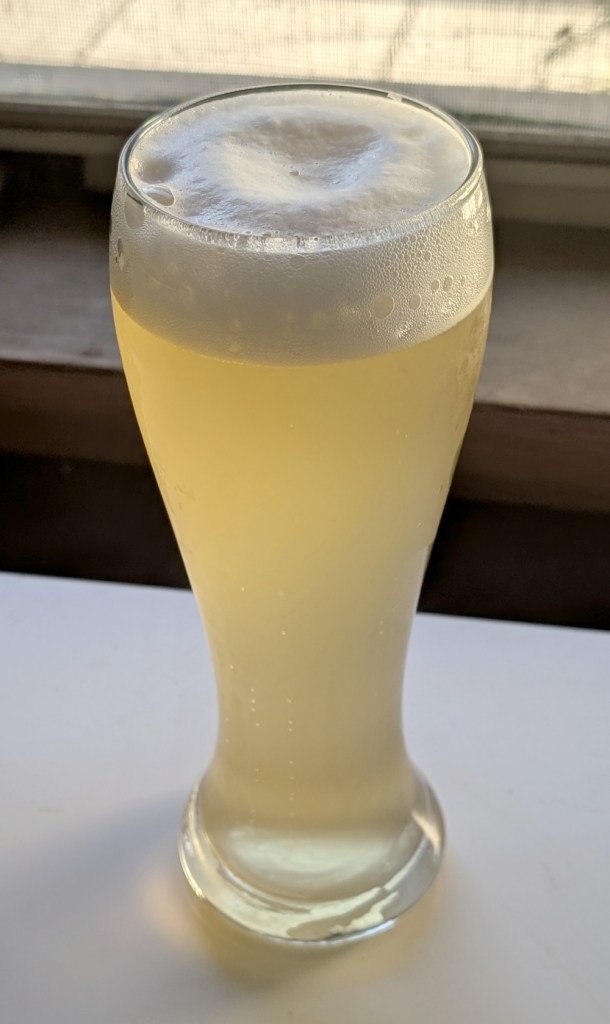
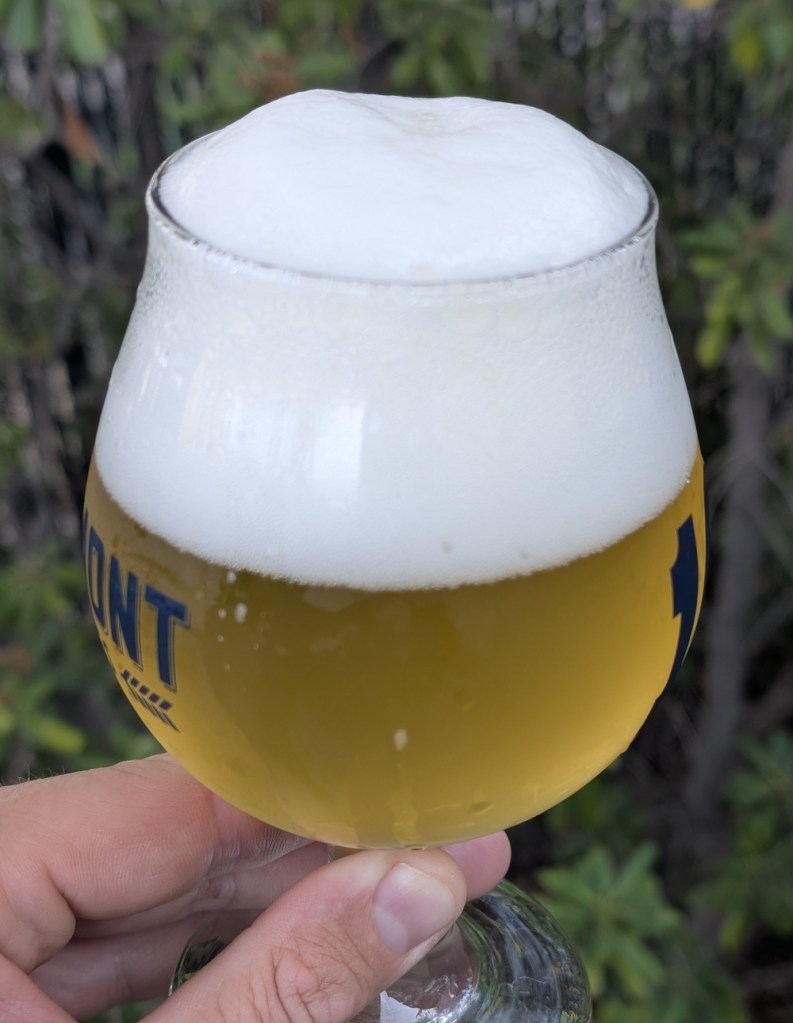
    • Deep gold beer with an orange tinge; slight haze, pouring with a fluffy white and reasonably persistent head.
  • Aroma
    • Medium-high yeast aroma, with fresh pomme fruit quality, a bit of white pepper also. Baked bread malt character at a medium-low level. Not prominent on hops.
  • Flavor
    • A light malty-sweet perception, and a hint of tartness; a slight bit of rye “richness” and graininess. Medium level of clean bitterness, with a slightly herbal character. Red apple and pear at a moderate level in the yeast.
  • Mouthfeel
    • Dry finish, high carbonation that gives a “fluffy” feeling on the tongue. Medium-light body.
  • Would I Brew This Again?
    • This is a great saison! Interestingly, it doesn’t taste bone-dry; the rye must round it out, along with the fruity qualities of the yeast. I might try a lower mineral water to see if it dries out the perception in the next batch.
  • Overall
    • 9/10

Six-Shooter Abbey Singel

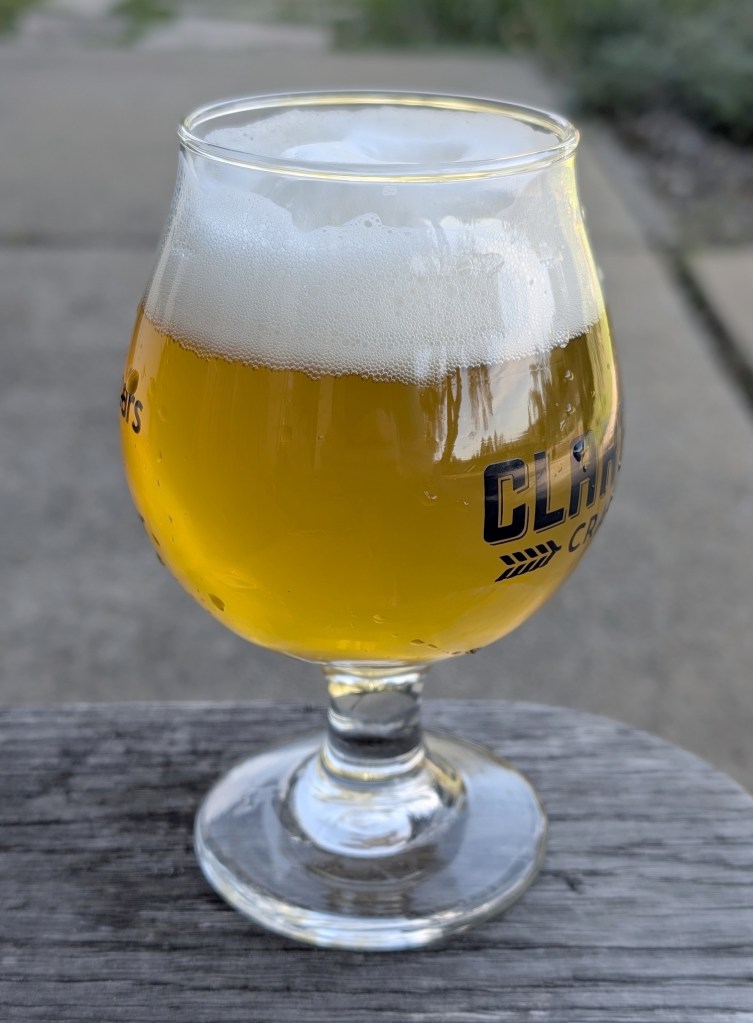
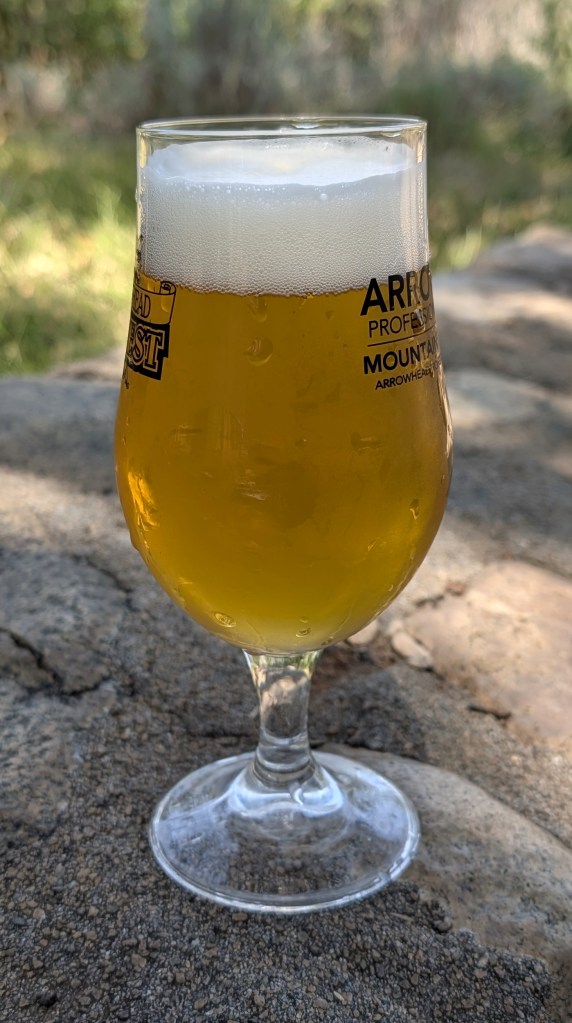
golden yellow beer with white head in tulip glass, sitting on weathered wood

Exploring even more styles that I have not brewed previously, and continuing in the world of Belgian beers, Belgian single is a good goal. This one was spurred by a recipe from the Fall 2025 Craft Beer & Brewing magazine. My version is very close to the published original, although I substituted Willamette for Styrian Goldings (an acceptable substitution according to Hopslist). The yeast was also a slight switch–the original recipe called for Wyeast 1388 Belgian Strong Ale; I couldn’t get this easily, but Fermentis WB-06 is supposed to be equivalent.

Six-Shooter Abbey Singel

  • 6 lb. Synergy Select pilsen malt (Briess)
  • 6 oz. biscuit malt (Dingemans)
  • 0.25 tsp. BrewTanB, added to mash
  • 4 oz. white cane sugar (added to boil)
  • 1.25 oz. Hallertauer Mittelfrueh hop pellets (2.5% alpha), 60 minute boil
  • 1.25 oz. Hallertauer Mittelfrueh hop pellets (2.5% alpha), 15 minute boil
  • 0.25 tsp. BrewTanB, 10 minute boil
  • 0.5 Whirlfloc tablet, 5 minute boil
  • 0.5 oz. Willamette hop pellets (5.8% alpha), 5 minute boil
  • 1 pkg. Safbrew Wheat dry yeast (Fermentis WB-06)
  • 0.5 oz. Biofine Clear, added to keg

Target Parameters

  • 85 minute infusion mash, 149°, full volume mash
  • 1.054 o.g., 1.012 f.g., 5.5% abv, 31 IBU, 5 SRM
  • Water built from RO, with target of 53 ppm Ca, 6 ppm Mg, 6 ppm Na, 73 ppm SO4, 67 ppm Cl
  • 3 gallon batch

Procedure

  • Starting with 4.5 gallons of RO water, I added 0.25 g salt, 1 g epsom salts, 1.5 g gypsum, and 2 g calcium chloride in order to hit my water chemistry targets.
  • I heated the water to 154°, added the grains, and then held the mash at 149° for 85 minutes, with recirculation.
  • Then, I raised the mash temperature to 168° for 10 minutes, before pulling the grains.
  • In total, I collected 4.1 gallons of runnings with a gravity of 1.043, for 73% mash efficiency.
  • I brought the runnings to a boil, added the sugar, and boiled for 60 minutes while adding hops and finings per the recipe.
  • After the boil, I chilled the wort to 74° before moving into the fermentation chamber for the final cool-down to 66°.
  • Starting gravity was 1.057. I brewed this beer on 8 October 2025.
  • Once I pitched the yeast, I held at 66° for fermentation. Vigorous activity kicked off within 12 hours.
  • I pulled the beer to ambient on 11 October 2025 for a few hours (while chilling another beer) and then returned it to the fermentation chamber at 67°.
  • The beer was still occasionally bubbling on 18 October 2025, with a bubble through the airlock every minute or so.
  • I kegged the beer on 8 November 2025, adding 1.65 oz. of corn sugar to start carbonation and scrub any oxygen. Although I used an open transfer, I purged the keg after kegging.
  • The keg was held at ambient for a few weeks, before chilling to 34°. I added Biofine Clear on 30 November 2025.
  • Final gravity was 1.006, for 6.7% abv.

Tasting

  • Appearance
    • Light gold beer, decent clarity but a slight haze; pours with a persistent and fine white head. Good lacing.
  • Aroma
    • Fresh pear and melon yeast character at a moderate level–amazing! It smells fantastic. A low doughy malt aroma is also present. The aroma is perfect!
  • Flavor
    • Doughy fresh white bread malt character. Medium low pome fruit yeast character. Medium-high bitterness, with a spicy quality.
  • Mouthfeel
    • Medium high carbonation. Light body. Dry finish.
  • Would I Brew This Again?
    • This is a really, really good beer–I love everything about it, except for the annoyingly persistent haze. Even with fining, it just hasn’t cleared up completely. That said, the aroma is amazing! It’s interesting that WB-06 is suggested for German wheat ales or witbiers; even with adjusted fermentation conditions, I’m hard pressed to see how it would be in that style. The banana and clove aren’t there. The liquid yeast versions of WB-06 (White Labs WLP570 or Wyeast 1388) are also supposed to be slow flocculators, so if clarity really mattered I might try a different yeast strain. I really like what WB-06 brings for aroma and flavor; it’s interesting without being in-your-face. I’m also pleased with how the mash+yeast choices made an appropriately dry beer. I would brew this recipe again! (but probably in the same batch size – 5 gallons might get a little boring)
  • Overall
    • 7/10

Nectaron Saison

I increasingly enjoy and appreciate saisons, for their easy drinkability and interesting flavors. A good saison can do a lot with simple ingredients! Many homebrew recipes out there are way higher alcohol than I want in five gallon quantities, though, often in the 6 or 7 or even 8 percent range. The first page of results in the AHA recipe archive averages 6.9% abv, and the smallest recipe clocked in at 5.8% abv; that’s just not to my personal tastes.

So, I was intrigued by an article in the Summer 2025 issue of Craft Beer & Brewing, which highlighted saisons and presented a clone recipe for a recent interpretation of the style. Upright Saison Elani originated at Upright Brewing in Portland, Oregon; it was light (4.8% abv), simple (only three grains in the grist), and featured the relatively new hop Elani. This sounded fantastic!

Because Elani is a somewhat new and niche hop, my local homebrew shop didn’t have it in stock, but they did suggest Nectaron as an alternative. I haven’t done anything with Nectaron previously, and the citrus/tropical/stone fruit profile seemed like a good substitute for Elani and a great match for a summer saison. I had some Belle Saison yeast in my stash, so opted for that instead of the Imperial B56 or Wyeast 3276 in the original recipe.

In the spirit of my Brew Year’s Resolution to increase my percentage of “small batch” beers, this was a 3 gallon batch. So far, three out of 13 batches this year (23 percent) have been in this smaller format; by comparison, I had three out of 23 batches in the 3 gallon size last year. I have one or two more 3 gallon batches planned for 2025, so I’m feeling on target to meet my goal. Beyond the metrics, it has been nice to have smaller batches for recipes in the “good beer but I don’t want 5 gallons” categories.

Nectaron Saison

  • 4 lb 2 oz. 2-row pale malt (Rahr)
  • 12 oz. white wheat malt (Briess)
  • 4 oz. Carapils malt (Briess)
  • 1.5 oz. rice hulls
  • 0.25 tsp. BrewTanB, added to mash
  • 0.5 oz. Hallertauer Mittelfrueh hop pellets (2.5% alpha), 75 minute boil
  • 1 oz. Nectacron hop pellets (10.1% alpha), 10 minute whirlpool
  • 1 pkg. Belle Saison yeast (Lallemand)

Target Parameters

  • 60 minute infusion mash, 147°, full volume mash
  • 1.044 o.g., 1.007 f.g., 4.8% abv, 21 IBU, 3 SRM
  • Water built from RO, to hit targets of 63 ppm Ca, 11 ppm Mg, 105 ppm SO4, 67 ppm Cl, RA=-52

Procedure

  • I built my water up from scratch, starting with 4.8 gallons of RO, to which I added 2 g epsom salt, 2 g gypsum, and 2.5 g calcium chloride.
  • Then, I heated the water to 151° before adding the grains and holding at 147° with recirculation for 60 minutes. I raised the mash temperature to 168° for 10 minutes, before removing the grains.
  • In total, I collected 4.5 gallons of runnings with a gravity of 1.035, for 81% mash efficiency.
  • I brought the runnings to a boil, boiling for 75 minutes and adding hops and finings per the recipe.
  • After the boil, I turned off the heat and chilled to 78° before transferring to the fermenter and pitching the yeast.
  • I brewed this beer on 7 June 2025. Starting gravity was 1.045.
  • I used an open fermentation, putting a bit of foil across the top instead of an airlock. I fermented at ambient temperature, in the mid-70s.
  • A good crown of krausen was on the beer within 24 hours of pitching, and the fermenter temperature was around 76°. The krausen had mostly fallen by 14 June 2025, and I put a blow-off tube on the beer on 16 June 2025.
  • I kegged the beer on 21 June 2025, with 1.8 oz. of corn sugar added. I allowed it to carbonate at room temperature.
  • The final gravity was 1.003, for 5.5% abv. This is drier than stated in the original recipe or predicted by software (1.007 at each), but I’m not surprised given the diastatic yeast strain and low mash temperature.

Tasting

  • Appearance
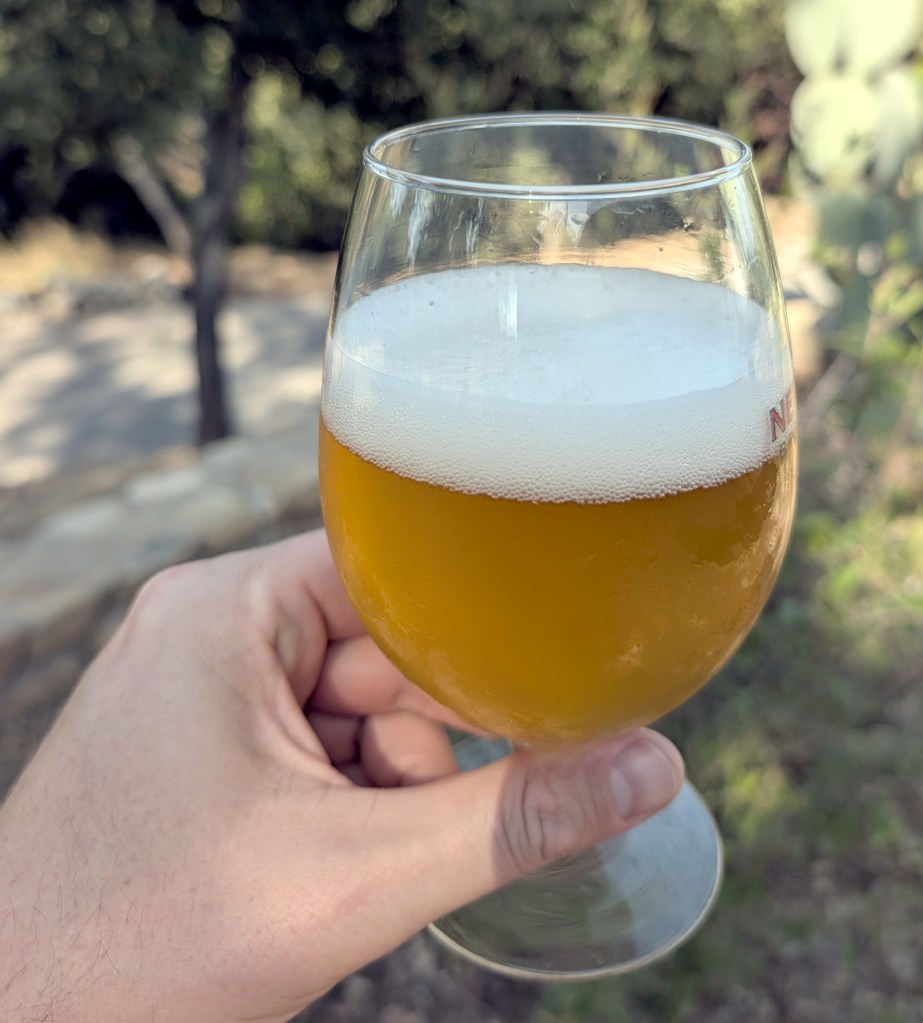
    • Pale yellow, slightly hazy beer; pours with a persistent and fluffy white head.
  • Aroma
    • Pineapple, lemony and slightly spicy aroma at a medium-low level; slight doughy character, too. Pineapple and peach come out as the beer warms, and a stronger peppery character.
  • Flavor
    • Medium low malt with slightly grainy quality; medium bitterness which is more apparent due to the dryness of the beer. Pineapple at a low level and peach appear as the beer warms.
  • Mouthfeel
    • Light body, high carbonation, dry finish.
  • Would I Brew This Again?
    • This is a highly drinkable, refreshing saison! I could see this becoming a house recipe, especially one against which to try out yeast variants. Because Belle Saison is no longer available in homebrew quantities, I suppose the issue is somewhat forced. I really like that strain’s subtlety here, though, and that it’s not a phenol bomb, even with ambient fermentation temperatures. I don’t know that Nectaron really stands out here; it might be better as a dry hop. That said, the hops show more character as the beer warms. It might be interesting to try a dry hop addition or a warmer fermentation, for more hop and yeast character–if that’s what I was looking for. As I have sampled the beer more recently, I’m happier and happier with the current level of things. So maybe it doesn’t need to become a dry hop bomb?
  • Overall
    • 8/10

Steve’s Cali-Belgique IPA Homage

Homebrew is best enjoyed with friends and family, whether it’s a brew day or a warm summer afternoon sharing a new recipe out on the patio. The social aspect is a big part of my enjoyment of the hobby, as I make new friends and welcome old friends into the world of brewing.

Steve and I met through work, and we had our first brew session together in 2009. He was quickly hooked, and soon started his own brewing adventures. Like many brewers, Steve began with extract and transitioned into brew-in-a-bag before too long. He loved experimenting (an early attempt at smoked beer involved some Liquid Smoke added at bottling; do not try this at home, because even Steve grudgingly admitted that it wasn’t very good), and he also loved riffing off of commercial recipes. We would often bounce ideas off of each other, do side-by-side tastings, and give feedback for each others’ beers. We also had semi-regular “hostage swaps,” trading a growler of his homebrew for a growler of mine. Steve and I had many adventures in beer over the years, with brew days together, the San Diego AHA meeting in 2015, carpooling to club meetings, pouring our beers at festivals, and more. He was a creative brewer in ways that I am not–I like to carefully plan each recipe, and Steve was more the type to say, “hey, I wonder what happens if I add sage to this,” or “can I get an approximation of this style with a random yeast?” Steve’s sudden and untimely passing earlier this year has been hard–I lost a close friend, a role model, and a good brewing buddy.

In honor and memory of Steve, I wanted to brew one of “his” beers. A few recipes stand out for me – a sage saison, a Mirror Pond Pale Ale clone, and most all his Cali-Belgique recipe. Cali-Belgique IPA was one of Steve’s early brewing obsessions, attempting to clone one of Stone Brewing’s beers. No longer commercially available, Cali-Belgique was a modification of the flagship Stone IPA, fermented with Belgian ale yeast. Steve enjoyed this beer, and wanted to make his own version; I sampled a few early brews, as he got closer and closer to his vision for the beer. Along the way, it turned into an excellent recipe and one that was truly Steve’s own, not just a clone. I’ll forever associate this beer with him!

Crafting Steve’s Cali-Belgique

Unfortunately, I didn’t have Steve’s Cali-Belgique IPA recipe (I had never gotten around to brewing it myself, because I could readily get the beer from Steve), but I remembered that Steve pretty regularly phoned his recipes in to our local homebrew shop. So, I reached out to Charles at Pacific Brewing Supplies, and I was in luck! Charles happened to have the grain bill and hop list, which set us well on the way to reconstructing this recipe.

The latest version of Steve’s Cali-Belgique had 50% 2-row, 33.3% Belgian Pilsner malt, 8.3% Carapils, and 8.3% Dark Munich. Steve double-milled his grains, and Charles thinks Steve was hitting around 75% efficiency in his system. He started as an extract brewer, spent much of his brewing career using brew-in-a-bag, and spent the last part with an Anvil Foundry all-in-one system. Based on all of this, target gravity was probably around 1.064 or 1.065. For my own version, I increased the 2-row from 6 lb to 8 lb to improve the gravity on my system and make it match Steve’s system better. A future brew on my system should increase percentage on all grains. I assumed a mash temperature of around 152°, just for simplicity.

The latest version of Steve’s recipe included 1 oz. of Chinook (13% alpha), 2 oz. of Columbus (15% alpha), and 1 oz. of Centennial (10% alpha). I had to guess at usage, but assumed Chinook as the main bittering hop and then a combination of late hop and dry hop additions for the rest. Steve seemed to always be adjusting the recipe, so it’s safe to play around in the hopping approach, because that’s what he would do. Following Steve’s preferences and the original Stone IPA recipes, it was probably hitting around 65 IBU.

Yeast varied over the years, but Steve’s most recent batches used Abbaye or Monk dry yeast. For fermentation temperature, I remember the beer having the nice spicy yeast notes and phenols that come with a warmer temperature for these Belgian strains. So, I decided to ferment around 72°.

With all of this information gathered, it was time to brew and sample Steve’s Cali-Belgique. Cheers to you, Steve, and thanks for the many happy hours of stargazing, conversation, philosophy, and beer tasting.

Steve’s Cali-Belgique IPA Homage

  • 8 lb. 2-row malt (Great Western)
  • 4 lb. pilsen malt (Dingemans)
  • 1 lb. dextrin malt (Viking)
  • 1 lb. Munich dark malt (Viking)
  • 0.5 tsp. BrewTanB, added to mash
  • 1.15 oz. Chinook hop pellets (12.3% alpha), 60 minute boil
  • 0.75 oz. Centennial hop pellets (8.1% alpha), 10 minute boil
  • 0.75 oz. Columbus hop pellets (15.6% alpha), 10 minute boil
  • 0.25 tsp. BrewTanB, 10 minute boil
  • 1 Whirlfloc tablet, 5 minute boil
  • 1 pkg. Abbaye Belgian ale yeast (Lallemand)
  • 1 pkg. Monk ale yeast (CellarScience DY106B)
  • 1.25 oz. Columbus hop pellets (15.6% alpha), dry hop in fermenter
  • 0.25 oz. Centennial hop pellets (8.1% alpha), dry hop in fermenter

Target Parameters

  • 60 minute infusion mash, 152°, full volume mash
  • 1.063 o.g., 1.016 f.g., 6.2% abv, 68 IBU, 6 SRM
  • Claremont water adjusted with lactic acid and minerals to hit 76 ppm Ca, 22 ppm Mg, 89 ppm Na, 182 ppm SO4, 110 ppm Cl, 20 ppm bicarbonate

Procedure

  • Starting with 7.6 galllons of water, I added 6.33 mL of 88% lactic acid, to drop out the carbonates. Then, I added 4 g of epsom salt and 4 g of gypsum to kick up the sulfates.
  • I heated the strike water to 159°, before adding the grains and 25.7 mL of 10% phosphoric acid, holding the mash at 152° (with recirculation) for 60 minutes.
  • At the end of the mash, I pulled the grains. In total, I had 6.75 gallons at a gravity of 1.052, for 68% mash efficiency.
  • I brought the kettle to a boil and boiled for 60 minutes, adding hops and finings per the recipe. Then, I turned off the heat and chilled the wort to 72° before transferring to the fermenter and pitching the yeast.
  • Starting gravity was 1.060. I brewed the beer on 30 March 2025, and fermented at ambient (~65°).
  • When I checked the fermenter on 1 April 2025, there was no activity in the airlock, so I opened the fermenter and confirmed no activity. I had a pack of Abbaye Ale yeast on-hand, so pitched that. Krausen was visible by the next day. I put a heat pad on the beer, but it got a bit hot; around 80° by 3 April. Oops! I let it ride at ambient at that point.
  • I kegged the beer on 14 May 2025, adding the dry hops in a bag. I removed the hops on 18 May 2025.
  • Final gravity was 1.015, for 6.0% abv.

Tasting

  • Appearance
    • A very clear, gold beer, which has a thick and persistent white head
  • Aroma
    • I get a strong sensation of pineapple in the aroma as the beer warms up; some moderate alcohol notes, too. Yeast character dominates, and I don’t get much for hops or malt.
  • Flavor
    • This is a very bitter beer with a resinous edge to the hops. It has a medium-low maltiness, with a light caramel quality. There is a touch of clove flavor as the beer warms. The bitterness lingers on the tongue.
  • Mouthfeel
    • Medium body, medium carbonation, slightly dry finish.
  • Would I Brew This Again?
    • Yes! This beer goes down surprisingly smoothly, which I didn’t necessarily expect. I would like more dry hop aroma, and probably should just let the hops float free in the fermenter rather than bagging them. For a variant, I might try Eclipse and El Dorado, while keeping the same yeast. Mosaic or Galaxy could also work. The beer overall is quite good – the low hop aroma / low flavor complexity is the main reason that I gave it a lower score (no fault of the recipe – just my handling of the hops). That said, I don’t really remember Steve’s version of this having much for hop aroma. So, I might adjust the beer for my own preferences, but as something that captures his beer as I remember it, it’s pretty close!
  • Overall
    • 6.5/10
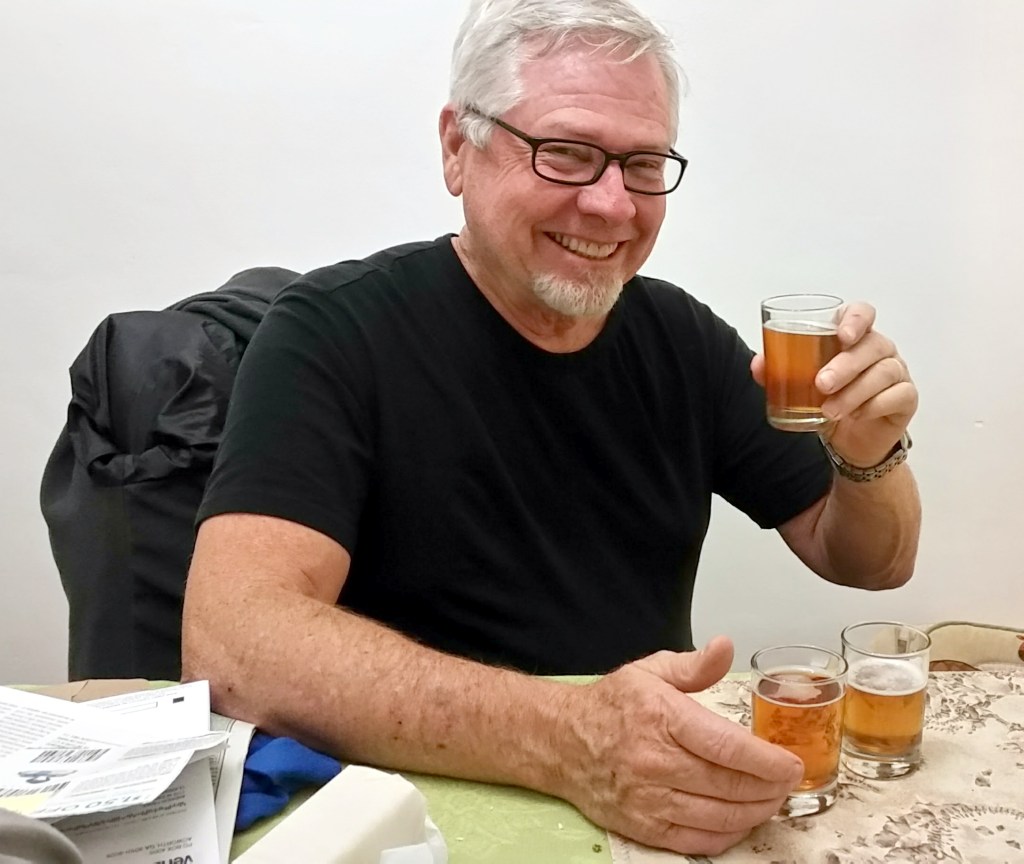
Steve helping with a festbier tasting, stacking my homebrew against commercial examples. I always enjoyed beer tasting with him…”I brewed up this new recipe…I’d love to get your thoughts on it!”

Patersbier 2025

I love the concept of a patersbier (“Father’s Beer”), as a relatively light and low alcohol yet flavorful take on a Belgian ale. As with many Belgian ales that were associated with the monastic traditions, there is plenty of romance and a good dollop of fantasy around these brews. I’m not particularly interested into delving into historicity–I’m more interested in making a beer that I want to drink!

This particular version is a bit of a kitchen sink beer, intended to sweep out odds and ends from my brewing supply. Even so, I aimed to have a sturdy malt backbone. Hops were chosen, again, to use up a few varieties. I knew a Belgian yeast was in order, so Lallemand’s Abbaye Belgian fit the bill. It’s very different from the previous patersbier I made, which was a SMaSH with pilsner malt and Cascade hops.

Along the lines of my Brew Year’s Resolution to make more small batches, this was a 3 gallon batch. I also did a quick brew day, with 30 minute mash and 30 minute boil.

Patersbier 2025

  • 2.75 lb. Vienna malt (Weyermann)
  • 2 lb. 2-row malt (Great Western)
  • 0.5 lb. Caramel Munich 60L malt (Briess)
  • 0.5 lb. Munich II malt (Weyermann)
  • 0.25 lb. Caramel Malt 120L (Briess)
  • 0.25 tsp. BrewTanB, added to mash
  • 1 oz. Styrian Goldings hop pellets (3.2% alpha), 30 minute boil
  • 0.5 oz. Crystal hop pellets (4.5% alpha), 30 minute boil
  • 1 pkg. Abbaye Belgian ale yeast

Target Parameters

  • 1.045 o.g., 1.015 f.g., 3.9% abv, 13 SRM, 26 IBU
  • Full volume mash at 158° for 60 minutes
  • Claremont tap water, no adjustment

Procedure

  • I heated the mash water to 164°, added the grains, and held at 158° with recirculation for 30 minutes. Then, I raised the mash to 168° for 10 minutes before pulling the grains.
  • In total, I collected 4 gallons of runnings with a gravity of 1.037, for 66% mash efficiency.
  • I brought the kettle to a boil and added hops per the recipe. After 30 minutes, I turned off the heat and chilled the wort to 68° before transferring to the fermenter.
  • Starting gravity was 1.044. Once I pitched the yeast, I let it ferment at ambient. I brewed the beer on 12 March 2025.
  • I kegged the beer on 24 March 2025. Final gravity was 1.013, for 4.1% abv. I added 1.5 oz. of corn sugar dissolved in ~0.5 cup of water and boiled, in order to do natural carbonation. I finished off the carbonation with forced CO2. At the time of kegging, a pleasant and spicy yeast character was evident.

Tasting

  • Appearance
    • Medium amber beer, clear, ivory head with good persistence.
  • Aroma
    • Moderately high yeast aroma with good phenolic character; spicy notes, some red apple. Some bready and caramel notes come through as the beer warms up.
  • Flavor
    • Spicy yeast character at the forefront; medium level of malt character with a malty, bread crust quality. Medium-low level of hops.
  • Mouthfeel
    • Light body, medium level of carbonation, dry finish.
  • Would I Brew This Again?
    • This is good for what it is–easy drinking and lots of yeast character. It’s a bit thin on the body, so might benefit from a touch more crystal malt. The yeast character is perfect! As compared with my previous patersbier, I like the 2025 recipe much better.
  • Overall
    • 7/10