
I’ve been enjoying Belgian beers with an increased frequency, and saison has been a fun style to try within that family. This recipe was crafted to bring the simplicity of pilsner malt alongside a bit of Munich for character and some flaked rye to add a rustic quality. Lallemand’s Belle Saison, with an open fermentation, helped bring the yeast character. As is typical for these kinds of brews, I’m doing a small batch of ~3 gallons.
Rye Saison
- 5 lb. Synergy Select Pilsen malt (Briess)
- 1 lb. Barke Munich malt (Weyermann)
- 1 lb. flaked rye
- 0.25 tsp. BrewTanB, added to mash
- 0.6 oz. Perle hop pellets (6.3% alpha), 60 minute boil
- 0.25 tsp. BrewTanB, 10 minute boil
- 1 pkg. LalBrew Belle Saison dry yeast
Target Parameters
- 75 minute infusion mash, 148°, full volume mash
- 1.053 o.g., 1.002 f.g., 6.8% abv, 23 IBU, 5 SRM
- Water built from RO and Claremont tap water, with mineral additions to hit 67 ppm Ca, 15 ppm Mg, 40 ppm Na, 101 ppm SO4, 53 ppm Cl, 59 ppm bicarbonate.
- 3 gallon batch
Procedure
- I prepared my water with 2.5 gallons of RO and 2 gallons of tap water, along with a Campden tablet, 2 gram epsom salts, and 1 gram of gypsum. I heated this water to 154° before adding the BrewTanB, 5 mL of 88% lactic acid (probably too much – oops! I had it set for the MPH and not BW model in BeerSmith), adding the grains and holding at 148° with recirculation for 75 minutes. Then, I heated the mash to 168° and held for 10 minutes before removing the grains.
- I collected 3.96 gallons of runnings with a gravity 1.046, for 70% mash efficiency. This is better than I expected!
- I heated the runnings to a boil, boiling for 60 minutes before turning off the heat and chilling to 75°. I transferred the wort to a fermenter and pitched the yeast. Because I wanted an open fermentation, I put foil over the out port of the fermenter.
- I brewed this beer on 29 March 2026; starting gravity was 1.057, a bit higher than calculated (but that’s OK!).
- The fermentation proceeded at ambient; it was down to 72° by 30 March 2026, with abundant krausen. The fermenter was at 70° by 31 March 2026, so I put it next to a heating pad in order to warm the fermenter. This brought it up to 80° by the evening of 1 April 2026.
- The fermenter was holding at 74° by 4 April 2026; krausen had largely subsided at that point. I took the foil off and replaced it with a blowoff tube.
- I kegged the beer on 20 April 2026, transferring into a small keg and adding 3.25 oz. of corn sugar dissolved in ~1 cup of water.
- Final gravity was 1.001, for 7.5% abv.
- Tracking keg pressure, the beer was at 18 psi on 4 May 2026, well under the set point for saison-level carbonation. I moved the beer to the conditioning chamber and topped it off with CO2.
Tasting
- Appearance
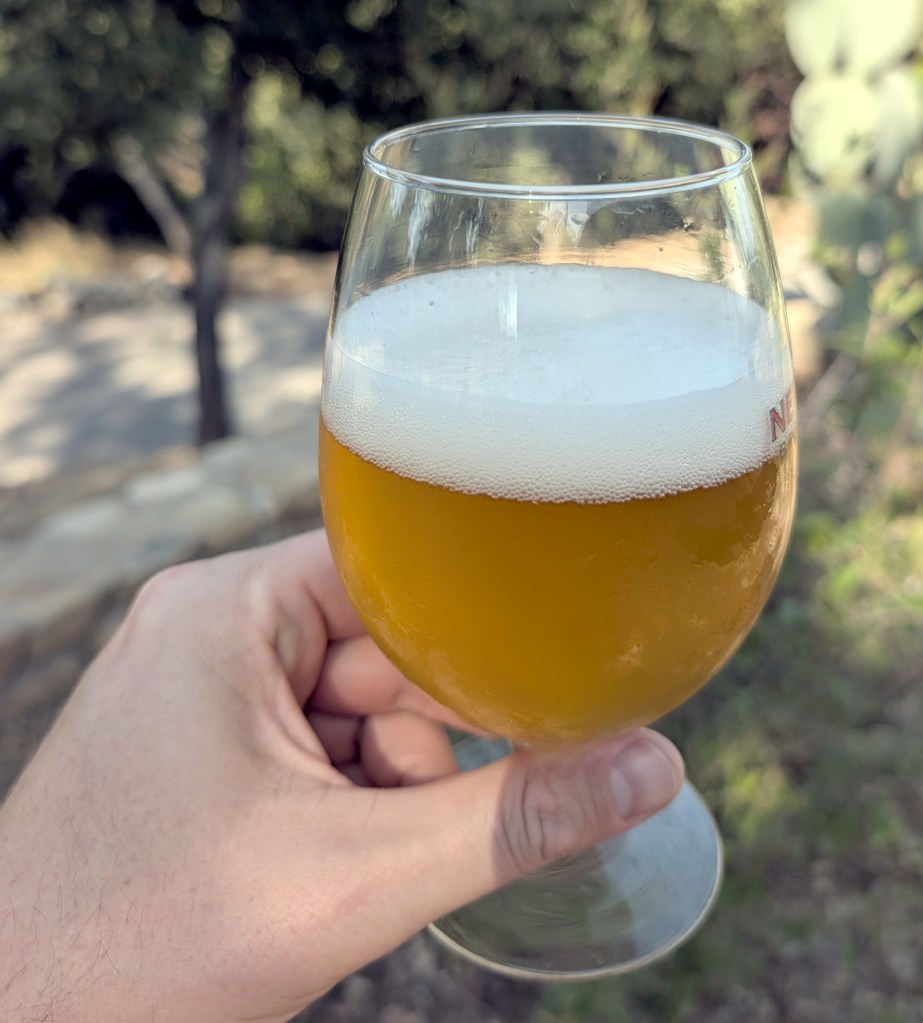
- Deep gold beer with an orange tinge; slight haze, pouring with a fluffy white and reasonably persistent head.
- Aroma
- Medium-high yeast aroma, with fresh pomme fruit quality, a bit of white pepper also. Baked bread malt character at a medium-low level. Not prominent on hops.
- Flavor
- A light malty-sweet perception, and a hint of tartness; a slight bit of rye “richness” and graininess. Medium level of clean bitterness, with a slightly herbal character. Red apple and pear at a moderate level in the yeast.
- Mouthfeel
- Dry finish, high carbonation that gives a “fluffy” feeling on the tongue. Medium-light body.
- Would I Brew This Again?
- This is a great saison! Interestingly, it doesn’t taste bone-dry; the rye must round it out, along with the fruity qualities of the yeast. I might try a lower mineral water to see if it dries out the perception in the next batch.
- Overall
- 9/10

