Spring Classic IPA

I just love the “traditional” northwestern IPAs, as mentioned numerous times before on this blog. So many breweries focus on the tropical fruit profiles, which I also love, but sometimes I just want pine and citrus and dank flavors in my IPA.

This latest batch doesn’t follow any particular recipes; I’m just aiming for a bit of interesting base malt character with a touch of crystal malt. So, I leaned on the two-row for about three-quarters of the grist, along with a bit of Golden Promise for interest, some crystal 40, and a bit of biscuit. The latter two used up my supplies, so it was good housecleaning.

The hopping was traditional with a twist. A recent HOPBOX had some of their hop extract, enough to add about 47 IBU. According to their website, it’s mostly CTZ-type hops with some other semi-random aroma varieties. That sounded like a perfect bittering base for my beer, and I have also wanted to try out some of these hop extracts for awhile. I elected to put the rest of my hops all in the whirlpool and dry hop additions. In this case, Amarillo, Centennial, and Cascade were perfect choices.

This batch was brewed while my Foundry was down for repairs, so I used the “traditional” batch sparge technique. I’m glad to say I still have the skills here, and hit my numbers really closely.

Spring Classic IPA

  • 10 lb. 2-row pale malt (Rahr)
  • 3 lb. Golden Promise Finest Pale Ale malt (Simpsons)
  • 9 oz. 40L caramel malt (Briess)
  • 4 oz. biscuit malt (BlackSwaen)
  • 10 mL Yakima Valley Hops CO2 hop extract (48.91% alpha), 60 minute boil
  • 1 Whirlfloc tablet, 5 minute boil
  • 1 oz. Amarillo hop pellets (7.8% alpha), 15 minute whirlpool
  • 1 oz. Cascade hop pellets (8.7% alpha), 15 minute whirlpool
  • 1 oz. Centennial hop pellets (12.5% alpha), 15 minute whirlpool
  • 2 pkg. American West Coast Ale dry yeast (Lallemand BRY-97)
  • 1 oz. Amarillo hop pellets (7.8% alpha), dry hop in keg
  • 1 oz. Cascade hop pellets (8.7% alpha), dry hop in keg
  • 1 oz. Centennial hop pellets (12.5% alpha), dry hop in keg

Target Parameters

  • 1.059 o.g., 1.010 f.g., 6.5% abv, 69 IBU, 7 SRM
  • Infusion mash to hit target of 148°, 60 minutes, batch sparge
  • Claremont tap water with gypsum added to to achieve 79 ppm Ca, 6 ppm Mg, 91 ppm Na, 172 ppm SO4, 85 ppm Cl, 144 ppm HCO3, 118 ppm alkalinity, 58 ppm RA

Procedure

  • I heated 4.6 gallons of water (with Campden tablet) to 159°, and mashed in with my grains to hit 149°. I added 6 mL of 88% lactic acid to adjust the pH. I mashed for 60 minutes before adding 0.75 gallons of 185° water. I let it rest, vorlaufed, and then collected the first runnings. Next I added 3.75 gallons of water at 185°, let it rest at around 170° for 10 minutes, and then collected the second runnings.
  • In total, I collected 7.6 gallons of runnings with a gravity of 1.050, for 75% mash efficiency.
  • While the kettle was coming up to a boil, I soaked the hop extract in hot tap water, in order to make it easier to add. That certainly did the trick!
  • I added 6 g of gypsum to the boil, to hit my water target.
  • Once the kettle was boiling, I added the hop extract and then added other items per the recipe.
  • After a 60 minute boil, I turned off the flame, added the whirlpool hops, and let it rest (with occasional stirring) for 15 minutes before chilling.
  • I transferred the wort to my fermenter and chilled it down to 66° before pitching the yeast.
  • I brewed this beer on 15 April 2022, and fermented it at 66°. Starting gravity was 1.059, right on target.
  • I moved the beer to ambient on 24 April 2022, and kegged it on 4 May 2022. I added the drop hops at this point, with a mesh bag inside the keg.
  • The final gravity was 1.011, for 6.4% abv. I’m very pleased on how closely I hit my numbers overall!

Tasting

  • Appearance
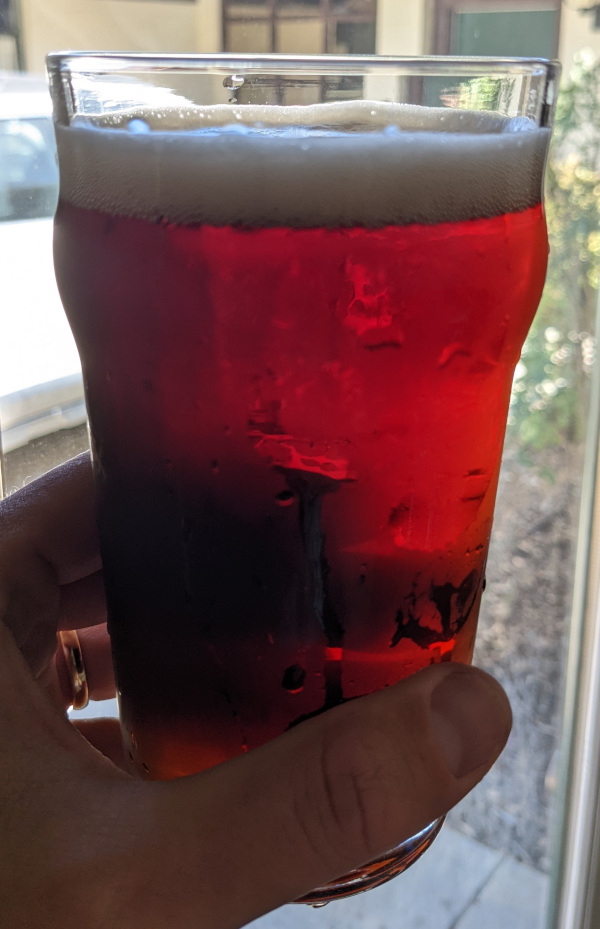
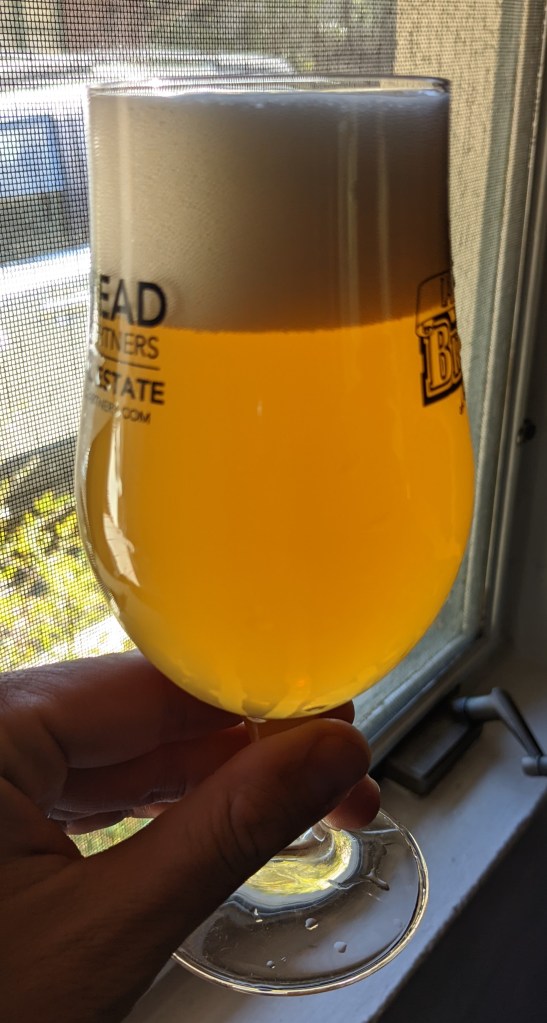
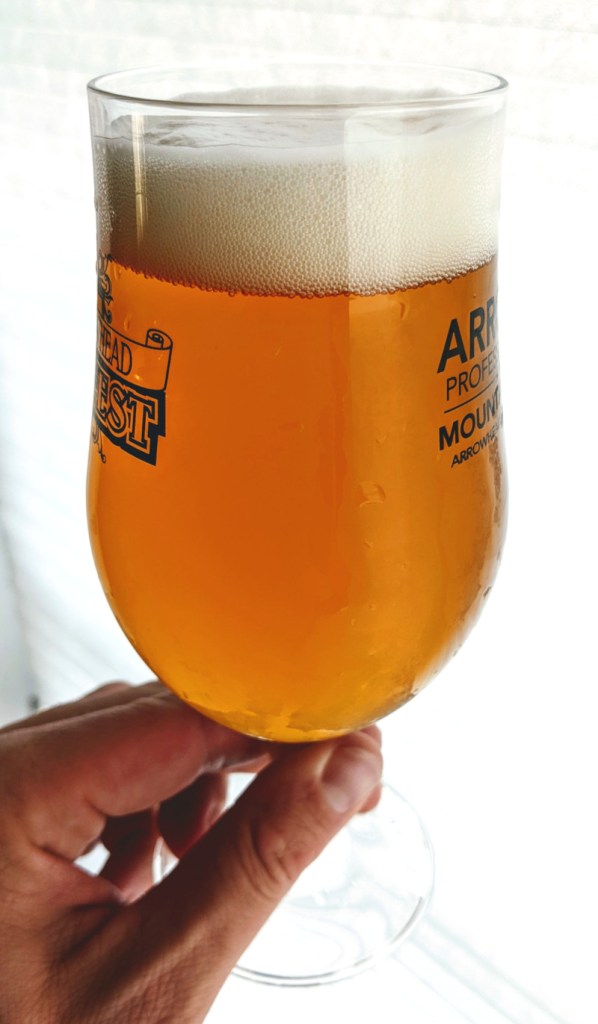
    • Pours as a golden, somewhat hazy beer, with a creamy white head that is very persistent. The head leaves gorgeous lacing down the sides of the glass.
  • Aroma
    • Orange and overall citrus notes, with a slight malty background. The yeast character is quite clean.
  • Flavor
    • A citrus, citrus pith, pine, and resiny hop bitterness at the front, with a clean malty presence and a light bit of candy behind that. The hop character has that “sticky” quality on the tongue that I really adore in a good traditional American IPA.
  • Mouthfeel
    • Medium body, with moderate carbonation and a dry finish.
  • Would I brew this again?
    • I feel like I’ve gotten my “traditional” West Coast IPAs down pretty well now. I know the hops and hop combos I like, and have found that perfect balance of crystal malt and base malt. I also have a few variations on recipes that work well. It definitely has a “hop haze,” which I suppose dings it a little bit in terms of my overall score, but I also expect that should be cleared out by the end of the keg. BRY-97 is my favorite IPA yeast now, too! Another thing I love about this beer is that I perceive it just a little differently every time I sample it. Sometimes the pine hits me, sometimes the orange, sometimes the resin.
  • Overall
    • 9/10

Winner, Winner: Big Surprise Belgian Pale Ale

The Southern California Homebrewers Festival was held recently, and per tradition they had a style-focused competition. Each participating club could submit an entry for a bragging rights “best of show” beer…this year’s style of choice was Belgian Pale Ale. My beer was selected as the entry for our brew club (Horse Thief Brewer’s Association)…and I was blown away to learn that it was the top beer of the competition, among approximately 30 other entries! Due to a work conflict, I wasn’t able to be there in person, but enjoyed hearing about the results via text message (I was in the field when I received the news). The ?downside is that I received an empty keg back, so wasn’t able to enjoy the beer after my first few samples! I guess that means I’ll be brewing it again sometime soon.

Photo by Nataliya Vaitkevich on Pexels.com

These high ratings surprised me because I had never brewed the style before, was using an untested recipe, and didn’t actually expect to win. But hey, I won’t complain. Even though I didn’t think the beer was anything particularly special, other people obviously did, and I’m kinda proud of that.

The recipe I brewed here was a modification of Ben’s Belgian Pale Ale, which received a silver medal at the 2019 National Homebrew Competition. The recipe is posted on the AHA website; I figured that it would be a good starting point for my own version. This is not a style I’ve sampled a ton of, so I was working a bit in the dark. The original recipe called for flaked oats and red wheat malt, but I elected to pull those out to ensure a clearer result. After a bit of research, I settled on Omega Labs’ Belgian Ale A yeast, because it is supposed to be on the cleaner side for Belgian yeasts–a desirable quality in a Belgian pale ale. I suppose there are enough changes that the original recipe was an inspirational starting point, rather than anything I explicitly followed. I did choose to make Saaz the centerpiece of the hopping, in a nod to tradition.

Andy’s Belgian Pale Ale, in a “farewell tasting” before it headed off to the brewing festival

Big Surprise Belgian Pale Ale

  • 7 lb. Barke pilsner malt (Weyermann)
  • 2 lb. Munich I malt (Weyermann)
  • 12 oz. Cara 20 malt (Dingemans)
  • 8 oz. aromatic Munich malt 20L (Briess)
  • 8 oz. caramel Munich 60L malt (Briess)
  • 4 oz. dextrin malt (Viking)
  • 0.75 oz. Saaz hop pellets (4.0% alpha), 60 minute boil
  • 0.35 oz. Magnum hop pellets (10.1% alpha), 60 minute boil
  • 0.5 oz. Saaz hop pellets (4.0% alpha), 20 minute boil
  • 1 Whirlfloc tablet, 5 minute boil
  • 1 oz. Saaz hop pellets, 5 minute boil
  • 1 pkg. Belgian Ale A yeast (Omega OYL-024)

Target Parameters

  • 1.051 s.g., 1.010 f.g., 5.4% abv, 29 IBU, 10 SRM
  • Claremont tap water, adjusted to hit 45 Ca, 6 Mg, 91 Na, 50 SO4, 115 Cl, 144 HCO3
  • Full volume mash, 60 minutes at 152° and 10 minute mash-out at 168°.

Procedure

  • I mashed in with 7 gallons of water at 158°, to hit a mash temperature of 152°. I added 1 g CaCl to adjust water chemistry, as well as 2.5 mL 88% lactic acid to adjust pH. I held at 152° for 60 minutes, before raising the mash to 168° for a 10 minute mash-out.
  • I removed the grains and heated the runnings to a boil. In total, I collected 6.1 gallons of runnings with a gravity of 1.047, for 71% mash efficiency.
  • I brought the kettle to a boil, adding hops and finings per the recipe. After 60 minutes, I turned off the heat and chilled to ~66°.
  • On the morning of brew day, I made a 1L vitality starter to wake up the yeast.
  • I brewed this beer on 13 March 2022. Starting gravity was 1.052. I fermented the beer at ambient temperature in my garage, around 60°.
  • After vigorous fermentation slowed down, I moved the fermenter inside on 18 March 2022, where the temperature was slightly warmer (~66°). Very vigorous fermentation took off again (filling the airlock with yeast), so I cleaned the airlock, sanitized it, and let it go from there.
  • I kegged the beer on 8 April 2022, using 3.5 oz. of corn sugar dissolved in 1 cup of water. Final gravity was 1.011, for 5.4% abv.
  • I let the keg sit at ambient for ~2 weeks, and topped up the carbonation with forced CO2. The flavor was pretty good, but it was not terribly clear. So, I added 1 tsp. of gelatin dissolved in water on 24 April 2022. Within two days, the clarity was gorgeous!

Tasting

  • Appearance
    • Very clear, light amber color. The beer pours with a creamy and persistent white head.
  • Aroma
    • Bready and light caramel aroma, with a light pear-like fruitiness to the yeast aroma.
  • Flavor
    • Light fruity yeast character at the front, with a bready/grainy malt character. Bitterness is moderate, with a smooth extended finish.
  • Mouthfeel
    • Medium body, medium carbonation, slightly dry finish.
  • Would I brew this again?
    • Gelatin improved the clarity on this beer a TON! I really like the restrained yeast character here; it is interesting without being cloying or overpowering. I would highly recommend the Omega Labs’ Belgian Ale A for anyone else looking to make this style–the pear quality is particularly enjoyable. The few samples I had were good enough, although not mind-blowing to me. I guess that’s the slightly understated nature of this style. I’m going to have to give it another try, because I’m now intrigued, especially given the fact that other people liked it so much.
  • Overall
    • 7/10

Pre-Prohibition Lager

Continuing my journey through the world of lagers, I decided to try a new version of a Pre-Prohibition lager. I’ve made something from this style range before, during my first foray into lagers, and it turned out pretty well. For the current batch, I used a blend of pilsner and 2-row malt to achieve a bit of complexity, layering in some flaked corn to give the “American” component. I got some Triumph hops in a HOPBOX selection, and thought this would be well suited for my American lager. Triumph is an American hop with European parentage, including some noble hops, and it is supposed to bring some noble characteristics along with delicate fruit qualities.

Pre-Prohibition Lager

  • 6.5 lb. Pilsner Malt (Viking)
  • 4 lb. 2-row malt (Rahr)
  • 1 lb. flaked corn
  • 0.25 lb. rice hulls
  • 0.5 oz. Triumph hop pellets (7.9% alpha), 60 minute boil
  • 0.75 oz. Triumph hop pellets (7.9% alpha), 15 minute boil
  • 1 tsp. BruTahB, 10 minute boil
  • 1 Whirlfloc tablet, 5 minute boil
  • 0.75 oz. Triumph hop pellets (7.9% alpha), 5 minute boil
  • 2 pkg. Diamond lager yeast (Lallemand)

Target Parameters

  • 1.051 s.g., 1.008 f.g., 28 IBU, 5.7% abv, 4 SRM
  • Full volume Hochhurz mash, 45 minutes at 144°, 45 minutes at 10 minutes at 160°, 10 minute mash-out at 168°
  • Water built from scratch to hit 59 ppm Ca, 8 ppm Mg, 89 pm SO4, 63 ppm Cl, -47 ppm RA

Procedure

  • I added 2.7 g gypsum, 2.2 g epsom salt, and 3.4 g calcium chloride to 7 gallons of RO water, to hit a target of 59 ppm Ca, 8 ppm Mg, 89 pm SO4, 63 ppm Cl, and -47 ppm RA.
  • I heated the water in the Foundry to 150°, and added the grains to hit a mash temperature of 144°. I added 1.5 mL of 88% lactic acid to adjust pH slightly. I held the mash at 144° with recirculation for 45 minutes, and then raised the temperature to 160°, holding it here for 45 minutes also. Finally, I raised the mash to 168° and held it here for a 10 minute mash-out.
  • After the mash-out, I removed the grain basket and brought the runnings to a boil. I collected 6.3 gallons of runnings with a gravity of 1.048, for 71% mash efficiency.
  • I brought the beer to a boil, aiming for 60 minutes, adding hops and such per the recipe. My Foundry had an issue mid-boil (the power switch was starting to burn out),so it took a bit of work to limp the boil through to the end. I adjusted the length of the boil time slightly to compensate.
  • After approximately 60 minutes of total boil, I turned off the heat and chilled to ~68°, before transferring to the fermenter and chilling down to 48° in the fermentation chamber. I then pitched the yeast.
  • I brewed the beer on 14 February 2022, and fermented at 52°. Starting gravity was 1.053.
  • I kegged the beer on 8 April 2022. Final gravity was 1.013, for 5.3% abv.

Tasting

  • Appearance
    • Brilliantly clear, light yellow beer with moderately persistent head. The head pours fairly thick, but thins out after awhile.
  • Aroma
    • Clean! Slight grainy/corn profile; not much hop character, although there is a bit of a spice hop note.
  • Flavor
    • Malty/grainy, with light corn flavor; moderately high bitterness, but not much for hop character otherwise.
  • Mouthfeel
    • Fairly crisp finish, with moderate carbonation. Medium body. Very smooth drinking!
  • Would I brew this again?
    • YES! This is a nice version of the style; I suppose it doesn’t hit all of the BJCP style notes, but it really is a pretty awesome American lager. A touch more hop aroma would be nice, but not mandatory.
  • Overall
    • 9/10

Stratigraphic Pale Ale

As mentioned previously, Yakima Valley’s HOPBOX is a good way to sample fresh and interesting hops. My first box included Strata and El Dorado; I’ve brewed with the latter previously, but not Strata. I was noodling about for a recipe that would have tropical-type notes, and these seemed to be a good way to achieve that goal.

The base recipe is a fairly standard American pale ale; I aimed for the lighter side of the style, with a very deft touch of caramel malts. To maximize the hop character, I dosed all of the aroma hops in the whirlpool and the dry hop additions. Otherwise, there’s not a ton of note in the recipe design.

Stratigraphic Pale Ale

  • 7.25 lb. 2-row pale malt (Rahr)
  • 4 lb. Maris Otter malt (Crisp)
  • 5 oz. crystal 15 (Great Western)
  • 4 oz. caramel 10L (Briess)
  • 0.25 oz. Bravo hop pellets (14.2% alpha), 60 minute boil
  • 1 oz. El Dorado hop pellets (16.2% alpha), 15 minute whirlpool
  • 1 oz. Strata hop pellets (13.7% alpha), 15 minute whirlpool
  • 1 pkg. Safale American Ale yeast (Fermentis US-05)
  • 1 oz. El Dorado hop pellets (16.2% alpha), dry hop in keg
  • 1 oz. Strata hop pellets (13.7% alpha), dry hop in keg

Target Parameters

  • 1.053 s.g., 1.011 f.g., 5.5% abv, 5 SRM, 38 IBU
  • Full volume mash, 60 minute mash at 152°, 10 minute mash-out at 168°
  • Claremont tap water adjusted to hit target of 71 ppm Ca, 6 ppm Mg, 91 ppm Na, 154 ppm SO4, 85 ppm Cl, 144 ppm bicarbonate, RA=63.

Procedure

  • I heated 7.25 gallons of water to 159°, and mashed in with the grains to hit a target mash temperature of 152°. I added 7.5 mL of 88% lactic acid to adjust the pH. I held it here while recirculating for 60 minutes, before raising the temperature to 168° for a 10 minute mash-out.
  • I removed the grain basket and brought the kettle to a boil. In total, I collected 6.4 gallons of runnings with a gravity of 1.048, for 70% mash efficiency. I added 5 g of gypsum to the boil kettle, to adjust the mineral profile of the water.
  • I added hops and finings per the recipe, with a 60 minute boil. After 60 minutes, I turned off the heat, added the whirlpool hops, and whirlpooled for 15 minutes.
  • After the whirlpool, I chilled and then transferred to the fermenter.
  • I chilled the wort down to 66° in my fermentation chamber, before pitching the yeast. I fermented at 66° also.
  • I brewed the beer on 29 January 2022. I kegged it on 8 March 2022, adding the dry hops to the keg.
  • Final gravity was 1.012, for 5.4% abv.

Tasting

  • Appearance
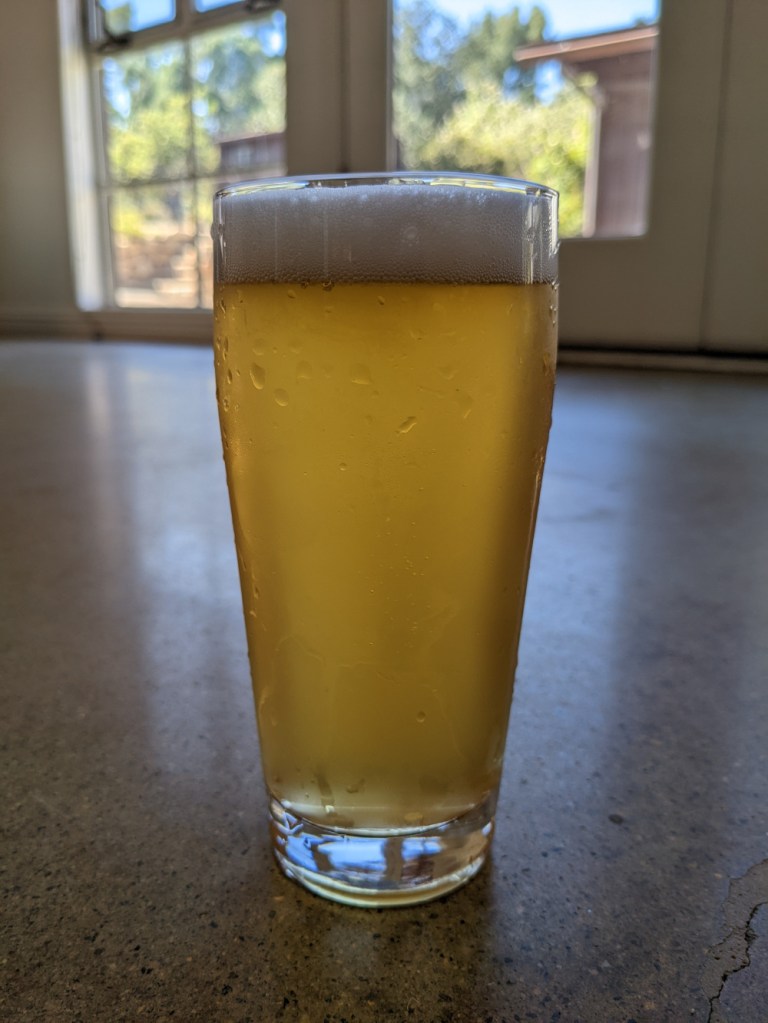
    • Gold beer, slight haze; pours with a persistent fine white head.
  • Aroma
    • Citrus/orange prominent, with a bit of tropical fruit and strawberry also. Light malt aroma. Clean yeast character.
  • Flavor
    • Light malty flavor, against a moderate bitterness. The hop flavor is citrus, tropical fruit, and strawberry. Very nice!
  • Mouthfeel
    • Medium body, medium carbonation, slightly dry finish.
  • Would I brew this again?
    • Yes! This is a nice hop combo. I ding the beer slightly for the haze, but otherwise this is a great recipe for tropical-type hops. I enjoyed Strata–the strawberry character really is something!
  • Overall
    • 8/10

Kölsch Simplicitas

I try to do a kölsch-style ale roughly once a year, in part because I like the style, in part because it’s hard to find (in my opinion) truly great commercial examples, and in part because it’s a fun challenge to brew such a fussy beer. I’ve made a few iterations over the years, heading ever simpler with each batch. 2020’s version (Kölsch Minimus) was really elegant in its simplicity, so I modified it slightly for ingredients on-hand and to try a slight variation. Whereas last year’s batch had pilsner and Munich malt, this year I used pilsner and a touch of Carahell. I used the Edelweiss hop blend (instead of Sterling), and brought in the Lallemand Köln Kölsch-style ale yeast instead of K97.

clear, yellow beer with white head, poured into a clear glass, held in a hand

Kölsch Simplicitas

  • 9.25 lb. Viking pilsner malt
  • 0.5 lb. Carahell malt (Weyermann)
  • 1 oz. Edelweiss hop blend (5.1% alpha), 60 minute boil
  • 0.5 oz. Edelweiss hop blend (5.1% alpha), 10 minute boil
  • 0.25 tsp. BruTanB, 10 minute boil
  • 1 Whirlfloc tablet, 5 minute boil
  • 0.5 oz. Edelweiss hop blend (5.1% alpha), 5 minute boil
  • 1 pkg. Köln Kölsch Style ale yeast (Lallemand)

Target Paremeters

  • 1.047 s.g., 1.009 f.g., 5.0% abv, 4 SRM, 24 IBU
  • Full volume mash, 90 minute mash at 150°, 10 minute mash-out at 168°
  • Claremont tap water, adjusted with 88% lactic acid to hit target of 28 ppm Ca, 6 ppm Mg, 91 ppm Na, 50 ppm SO4, 85 ppm Cl, 15 ppm HCO3, -11 ppm RA

Procedure

  • I adjusted the tap water with 5.4 mL of 88% lactic acid, to neutralize the carbonates. Then, I heated to 156° and mashed in, to hit a target of 150°. I added 2 mL of 88% lactic acid to adjust mash pH. I held the mash at 150° for 90 minutes while recirculating, and then raised the mash to 168° for 10 minutes, before removing the grains.
  • In total, I had 6.4 gallons of runnings with a gravity of 1.041, for 73% mash efficiency.
  • I brought the runnings to a boil, adding hops and finings per the recipe.
  • After a 60 minute boil, I turned off the heat and chilled to 64°, before transferring to the fermenter.
  • I brewed this beer on 8 January 2022. After pitching the yeast, I held the beer at 64° for fermentation.
  • I kegged the beer on 4 March 2022, transferring into a purged keg. The final gravity of the beer was 1.010, for 4.9% abv.

Tasting

  • Appearance
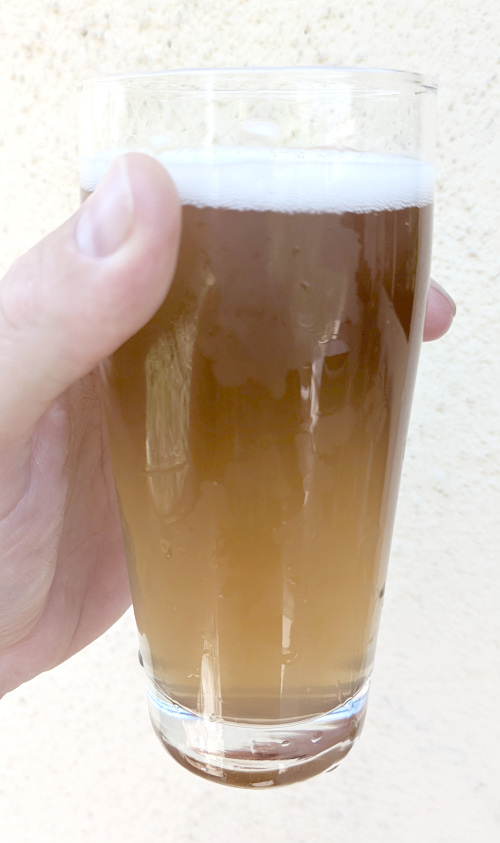
    • Very clear, just short of brilliant; medium-yellow in color. Pours with a creamy white head–absolutely beautiful and very persistent!
  • Aroma
    • Lightly grainy malt aroma; hop character is fairly minimal now, although in the earlier days of the beer there was a more prominent floral note that has since faded. Yeast character is very clean.
  • Flavor
    • The beer has a very nice, moderately malty flavor, against a moderate level of bitterness. Malt and hops are perfectly in balance. Yeast character is clean, with very slight fruitiness.
  • Mouthfeel
    • Crisp finish! Yum. The body is medium-light, and carbonation is moderate.
  • Would I brew this again?
    • Yes! This is a nice alternate recipe relative to 2020’s kölsch. My only minor dings are that the hop aroma has faded a bit since initial tastings; I kept this one in the fermenter awhile before kegging, so I think I would be in better shape if I had done the transfer a few weeks earlier. Otherwise, this is a great alternative kölsch to add to my recipe library. I like the Lallemand German ale yeast; it seems to ferment a touch cleaner than K97. I don’t know if I have a strong preference for one or the other, at least in the case of a kölsch. It just brings something different.
  • Overall
    • 8/10