
Summer Haze Brown Ale

A friend of mine who lives out east experimented with smoking his own malt–in this case, he scrounged up some sassafras root, and used it to smoke a two-row malt. It took me a bit to think about what kind of beer I wanted to make with it, because I’ve already done smoked porters, and a stout wasn’t really appealing either. Why not try a brown ale? It’s not so heavy as to be undrinkable in the summer heat, and the other malt flavors would hopefully meld well with the smoked malt. This recipe is also intended to use up many of my specialty malts, so I freshen up my stockpile with newer malts. Although they seem to keep pretty well, it probably doesn’t hurt to rotate from time to time.
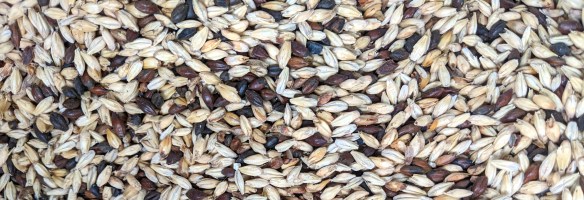
IMG_20180822_065954.jpg

Summer Haze Brown Ale

  • 4.1 lbs. California select 2-row malt (Great Western Malting Co.)
  • 2.5 lbs. Vienna malt (Great Western Malting Co.)
  • 2 lbs. sassafrass smoked 2-row malt
  • 14 oz. 40° crystal malt (Great Western Malting Co.)
  • 8 oz. pale chocolate malt (Crisp Malting Co.), 225° SRM
  • 4.3 oz. chocolate malt (Briess), 350° SRM
  • 1.9 oz. Carafa III malt (Weyermann)
  • 0.6 oz. Carafa Special II malt (Weyermann)
  • 1 oz. Cascade whole hops (5.5% alpha), 60 minute boil
  • 1 oz. Cascade whole hops (5.5% alpha), 10 minute boil
  • 1 Whirlfloc tablet, 10 minute boil
  • 1 pkg. Safale US-05 dry yeast

Target Parameters

  • 1.052 o.g., 1.011 f.g., 5.4% abv, 26 IBU, 25 SRM
  • Infusion mash to hit target of 152°, 60 minutes, batch sparge.
  • Claremont tap water, treated with Campden tablet

Procedure

  • I mashed in with 3.5 gallons of tap water at 163°, to hit a mash temperature of 151°. After 60 minutes, I added 1.5 gallons of sparge water at 170°. This rested for 15 minutes, before the vorlauf and then collection of the first runnings.
  • Next, I added 3.5 gallons of water at 170°, before resting for 10 minutes, vorlaufing, and collecting the rest of the runnings.
  • I collected 6.5 gallons of runnings at a gravity of 1.041, for 71% efficiency.
  • Next, I brought the kettle to a boil, adding hops and Whirlfloc per the schedule.
  • After a 60 minute boil, I chilled around 80° before transferring to the fermenter. I then chilled it the rest of the way in the fermentation chamber, down to 68°.
  • I sprinkled the yeast directly into the wort, fermenting at 68°.
  • Starting gravity was 1.046–I notched back the boil intensity a bit on this one (per recent recommendations from various corners of the internet), so I’ll need to start compensating for a change in evaporation rate.
  • I brewed this batch on Wednesday, August 22, and kept it at 68° until Friday, August 31. Then, I pulled it out of the keezer (to make room), finishing up at 75° ambient temperature.
Vienna Brown Ale

viennaMany of my recent brews have explored styles that are new to me–saison, Bohemian pilsner, witbier, and altbier, to name a few. This has been a ton of fun (and produced some tasty results), and I am ever-searching for new ways to expand my brewing repertoire further. For the next round of exploration, I want to really delve into Vienna malt. My standard base malt has been American 2-row, and last winter I spent a bit of time playing with Maris Otter too. I’ve certainly brewed with Vienna malt as a minor ingredient, but still don’t feel like I have a good handle on its flavor characteristics. Time to change that!
Descriptors for Vienna malt are typically vague–phrases like “full-bodied” and “golden colored” don’t really tell me much about the flavor itself. “Toast” and “biscuit” aromas are also supposed to be present. I’m not yet confident what this means within this particular malt, so I need to find out firsthand.

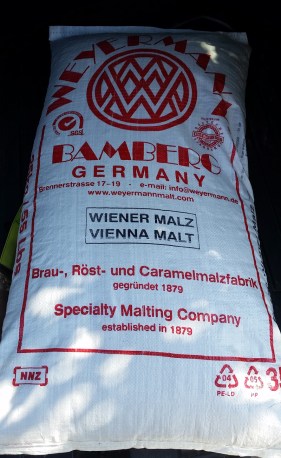
Thus, I recently purchased a 55 pound bag of Weyermann Vienna Malt from my local homebrew shop. I plan to do a whole series of brews with it during the rest of 2016. First up is a brown ale, then an IPA, and after that a classic Vienna lager (because it would be a shame not to!).

My brown ale recipe for this time around is fairly simple, veering towards the malty side (which I like in a brown ale). I have a good feel for what the various crystal and chocolate malts taste like, so this batch makes a solid first chance to get my brain cells around the overall properties of Vienna malt.

Vienna Brown Ale

  • 9.5 lbs. Vienna malt (Weyermann)
  • 0.5 lb. chocolate malt (Briess)
  • 0.25 lb. crystal 40 malt
  • 0.15 lb. de-bittered black malt (Dingemans)
  • 0.5 oz. Nugget hops pellets (13% alpha), 60 minute boil
  • 1 tablet Whirlfloc, 10 minute boil
  • 1 pkg. Nottingham dry yeast (Danstar)

Target Parameters

  • 1.051 o.g., 1.012 f.g., 5.1% abv, 24 IBU, 23 SRM, 5.5 gallons into the fermenter

Procedure

  • I mashed in with 4.1 gallons of water at 163°, to hit 154°. This was down to 151° after 45 minutes. After 60 minutes, I added 1 gallon of water at 190°, to hit a mash temperature of 155°. I waited 10 minutes, vorlaufed, and collected 3.3 gallons of first runnings. Then, I added 3.7 gallons of water at 182°, to hit 166°. After 10 minutes, I vorlaufed and drained the mash tun.
  • In total, I collected 7.1 gallons of wort with a gravity of 1.039, for 71% efficiency.
  • I boiled the wort for 60 minutes, adding hops and Whirlfloc per the schedule. The wort had boiled down to around 6.25 gallons (unchilled) by the end of the time.
  • After 60 minutes, I turned off the flame and chilled the wort to 80°. I transferred the wort into the fermenter (5.5 gallons total), and pitched the dry yeast directly. I sealed up the fermenter, and will begin fermentation at 68°.
  • Starting gravity was 1.048, slightly below my target of 1.051. I brewed this batch on 20 August 2016.

A Whole Mess of Kegging

Eagle Face Oatmeal Stout, ready for kegging

It’s only five weeks until AHA (American Homebrewers’ Association) in San Diego, and in preparation I’ve been brewing up a storm the past few weekends. In order to give everything sufficient time for conditioning, carbonation, and such, tonight was the night to keg it all.

Gondwana Pale Ale 1.2

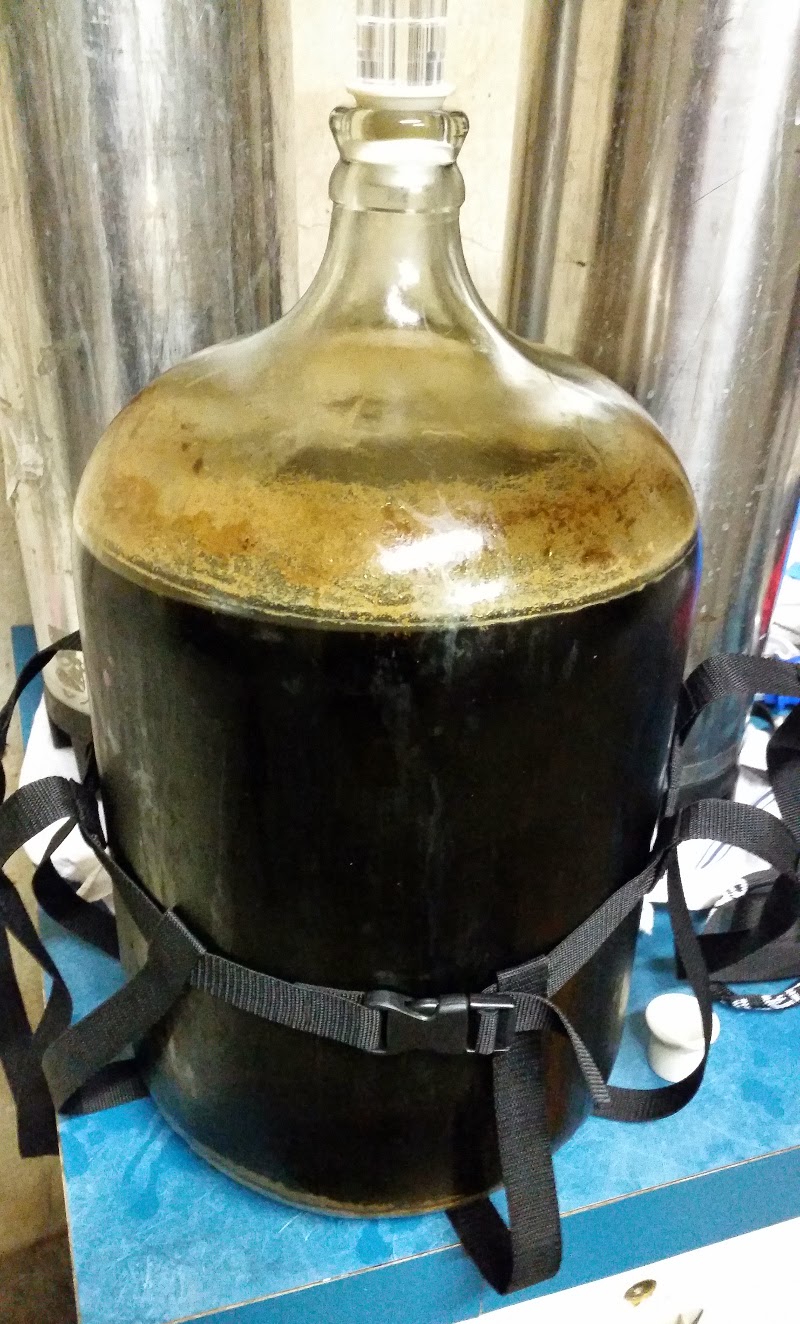
  • This beer had been in the primary fermenter for 3.5 weeks, for the first 10 days at 66°, and the rest of the time at ambient temperature.
  • I racked the beer onto 2 ounces of Citra hops (13.2% alpha, 3.7% beta), weighted down in a bag at the bottom of the keg.
  • Final gravity was 1.010; down from 1.048, this works out to 5.0% abv. The beer was wonderfully clear, with a medium yellow color and clean flavor.
  • I’ll let this dry hop at room temperature for a week or two before carbonating.


Eagle Face Oatmeal Stout 1.1

  • This beer had been in the primary fermenter for 2.5 weeks; I cold-crashed it for the final 24 hours down to 38°.
  • Final gravity was down to 1.021 from 1.061, which works out to 4.1% abv. The beer has really nice body to it, and should be delightful once carbonated.
  • I began carbonating this beer immediately.


Bonedigger Brown Ale 1.1

  • This beer had been in the primary fermenter for 11 days (cold crashed during the final 24 hours).
  • Final gravity was 1.013, down from 1.052. This works out to 5.1% abv. Both flavor and appearance are on the mark.
  • I began carbonating this beer immediately.
To move things along, I’m going to try a “quick carbonation” technique. For the oatmeal stout and brown ale, I began carbonation under 40 psi at 38°. In 24 hours, I’ll lower pressure to 20 psi, and after another 24 hours I’ll check out the carbonation.

Bonedigger Brown Ale 1.1

Another one for the homebrewer conference…this is my second go at the brown ale. Basically unchanged recipe from last time.

Bonedigger Brown Ale 1.1

  • 9 lbs. 2-row malt
  • 1 lb. Maris Otter pale malt
  • 0.75 lb. 80°L crystal malt
  • 0.5 lb. carapils malt
  • 0.5 lb. chocolate malt
  • 1 oz. Cascade whole hops, bittering (60 minute boil)
  • 1 oz. Cascade whole hops, bittering (20 minute boil)
  • 0.5 oz. Willamette hops pellets, aroma (5.2% alpha; 3.7% beta; 5 minute boil)
  • 1 tsp. Irish moss (10 minute boil)
  • 1 pkg. US-05 Safale American Yeast, rehydrated in 150 mL of water.
Procedure
  • I mashed in with 3.75 gallons of water at 164.5°, hitting my target mash temperature of 153°.
  • The mash was down to 151° after 35 minutes, and down to 149° after 50 minutes.
  • I added 0.75 gallons of water at 190°, stirred, and let sit for 10 minutes. I vorlaufed and collected 3.1 gallons of wort.
  • I added 3.25 gallons of water at 185°, which raised the temperature of the mash bed to around 168°. After 10 minutes, I vorlaufed and collected the remainder of the wort.
  • In total, I collected 6.4 gallons of wort at 1.052 specific gravity. This works out to 79% efficiency.
  • I boiled for 60 minutes, adding hops and Irish moss at the appropriate intervals.
  • After chilling with the wort chiller, 5 gallons of wort went into the fermenter. The starting gravity is 1.059.
  • After pitching the yeast, I set my temperature controller to 68°. On the second day, once fermentation had started, I dropped the temperature down to 65°.
  • This beer was brewed on April 26, 2015, and fermented for 10 days, before cold crashing for 24 hours and then kegging.