Eagle Face Oatmeal Stout Update

Three and a half weeks after brew day, it was time to take care of the Eagle Face Oatmeal Stout. Over the holiday break, I worked on getting set up for kegging. I converted a 7 cubic foot deep freezer into a “keezer”; I’ll probably detail that in another post, but the short version is that it has a redwood collar made out of 2×4’s, with a three keg (and three faucet) capacity. This oatmeal stout is my first beer kegged in a 5 gallon keg (I’ve done some 5 L mini-kegs using the Philtap system), and was wonderfully easy to package!

The beer was brewed on Saturday, December 13, and was happily fermenting by the next morning. On the evening of December 14, I noticed that temperature of the fermenter had risen to 74°, a few degrees over what is ideal for this strain. Part of the problem was that I had my temperature sensor for the temperature controller hanging in the air, rather than taped to the fermenter. Lesson learned, and I was able to drop the fermenter down to the mid-60s by the next morning. Not ideal, but it seems like the extra conditioning time cleared out any negative flavors.

On January 1, 2015, I pulled the fermenter from the chamber and set it on the floor. This was in the midst of a cold snap, so the whole setup was soon down to the ambient temperature of 52°. The temperature increased a little bit over the next few days, to 60° or so, but didn’t exceed that.

In terms of overall character, the English Ale Yeast (White Labs WLP002) was fast-acting and extremely flocculant. In other words, true to the strain. This was coupled with relatively low attenuation (see below), as expected.

On January 7, 2015, I kegged the beer. Final gravity was 1.022, down from 1.057. This works out to 4.6% abv and 60% apparent attenuation. The beer was slightly sweet (as expected for the yeast strain), with a nice background bitterness and just a subtle fruity aroma. If I do this recipe again, it would be interesting to try another strain to see what a drier version of the beer is like. I transferred 5 gallons (virtually all of the beer in the fermenter) into a refurbished cornie keg.

After kegging, I put the keg in the keezer, which is set for 42°. Following suggestions for force carbonation from Midwest Brewing, I set the CO2 pressure to 40 psi. I’ll do this for 24 hours, lower to 20 psi for another 24 hours, lower to ~13.5 psi, and then sample. Thus, I should be ready for at least preliminary sampling by the weekend!
Beringea IPA

Continuing to ramp up brewing for my kegging outfit, I would like a nice IPA on tap later this month. In addition to using up the end of my 50 pound bag of 2 row malt, I also wanted to finish out a partly-used bag of Chinook hops as well as continue working through my supply of South Dakota-grown Cascade hops. Finally, I really like the aroma of Simcoe hops, but I didn’t dry hop my last recipe with them long enough, so the aroma on that batch was a little underwhelming. I decided to give Simcoe another try, with a longer dry hopping period this time around. Note added later: I ended up changing my mind and going with Amarillo hops, which I haven’t used for dry-hopping previously. Simcoe will get saved for later!

At any rate, I’ve designed a recipe that I’m hoping will hit the target for maltiness and hoppiness. The name refers to the adjacent parts of North America and Asia across which many an organism has migrated between continents over the millenia. We’ll see how this recipe works out!

Beringea IPA

  • 10.4 lbs. 2 row malt
  • 1 lb. Carapils malt
  • 0.75 lb. 60° L crystal malt
  • 0.15 lb. chocolate malt
  • 1.25 oz. Chinook hops pellets (11.4% alpha; 3.4% beta), 60 minute boil
  • 1 oz. Cascade whole hops (est. 5.5% alpha), 15 minute boil
  • 2 oz. Simcoe hops pellets (13.0% alpha; 4.5% beta) Amarillo hops pellets (8.2% alpha, 5.7% beta), 2 weeks dry hop
  • California Ale Yeast (White Labs WLP001), prepared 2 days in advance with 1.5 L starter
  • 1 tsp. Irish moss (10 minute boil)
Anticipated statistics
  • 1.060 s.g., 1.013 f.g, 6.2% abv
  • 56.9 IBU
  • 12.4 SRM
Procedure
  • I mashed in with 3.9 gallons of water at ~173°; the mash stabilized at 155° after 5 minutes, and was down to 154° after 30 minutes. After an hour, I added .75 gallons of water at 190°, let it sit for 10 minutes, vorlaufed, and collected ~3.1 gallons of wort.
  • Then, I added 3.14 gallons of 185° water to the mash tun, which brought the mash up to 165°. I let this sit for 10 minutes, vorlaufed, and collected the rest of the wort. This came to a total of 6.75 gallons, with a gravity of 1.049 at 60°, which works out to 75% efficiency.
  • I brought the wort to a vigorous boil, and added the Chinook hops.
  • Because the original wort volume (6.75 gallons) was on track to be more than I anticipated, I aimed for a very vigorous boil to clear out the excess. I was down to 6.25 gallons after 30 minutes, and ~5.75 gallons after 60 minutes of boiling.
  • After 45 minutes, I added the Cascade hops.
  • After 50 minutes, I added the Irish moss.
  • After 60 minutes, I turned off the flame and used my wort chiller to cool the wort. Prior to chilling, I took a sample of wort for specific gravity. This is a minor change in my procedure–by taking the sample now, I figure I reduce the risk of contamination or wort loss due to clumsiness later.
  • I chilled the wort in two stages. The first was by running tap water through the wort chiller. After the wort temperature was around 82°, I siphoned around 3.5 gallons of ice water through the chiller, which brought the temperature down to around 68°.
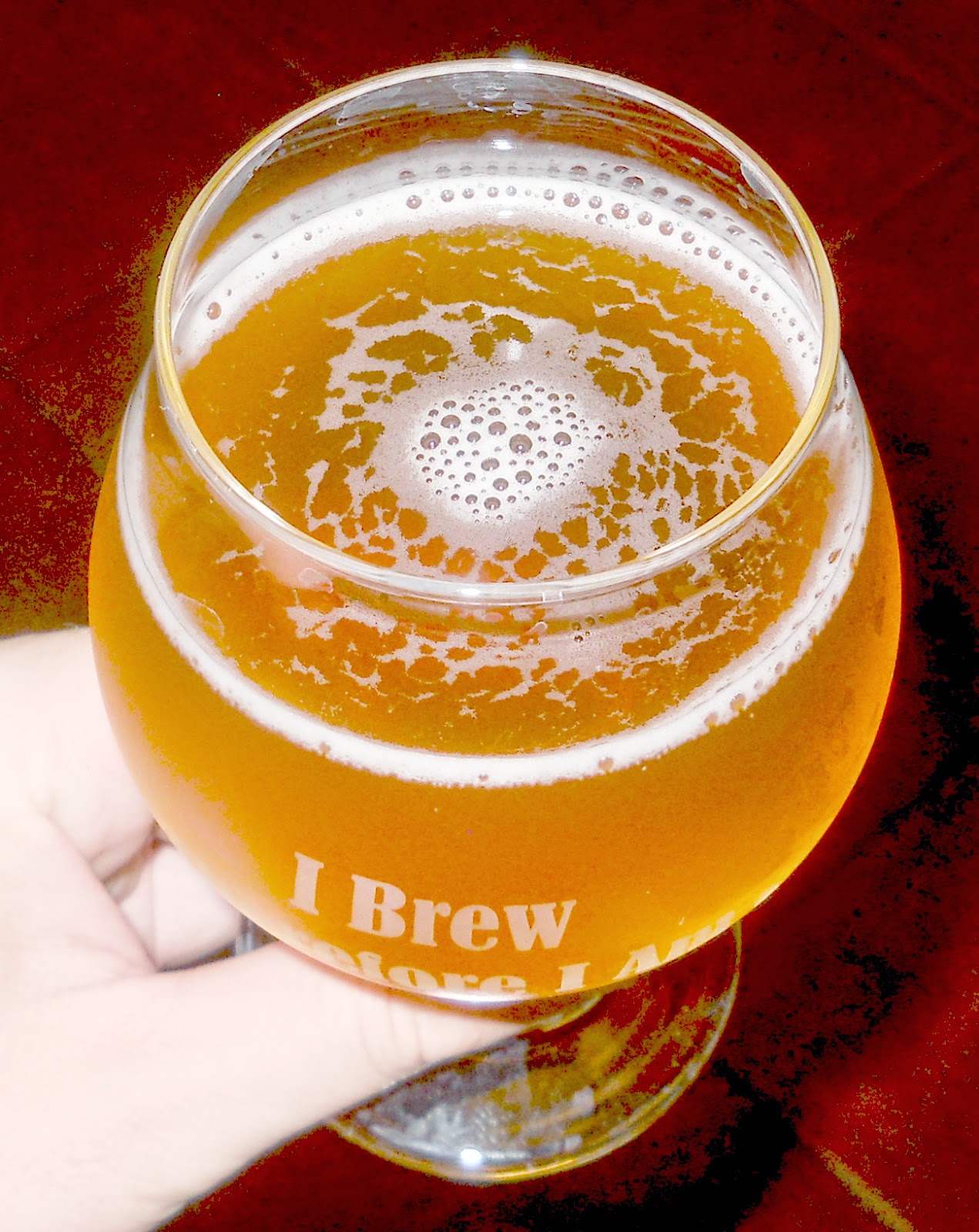
  • The wort is a beautiful deep copper color, with a smooth bitterness and pleasant flavor. Starting gravity was 1.060 at 60°, exactly on target.
  • I transferred the beer into the carboy while aerating with the Venturi pump, and pitched the yeast starter. I’m fermenting the beer at 65°, in my usual temperature controlled fermentation chamber.
  • This batch was brewed on 3 January 2014.

Experimental Amber Ale

As I work on a keezer build(!) over the winter break, I’m also developing beers with which to populate said keezer during its launch. Eagle Face Oatmeal Stout will be the inaugural tap, but I’m also hoping to build two more beers for this three-keg system. For my second tap, I thought an amber ale would be a nice balance–it also was a chance to use up some of the hops packages that were cluttering my freezer. Thus, the Experimental Amber Ale was born!

I will note that the recipe in the end was a bit of a mistake; I had intended to throw in a pound of crystal 60, but forgot to write it down when I went to the brew store. The resulting malt bill was thus a little simpler than I intended. This also meant that I miscalculated my mash steps (I didn’t remove the crystal malt from BeerSmith’s recipe calculations), and the mash was a bit thinner than it should have been, at least by a little. But…I am hopeful that the strong mix of Maris Otter malt will balance out the flavor, and I do not think the mash was thin to the point of inhibiting enzymatic reactions (I achieved 85% efficiency!).

Experimental Amber Ale

  • 4.5 lbs. American 2 row malt
  • 4 lbs. Maris Otter pale malt
  • 0.25 lbs. chocolate malt
  • 1 oz. Cascade whole hops (5.5% alpha acid; boil 60 minutes).
  • 1 oz. Willamette hops pellets (5.3% alpha acid, 3.7% beta acid; boil 10 minutes)
  • 1 oz. Liberty hops pellets (4.5% alpha acid, 3.5% beta acid; whirlpool ~30 minutes)
  • 1 tsp. Irish moss
  • 1 tbs. 5.2 pH stabilizer
  • 1 pkg. Safale US-05 dry yeast (rehydrated in 1 cup water)
Procedure
  • I mashed in with 3.1 gallons of water at ~172°, which stabilized to 156° within 10 minutes (and was still at that temperature after 20 minutes).
  • After 60 minutes of mash, I added 1.2 gallons of water at 185°, which bumped the mash temperature up to ~160°. I let this sit for 10 minutes, vorlaufed, and then collected ~3.3 gallons of wort.
  • I then added 3.15 gallons of water at 185°, let it sit for 10 minutes, vorlaufed, and collected the rest of the wort, for a total of ~6.7 gallons. This had a gravity of 1.041, which works out to 85% efficiency! This high efficiency, I suspect, is due to the fact that I sparged more than I would have normally (due to assuming the extra pound of crystal malt in the calculations, which wasn’t physically in the recipe).
  • I brought the wort to a boil, and added the Cascade hops.
  • After 45 minutes of boiling, I added the Irish moss.
  • After 50 minutes of boiling, I added the Willamette hops.
  • After 60 minutes, I turned off the flame, added the Liberty hops, and started chilling. The volume in the brew kettle at this point was around 5.8 gallons.
  • I rehydrated the yeast in 1 cup of water, and pitched it.
  • The starting volume was ~5.5 gallons and had a gravity of 1.047 at 60°.
  • I set the temperature for the fermentation chamber at 65°. The beer was brewed on 1 January 2014.
Despite my mistake in my calculations, I think this will (inadvertently) be an OK brew. I’ll be curious to see how it ends up with no crystal malt, and how the combination of 2-row and Maris Otter play together. It probably won’t be true to the American amber ale style, but it should still be drinkable!

Looking Back on the News and Brews of 2014

2014 has seen more changes to my brewery and brewing practice than just about any year since I started brewing. In part, this happened because I feel comfortable enough with the hobby–and that I’ll be brewing for the long-term–to invest in more equipment. This in turn was enabled by a move into a new place that had a garage with utility sink, so I was able to get the operation out of the kitchen (with its various space, sanitation, and process limitations) and into a dedicated brewing area. More space meant more equipment…which meant more options for brewing! As a result, I feel like I have really grown and improved as a brewer. This has been challenging at times–the switch to all-grain was like learning to brew all over again! But, the challenges have been mostly fun and solvable; the best kinds of challenges to have.

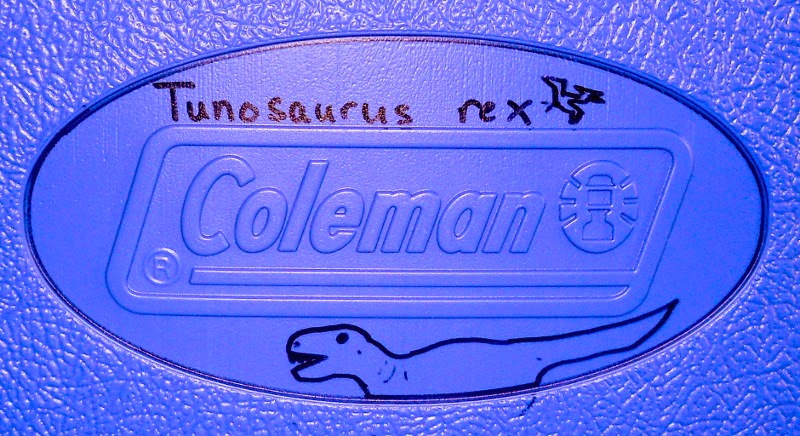
A handy inscription on my mash tun

Major Changes in Technique / Equipment

  • Changing from partial volume to full volume boils. This was a relatively minor change in the grand scheme of things, but it did pave the way for all-grain brewing.
  • Transitioning into all-grain brewing. This is perhaps the largest and most enjoyable change. As mentioned above, in many ways it was like learning to brew all over again. New equipment, new things to worry about (or relax about). 
  • Improved temperature control. This change has allowed me to extend my brewing season, as well as ensure happier yeast during my previous “usual” brewing season (late fall through early spring).
  • Yeast starters. Where I had been relying largely on dry yeast, I am excited to expand into some new strains in the world of liquid yeast packaging.
  • Beginning the transition into kegging. As I finish out the year, I’ve been building a keezer setup, with anticipated “first draft” in the first week or two of the New Year.
Favorite Brews of 2014
  • Bonedigger Brown Ale. This may be the first recipe I’ve ever designed that turned out perfect on first try. I chalk it up to dumb luck, and will definitely put this into regular rotation!
  • Gondwana Pale Ale. This one took two iterations, but ended up as a nice showcase for Citra hops (my new favorite hop variety–it will be tough to hold back on overusing this one!).
  • Summer Blonde Ale. This ale was my first temperature-controlled brew, and ended up as a quite drinkable warm-weather concoction. This too is going into regular rotation!
Goals for 2015
  • Experiment with new ingredients–yeast, hops, and malts. I have worked a lot with “classics” such as crystal malt, basic American and British yeasts (e.g., Nottingham, various Chico strains, etc.), and Cascade hops. In the upcoming year, I would like to expand into some untouched territory.
  • Perfect kegging and in-keg carbonation of my homebrew, along with small-scale bottling from the keg. I’m thinking about building a bottling gun, just for fun.
  • Develop an in-house white IPA recipe. While I was traveling recently, I got a chance to try an amazing Italian white IPA (Lariano Vergött), and since then have been dreaming about devising one of my own.
  • Brew and/or develop more session beer recipes. Pretty much what it says.
  • Brew a lager. Now that I have good temperature control, I can start to think about lagers and pilsners. This opens up a whole new world of styles and techniques, of course. 
Summer Blonde Ale
Homebrew Roll Call (everything I brewed in 2014)

Andy’s Pumpking Ale 1.0 Update

I only recently realized that I didn’t post details on the fermentation and bottling of my pumpkin ale.

After brewing on 13 October 2014, and ~2 weeks of fermentation and conditioning, I bottled on 26 October 2014. Final gravity was 1.012, down from a starting gravirty of 1.060. This works out to 6.3% abv.
I primed a mini-keg (5 L) with 1.5 tbs. of corn sugar, and filled up the keg. I had 3.5 gallons left, and wanted to aim for 2.4 volumes of CO2. Thus, I carbonated with 3 oz. of corn sugar boiled in 2 cups of water. The end yield was 18 12-oz. bottles, 5 22-oz. bottles, and 6 18-oz. bottles.
After a few weeks of conditioning, I sampled some bottles. The beer is more carbonated than I like–I suspect this may be due in part to not stirring the beer sufficiently after adding the priming sugar. I also suspect some secondary fermentation is involved, due to the high carbonation in the keg, too.
I took a bottle to my local homebrew club meeting, and the brew overall got pretty decent marks from the crew. Our club president deemed it as nicely balanced, and I would tend to agree. This is definitely a recipe I’ll be trying again!
A formal tasting evaluation will follow later.