Dad’s 3P

For quite some time, I’ve been itching to make a lager. It was on my goal list for 2015, but never quite happened. The main thing deterring me was the time investment–the process takes longer than an average ale, so I didn’t want to tie up my fermentation chamber for months. I have to keep the taps on my keezer all occupied, after all!
When I discovered a “quick-lager” method, that provided the incentive I needed. This is a technique popularized by the folks at Brulosophy (although not developed by them, as they are quick to point out). Essentially, you use a temperature-change regimen to keep the process moving along. Most of the potential off-flavors are produced in the first half of fermentation, so once the beer is more 50% attenuated, you can raise the temperature and speed up the finishing. Then, it’s a cold crash, some gelatin, and you’re done!

For my first lager, I chose a recipe that my dad has been brewing for many years. It is a “Pre-Prohibition Pilsner,” in the style of the American beers that were made before Prohibition destroyed many of the traditional breweries and beers. He makes an extract version that is absolutely delicious, and has been brewing it in some form or another for close to 15 years. The original recipe came from the April 1999 issue of Brew Your Own, and I have modified it slightly for hop and yeast availability. The main changes are using Spalt instead of Tettnanger and WLP800 (Pilsner Lager) instead of an American pilsner strain.
I will note that the rye flakes are “off-style” for a classic American pilsner, and I suppose the yeast is too. But, it’s homebrew, so I’ll make my beer the way I want to and forget about official style guidelines. I also wanted to approximate the classic water of Pilsen, so used a water blend heavily tilted towards distilled water. Our tap water here has a ton of minerals, and so is not well-suited on its own for the styles (including American pilsners) that are best with soft water.
Dad’s 3P (Pre-Prohibition Pilsner)
  • 9 lbs. pilsner malt
  • 1 lb. flaked maize
  • 0.5 lb. carapils malt
  • 0.5 lb. flaked rye
  • 2 oz. German Spalt hops pellets (2.4% alpha, 4.3% beta), 60 minute boil
  • 1 oz. Hallertau hops pellets (2.7% alpha, 3.8% beta), 30 minute boil
  • 1 oz. Hallertau hops pellets (2.7% alpha, 3.8% beta), 15 minute boil
  • 1 tsp. Irish moss, 10 minute boil
  • 1 tsp. yeast nutrient
  • 1 package Pilsner Lager yeast (White Labs, WLP800), prepared in 2L starter
  • “Special water blend” – 2 gallons of the carbonate-heavy Claremont water with 7 gallons of distilled water.
Procedure
  • Five days in advance, I prepared a 2 liter yeast starter, and let it ferment out for 2.5 days (after the krausen had fallen). I then put it in the refrigerator to cold crash for another 3 days.
  • I mashed in with 4.25 gallons of water at 161.8°, aiming for a target mash temperature of 149°. The mash hit 149.8°, and was down to 146° after 55 minutes.
  • After the 60 minute mash rest, I added 0.84 gallons of water at ~160°, let it rest for 10 minutes, vorlaufed, and collected the first runnings. Then, I added 3.82 gallons of water at 180°, which brought the mash bed up to 162°. I let this rest for 10 minutes, vorlaufed, and drained again.
  • In total, I collected 7.75 gallons of wort with a gravity of 1.043, for an efficiency of 82%. I suspect my water volume must have gotten off somewhere in the process. But, I’m not too worried because this is my target gravity anyhow before the boil.
  • I brought the wort to a boil, and added the hops, Irish moss, and yeast nutrient per the schedule.
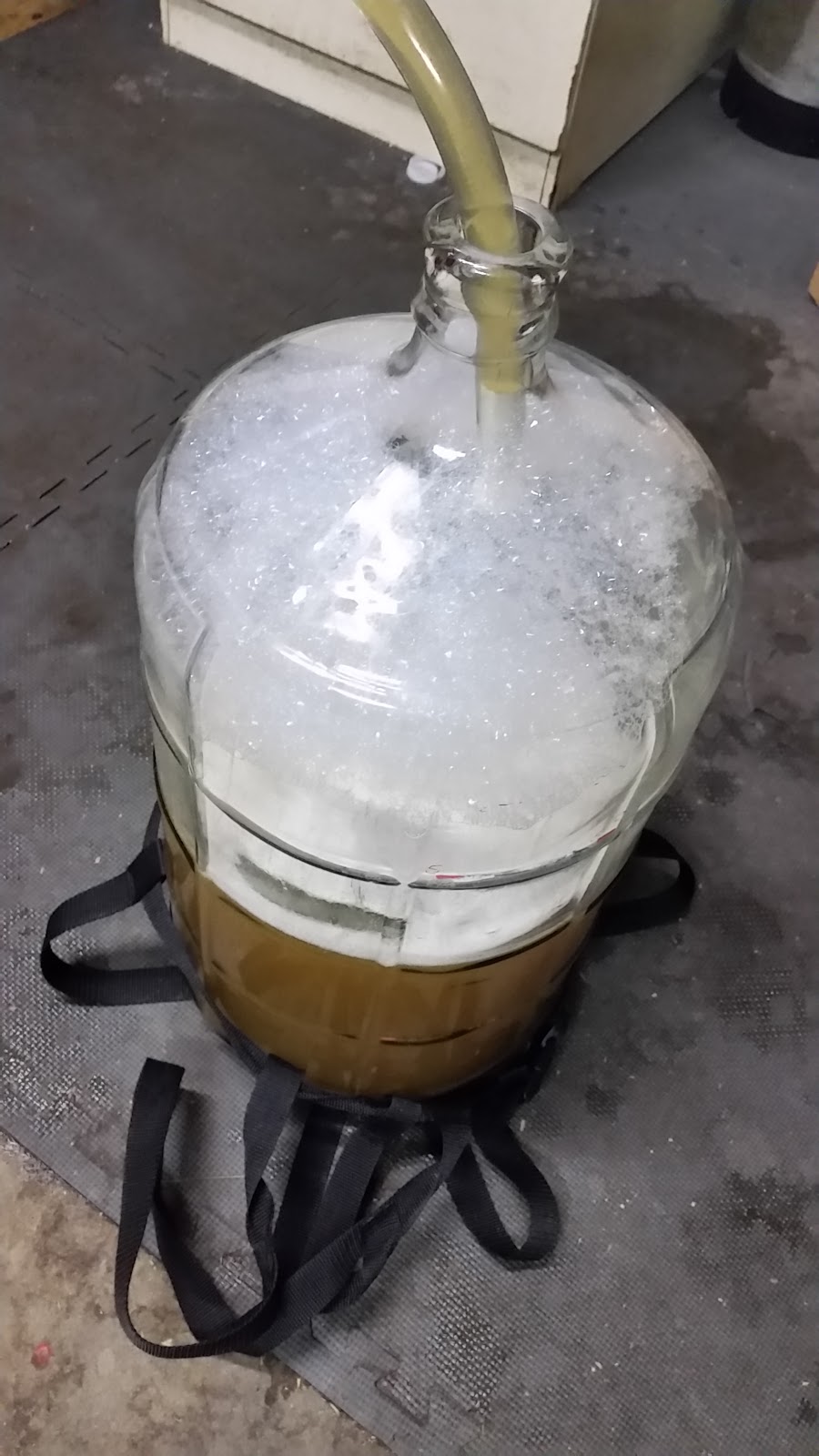
  • After 60 minutes of boiling, I chilled the wort to 74° using my wort chiller. Then, I transferred it with aeration and placed it in the fermentation chamber for 90 minutes to bring the wort down to 60°. At this point, it was pretty late, and I decided it would be okay to pitch the yeast. I saw evidence of fermentation (krausen starting to form, very slow bubbling in the airlock) when I checked on the beer around twelve hours later.
  • Starting gravity was 1.051. I’ll do the first stage of fermentation at 54°. I brewed this on 9 January 2016, and will check on the gravity in about a week, to see if it is ready to warm up.
Eagle Face Oatmeal Stout 1.2

I’ve brewed my house oatmeal stout recipe twice previously, and both times it has been a winner. Looking towards my keg rotation, I thought it would be nice to roll this one out for 2016. I’ll note that this is the third time I’ve brewed this one in essentially the same form–probably a record for my home brewery.

The primary minor change to this batch versus the others has been to use “old fashioned oatmeal” out of the pantry instead of the flaked oats from the brewshop. Based on my reading, they are essentially the same thing. Many brewing forums tout using oats from the grocery store as cheaper–however, I think this is fairly overstated, particularly for the amounts of oats used in most recipes. In some cases, even, the brewshop oats are cheaper! And ever in the worst-case scenario, it’s a savings of a few cents at most. Thus, the “wisdom” of grocery store products being a massive savings over the homebrew shop products is not entirely correct here. I think the primary utility is as a quick alternative if you need to add oats flavor but forgot to buy them with the rest of your grains.
Eagle Face Oatmeal Stout 1.2
  • 8.5 lbs. 2 row malt (Great Western)
  • 1.25 lbs. old-fashioned oats
  • 1 lb. 80° L crystal malt
  • 1 lb. Victory malt
  • 0.75 lb. chocolate malt
  • 0.5 lb. roasted barley (Simpsons)
  • 0.3 lb. rice hulls
  • 1 tsp. Irish moss, 10 minute boil
  • 1.1 oz. Northern Brewer hops pellets (9.9% alpha, 4.5% beta), 60 minute boil
  • 1 pkg. English Ale yeast (White Labs WLP002, 0.9 L starter)
Procedure
  • Three days before brewing, I began a 1.5L starter (191 g of extra light DME and ~.5 tsp of yeast nutrient in 1.75L of water, for a target gravity of 1.040). After 48 hours, I decanted 0.6L for future use and cold-crashed the rest of the starter.
  • I mashed in with 5 gallons of water at 170°, and hit 156.5° for my mash-in temperature. The mash had dropped to 155° after 30 minutes and was down to 153.4° after 50 minutes.
  • After 60 minutes, I added 0.5 gallons of 162° water, let this sit for 10 minutes, vorlaufed, and collected the first runnings. Then, I added 3.75 gallons of water at 185°, which raised the mash bed to 162°. I let this sit for 10 minutes, vorlaufed, and collected the remainder of the wort.
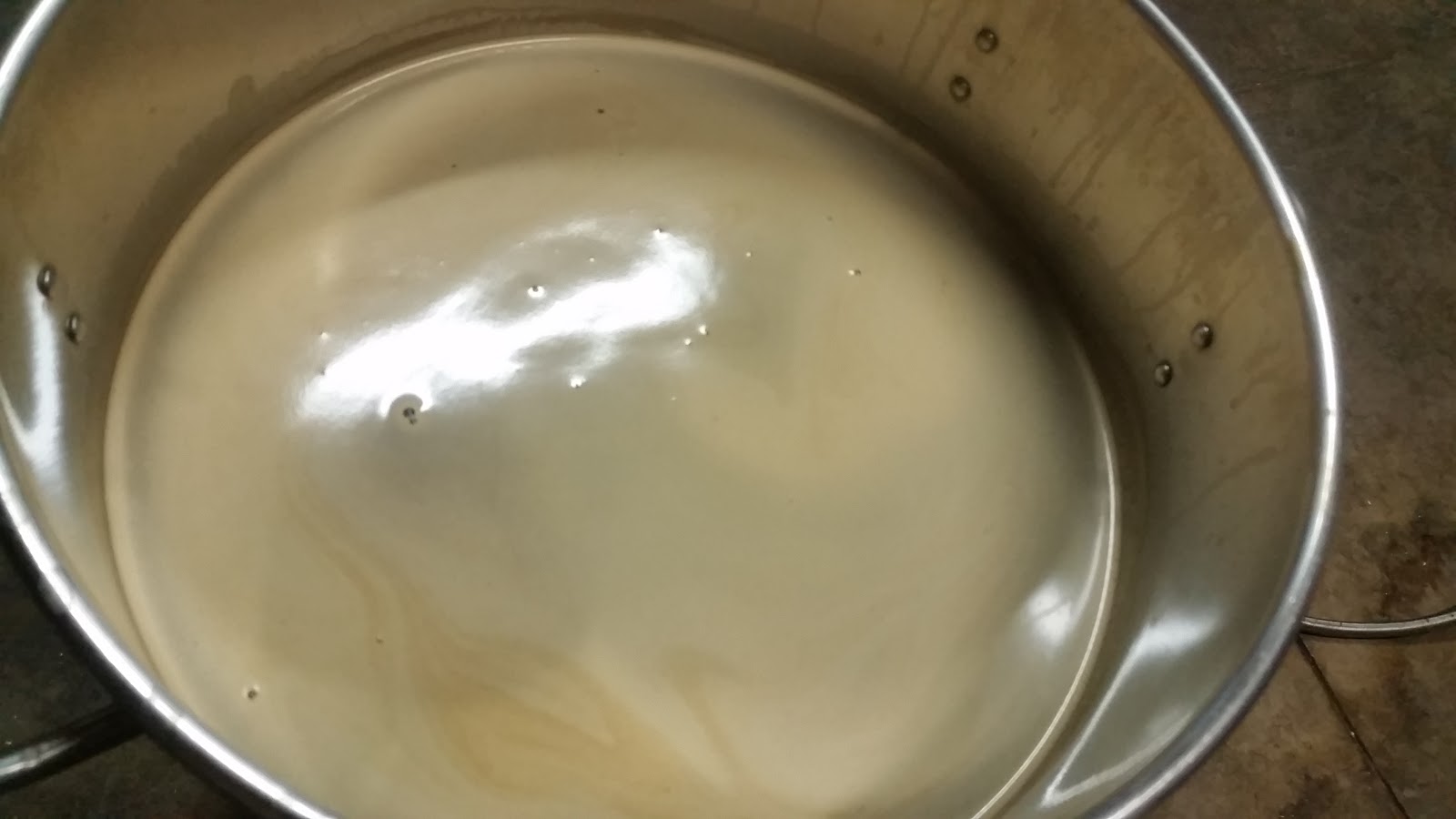
  • All together, I collected 6.8 gallons of wort with a gravity of 1.049, for a mash efficiency of 72%. I note that the relatively small quantity of rice hulls seemed to be just fine for this recipe.
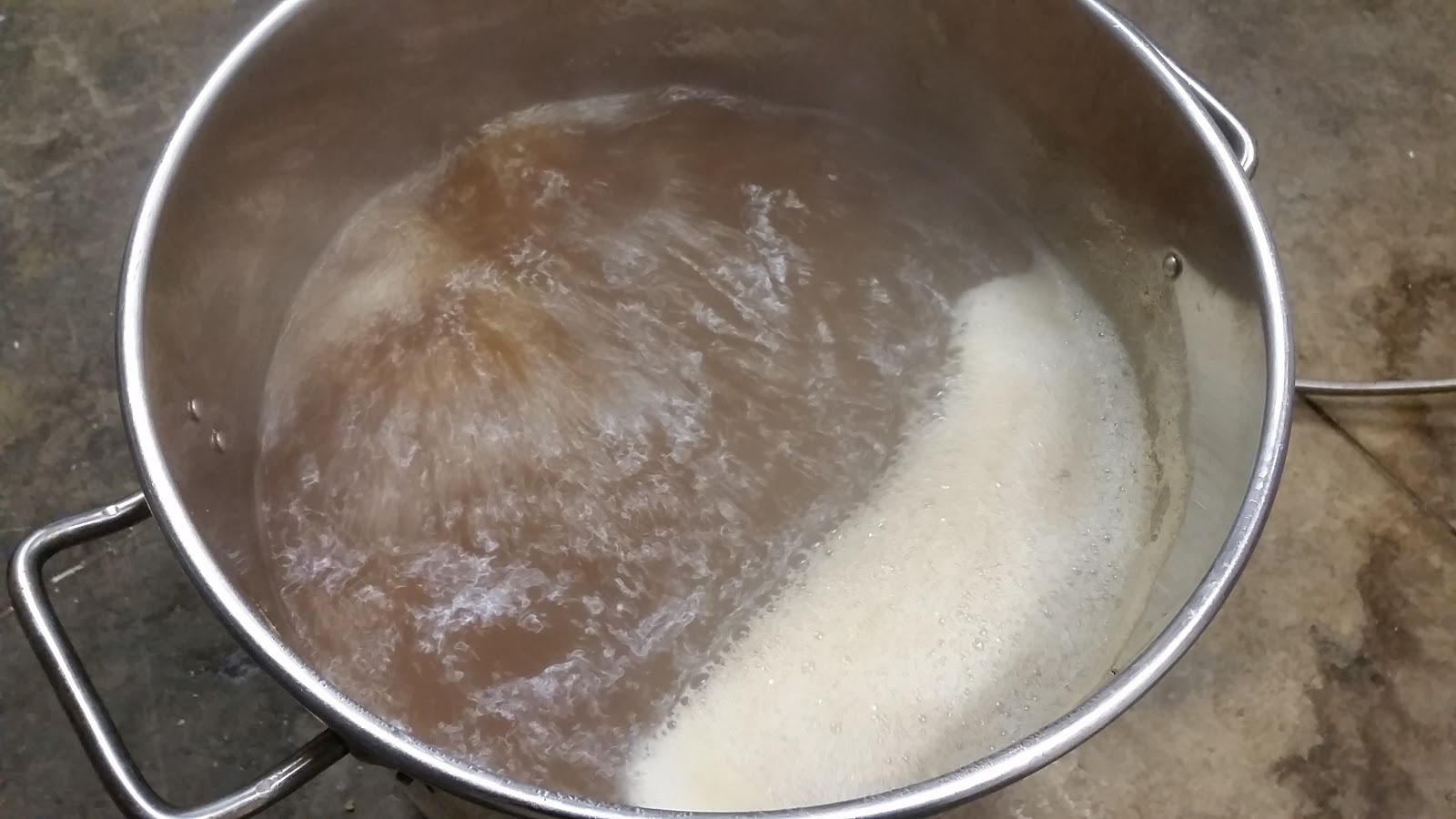
  • I brought the wort to a boil, adding the hops and Irish moss as scheduled.
  • After 60 minutes of boiling, I turned off the heat and chilled the wort to 75°. The final yield was ~6 gallons of wort with a gravity of 1.060. I decanted most of the spent wort from the starter, and pitched the yeast slurry before sealing up the fermenter.
  • I brewed this beer on Sunday, January 3, 2016 (first brew of the year!). It will be fermenting at 68°.

Alt-Alt Ale Kegged

On Wednesday, January 6, I kegged the Alt-Alt Ale. It had been fermenting for 11 days, and was down to a final gravity of 1.008. This equates to 5.8% abv. In tasting, I definitely pick up the honey malt. The yeast leavings were pretty remarkable–this had a high, hard, and foamy krausen, which ringed the fermenter more than just about any other yeast I’ve seen. This was fairly bizarre for WLP001, so I think it is a good decision to end my particular culture there, and reculture the yeast for next time I use it. The beer is now carbonating under high pressure, and will condition until the next keg in my keezer is kicked.

Jarrylo Session IPA

For my last brew of 2015, I’m making a session IPA that is a modest departure from my previous session IPA. This is primarily to adjust for and use up ingredients on-hand, but also in order to try out a new yeast strain with some promise for session beers (“Conan”). I used WLP002 (English ale) for my last session IPAs, and liked it, but thought that the potentially low attenuation of Conan also has promise for a session IPA. We’ll see how it works!

The other twist on this brew is that I’m using Jarrylo hops, a relatively new variety. They’re not particularly intended for IPAs, but an IPA seems like a good way to showcase hop character, particularly in the late additions and dry-hop. Because Jarrylo is described as having notes of banana, pear, and spice, I figured some more citrusy/fruity varieties would meld well for the bittering and flavor hops additions. So, Citra and Mosaic are also in the mix. When smelling the Jarrylo hops pellets, I get a fair bit of pepper and maybe some fruitiness behind that. Perhaps it’s a mistake to dry hop with this one for an IPA, but that’s what homebrewing is all about!

Jarrylo Session IPA

  • 5.25 lbs. 2-row malt (Great Western Malting Co.)
  • 3.75 lbs. Borlander Munich Malt (Briess)
  • 0.5 lbs. caramel Munich 60L (Briess)
  • 1 oz. Citra hops pellets (13.2% alpha), 15 minute boil
  • 1 oz. Mosaic hops pellets (12.8% alpha), 10 minute boil
  • 2 oz. Jarrylo hops pellets (14.2% alpha), 2 minute boil
  • 2 oz. Jarrylo hops pellets (14.2% alpha), 2 week dry hop
  • 1 pkg. Vermont Ale (“Conan”) yeast, The Yeast Bay (prepared in 1L starter)
  • 1 tsp. Irish moss (10 minute boil)
Procedure
  • I mashed in with 3.75 gallons of water at 169.8°, to hit a mash temperature of 156°. The mash was down to 153.5° after 25 minutes and 150° after 45 minutes. After 50 minutes, I added 1.1 gallons of water at 190°, to raise the mash temperature to 156°. I elected to use a shortened mash procedure in order to add a tiny extra bit of body to the final beer (per the session beer workshop I went to at AHC). So, only 60 minutes passed between when I mashed in and when I collected the first runnings.
  • I vorlaufed and collected the first runnings, and added 3.75 gallons of water at 179°, which raised the mash bed to 166°. I let it sit for 10 minutes, vorlaufed, and collected the remainder of the wort.
  • I collected a total of 6.9 gallons of wort with a gravity of 1.037. This equates to an extract efficiency of ~75%.
  • I started the boil, and added the hops per the schedule above.
  • After 60 minutes of boiling, I turned off the heat and chilled the wort to 70°. Then, I pitched the yeast and set the beer to fermenting, at 68°. I brewed this batch on 30 December 2015. Starting gravity was 1.047.
  • Note on the yeast starter: Because I am liking the Conan strain, I overbuilt my starter. I made 1.6 L of a 1.040 gravity, and set aside 0.6 L for my next batch (~100 billion cells, approximately).

2015’s Homebrew Highlights

My beer of the year, Citra Blonde Ale

Looking back, 2015 was a banner year for my brewing. Speaking immodestly, I produced some excellent beers. Just as importantly, if not more so, I really stretched myself in terms of new styles and techniques.

  • Favorite Batch
    • Citra Blonde Ale
      • This blonde ale nailed every single aspect–in fact, I might say it is one of the best beers I’ve brewed over the years.
  • Least Favorite Batch
    • I didn’t have any batches that totally went south, but I did have some that were just not quite where I wanted them. My Live Long and Porter was squarely mediocre, as was my attempt at an Old Speckled Hen Clone. The former was mostly a result of recipe–the latter was, at least in part, the need to age for way longer than I was willing to give it.
  • Experimental Recipe with Most Potential
    • Pannotia White IPA
      • I’ve done two iterations of this recipe now, and each time have dialed it in just a little closer to my overall goals. One more, and I think I should have it where I want it! This is my “brew to watch” for 2016.
  • Most Fun New Style/Recipe to Try
    • Berliner Weisse
      • I’ve long been hesitant to brew a sour beer (and truth be told, I think that sours are a bit overdone), but I couldn’t pass up a chance to try kettle souring. It was super easy, and the result has been pretty tasty!
  • Best Technique Added to Repertoire
    • I tried a lot of new things this year (different hopping schedules, session IPA’s, kettle souring, brew-in-a-bag, and oaking, to name a few), but I think the biggest addition to my toolkit has been kegging. I absolutely love the convenience–so much less scrounging, scrubbing, and sanitizing–and it also makes hosting people easier (no more piles of bottles on the counter). I’ll admit that the “cool factor” of a few taps on-hand is nice, too. It’s nice to be able to just have a few ounces if that’s all I want, rather than committing to a full 12, 18, or 22 ounce bottle. A win all around!
  • Most Frustrating Technique/Tool to Master
    • I would say that mastering my refractometer has been among the most frustrating aspect of brewing this year. It is a handy little tool, but wow, is the scale off major time. It took quite a few iterations and the development of an instrument-specific equation to get it to the point where I feel comfortable with it.
  • Best Ingredient Added to Repertoire
    • I have to say that WLP400, White Labs’ Belgian Wit yeast, is probably one of the most enjoyable strains to work with, in terms of quality of the results. I’ve used it in both of my White IPA batches, and I’m hooked.
  • Favorite Book
    • Hands down, it’s Gordon Strong’s Modern Homebrew Recipes. Every single recipe I’ve tried or modified from there has been excellent. It has also helped me to really think about my process, and the effects that process can have on each batch (e.g., late hopping, adding dark grains at the vorlauf, etc.). A close runner-up is Mastering Homebrew by Randy Mosher. Not only is it informative, but it’s got the best (and most helpful) graphics of any homebrew book I’ve seen yet. Strong’s book has pushed my technique the most, but Mosher’s has solidified the basics the most. They are a good duo of publications!