The Celtic Elk Stout 1.1

Nearly five years ago, I made an Irish stout that tasted great and did well in competition. I gave another go this year, seeking a dark beer with lots of flavor but not a lot of booziness. It was a success!

The recipe is basically the same as last time, just with some minor ingredient adjustments.

The Celtic Elk Stout 1.1

  • 6 lb. Maris Otter malt (Crisp)
  • 1.5 lb. flaked barley
  • 13.6 oz. crystal 75 malt (Great Western)
  • 12 oz. roasted barley (Briess)
  • 10 oz. chocolate malt (Briess)
  • 4 oz. crystal 10 malt (Briess)
  • 3 oz. Blackprinz malt (Briess)
  • 3 oz. Carafa Special III malt (Weyermann)
  • 3 oz. rice hulls
  • 0.65 oz. Warrior hop pellets (15.8% alpha), 60 minute boil
  • 1 Whirlfloc tablet, 5 minute boil
  • 1 pkg. Irish Ale Yeast (WLP004)

Target Parameters

  • 1.045 o.g., 1.014 f.g., 4.1% abv, 35 IBU, 39 SRM
  • Infusion mash, 156° for 60 minutes, batch sparge
  • Claremont tap water

Procedure

  • The night before brewing, I made a 0.75 L starter, and let it run on the stir plate.
  • I mashed in with 3.5 gallons of water at 168°, to hit a mash temperature of 156°.
  • After 60 minutes of mashing, I added 1.5 gallons of water at 185°, let sit for 10 minutes, vorlaufed, and collected the first runnings. Next, I added 3.75 gallons of water at 185°, let sit for 10 minutes, vorlaufed, and collected the second runnings.
  • In total, I collected 7.5 gallons of runnings with a gravity of 1.045, for 87% efficiency! This was way too high, so I removed 0.5 gallons of runnings and added 0.5 gallons of tap water, to hit 1.041. This was much better. I saved 2 cups of this to use in bread (and it made tasty bread!).
  • I brought the kettle to a boil, adding hops and finings per the schedule. After 60 minutes, I turned off the flame and chilled the wort.
  • Once the wort was down to around 75°, I transferred to the fermenter and chilled the rest of the way down to 66°. Finally, I pitched the yeast.
  • I brewed this beer on 18 April 2020. Starting gravity was 1.050.
  • I fermented the beer at 66°, and kegged the beer on 25 April 2020. To save some CO2 and try keg conditioning, I primed the keg with 2.1 oz. of corn sugar in boiling water.
  • Final gravity was 1.019, for 4.1% abv.

Tasting
  • Appearance
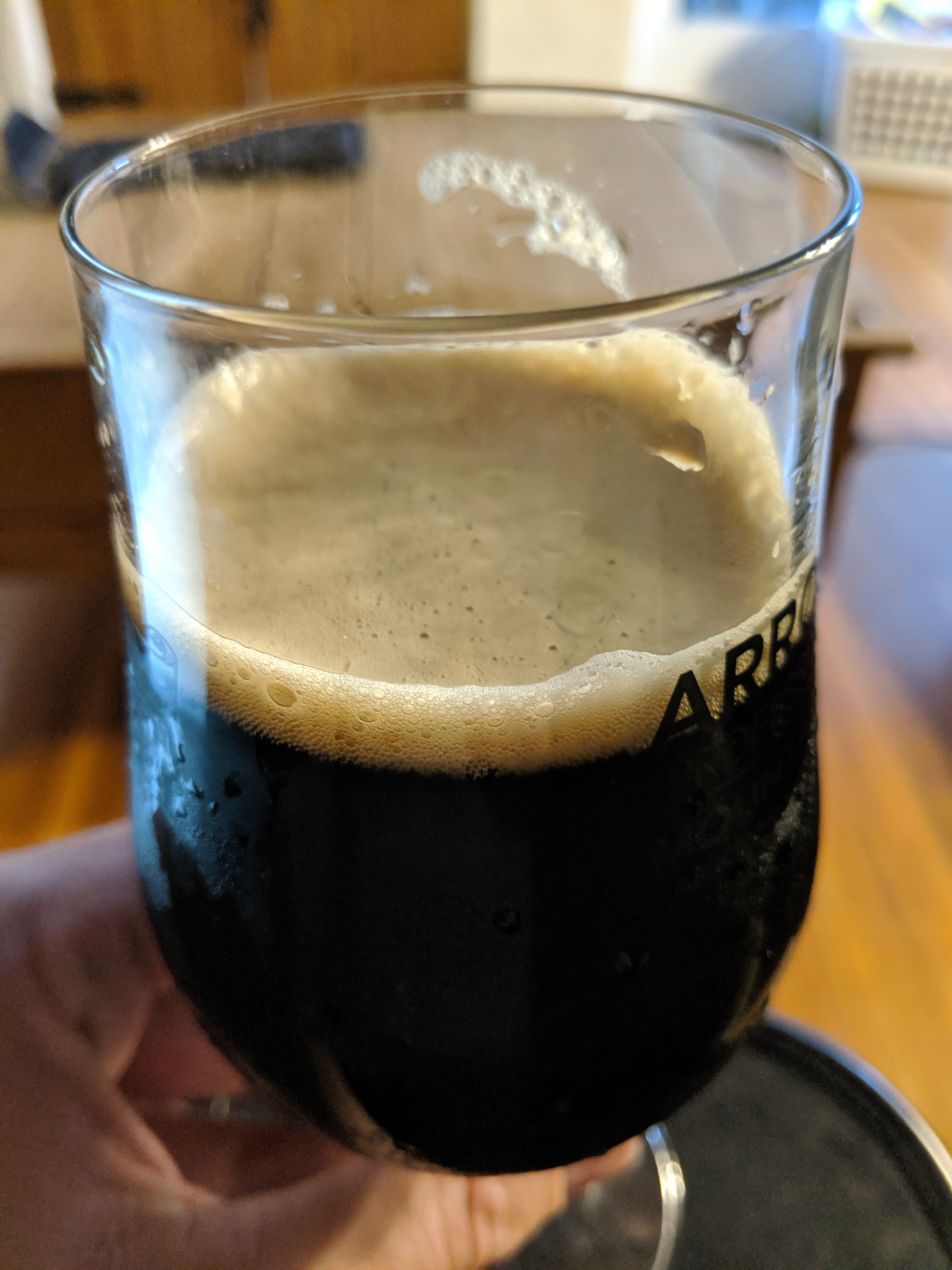
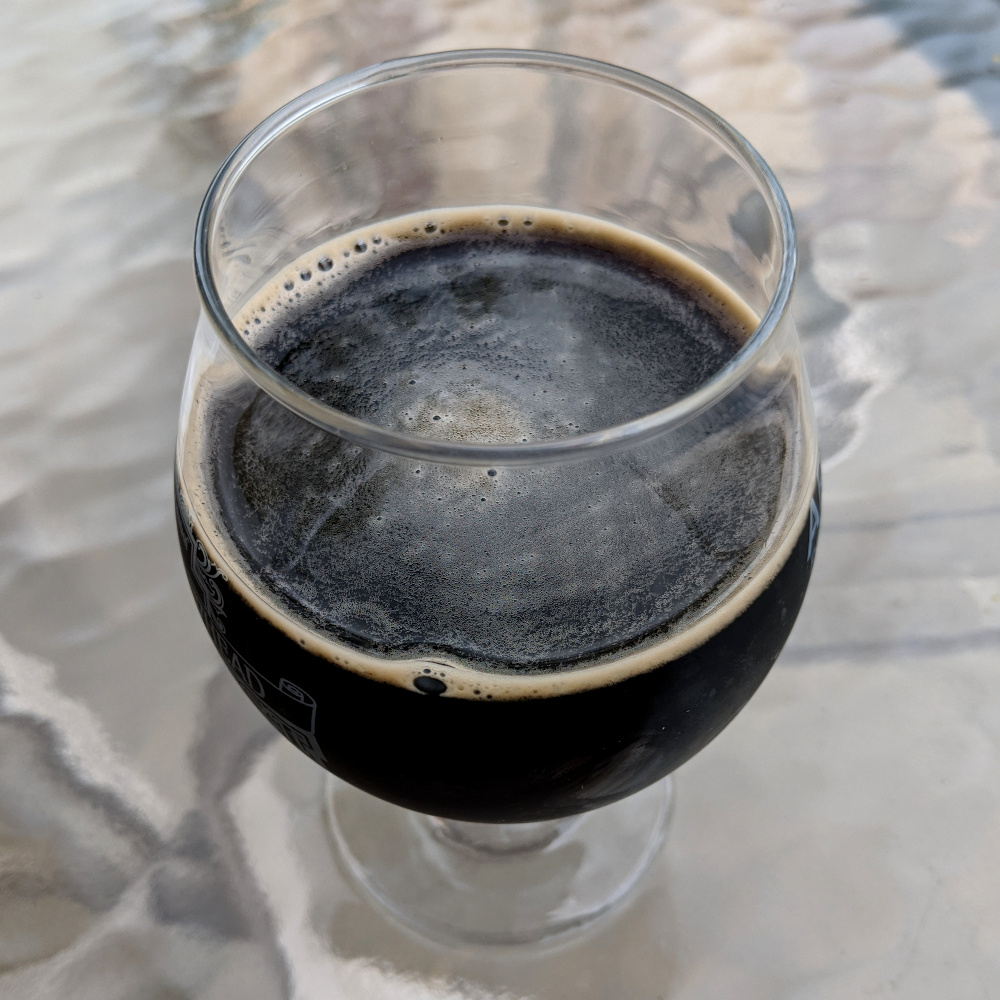
    • Dark! Black in the glass, and a deep, dark brown if you get a thin sliver of beer. Thin but persistent brown head.
  • Aroma
    • Rich aroma of chocolate with a touch of roasted coffee. There are hints of dried cherry behind that; I don’t think it’s esters (because the flavor of the beer is pretty clean in terms of yeast character), but a synergistic effect of the dark malts. I like it!
  • Flavor
    • Roasted coffee character at the outset, with a touch of dark chocolate behind that. There is a really nice coffee-type bitterness from the malt than creeps in alongside the hop bitterness. Hop bitterness is clean. The flavor is malt forward, with hops secondary, until the finish. There is an extended, slightly bitter (but not unpleasant) finish.
  • Mouthfeel
    • Dry, medium-light body, moderate carbonation.
  • Would I brew this again?
    • This is a great recipe, and a fine interpretation of the style. I think my modifications were okay overall, although I’ll replace the Carafa III with all debittered black malt next time, and use pale chocolate instead of regular chocolate malt, because the malt was just a little too much chocolate and not enough roast. As the beer matures, it has really come into its prime. I rushed it just a touch to get it on-tap, and so it had a hint of sweetness at first from the corn sugar used for priming (at least I think that’s what I was experiencing). That’s gone away now. This recipe produces a really quaffable beer, and the low alcohol level (4.1% abv) isn’t really a flavor/mouthfeel detriment thanks to the malt character.
  • Overall
    • 9/10

No Latitude Tropical Stout

IMG_20190519_191408Summer fun doesn’t mean I have to be limited to light lagers (and I do love light lagers!). I think there is a place for dark beers in the warm weather, given the right recipe and the right mindset. So, a “tropical stout” seemed like a good ticket. I had initially thought I would make something with coconut, but realized I didn’t necessarily want a full batch of a coconut beer. Why not just a simple, clean(ish), flavorful stout? So, I checked out Gordon Strong’s Modern Homebrew Recipes book and found his Jamaican Eclipse recipe. The general concept is to take a stout recipe and ferment it with lager yeast at ale temperatures. In my reading, there seems to be a lot of lore around tropical/Caribbean stouts and yeast type, and I wonder to what extent any of it is true. Either way, even a “Fantasy Island” version of the recipe is intriguing to me.
I followed Strong’s grain bill only loosely, making many substitutions and adjustments. I had no idea how much I might like this, so I scaled it for a 3 gallon batch. The result? Pretty flavorful, and a definite re-brew candidate!

No Latitude Tropical Stout

  • 6.25 lb. Maris Otter malt (Bairds)
  • 8 oz. crystal 80° malt
  • 6 oz. roasted barley
  • 4 oz. chocolate malt (Briess)
  • 2 oz. Blackprinz malt, 2-row (Briess)
  • 10 oz. corn sugar (dextrose), added to kettle before boil
  • 0.5 oz. Warrior hop pellets (15.8% alpha), 60 minute boil
  • 1 Whirlfloc tablet, 10 minute boil
  • 1 tsp. Fermax
  • 2 pkg. Saflager (W34/70) lager yeast, Fermentis

Target Parameters

  • 60 minute infusion mash, 152°, batch sparge
  • 1.064 o.g., 1.011 f.g., 7.1% abv, 39 IBU, 32 SRM
  • Claremont water, treated with Campden tablet

Procedure

  • I mashed in with 2.75 gallons of water at 163°, to hit a mash temperature of 153°. It was down to 149° after 20 minutes, likely due to the smaller thermal mass involved here.
  • After 60 minutes, I added 0.75 gallons of water at 185°, let sit for 10 minutes, vorlaufed, and collected the first runnings. I then added 2.5 gallons of water at 185°, let sit for 10 minutes, vorlaufed, and collected the second runnings.
  • In total, I collected 4.65 gallons of runnings with a gravity of 1.044, for 75% mash efficiency. I added the corn sugar prior to the boil.
  • I brought the runnings to a boil, adding hops and other ingredients per the schedule.
  • After 60 minutes, I turned off the flame and chilled down to 67°. I transferred to the fermenter and pitched the yeast.
  • I fermented the beer at 67°. Starting gravity was 1.060.
  • I brewed the beer on 15 April 2019 and cold crashed on 28 April 2019, kegging on 29 April 2019.
  • Final gravity was 1.013, which works out to 6.3% abv.

Tasting

  • Aroma
    • Roasty, chocolatey malt aroma, but not much in the way of hops. Really nice! As it warms up, I pick up a slight alcohol note, but this is permitted within the bounds of the BJCP style description.
  • Appearance
    • Thick and persistent brown head; the beer itself is fairly clear, and brown with a faint reddish tinge
  • Flavor
    • Chocolate-forward, with a bit of roast behind that. The bitterness is moderate and clean, but not over the top. Not much in the way of hop flavor. The finish is evenly balanced between hoppiness and maltiness. This is a very smooth, highly drinkable beer.
  • Mouthfeel
    • Moderate body, but not so much as to kill drinkability. Moderate carbonation.
  • Would I brew this again?
    • Yes! Maybe it’s a bit of a psychological thing, but this definitely does seem like a good warm-weather stout. It’s smooth, quite drinkable, and doesn’t taste like it is 6.3% alcohol. I don’t see much in the way of improvement needed, although I could kick the fruitiness and body up a notch. A bit of crystal 120 might help with that.
  • Overall
    • 8/10

Session Stout

The past few months have been exceedingly packed for a variety of reasons, and so I’ve had little time to brew and even less time to blog! Here is a quick report on an Irish-like stout I brewed up around a month ago.

The intention for this recipe was to create an Irish-like stout; note that I say “Irish-like” because I didn’t go completely authentic with all ingredients. I also wanted something that was fairly low in alcohol and quite drinkable. Thus, I aimed for something <4.5% abv and fairly dry.

The recipe is modified (slightly) from a recipe in Jennifer Talley’s Session Beers book.

Session Stout

  • 6.46 lb. 2-row malt (Rahr)
  • 1 lb. flaked barley
  • 0.75 oz. roasted barley (Bairds)
  • 4.2 oz. black malt (Bairds)
  • 3 oz. chocolate malt (Briess)
  • 1 oz. pale chocolate malt (Crisp)
  • 4 oz. rice hulls
  • 0.5 oz. Warrior hops (15.8% alpha), 60 minute boil
  • 1 Whirlfloc tablet, 10 minute boil
  • 1 pkg. Irish ale yeast, prepared in 0.75L starter

Target Parameters

  • Infusion mash to hit target of 152°. Batch sparge.
  • Claremont tap water.
  • 1.043 o.g., 1.012 f.g., 4.2% abv, 31 IBU, 42 SRM, 5 gallons into fermenter

Procedure

  • I mashed in with 2.83 gallons of water at 162°, to hit a target temperature of 151°.
  • After 60 minutes, I added 1.65 gallons of water at 185° for the first batch sparge, let it sit for 10 minutes, vorlaufed, and collected first runnings. Then, I added 3.5 gallons of water at 185°, let sit for 10 minutes, vorlaufed, and collected the second runnings.
  • In total, I collected 6.5 gallons of wort at a gravity of 1.037. To this, I added 0.25 gallons of RO water to bring the volume up to 6.75 gallons.
  • I boiled for 60 minutes, adding hops and other ingredients at the times indicated in the recipes.
  • After flame-out and chilling, I aerated while transferring into the primary fermenter.
  • Starting gravity was 1.042, and I fermented at 67°. The beer was brewed on 9 October 2017.
  • I kegged this beer on 2 November 2017. The yeast had settled into a nice dense cake at the bottom of the fermenter.
  • Final gravity was 1.012, for 3.9% abv. This was pretty close to my target, so I’m happy. I force carbonated at high pressure with a little bit of shaking, and was drinking the beer within a day after kegging.
  • In my initial tasting, this beer pretty much hits all the notes I wanted. It’s a highly drinkable Irish-type stout with a good bit of flavor. I think this will be a good beer to kick off fall!

Pumpkin Patch Imperial Stout

I have a more-or-less annual tradition of making a pumpkin beer, and I was looking for something a bit different this time around. Although to be honest, I’m always looking for something different on pumpkin beers! Each brewing year brings something unique–for 2017, I’m doing a pumpkin imperial stout!

The recipe is patterned after a BYO clone recipe for Southern Tier’s Warlock Imperial Stout, in the September 2017 issue. I scaled it down from 5 gallons to 3 gallons, because I didn’t really want a massive quantity of a ~10% abv beer. To up the malt complexity, I subbed in Vienna malt for the recipe’s 2-row, and subbed Warrior in for Chinook hops. Because this is such a high gravity beer, I assumed 70% mash efficiency (which turned out to still be a bit high). My local shop didn’t have WLP022 (Essex Ale yeast) in stock, so I opted for Mangrove Jack’s M15 (Empire Ale).

Pumpkin Patch Imperial Stout

  • 6.25 lbs. Vienna malt (Great Western)
  • 5 lbs. 2-row pale malt (Rahr)
  • 0.6 lb. flaked barley
  • 0.5 lb. de-bittered black malt (Dingemans)
  • 0.3 lb. caramel malt 60L (Briess)
  • 0.25 lb. Munich II malt (Weyermann)
  • 0.19 lb. chocolate malt (Briess)
  • 0.15 lb. rice hulls
  • 0.6 lb. pumpkin puree (homemade)
  • 1 oz. Warrior hops (15.8% alpha), 60 minute boil
  • 1 Whirlfloc tablet, 10 minute boil
  • 1 tsp. Fermax yeast nutrient, 10 minute boil
  • 1 pkg. Empire ale yeast (Mangrove Jack’s M15)
  • Cinnamon, vanilla, nutmeg, and ginger extracts to taste (3:1 ratio of cinnamon to others)

Target Parameters

  • Infusion mash to hit target of 150°, 60 minutes. Batch sparge.
  • Claremont tap water, with Campden tablet.
  • 1.095 o.g., 1.022 f.g., 9.7% abv, 70.5 IBU, 38 SRM, 3 gallons into fermenter

Procedure

  • I mashed in with 4.4 gallons of water at 162°, to hit a mash temperature of 151.4°. Given the big bulk of grain, the mash temperature held pretty well for the full 60 minutes.
  • After 60 minutes, I vorlaufed and collected the first runnings. I had a very slow run-off for this step.
  • I then added 2.45 gallons of sparge water at 185°, let it sit for 10 minutes, and vorlaufed again. I did a gentler (slower) vorlauf, which seemed to help with the sparging issue.
  • In total, I collected 4.9 gallons of water with a gravity of 1.065, for 67% mash efficiency. Given the high target gravity versus the volume of water, I’m not incredibly surprised. Nonetheless, I’ll want to remember to adjust efficiency accordingly for my next high gravity recipe.
  • I brought the wort to a boil and added the various hops, etc., at the designated time. After 60 minutes, I turned off the heat and chilled the wort to around 80°. I transferred while aerating, and then pitched the yeast directly.
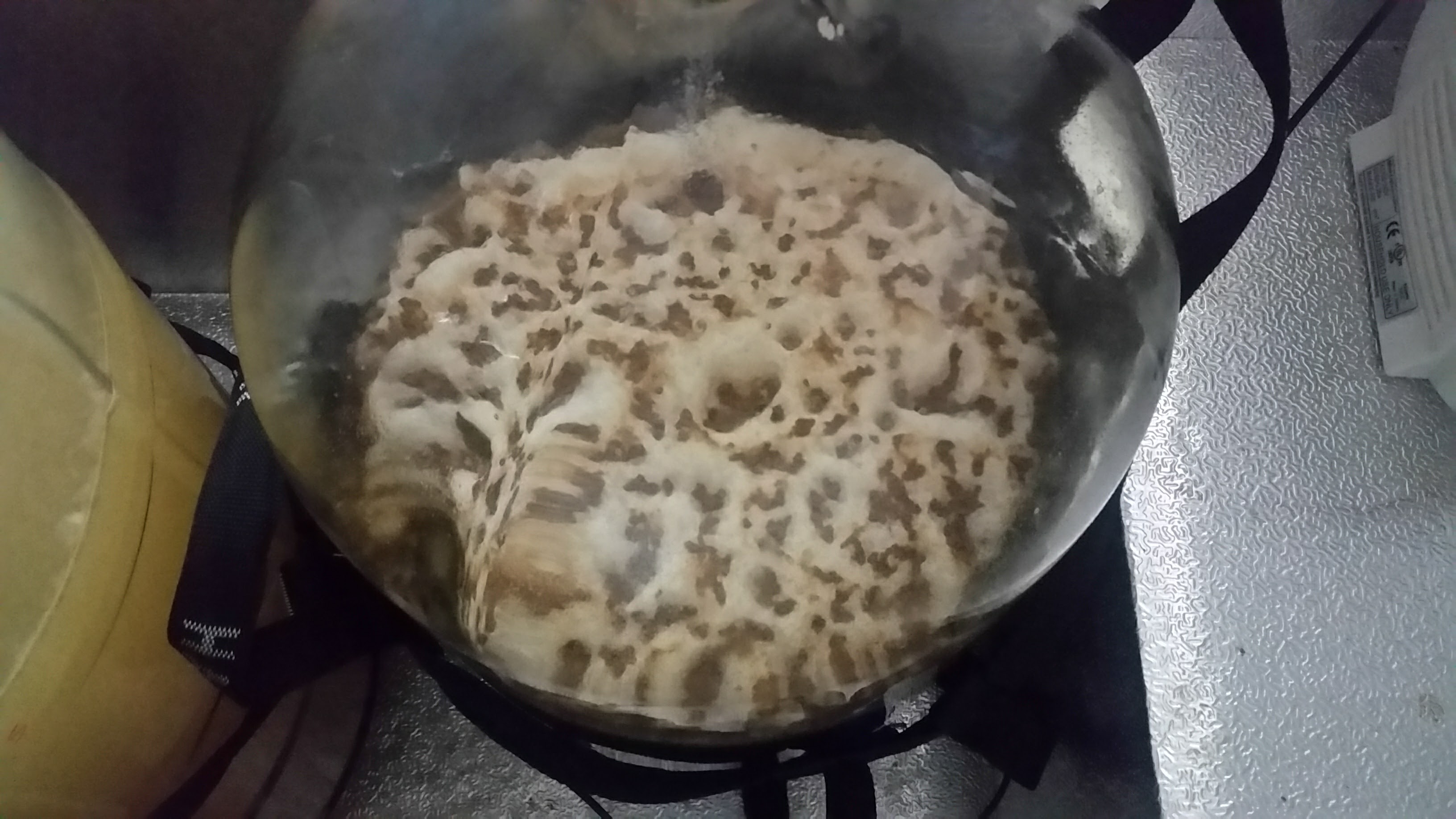
  • Starting gravity was 1.085. I’ll be starting fermentation at 66°. I brewed the beer on 19 August 2017, and had visible yeast activity within 9 hours after pitching.
  • After around two weeks, I’ll add the appropriate spice extracts. I plan to make these myself, using a vodka infusion. Although the original recipe calls for clove extract, I am going to leave that out, because (as I read once from Gordon Strong) clove is too often an off flavor and might detract from the overall taste on the final product.

20170820_104709

Fermenting happily, ~12 hours after yeast pitching

Eagle Face Oatmeal Stout (1.4)

Time to do the semi-annual brew of my world-famous recipe (by virtue of appearing in Zymurgy), Eagle Face Oatmeal Stout! This iteration has only small modifications, to account for my current mash efficiency (~75%), which means a slight reduction in the amount of base malt. I also changed the hops (to use up one of my high-alpha hops), which shouldn’t result in a substantive difference for the flavor profile because they’re really just for bittering anyhow. Finally, I toasted my oatmeal to try something a little different. The day before brewing, I set the oats in a 350° oven for 1.25 hours, which resulted in a nice toasty aroma and crispier oats with a slight golden edge on most of the flakes. We’ll see how that changes stuff (if it does).

20170101_135414

Toasted oats, ready for the brew.

Eagle Face Oatmeal Stout 1.4

  • 7.5 lbs. 2 row malt (Great Western)
  • 1.5 lbs. old-fashioned oats (lightly toasted)
  • 1 lb. 80° L crystal malt (Briess)
  • 1 lb. Victory malt (Briess)
  • 0.75 lb. chocolate malt (Briess)
  • 0.5 lb. roasted barley (Bairds)
  • 0.38 lb. rice hulls
  • 1 Whirlfloc tablet, 10 minute boil
  • 0.82 oz. Magnum hop pellets (13.2% alpha), 60 minute boil
  • 1 pkg. English Ale yeast (White Labs WLP002, in starter)

Target Parameters

  • 156° mash, 60 minutes
  • 1.061 o.g., 1.022 f.g., 5.1% abv, 37 IBU, 41 SRM, 5.5 gallons into the fermenter

Procedure

  • A few days in advance of the brew, I prepared a 2L starter. After two days on the stir plate, it was starting to flocculate out, and so I cold-crashed the starter. I split the starter into a 1.4L volume for pitching in this batch, and set aside 0.6L for a later brew.
  • As with my most recent brewing session, I have modified my mash procedure slightly. I added the strike water directly to the unheated mash tun, and then added the malt after temperature stabilized at my desired strike point. In this case, I added 4.2 gallons of water at 180°. Once in the mash tun, the temperature dropped to 175°, a bit above my target of 168.7°. So, I let things sit until it matched my target, and then mashed in. For future reference, I should only overshoot my strike water temperature around 5° or so; this will result in a little bit shorter time to reach the planned temperature in the mash tun.
  • My mash temperature settled at 154-156°, depending on where I measured it in the tun. It was down to 152° after 45 minutes. After 60 minutes, I added 0.75 gallons of water at 185°, let sit for 10 minutes, vorlaufed, and collected the first runnings. I then added another 3.5 gallons of water at 175°, which raised the mash bed to 160°. After sitting and vorlaufing, I collected the second runnings.
  • In total, I collected 6.4 gallons of wort at a gravity of 1.052, for 76% mash efficiency.
  • I started the boil, adding ingredients per the schedule. After 35 minutes of boiling, I added an additional 0.25 gallons of R.O. water, to bring up the boil volume slightly and drop the gravity slightly.
  • After a 60 minute boil, I turned off the flame and started chilling. Once I got down to 70°, I transferred the wort (while aerating with the usual Venturi pump and wort sprayer) into my primary fermenter.
  • My pre-fermentation volume was 5.25 gallons, up to 5.5 gallons (approximately) once I pitched the yeast.
  • Starting gravity was 1.060, close enough to my target for me to be happy (anything within 0.001 is well within instrument measurement error)! I’ll be fermenting at 68°. This batch was brewed on 2 January 2017.