Palaeotis Pils

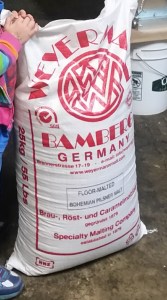
pilsner_maltOn my continued quest to learn brewing grains in depth, I recently purchased a 55 lb. sack of Weyermann’s floor-malted Bohemian pilsner malt. This is the same stuff I used for my Lithographica Pilsner, and is cool on a scientific level because the grains are malted on floors made of Solnhofen Limestone (more details here).

For my first brew with this sack of malt, I elected on doing a German pils. That’s a new style for me, and also can be brewed with a minimum complexity of ingredients (I’m really gravitating towards those sorts of simple recipes).

The name for the batch honors an important fossil bird from the Messel pits of Germany, around 47 million years old. Palaeotis is potentially an early ratite, a member of the group of birds including ostriches and emus.

Palaeotis Pils

  • 8.5 lbs. floor-malted Bohemian pilsner malt (Weyermann)
  • 0.21 lb. acidulated malt
  • 0.6 oz. Magnum hop pellets (13.2% alpha), 60 minute boil
  • 1 oz. German Hallertau hop pellets (3.2% alpha), 5 minute boil
  • 1 tsp. Fermax yeast nutrient, 10 minute boil
  • 1 Whirlfloc tablet, 10 minute boil
  • German lager yeast (White Labs WLP830), prepared in 1.7L starter

Target Parameters

  • Double decoction mash, 10 minute rest at 122°, infusion to hit 60 minute rest at 148°, thick decoction to raise temperature to 154°, 10 minute rest, thin decoction to mash out at 168°. Batch sparge.
  • Water built from R.O., to hit 59.1 ppm Ca, 8.2 ppm Mg, 89 ppm SO4, and 62.9 ppm Cl.
  • 1.045 o.g., 1.008 f.g., 4.9% abv, 34 IBU, 3 SRM, 5 gallons into fermenter

Procedure

  • Five days in advance (4 December 2016), I made a 1.75 L starter for my yeast culture. After two days on the stir plate, I cold-crashed the starter.
  • For this recipe, I built my water to match the “Pilsner Water” profile on Braukaiser. For the 3.6 gallons of mash water, I added 1.4 g of gypsum, 1.1 g of epsom salt, and 1.8 g of calcium chlorie. For the 5 gallons of sparge water, I added 1.9 g of gypsum, 1.6 g of epsom salt, and 2.5 g of calcium chloride.
  • I mashed in with 2.25 gallons of water at 134° to hit 126°, and left it for a 10 minute protein rest.
  • Next I added 5.25 quarts of water at 197°, to hit a mash temperature of 149° (after a bit of stirring).
  • After 50 minutes, I pulled a thick decoction of 7 quarts. I heated it to 154°, let it rest for 10 minutes, and brought to a boil for 10 minutes. The decoction addition brought the mash up to 156. I let the mash rest for 10 more minutes.
  • Next, I pulled 1 gallon of wort for a thin decoction, boiled it for 10 minutes, and returned it to the mash. This raised the temperature up to around 168°.
  • I pulled the first runnings, and added the 5 gallons of sparge water. After 10 minutes and a vorlauf, I collected the remainder of the wort. I had around 7 gallons, so added 0.25 gallons of water to bring up the volume to my target.
  • In total, I had 7.25 gallons of mash runnings at a gravity of 1.038, for 84% efficiency.
  • I brought the kettle to a boil, and added the hops and other ingredients per the schedule. I added 0.25 gallons of RO water during the boil, to top things up and keep the gravity from getting too high.
  • After 60 minutes, I chilled the wort down to 70°, transferred the wort while aerating, put the fermenter into the fermentation chamber, and pitched the yeast.
  • Starting gravity was 1.048, a touch above my target of 1.045. I will be fermenting this at 52°. I brewed the beer on 9 December 2016.
Beer Tasting: Packrat Porter

  • The Basics
    • Starting gravity = 1.054; final gravity = 1.017; abv = 5.1%; estimated IBU = 38
  • Aroma
    • Lots of malty aroma, with a grainy and roasty character to it. I don’t pick up much in the way of hops or yeast esters.
  • Appearance
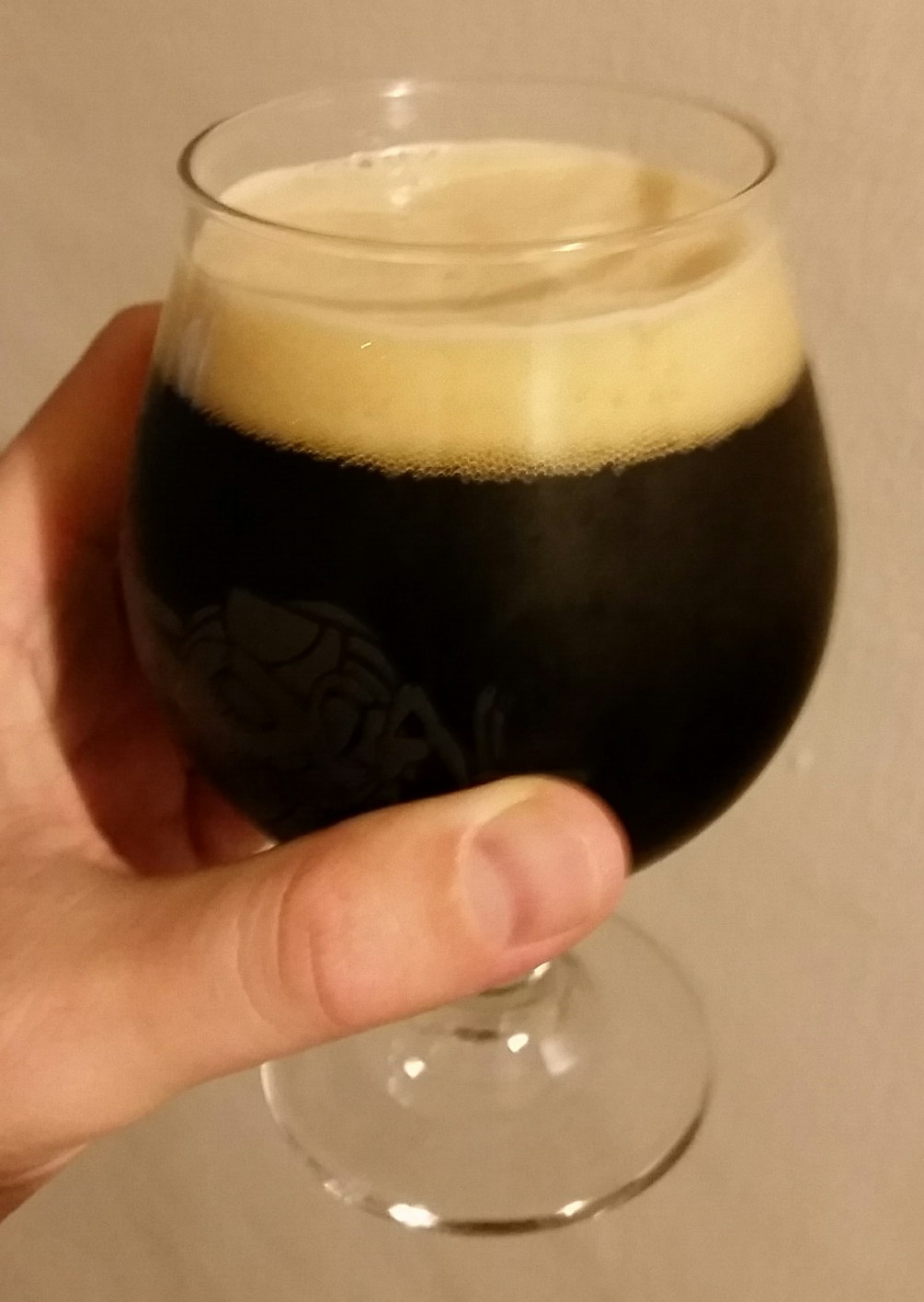
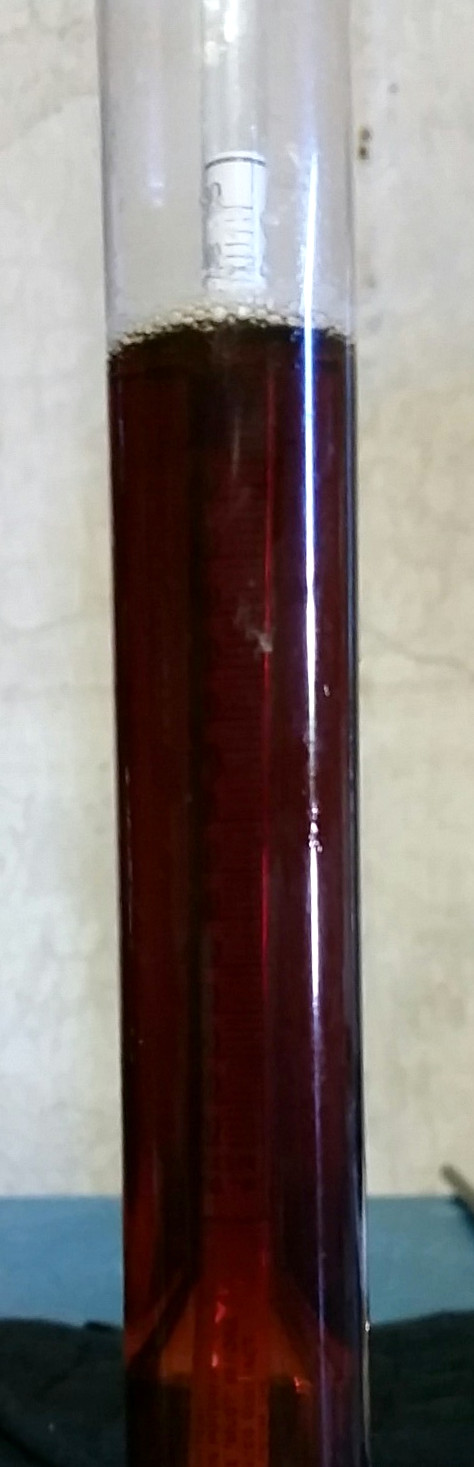
    • The beer is deep brown in gross examination. When held up to the light, a deep ruby tinge is quite apparent, as well as excellent clarity. It’s very pretty! The head is beige, fine, and moderately low, with excellent retention during the course of consumption. 
  • Flavor
    • The beer is malt-forward, with a primarily grainy and chocolate character backed up by roasty notes (in the overall same ballpark as the aroma). The bitterness is moderate and smooth, but not overwhelming.
  • Mouthfeel
    • The beer has a moderate body and a pleasant, fine carbonation with a slightly creamy sensation. The finish is relatively dry and tasty. 
  • Would I brew this again?
    • Yes! For something that was thrown together from odds-and-ends, it turned out exceptionally well. Although I am unlikely to duplicate this exact recipe ever again, I think the overall ‘feel’ is a definite winner. The beer is a solid improvement on my last porter, most probably in my choice of a less attenuative English ale yeast as well as a healthy addition of flaked oats, which added some needed body over the previous recipe. I would note that this probably is best classified as a “hybrid porter”–the starting gravity is a bit higher than conventional for an English porter and the graininess is apparently slightly out of character, but it’s not quite aggressive enough to be an American porter (no ‘burnt’ characteristics and the hops are fairly tame). Ignoring the BJCP, though, it’s a great beer! I would definitely brew a simplified version of the recipe (cut the micro-additions of various grain sample packs), or perhaps even switch it up by using Maris Otter for the base malt.
  • Overall rating
    • 8.5/10

Beer Update: Packrat Porter and Clonal Common

Today I kegged my Packrat Porter, which had been in the primary for just over two weeks. Final gravity was 1.017, down from 1.056, which works out to 5.1% abv. This is about spot on the nose for what I had anticipated. The flavor is pretty nice, but I can’t say much other than that it tastes like porter. I plan to speed carbonate this one, so that it’s ready for serving by the end of the week.

The Clonal Common appeared to ferment nicely over the past week. To help it finish out, I edged the temperature controller up to 64° from 60°. I’ll let it sit there for 3-4 days, edge it up to 68° for a day or two to help things finish out, and then cold crash it prior to kegging.

Packrat Porter

Yeast sludge settling out

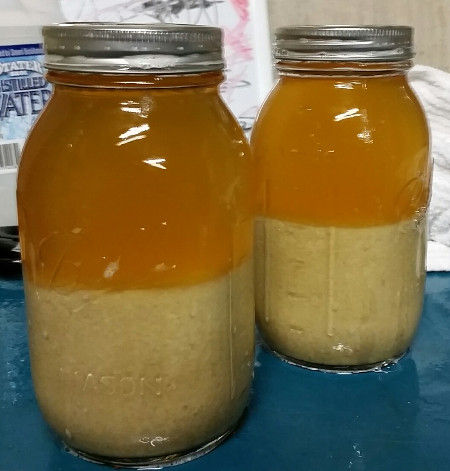
I’m always interested in expanding my skills and homemade brewing equipment, and it seemed like an opportune time to take a big step forward. I’ve been curious about washing and reusing yeast for some time, but just haven’t made the effort to enact the process. So, when I kegged my Seven Seas Session IPA, I saved the sludge from the bottom of the primary fermenter. I added a bit of boiled and cooled water, and then decanted the slurry into two quart mason jars. Each jar was about 2/3 full (a little too full, in retrospect), and I then topped each up with more cooled and boiled water. I let them sit for awhile, and then decanted the liquid as well as the top layer of sludge into another quart jar. This, too, was topped up with water and then placed in the fridge for a week. Last night, in preparation for today’s batch, I prepared a 1L yeast starter and added the yeast from the bottom of the jar. This stirred overnight and into the afternoon, at which point I was ready to pitch the yeast. The starter looks and smells quite healthy, so I’m optimistic about this little experiment. Next time, I may instead overbuild a primary yeast culture and save that, instead of reusing yeast from a previous batch.

I also decided to try adding the dark grains and crystal malts during the vorlauf, following a technique suggested by Gordon Strong in his recent homebrew recipes book. This was a little tricky when it came time to calculate the various water volumes required, and I missed the target by a little bit (I had done the calculations without the various crystal malts, and I also presume the oats soaked up a bit of extra water). I improvised by washing the grains at the end with a final pulse of water, and that brought me right to my volume and gravity target. Lesson learned!

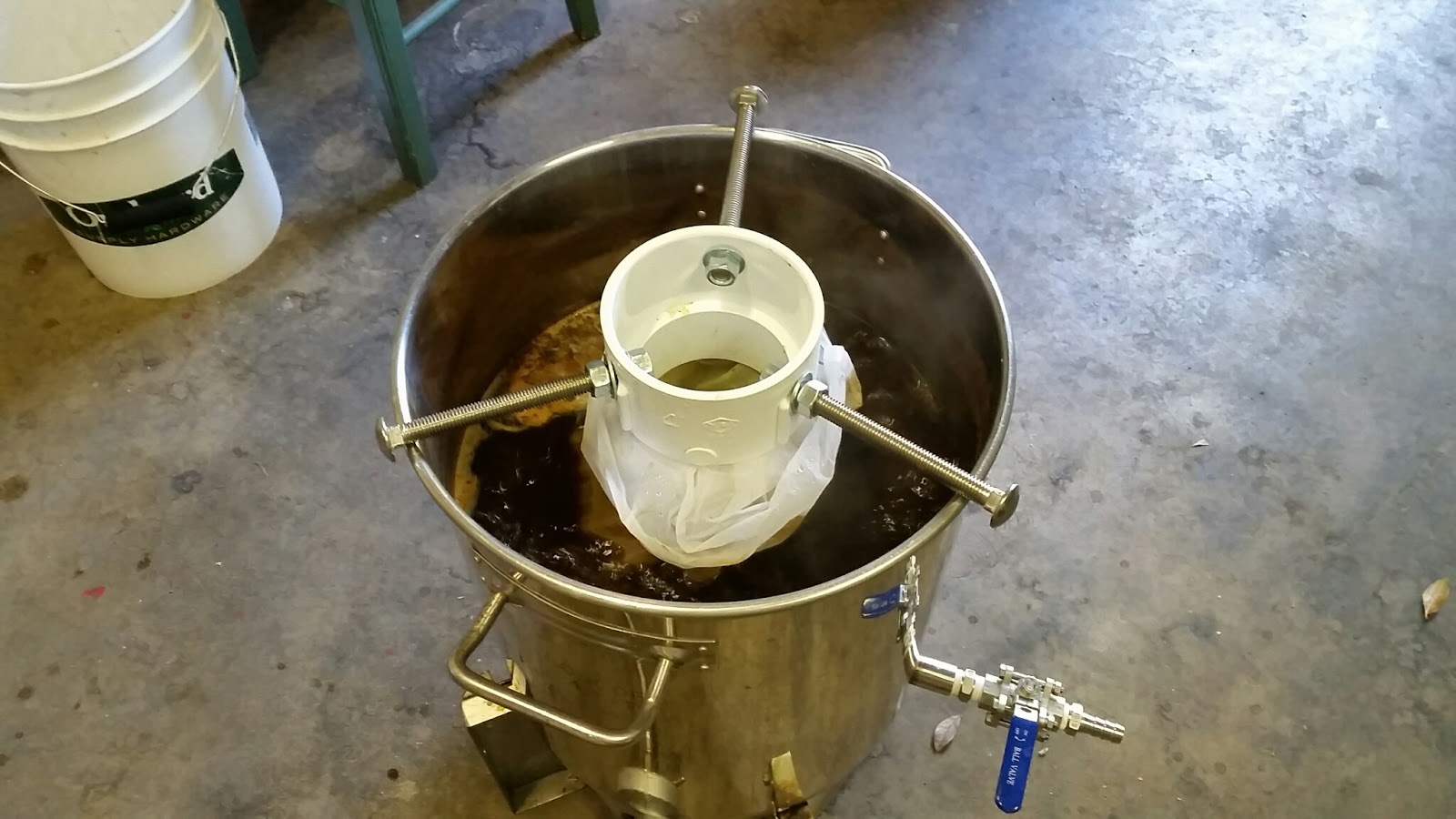
The final major addition to today’s brew process was the construction of a hop spider. I essentially followed directions from BYO magazine, but instead used a food-grade straining bag instead of a paint-straining bag. It worked quite well during the boil, and will definitely be easier than wrangling multiple bags during more hoppy brews.
Today’s brew was an American(ish) porter, named in honor of a resident of our quarry this summer. It was also appropriately named as the dumping ground for a whole bunch of leftover ingredients and free samples, as well as my first attempt at yeast washing. I am under no illusions that some of the smaller grain additions will have a detectable effect, but I can’t stand the idea of throwing out those little packets, either! Given my experience with the last porter I brewed, which was a touch thin, I beefed up the recipe with a pound of flaked oats.
Packrat Porter
  • 8.55 pounds 2-row malt (Great Westerning Malting Co.)
  • 1 lb. flaked oats
  • 1.4 oz. Borlander Munich Malt (Briess)
  • 1.4 oz. Victory malt (Briess)
  • 1 lb. chocolate malt, added at vorlauf
  • 0.75 lb. 60° caramel Munich malt (Briess), added at vorlauf
  • 0.37 lb. 40° crystal malt, added at vorlauf
  • 1.4 oz. 60° caramel malt (Briess), added at vorlauf
  • 1 oz. Newport hops (10.7% alpha), 60 minute boil
  • 1L starter of English ale yeast, WLP002 (reused)
  • 1 tbs. 5.2 pH stabilizer (in mash)
  • 1 tablet Whirlfloc (10 minute boil)
Procedure
Hop spider in action
  • I mashed in with 3.1 gallons of water at 168°, which stabilized to around 155°. The mash had dropped to 152° after 60 minutes.
  • After 60 minutes, I added the dark and crystal grains, as well as 1.27 gallons of water at 185°. I let this sit for 15 minutes, vorlaufed, and collected 3.15 gallons of wort. Then, I added 3.65 gallons of water at 180°, which raised the mash bed to 164°. I let this sit, vorlaufed, and collected the remainder of the wort. This totaled 6.1 gallons at a gravity of 1.046. This was a little under my target on both counts, so I added 0.75 gallons of water at 120°. I drained this for the final collection.
  • All told, I collected 6.75 gallons of wort with a gravity of 1.048. This works out to 75% efficiency.
  • Once the wort came to a boil, I added the hops and boiled for 60 minutes. With 10 minutes to go, I added the Whirlfloc.
  • At flame-out, I chilled the wort down to about 80 degrees and then transferred it to the carboy. I placed it in the fermentation chamber and cooled it for an hour or so, and then pitched the yeast.
  • Starting gravity was 1.056, which should result in a final abv of around 5.1%. The unfermented wort has a nice dark color and a good taste. I plan to ferment this for 2 weeks at 68°.