I’ve been doing a bunch of brewing for my club’s participation at an upcoming homebrew festival, and so have neglected my own taps! In order to avoid the desperate turn of a vacant tap on the keezer, I cranked out another brew in July, just before I left for a two week stint in the field.
It took a bit of thought to settle on a style. I was first leaning towards a lager of some sort, but also wanted something with a slightly quicker turnaround. Then an IPA popped into my head, but after looking through a few recipes I didn’t find anything that terrible inspirational. Finally, I thumbed through Gordon Strong’s Modern Homebrew Recipes, and ran across his Galaxy Pale Ale. I made a few adjustments for ingredients, and brewed the batch!
Strong’s original recipe was Galaxy hops only, and didn’t have any dry hop addition. I didn’t have enough hops on hand to do both a generous addition of Galaxy as well as a generous dry hop, so I modified the hop bill accordingly. For the hot days of late August, I wanted something tropical and fruity on the palate and the nose. I have a good combo of hops in that realm in the freezer, so put together a combination of Mosaic, Simcoe, Galaxy, and Citra (the MSGC combo of the recipe name). These are four of my favorite hops, and I’m hoping will combine nicely.
As I added up the hops, I realized I didn’t need a bittering addition. Everything will get added at flame-out, with a whirlpool to extract bittering, aroma, and flavor. This is an experiment for me–I’ve never done a beer before with all hop additions after flame-out.
The grain bill is 45% pilsner, 45% 2-row, and 10% Vienna malt. The original recipe called for light Munich instead of Vienna–I don’t have any Munich on-hand, so made this substitution. The flavor will be a bit lighter as a consequence, but I don’t necessarily see that as a bad thing.
MSGC Pale Ale
- 4.5 lbs. Barke pilsner malt (Weyermann)
- 4.5 lbs. 2-row brewer’s malt, California select (Great Western)
- 1 lb. Vienna malt (Great Western)
- 1 Whirlfloc tablet (10 minute boil)
- 1 oz. Citra hop pellets (14.1% alpha), 10 minute whirlpool
- 1 oz. Galaxy hop pellets (18.1% alpha), 10 minute whirlpool
- 1 oz. Mosaic hop pellets (10.9% alpha), 10 minute whirlpool
- 1 oz. Simcoe hop pellets (13.6% alpha), 10 minute whirlpool
- 1 pkg. US West Coast Yeast (Mangrove Jack’s M44)
- 1 oz. Citra hop pellets (14.1% alpha), dry hop in keg
- 1 oz. Galaxy hop pellets (18.1% alpha), dry hop in keg
- 1 oz. Mosaic hop pellets (10.9% alpha), dry hop in keg
- 1 oz. Simcoe hop pellets (13.6% alpha), dry hop in keg
Target Parameters
- Infusion mash to hit target of 142°, 60 minutes, batch sparge.
- 1.051 o.g., 1.013 f.g., 5.0% abv, 38 IBU, 4 SRM
- Water built from RO and Claremont tap water to hit final water balance of 80 Ca, 3 Mg, 6 Na, 83 SO4, 68 Cl, 60 HCO3, -9 RA, with 4 mL of 88% lactic acid added to mash to adjust pH.
Procedure
- I prepared the mash water with 4 g gypsum and 4 g CaCl added to 3.5 gallons of RO water. I heated it to 161°, and mashed into hit a temperature of 151°. I also added 4 mL of 88% lactic acid to the mash, for pH adjustment. The mash temperature was down to 148° after 30 minutes.
- I created my sparge water from a blend of 2.25 gallons of tap water (with Campden tablet) and 2.5 gallons of RO water. No further adjustments were made. I started the sparge by adding 1.5 gallons of water to the mash, letting sit for 10 minutes, vorlaufing, and collecting the first runnings. I then added 3.25 gallons of sparge water to the mash tun, let it sit for 10 minutes, vorlaufed, and collected the rest of the runnings.
- In total, I collected 7 gallons of runnings with a gravity of 1.041, for 78% mash efficiency.
- I brought the kettle to a boil. The only thing to add during the boil was the Whirlfloc tablet!
- After flame-out, I added a big mesh bag with the hops, and stirred for 10 minutes. Then, I chilled to 85°, transferred with aeration, and chilled the wort overnight. Once I had hit my fermentation temperature of 68°, I pitched yeast.
- I brewed this batch on 16 July 2018, and left it in the primary until kegging. Starting gravity was 1.049.
- Final gravity was 1.007. I kegged the beer on 9 August 2018, added the dry hops, chilled to 50°, carbonated (with shaking), and put the beer on tap.

Tasting
I did a tasting for this beer on 19 August, after 10 days on tap. It’s pretty excellent–one of the best beers I have done in awhile!
- The Basics
- 1.049 s.g., 1.007 f.g., 5.5% abv, 38 IBU, 4 SRM
- Aroma
- A nice forward tropical fruit aroma, with a bit of mango, peach, and citrus all melded together. Delicious on the nose!
- Appearance
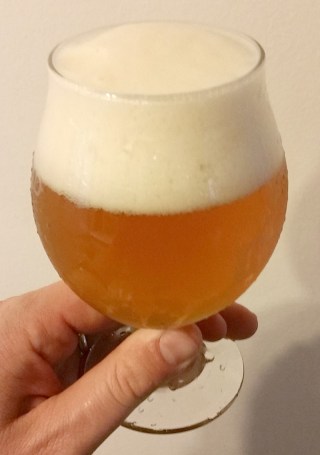
- Light gold color with slight haze. Thin white head that is reasonably persistent.
- Flavor
- It’s a fruit explosion! The beer has a gentle but firm bitterness, with flavors of pineapple, passion fruit, mango, and citrus (and just a little bit of “dank” character). The malt character is slightly grainy, with a nice bit of complexity behind that.
- Mouthfeel
- Medium-light bodied, with an off-dry finish. Carbonation is moderate.
- Would I brew this again?
- Absolutely! This is one of the best pale ales I’ve made in a long time. The hop aroma and flavor are amazing, and I love the complexity that the four-hop blend brings to this. Although the beer is paler in color than acceptable for the BJCP style, I dig it in this particular recipe. It really is a nice beer!
- Overall
- 10/10
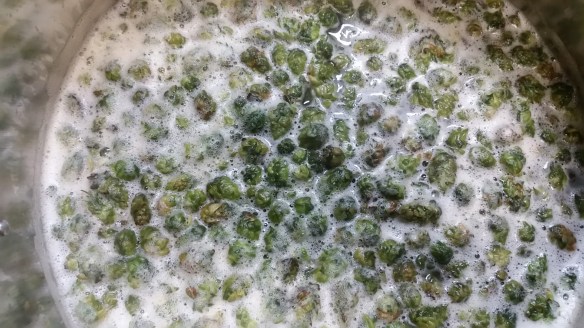
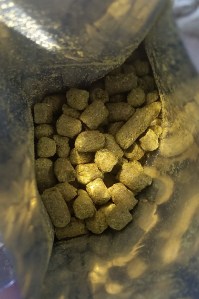 My local homebrew shop happened to have a pound of African Queen hop pellets during my most recent visit…for those not in the know, this is a variety grown in South Africa, and one of the few that is available (for now) in the United States. Due to some recent hop farm purchases, future South African hop availability is likely to be even tighter than before, so I had to jump at this chance to brew with this variety.