Holy Helles

After years of avoiding lagers, I’m diving into the deep end. In the past two months alone, I’ve done a German pils and a Vienna lager, and these were hard on the heels of a Bohemian pilsner and another Vienna lager. I’ve generally used a faster fermentation and lagering schedule for my lagers, but for this batch I wanted to A) take my time a bit; and B) try out a style I haven’t brewed previously. The idea of a Munich helles is appealing because it is supposed to be a very malt-forward style with minimal bitterness, so it’s likely to be of broad interest to more people than something more bitter. Also, by slowing down the process I also can clarify without gelatin, which also means strict vegetarian/vegan types can drink it without complaint. Overall, a Munich helles seemed like a nice change from my most recent batches, and I figured it would make a nice brew to serve with Easter dinner. So, I’m calling this batch “Holy Helles”. I’ll note I’m not the first brewer to think themselves so clever, but I’m sticking with it anyhow.

The recipe isn’t based on anything in particular; I read across a number of sources to come up with the combination of malt, yeast, and hops. This should hit the “sweet spot” for the particulars of the Munich helles style.

20170107_103335

Holy Helles

  • 8.25 lb. floor-malted Bohemian pilsner malt (Weyermann)
  • 1.25 lb. Munich I malt (Weyermann)
  • 3 oz. BEST acidulated malt (BESTMALZ)
  • 2 oz. Carapils malt (Briess)
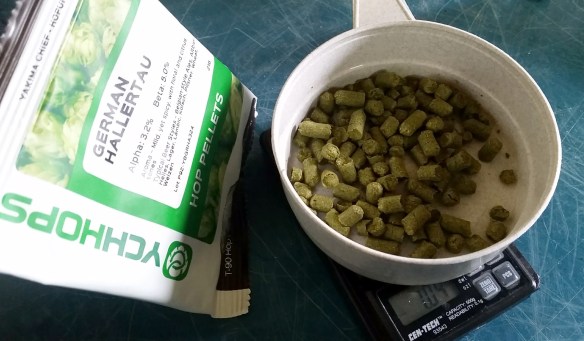
  • 1.5 oz. German Hallertau hop pellets (3.2% alpha), 60 minute boil
  • 0.5 oz.German Hallertau hop pellets (3.2% alpha), 10 minute boil
  • 1 Whirlfloc tablet, 10 minute boil
  • 1 tsp. Fermax yeast nutrient, 10 minute boil
  • 1 pkg. Southern German Lager yeast (WLP838, White Labs)

Target Parameters

  • Multiple infusion and single decoction mash, 20 minute rest at 130°, infusion to hit 45 minute rest at 148°, thick decoction to raise temperature to 168°. Batch sparge.
  • Water built from R.O., to hit 44 ppm Ca, 2 ppm Mg, 22 ppm SO4, 68 ppm Cl, and 5 ppm bicarbonate.
  • 1.046 o.g., 1.010 f.g., 4.8% abv, 19 IBU, 4 SRM, 5.5 gallons into fermenter

Procedure

  • Several days in advance, I made a 2L starter, let it run for 2 days, and then cold-crashed.
  • I calculated that I would need 9.2 gallons of water, so weighed out 1 g of gypsum, 0.7 g of epsom salt, 5.4 g CaCl, and 0.3 g baking soda for my mineral additions. I split these into 2 parts. Half of the mass will go into the strike water and half into the sparge water.
  • I added 2.45 gallons of water at 148° to my mash tun, and let the mash tun warm up until it hit 143°. Then, I added my grains, and achieved my target acid rest temperature of 143°.
  • After 20 minutes, I added 1.5 gallons of water at 186°, to hit a mash temperature of 146°. It was down to 143° after 35 minutes, and at more or less the same temperature after 45 minutes total. I decocted 1.5 gallons of a medium-thick mash, brought it to a boil, boiled for 10 minutes, and added it back in to the mash to hit a mash-out temperature of 163°. I let this sit for 10 minutes before draining the mash tun to collect the first runnings.
  • I added 5.25 gallons of water at 180°, let the mash sit for 10 minutes, vorlaufed, and collected the second runnings.
  • In total, I collected 7.6 gallons of wort with a gravity of 1.044–that’s 90% mash efficiency! I chalk it up to the decoction, and that’s awesome, but the end result would be too high in gravity. So, I added 1 gallon of RO water to dilute everything down to 1.040 and get 8.6 gallons.
  • I targeted a 90 minute boil time. Once I started the boil, I thus waited 30 minutes before adding the first round of hops. Other hops and additions were made per the schedule in my recipe.
  • Nine minutes before flame-out, I checked gravity again and saw that it was at 1.048, a touch higher than my target. So, I added another 0.5 gallon of RO water.
  • After flame-out, I chilled the wort down to 72°, and got ready for the transfer.
  • There was a lot of wort, so I drained the first gallon of trub off in order to keep the portion going into the fermenter fairly clean. Even with this, I ended up with just under 6 gallons of wort in the fermenter.
  • I popped the fermenter into my fermentation chamber, and set it for the final chill down to 45°. Once I hit this (about 6 hours later), I pitched the yeast and set the temperature to 50°.
  • I brewed this beer on 7 January 2017. It had a starting gravity of 1.047 (just a touch above target).
  • I had minor signs of fermentation within 24 hours and fairly good krausen within 48 hours. Three days into fermentation, we lost power for ~16 hours. The fermentation was thus unregulated for that stretch. I wasn’t able to check on the beer (being laid up in bed with a bad cold), but presumably the temperature went up just a touch (although the ambient temperature remained around 60°).
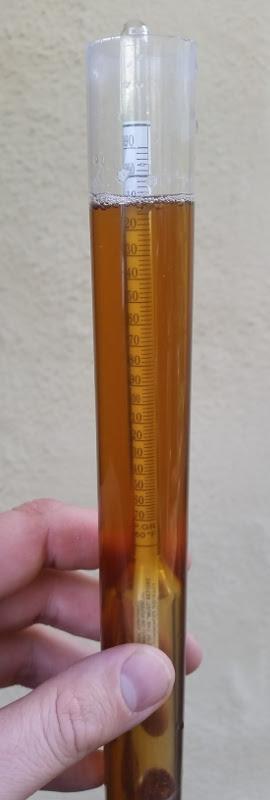
  • I did a check on the beer on 15 January 2017. There was a strong sulfur aroma coming from the fermenter. The gravity was 1.020, for 56% apparent attenuation. On this day, I raised the fermentation temperature to 52°. Fortunately, I didn’t detect any off (e.g., fruity) flavors in the beer, so I am satisfied that the brief power loss wasn’t too detrimental.
  • My planned fermentation schedule is 7 days at 50°, 7 days at 52°, 7 days at 54°, 4 days at 68°, and then a week or so at 32° before transferring to the keg for long-term lagering. This will allow me about 2 months of dedicated lagering before I serve this at Easter.

Lager / Pils Update

vienna_lagerThings have been moving along on my latest Vienna lager (Take Two Vienna Lager) and German pils (Palaeotis Pils). The two beers are in the same fermentation chamber; because the pils was brewed most recently, the temperature control regimen has been dictated by that batch.
For these brews, I elected to use a fast lager schedule. The pils was brewed on 9 December, with a starting gravity of 1.048. When I checked the beer on 16 December, the gravity was down to 1.020. At 57% apparent attenuation, this exceeded the recommended 50% threshold for temperature ramp-up, so I was clear to go. I didn’t bother to check on the Vienna lager, because it had been in there for a week extra and high krausen had long since passed. So, I figured it was more than safe to ramp that one up too.

At this point, I turned off the fermentation chamber to let things free-rise for the first day. Because my garage temperature was fairly cool, the temperature in the fermentation chamber hadn’t exceeded 55° after 24 hours. So, I added the heating pad and set the temperature for 68°. The temperature probe was loose, so that it would sense ambient temperature in the chamber, for a slower rise in the fermenters themselves than if the probe was attached to a fermenter directly.

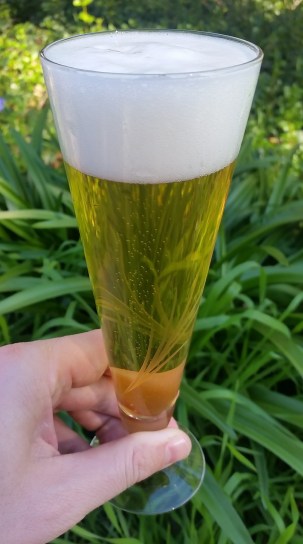
I checked the pils again on 24 December, at which point the gravity was 1.011, and this was unchanged two days later (5% abv, with the 1.048 starting gravity). The Vienna lager (depicted in the photo) was at a final gravity of 1.013 (5.1% abv, following a starting gravity of 1.052). So, on 26 December I set the fermentation chamber to 34°, still leaving the temperature probe loose so as to ensure a slower temperature drop in the fermenters. I filled the airlocks with vodka, to avoid having the sanitizer water sucked in as things cooled.

After 24 hours of cold-crashing, I added gelatin, with 1/2 tsp. in a half cup of water for each batch. I’ll let things settle for a few more days before kegging and carbonating.

Take Two Vienna Lager

My previous attempt at a Vienna lager was pretty darned tasty, but a little short of the style in terms of coloration. For my next round, I elected to throw in a few additional dark malts, as a short-cut to something more on style. Additionally, I decided on a straight-forward infusion mash, rather than messing around with decoction. The decocted lager I did before was really tasty, but also a bit of work, and I wanted a quicker brew session for this batch.

The recipe was modified from one by Andy Weigal that medaled at NHC in 2015. I simplified the grist slightly (replacing the portion of pilsner malt with Vienna malt, and using regular Munich malt instead of Munich II). Additionally, I switched to Saaz alone for aroma and bittering.

Take Two Vienna Lager

  • 9.5 lbs. Vienna malt (Weyermann)
  • 0.75 lbs. Munich malt
  • 0.25 lbs. melanoiden malt
  • 0.175 plbs. Carafa Special II malt (Weyermann)
  • 1.25 oz. Saaz hop pellets (5.6% alpha acid), 60 minute boil
  • 0.25 oz. Saaz hop pellents (5.6% alpha acid), 5 minute boil
  • 2 pkg. German lager yeast (White Labs WLP830), prepared in starter to target ~390 billion cells
  • 1 Whirlfloc tablet, 10 minute boil
  • 1 tsp. yeast nutrient, boiled in 1/2 cup water and added to chilled wort

Target Parameters

  • 152° mash, batch sparge, 60 minutes
  • 1.051 o.g., 1.011 f.g., 5.2% abv, 25 IBU, 12 SRM, 6 gallons into the fermenter

Procedure

  • Five days in advance of brew day, I prepared a 3.5L starter, using 2 packages of yeast and 353 g of extra light DME. After 2 days, I decanted 1L of the starter to set aside a 125 billion cell culture for later use. The remainder was cold-crashed for 3 days, with supernate decanted.
  • On this batch, I followed a water treatment popularized by Gordon Strong. I added 1/4 tsp. of phosphoric acid per five gallons of brewing water, and also added 1 tsp. of calcium chloride to the mash. I am a little surprised by his minimal treatments (especially on the acid additions, given their likely minimal effect on mash pH), but figured I would give it a try.
  • To start the mash, I added 3.6 gallons of water at 167°. This slightly overshot my mash target of 152° (hitting 156°), so I added a half gallon of cold water. This undershot my mash target, so I added a half gallon of boiling water to finally hit the mash target temperature about 25 minutes into. Close enough, I figure.
  • After collecting the first runnings, I added 4.25 gallons of water for the sparge (followed by vorlaufing) and collected the second runnings.
  • All told, I collected 7.5 gallons of runnings with a gravity of 1.045. This equates to an efficiency of 85%. Perhaps it was so high because my mash ended up relatively thing…I’m not certain.
  • 20161202_224854I boiled the wort and added hops and other ingredients per the recipe.
  • After 60 minutes, I removed the hops, chilled the wort, and transferred to the fermenter. Once the temperature had dropped to 56°, I pitched the yeast.
  • I will be fermenting this at 52° for ~10-14 days. I brewed this on 2 December 2016.
  • Starting gravity was 1.052, right about at my target. Not too bad! The wort is a deep amber color…a bit darker than I expected, but still looks to be within BJCP style.

Decoction Envy Vienna Lager

Continuing my exploration of Vienna malt, I turned my sights onto the most Viennese of all Vienna malt-based brews: Vienna lager. This is my first time with the style, and only my third time brewing a lager beer, so I did a fair bit of research to flesh out the basics for this batch.

My recipe was modeled primarily on “Nothing But Vienna” from Gordon Strong’s Modern Homebrew Recipes. As the name implies, Strong’s recipe was a SMaSH, which appealed to me as a way to delve as deeply as possible into the mysteries of Vienna malt. The recipe from Modern Homebrew used a decoction mash to develop the rich amber color characteristic of the Vienna lager style, which meant a great chance for me to expand my techniques!

Vienna Malt

Once I had a base recipe in mind, I couldn’t resist the urge to modify it. Some of this was based on necessity, and some of this was based on my own inclination. The original brew called for whole Sterling hops; pellets were easier to track down. I also elected to use dry yeast, both for simplicity as well as to give dry lager yeast a try (in this case, the well-reviewed Saflager W34/70). Finally, I knew that I wanted to build up some water for this, but Strong’s water suggestion (RO water with just a bit of calcium chloride augmented by phosphoric acid) also departed from the “traditional” recommendation of a profile that matched some wells in Vienna itself (as listed in Noonan’s classic work). So, I modified that a bit too.

Based on my previous experience with a decoction mash, I knew that hitting mash temperatures after decoction additions was going to be a challenge. So, I adjusted all of my decoction volumes up. I got some assistance from the BeerSmith software on this. What I did was tinker with the step temperatures a bit. Let’s say my first mash step was at 144°, and my next step aimed for 150°. I knew that the mash would slip a bit below 144°–let’s say 138°–while I was doing the decoction. So, after I had the volumes for the 144° step, I changed the temperature target for that step to 138° (or whatever I thought the mash would end up at). I left the temperature for the next step the same. So, even though I was actually going for a 144°->150° mash temperature boost after the decoction, I told the software I was going for a 138°->150° boost. This upped the calculated decoction volume accordingly. As noted below, I ended up closer to my mash targets, but still not quite there yet. The main issue is that my temperature drop was more than expected, probably due to cooling in the mash tun as I strained out each decoction volume. Something to adjust for next time!

All in all, this was one of the most technically demanding (and fun!) brew sessions I’ve done to date. Here’s hoping the results match the effort!

Decoction mash in progress

Decoction mash in progress

Decoction Envy Vienna Lager

  • Distilled water, adjusted as outlined below
  • 10.5 lbs. Vienna malt (Weyermann)
  • 0.9 oz. Sterling hop pellets (8.1% alpha), 60 minute boil
  • 0.1 oz. Sterling hop pellets (8.1% alpha), 10 minute boil
  • 1 Whirlfloc tablet, 10 minute boil
  • 0.5 tsp. yeast nutrient (BSG Fermax), 10 minute boil
  • 2 pkg. Saflager yeast (W34/70)

Brewing Targets

  • Double decoction mash, with 20 minutes at 144°, 20 minute boil of decoction and raise mash to 154°, 20 minute boil and raise mash to 168°
  • Original gravity = 1.052 (actual = 1.055)
  • Color = 5 SRM (probably a bit higher due to decoction)
  • IBU = 29
  • 90 minute boil total

Procedure

  • To 6 gallons of distilled water, I added 5.1 g of gypsum, 1.5 g of calcium chloride, 5.4 g of chalk, and 1.5 mL of 10% phosphoric acid, to approximate the Vienna water profile. I note that the chalk didn’t really dissolve much, so for future brews I’m not really sure if this is a worthwhile addition.
  • I mashed in with the water at 151°, to hit a mash temperature of 145°. The mash at this point is quite thin.
  • After 25 minutes, I withdrew 5.5 quarts of thick mash, raised the temperature to 158°, let the mash sit for 15 minutes, and then boiled for 20 minutes.
  • I added the decoction back to the mash tun, which raised the mash temperature to 147°.
  • After 15 minutes, I removed 2.675 gallons of thick mash, raised it to 158° for 15 minutes, and then boiled for another 20 minutes. I added this back to the mash tun, which raised the overall mash up to around 150°.
  • After 10 minutes, I vorlaufed and drained the mash tun. I added 4 gallons of sparge water (adjusted with phosphoric acid and other minerals to match the Vienna profile) at 190°, which raised the mash water to 174° or so, but put the mash bed at 170° on the dot. After a few minutes, I collected the remaining wort.
  • Overall, I collected 8 gallons of wort with a starting gravity of 1.045. Wow! The efficiency was through the roof at 89%. To compensate for the high volume, I decided to boil down the wort for 30 minutes before adding the hops.
  • After 30 minutes of a very vigorous boil, the wort volume was down to 7.3 gallons and 1.049 gravity. After 60 minutes or so of boiling, we were at 6.5 gallons with a gravity of 1.053. At this point, I dialed back the boil a bit, so that I wouldn’t overshoot my target gravity. At 8 minutes to go, I added .25 gallons of tap water (with Campden tablet shaving) to lower gravity a bit; prior to this, the gravity was at 1.055 and thus the absolute outside limit of the Vienna lager style. The water addition brought it down to 1.053.
  • I added all hops and other additions per the recipe, with a total 90 minute boil.
  • At the end of the boil, I turned off the heat and cooled the wort down to 80°. At this point, I transferred it to my fermentation chamber and set it to cool to 55°.
  • Once the wort reached 55°, I sprinkled the yeast into the fermenter.
  • I brewed this beer on 3 September 2016. Visible signs of fermentation were apparent by the next morning.
  • I’ll be fermenting at 55° for 10-14 days, before raising the beer up to 68° for a diacetyl rest. After a few days of that, I’ll crash the beer to around 32° for a few days and then transfer to the keg.