
It’s late spring in California…theoretically, this should be a warm time of the year. A few months back, I wanted to have a clear, clean, tasty Mexican-style lager on hand for the anticipated afternoons out on the patio. It’s ended up being a cooler and rainier stretch than I expected, but that hasn’t hampered my enjoyment of this beer.
I’ve never brewed a Mexican-style lager in the vein of Corona or Modelo before, so this challenge started with some research. Corn is a key ingredient–but when I stopped by my local shop, they had just sold out of their last flaked corn (everyone else had the same recipe plans, I guess)! So, I took the suggestion to try a cereal mash with corn grits. This contingency plan apparently made all of the difference.
My recipe is based primarily on the Light Mexican Lager recipe in the May/June 2017 issue of Zymurgy (by Amahl Turczyn). The name for this recipe is an homage to the old provincial name for my part of California. It has little link with anything historical, because Alta California ceased to exist before German brewing techniques were widely adopted in Mexico…
This beer is going down as a legendary batch–I had fun brewing it with my dad (we rarely get to brew together because of the distance), and the beer tastes amazing. The cereal mash was a ton of work and substantially lengthened my brew day, but the results were worth it.
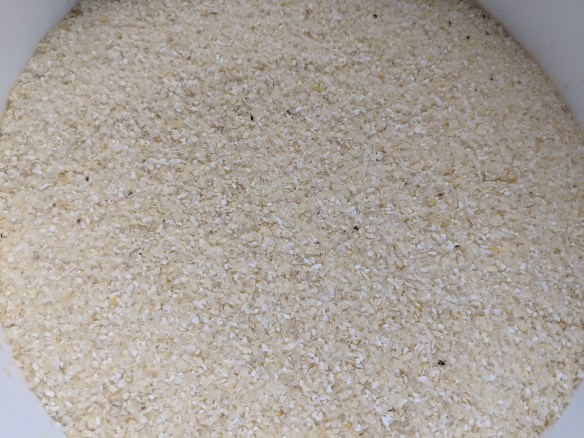
White corn grits, ready to go into the cereal mash
Alta California Lager
- 5.5 lbs. Barke pilsner malt (Weyermann)
- 2 lbs. white corn grits
- 1.5 lb. Vienna malt (Great Western)
- 4 oz. rice hulls
- 0.35 oz. Magnum hop pellets (13.2% alpha), 60 minute boil
- 1 Whirlfloc tablet, 10 minute boil
- 1 tsp. Fermax, 10 minute boil
- 1 oz. Saaz hop pellets (3.5% alpha), 5 minute boil
- 1 pkg. WLP940 Mexican Lager yeast (White Labs), prepared in 1.75 L starter
Target Parameters
- 60 minute infusion mash with cereal mash, 152°, batch sparge
- 1.055 o.g., 1.012 f.g., 5.7% abv, 44 IBU, 8 SRM
- “Mexican lager water”, built from ~8.5 gallons of RO water with 1.5 g of calcium chloride, to hit ~13 ppm Ca and 23 ppm Cl, -9 RA
Procedure
- This was a complicated brew session! Lots of moving parts, all happening at roughly the same time.
- A few days in advance, I made a 1.75L starter, letting it ferment out and then cold-crashing. The supernate was decanted off before pitching.
- My cereal mash procedure followed recommendations from Milk The Funk. I combined 0.5 lb. of the pilsner malt with the 2 lb. of white corn grits, adding water until things were at the right consistency. This was around a gallon of RO water. I added water until the grains approximated a “thin gruel” consistency, and held it at 158° for 5 minutes. Then, I heated the cereal mash to a boil, stirring constantly for 30 minutes. We added water as needed to keep it from getting too thick.
- As the cereal mash was nearing its end, we started the main mash, using 3 gallons of RO water with ~0.5 g of CaCl, heated to 138°. We hit a mash temperature (for just the barley, exclusive of the barley and corn in the cereal mash) of 133°. I added 6 mL of 88% lactic acid, and then added in the near-boiling cereal mash. This brought the temperature up to 145°. I added another 0.5 gallon of water at near boiling to hit around 148.5°.
- After 75 minutes, the mash was down to 143°. I added 1 gallon of water at 200° to bring the mash up to 149°. I let this sit for 15 more minutes, and then used an iodine test to check for conversion. Success! The mash was converted completely.
- I collected the first runnings, and then added 4.5 gallons of RO water with 1 g of CaCl, to raise the mash up to 160°. After 10 minutes, I vorlaufed and collected the second runnings.
- In total, we collected 7.1 gallons of runnings, with a gravity of 1.037. This equates to 79% mash efficiency!
- Because my gravity was a little low and my volume a little high, I boiled the runnings for 20 minutes before adding the hops. This was followed by a 60 minute boil, adding the various ingredients per the recipe. Towards the end of the boil, the gravity was up to 1.048, a little higher than I wanted. So, I added 0.25 gallon of RO water for adjustment.
- After the full 80 minutes of boiling, I chilled the wort down to ~80° and transferred to the fermenter. I chilled it down further to 50° before oxygenating (30 seconds) and pitching the yeast.
- I brewed this beer on 2 April 2019, starting with a 50° fermentation temperature as mentioned above. On 3 April, I raised the temperature to 53°. On 9 April, I raised the temperature to 60°, because I wanted to kick this through quickly.
- I raised the temperature to 62° on 12 April, and 67° on 14 April.
- Final gravity was 1.010, which equates to 4.6% abv. I cold crashed to 33° on 16 April 2019.
- I kegged the beer using a closed transfer on 24 April 2019. This was done to reduce oxygen pick-up and keep the beer fresher for longer.
- I force-carbonated the beer,noted that it had dropped pretty clear within about 2 weeks, and crystal clear within about 3 weeks. By the time of my tasting (~4 weeks after kegging), this beer was brilliant!
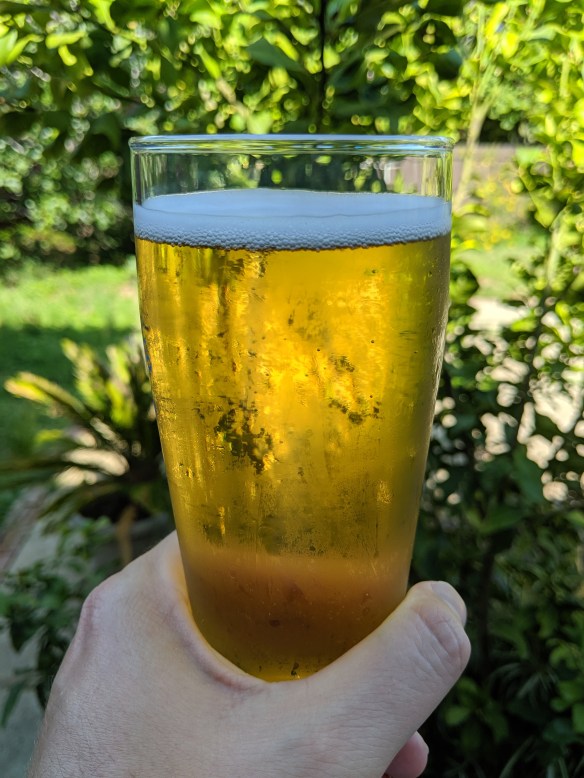
Tasting
- Aroma
- Clean, slight hint of corn, a little bit of hop spiciness
- Appearance
- Brilliantly clear, light gold in color. The tall white head settles down to a rim around the glass as the beer is consumed
- Flavor
- Crisp and clean; the grainy malt has a hint of corn behind it, and that is backed up by an assertive but not overwhelming hop bitterness. The finish is tilted towards the bitter end versus the malty end, but not overly so.
- Mouthfeel
- Off-dry, moderately high carbonation, smooth finish
- Would I brew this again?
- This is (modestly speaking) an amazing beer! I’m incredibly impressed by how this one rounded out. It’s eminently drinkable, and ridiculously beautiful in appearance. When I brought it to my brew club meeting, several people thought that I had thrown a commercial ringer into the mix! I’ve never had a lager clear so completely and so quickly. I suspect it’s a combination of the yeast strain and cereal mash–next time I brew this recipe, I won’t be making any changes or taking any shortcuts!
- Overall
- 10/10
 Andy's Brewing Blog