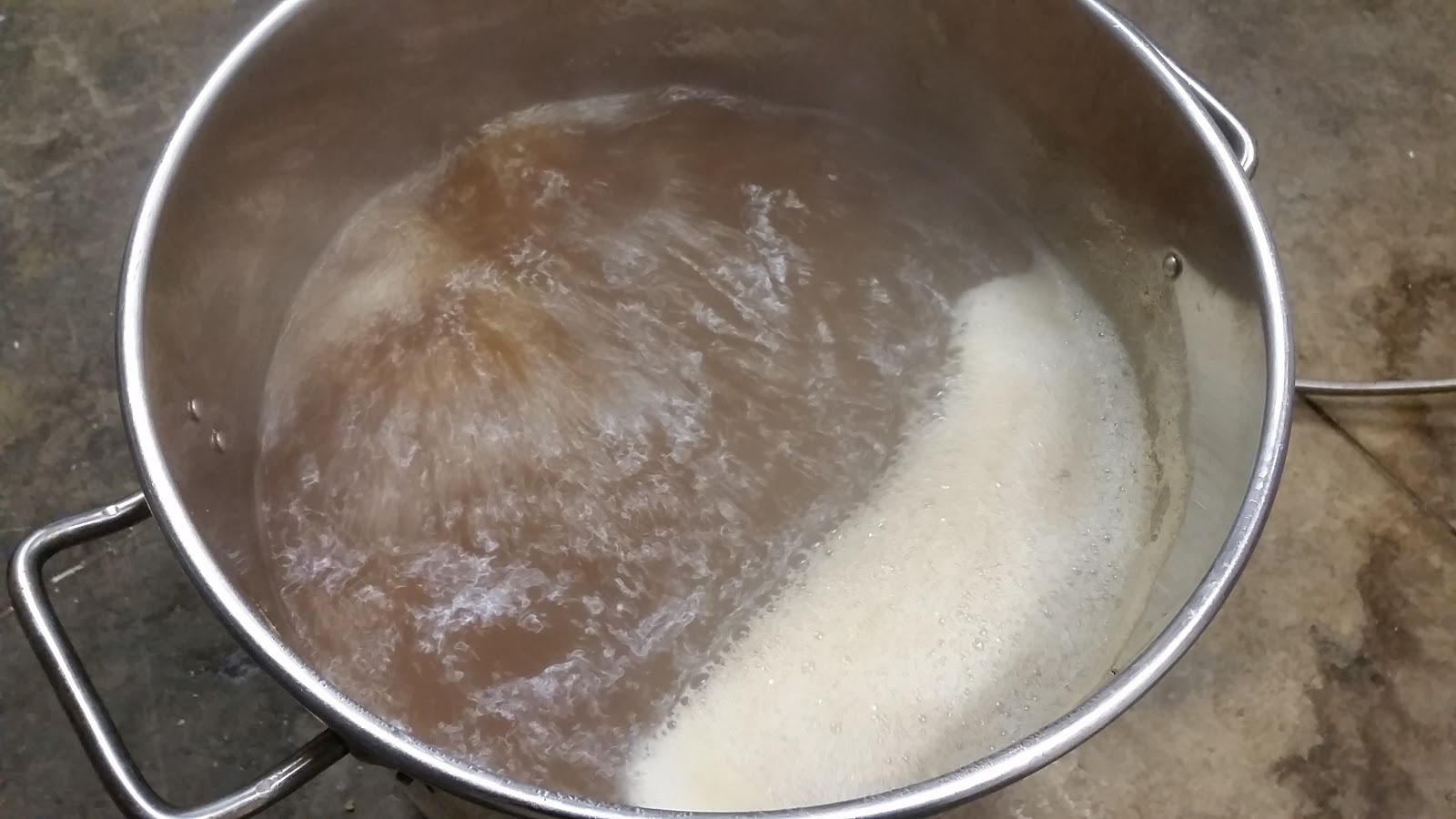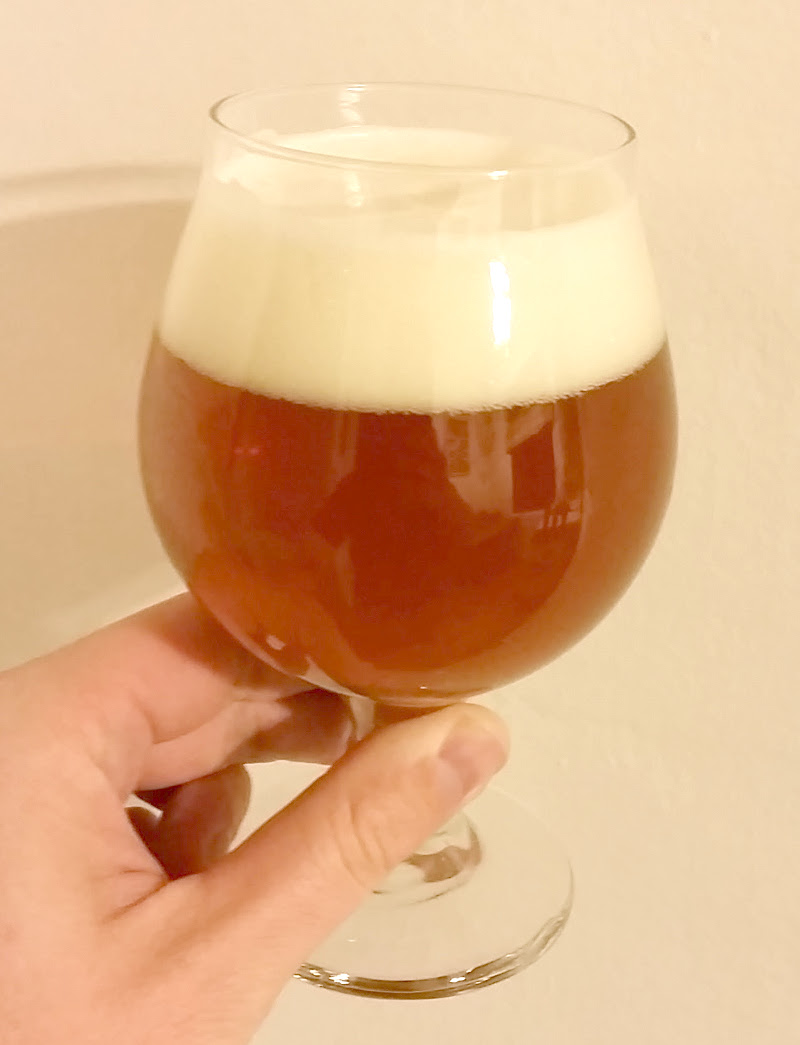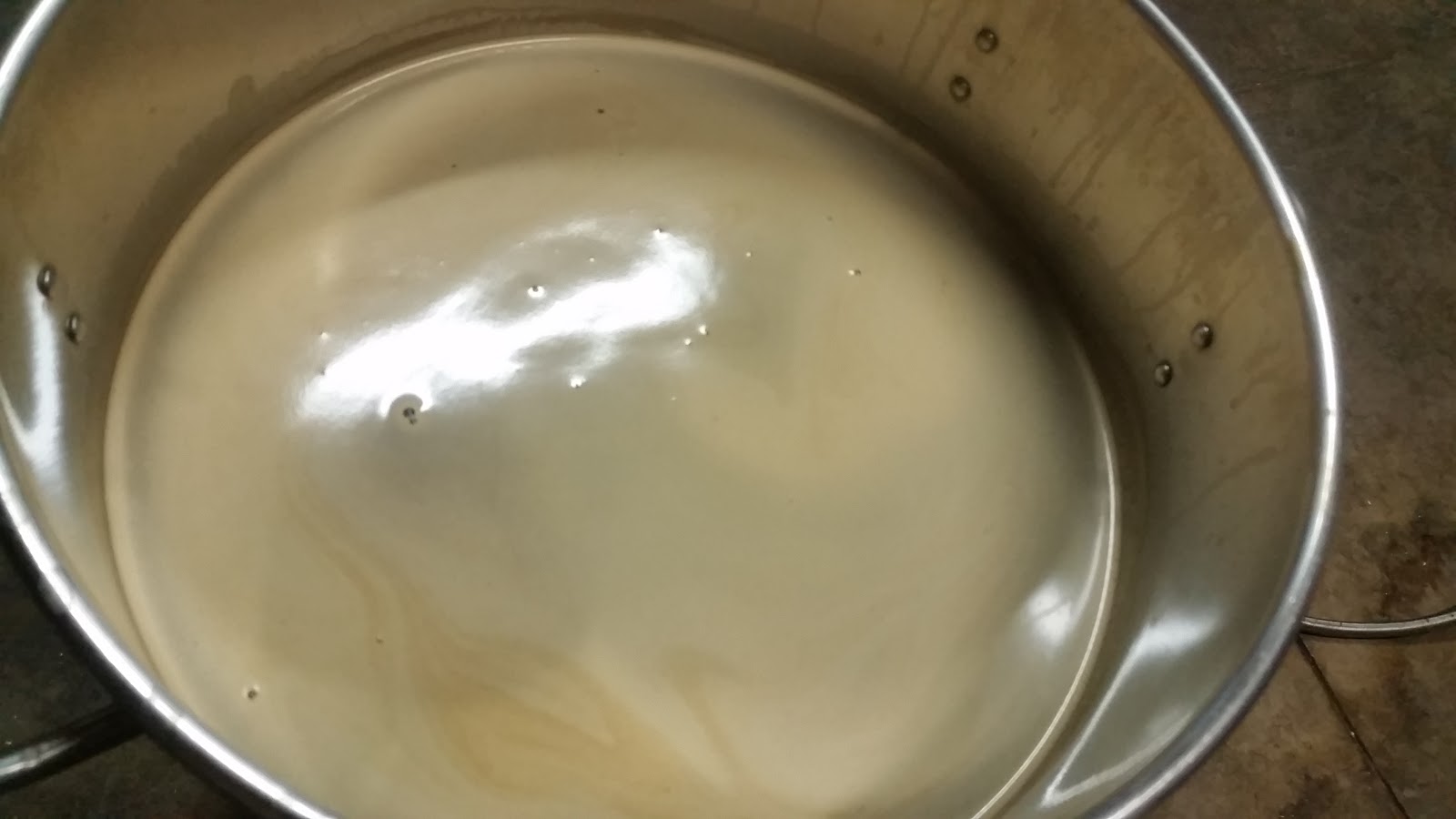
After 13 days in the primary fermenter, I kegged my Transatlantic IPA tonight. During the primary fermentation, I roused the yeast once or twice, to help attenuation along. In the end, I had a final gravity of 1.015, down from 1.064, for 6.5% abv and 75% attenuation. At the time of kegging, I added 3 oz. of hops pellets (2 oz. Simco, 1 oz. Galaxy), for dry-hopping. In my initial tasting, I’m pleased with what the Vermont Ale yeast has done so far (although I’m at the very low end of its attenuation range–will have to see how it tastes in the final product to decide if I want to do anything about it). The keg is now carbonating, in wait for the time when I can finally tap it!
Red Star Imperial Stout
My homebrew club occasionally does style competitions, where we each make our own interpretation of a particular target style. I have found it to be a really fun way to stretch my brewing legs and play with styles or techniques that I don’t normally do. Our February competition focuses on imperial stouts–definitely a new style for me.
I usually like the commercial imperial stouts that I sample, but when I homebrew I prefer recipes that are lower in alcohol. Five gallons of kegged imperial stout would just sit around forever. So, I elected to make a 2.5 gallon batch and bottle it. The recipe for this batch is based loosely on the Katherine the Strong Imperial Stout recipe from Gordon Strong’s Modern Homebrew Recipes book. I modified it a fair bit, to account for ingredients on-hand. Because of the small batch size, I decided to do Brew-In-A-Bag for the mash. With the high target gravity, this resulted in a fairly low efficiency (~67%). So, I added half a pound of DME to bring things up to par.
In a new technique for me, I decided to try overbuilding my yeast starter. This recipe calls for WLP001, which I use fairly frequently in-house. In fact, some of my upcoming batches will us it too, so I figured that I would harvest enough to save on buying more yeast later. Using the BrewUnited yeast starter calculator for guidance, I made a 2L starter with 202 grams of light DME and ~1/8 tsp. of yeast nutrient. After two days on the stir plate, I poured 1L (~170 billion cells) into a mason jar (December 3, 2015) for later use.
Red Star Imperial Stout
- 8 lbs. Maris Otter malt (Thomas Fawcett)
- 0.5 lb. golden light DME (Briess)
- 0.5 lb. flaked barley
- 0.5 lb. pale chocolate malt
- 0.25 lb. British crystal 70/80 malt (Bairds)
- 0.25 lb. roasted barley
- 0.25 lb. Victory (biscuit) malt
- 1 oz. Bravo hops pellets (13.2% alpha acid), 60 minute boil
- 0.5 tbsp. pH 5.2 stabilizer (in mash)
- 0.5 tsp. Irish moss (10 minute boil)
- 0.25 tsp. yeast nutrient (5 minute boil)
- 1 pkg. California Ale yeast (White Labs, WLP001), prepared in 1L starter
- I added the grains to 4.85 gallons of water and kept the mash at 154° to 156° for 60 minutes. I raised the temperature to 165° for a 10 minute mash-out.
- I removed the grains and drained them. I had approximately 3.75 gallons of wort with a gravity of 1.066, for an extract efficiency of 67%. So, I added 0.5 lb. DME (as mentioned above).
- Once the wort was at a boil, I added the hops and boiled for 60 minutes. I added the Irish moss and yeast nutrients at the appropriate times.
- After the boil, I chilled the wort, transferred to the fermenter, and shook to aerate it.
- The starting gravity was approximately 1.093, with 2.5 gallons into the fermenter. I pitched the yeast and set the fermentation chamber for a temperature of 68°. It was fermenting vigorously when I checked on it 12 hours later.
Beer Tasting: Pumpkin Ale 2015
My latest pumpkin ale is nearing the end of its run this year, so I wanted to do a tasting before the keg was kicked. I’ve served this beer to a number of friends, to rave reviews (well, except for one person who doesn’t like any pumpkin beer, period, but I accept that the style isn’t for everyone!). It has done a good job of satisfying my pumpkin beer cravings for another year.
- The Basics
- Original gravity = 1.064; final gravity = 1.017; abv = 6.2%; estimated IBU = 13
- Appearance
- The beige head is of a medium consistency on the bubbles, moderate in size, and quite persistent. The beer itself is clear and medium amber in color, with no evident haze.
- Aroma
- This beer smells just like pumpkin pie with whipped cream on top! I pick up vanilla and nutmeg fairly prominently, with a faint vegetal/pumpkin background. Somewhat surprisingly, I don’t get any cinnamon immediately on the aroma, but I think that’s my nose. A freshly poured glass sampled later had a very prominent cinnamon aroma. I detect no distinct malt or hops aroma.
- Flavor
- The flavor is moderately malty, with a light caramel character. Bitterness is moderate too, and evenly balanced against the malts. I don’t really pick up much spicing, if any, in the flavor itself, except perhaps a hint of cinnamon at the finish.
- Mouthfeel
- The body is moderate, with good carbonation as I would like in a beer like this. It has a slightly sweet finish, which pleasantly lingers.
- Would I brew this again?
- Yes! Overall, this beer drinks quite smoothly and has the spices very well balanced (to my palate), so it’s more than the typical pumpkin ale which is just a lager with some cinnamon and nutmeg. This is a very solid recipe, and the beer was well-received by most people who have sampled it. My only minor change might be to dial back the cinnamon a touch next time, but that’s an easy fix.
- Overall
- 8.5/10
The Celtic Elk Stout Kegged
I kegged The Celtic Elk Stout tonight, with 5 gallons as the end product. The final gravity was 1.018, down from 1.048, for 3.9% abv. Flavor is pretty nice so far!
Raspberry Syrup
![]() |
| Smushing the raspberries for syrup |
Now that my Berliner Weisse is carbonating, I wanted to have some syrup on-hand for the first taste. Raspberry syrup seemed like a good first one, so I grabbed a pack of Trader Joe’s frozen raspberries. The recipe I’m using is from a recent issue of BYO, very slightly modified.
Raspberry Syrup
- 12 oz. package frozen raspberries (3 cups)
- 2 cups white sugar
- 2 cups water
- I combined all of the ingredients in a small saucepan, and stirred occasionally while I brought the mixture to a boil.
- Once the mixture boiled, I let it sit for about 45 minutes.
- I pureed the mixture with a immersion blender, and then strained it through a fine-mesh colander to remove the seeds.
- Finally, I transferred everything to a bottle. It made a little less than 1 liter of syrup.