Re-Envisioning the American Homebrewers Association

logo for the American Homebrewers Association

The big news of late was that the American Homebrewers Association is being spun off from the Brewers Association as a stand-alone non-profit! I view this as nearly entirely a net good; the BA has increasingly treated the AHA as an unwanted guest during the past few years, and I don’t think the combination was making much sense anymore. The AHA had a reduced voice in BA governance, Homebrew Con was vastly scaled back (and cancelled for this year), AHA membership numbers were down from their peak, and there is a general sense that the hobby is ebbing versus the heady days of the early 2010’s. The vibe I got from the forums, likely at least in part from the aforementioned decisions, was that the AHA wasn’t able to provide a level of engagement or service that made it a compelling need for homebrew hobbyists.

There was some initial discussion at the AHA forum and a bit on Reddit, but overall this news has had surprisingly minimal chatter in the spaces I normally frequent. Exceptions include an optimistic blog post from Beervana, and an overview from Stan Hieronymus on Appellation Beer’s Monday links (including some important context and history that I haven’t seen much mentioned in the various AHA hagiographies). The AHA also posted some Q&A’s, which provide additional information.

AHA has asked for members to comment on what we’re hoping for in the newly independent organization, as well as a suggested vision statement. I have submitted my thoughts there, but in the meanwhile I also wanted to post them here in case they are useful for others.

Please provide comments to consider on the future planning of the AHA.”

pint glass of amber beer
Photo by Pixabay on Pexels.com
  • AHA will need to decide its target membership — is it just for the USA? USA+Canada+Mexico? Worldwide? AHA can’t be everything to everyone, which on the one hand will be a disappointment for some, but on the other hand is necessary for organizational focus.
  • On the topic of target membership, who is that? There is sometimes an implicit assumption that brewers are homeowners who work as engineers, and that’s not helpful. I really like the way that AHA has made things like 1 gallon stovetop batches more visible lately; let’s keep that energy going! (but don’t forget those making the 5 gallon batches)
  • Similarly, what sort of fermentations does AHA support? Beer is the obvious core. Does mead stay as a part of this? They seem to be linked at least at an organizational level. Does it make sense going forward? My gut on this is “yes,” but I think it’s a question that needs to be asked! Are the legal frameworks for mead different from those for beer? I would argue against distilling becoming a core of the organization — it’s a very different process, community, and legal framework — and wine also doesn’t make much sense.
  • I would love to see AHA target issues that matter to homebrewers. A big one in my book is that competitions like the NHC require many entrants to ship their entries in a semi-clandestine manner that contravenes shipping company policies! The NHC website itself states, “Shipments brought directly through UPS or FedEx may get denied, as shipping alcohol is against policy. Indicate ‘glassware’ or ‘samples’ if asked to provide such information.” Similar instructions are given for customs guidance for international entries. Maybe I’m too much of a rules follower, but this is inviting future disaster, and I don’t think the NHC should feel great about asking its entrants to lie, especially in a public forum. I’ll just be blunt and say that this is a stupid thing for a non-profit to do.
  • With the disconnect between AHA and BA, I foresee a need for AHA to step up and advocate for homebrewers in brewery spaces–especially holding club meetings or organizing general events. Although laws vary from locality to locality, a “toolkit” for homebrewers or homebrewing clubs who want to meet up and share homebrew at public spaces would be very helpful. I think it could also be a potential collaboration between AHA and BA to communicate to the commercial industry about this ongoing desire from hobbyists.
  • What is the future of Zymurgy? Personally, I like having a physical magazine; I spend too much time with electronic devices as it is, and I enjoy sitting with a homebrew and reading it cover-to-cover. I also recognize that print media is a mixed bag at best these days, not everyone shares my love of printed publications, and even the membership may be split on this. That said, I think any decisions should include both current membership (which I expect skews conservative in wanting a printed publication) and potential membership (which may or may not share those views).
  • Who owns Zymurgy? That is, where does the copyright for the back issues reside? There is a ton of great content in there, and I am hoping it won’t be locked up by BA. If this hasn’t been outlined yet, it needs to be done ASAP — don’t hope for a future resolution. What other IP will matter?
  • Consider apps carefully. If well designed, they are useful; but do we need another app for homebrewers? They are expensive to build and maintain, so I would somewhat argue against them.
  • The recipe archive at the AHA website and in Zymurgy is valuable. I’ve seen a lot of people say, “But there are so many recipes online! I don’t need that archive.” So many of the recipes online are awful. I trust the recipes that the AHA produces, because they have at least minimal vetting.
  • How does AHA confront the currently changing relationship of society with alcohol? I think it will continue to evolve and ebb and flow, but I do think we need to meet all potential hobbyists where they are.
  • Community is important. I really love the AHA forum, and find it (for my needs) to be the kind of community I want overall. That said, I really would like to see the AHA help with informal meetups. Not everyone is a club member, or wants to be a club member, or can be a club member, and not everyone has capacity to attend a national conference. But, many folks (me included) would welcome a chance to meet up, swap brews, and hang out with fellow homebrewers. Years ago, AHA used to sponsor rally days. Could something like that return?
  • What will membership guidelines / rules be? Most member-based organizations will have some kind of code of conduct / member expectations / etc. I don’t feel great about “litmus tests” for members, but I think we’ll want a process for removing someone who is acting counter to the aims of AHA or who grossly violates the norms of a healthy organization.
  • Members need to feel like we have voices. This hasn’t happened with the BA in recent years. I recognize that there are many potentially competing interests, but yet another survey isn’t necessarily going to be what we need. There should, eventually, be a clear process for volunteering and participating in governance of the AHA. It can’t just be those with the cash to pay to attend HomebrewCon (or its equivalent) every year; that’s only partially representative of the membership.
  • Speaking of fundraising, I suspect there is going to be heavy lifting to change the philanthropic nature of our homebrewing community. We are conditioned to “doing it for charity” at brew fests and such, but haven’t yet been primed to think of the AHA as one of those charitable options. Fortunately or unfortunately, many (most?) will think that the buck stops with their annual membership dues. We’re going to have to change that thinking. AHA will need to make a compelling case for why members should donate above and beyond their annual dues. Part of that is making initiatives that all members feel they might benefit from. That does not mean there shouldn’t be more focused initiatives (I support those!), but we need to have options. Don’t forget unrestricted donations, either! It doesn’t have to be an immediate donation — estate gifts are equally important. For that matter, make estate planning an option for members!
  • What other hobbyist groups are important to link up with? If we have similar needs or potentially at least small overlaps in audience, that could be mutually beneficial. Can we learn something from other hobbyist organizations? Have they noted trends or opportunities that might parallel needs for the AHA?
  • Speaking from a position of ignorance, what is the plan for after the BA? At least initial statements have said that connections for GABF, etc., will remain. What happens when BA says “no more” on that? (perhaps they have promised otherwise, but let’s be realistic here; if it’s not in writing, it’s going away) Would that scenario have a major impact? Or minor impact? Are there members who sign up just for GABF early access, and who would disappear if that disappeared?
  • For those who have followed things, there is a general distrust and dissatisfaction with the BA. I suspect that is part of why AHA is going independent. BUT…we probably want to have some form of working relationship, at some level. What will that look like?
glass of pale yellow beer in front of dark green plants
Photo by Michelle Riach on Pexels.com

Suggested Vision Statement for the AHA

  • “Relax, Don’t Worry, Have a Homebrew.” (only partly kidding)
  • “The American Homebrewers Association will create a community of home brewers of beer and beer enthusiasts, promoting the fun of the hobby, building opportunities for sharing knowledge and camaraderie, and advocating for homebrewers of all locations, backgrounds, and brewing approaches.”

Unruly Gnome Belgian Blond Ale

La Chouffe is a darned good beer, and I will often get a pour if I find it on-tap at a quality alehouse (shout-out to The Back Abbey!). Belgian Blond Ale (or Belgian Blonde Ale) is not a style I have brewed previously, so it’s time to rectify that! I did a bit of research to find a clone recipe for La Chouffe, and a version from Brewer’s Friend inspired my own version, along with “The Gnome” recipe in Gordon Strong’s Modern Homebrew Recipes. The original recipe on Brewer’s Friend used decoction, but I decided to just put a little melanoidin malt into the grist instead. I also included a mash rest at 126°, in an attempt to improve the head.

Because this is an experimental beer, and a high alcohol one at that, I decided to make a small (3 gallon) batch.

Unruly Gnome Belgian Blond Ale

  • 7.75 lb. pilsner malt (Rahr)
  • 3 oz. melanoidin malt (Weyermann)
  • 0.5 tsp. BrewTanB (mash)
  • 12 oz. clear candi sugar (added to boil)
  • 1 oz. Styrian Goldings hop pellets (3.2% alpha), 60 minute boil
  • 0.5 oz. Saaz hop pellets (2.0% alpha), 15 minute boil
  • 0.25 tap. BrewTanB, 10 minute boil
  • 0.5 Whirlfloc tablet, 5 minute boil
  • 0.5 oz. Saaz hop pellets (2.0% alpha), 5 minute boil
  • 0.5 tsp. yeast nutrient WLN1000 (White Labs), 5 minute boil
  • 6 g. coriander seeds (Turkish), 5 minute boil
  • 1 pkg. Abbaye Belgian ale yeast (Lallemand)

Target Parameters

  • 1.068 s.g., 1.009 f.g., 7.9% abv, 6 SRM, 21 IBU
  • Full volume step mash, with 15 minutes at 126°, 90 minutes at 146°, and 10 minutes at 168°; 60 minute boil
  • Water built up from RO and Claremont tap water, to hit water target parameters of 50 ppm Ca, 4 ppm Mg, 45 ppm Na, 56 ppm SO4, 82 ppm Cl, 10 ppm bicarbonate, RA=-30.

Procedure

  • To get my strike water, I mixed 2.5 gallons Claremont tap water and 2.5 gallons distilled water, added 2.1 mL of 88% lactic acid, 1/4 Campden tablet, 1 g CaCl, and 1 g CaSO4.
  • I heated the strike water to 131°, added the grains and 1 tbs. of 10% phosphoric acid, and held the mash at 126° for 15 minutes, before raising the temperature to 146° for 90 minutes. Then, I raised the mash to 168° for 10 minutes before pulling the grains.
  • In total, I collected 4.5 gallons of runnings at a gravity of 1.050, for 75% mash efficiency.
  • I brought the runnings to a boil, adding finings per the recipe. After a 60 minute boil, I turned off the heat and chilled to 74° before transferring to the fermenter and pitching the yeast.
  • I brewed this beer on 7 December 2024. Starting gravity was 1.070.
  • I had vigorous fermentation within 18 hours of pitching the yeast; temperature was down to 72°, and so I moved the fermenter into the fermentation chamber on 8 December 2024, and set it at 74°.
  • Fermentation (as evidenced by bubbling) was pretty much done by 10 December 2024.
  • I kegged the beer on 23 December 2024, adding 1 oz. of corn sugar in 0.5 cups of water for carbonation, and let it sit at room temperature.
  • Final gravity was 1.011, for 7.8% abv.

Tasting

  • Appearance
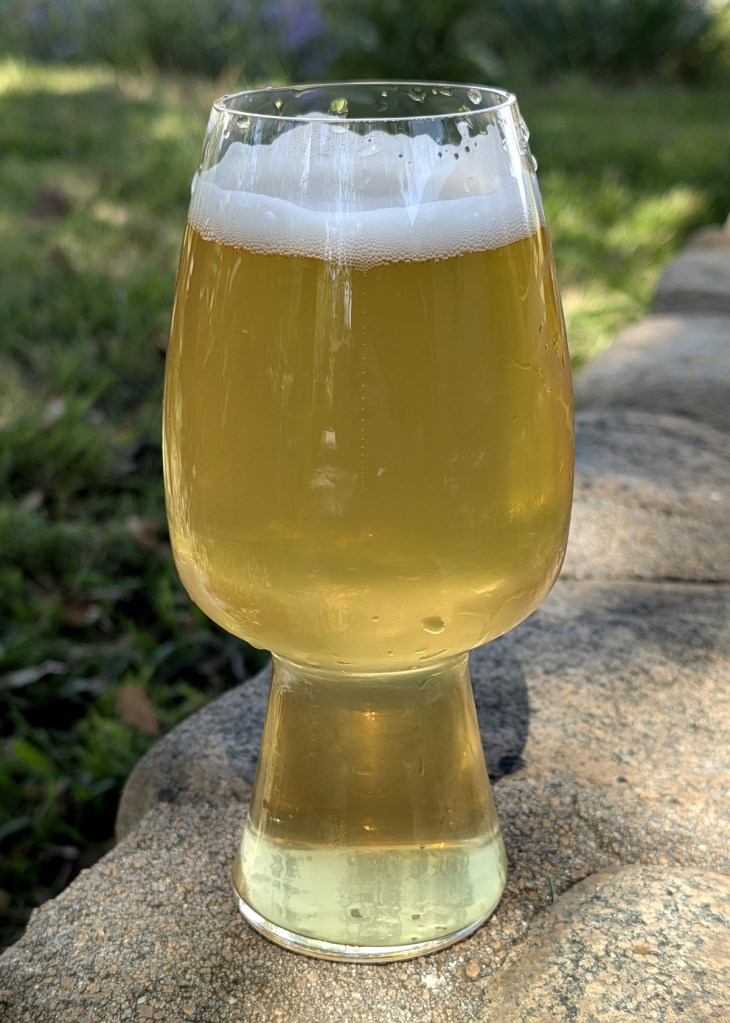
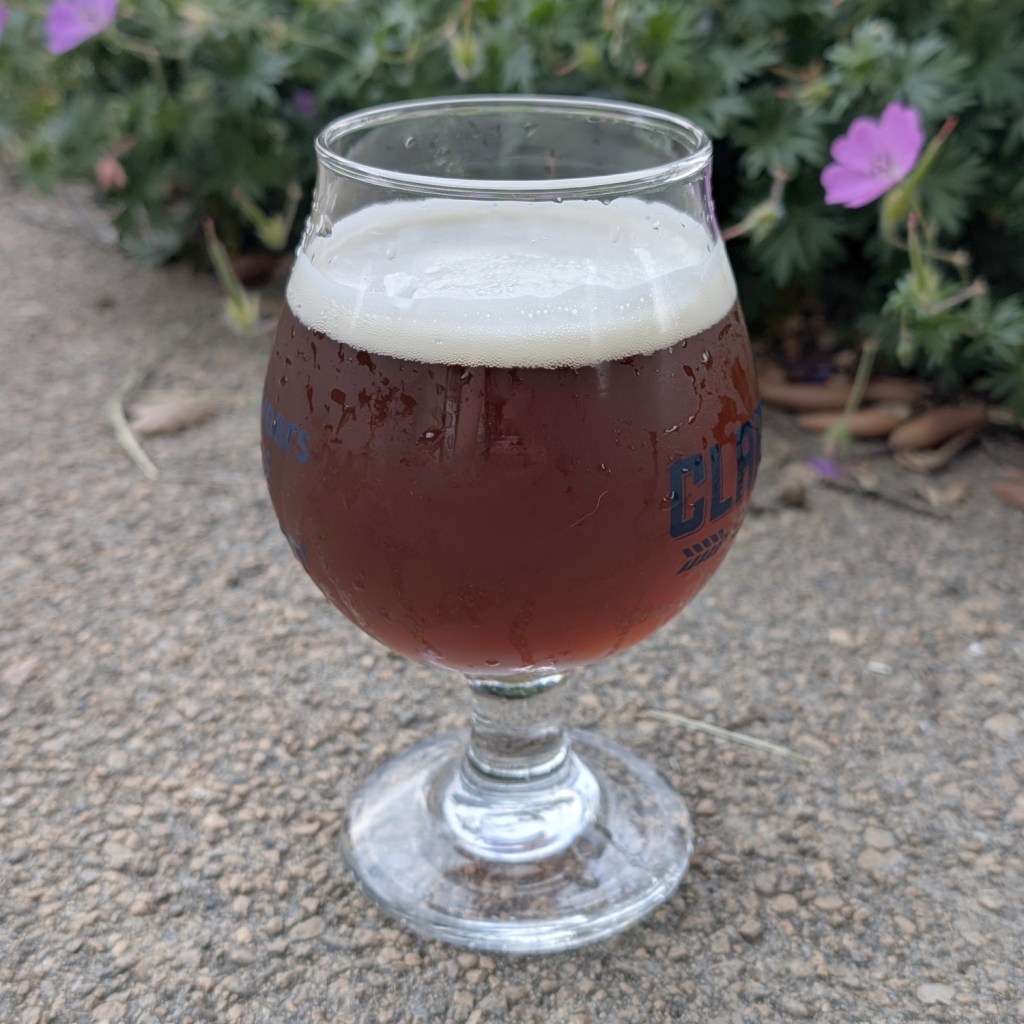
    • Very clear gold beer that pours with a creamy and persistent white head of foam. It’s quite pretty! I’ll note that it clarified a bit more after the photos were taken (about 10 days before this post).
  • Aroma
    • Moderate spicy phenolic notes, but overall pretty clean. A little light caramel malt comes through, and some citrus quality with light alcohol notes as it warms.
  • Flavor
    • Moderately high bitterness, crackery malt at a moderate level, with a touch of candy. Balance is towards the hops a bit. Orange peel citrus comes through as the beer warms. The yeast is perhaps a touch more prominent than what I remember in the commercial beer.
  • Mouthfeel
    • Highly carbonated, light body, dry finish. It drinks very easily!
  • Would I Brew This Again?
    • This is a good start. The yeast was perhaps a bit forward in the early samplings of the beer, but it has mellowed considerably over time. It might benefit from lower temperatures with this dry yeast strain, or a different strain at least relative to the style ideal (probably Ardennes for my next version, which isn’t available in dry yeast form; Belle Saison is another dry yeast I’m considering). Even so, this beer is dangerously drinkable! I might dial hops back a touch, perhaps to 15 IBU or so. The bitterness on the finish is just a touch harsher than I like. The coriander doesn’t come through, so I could safely ditch it; I don’t think anything would be lost. I might also try a fresher coriander from a different source area, which could also help.
    • Note added 10 February 2025: The beer has cleared to brilliant now!
  • Overall
    • 8/10

Pfriem Pilsner 2024

I have done a version of this three times previously, usually with some minor variations for hops or yeast. This time, I decided to do the hop varieties and timings exactly as written (with adjustments for alpha acid), to follow the original Pfriem Pilsner clone recipe from Dave Carpenter’s Lager book. Without further ado, here’s what I did.

Pfriem Pilsner 2024

  • 9.75 lb. pilsner malt (Rahr)
  • 6 oz. Carafoam malt (Weyermann)
  • 0.5 tsp. BrewTanB, in mash
  • 0.75 oz. Perle hop pellets (6.3% alpha), 60 minute boil
  • 0.5 oz. Tettnang hop pellets (2.4% alpha), 60 minute boil
  • 0.5 oz. Tettnang hop pellets (2.4% alpha), 10 minute boil
  • 0.75 oz. Saphir hop pellets (2.3% alpha), 10 minute boil
  • 0.5 oz. Spalt Spalter hop pellets (4.3% alpha), 10 minute boil
  • 0.5 tsp. BrewTanB, 10 minute boil
  • 1 Whirlfloc tablet, 5 minute boil
  • 1.5 oz. Tettnang hop pellets (2.4% alpha), 10 minute whirlpool
  • 0.75 oz. Saphir hop pellets (2.3% alpha), 10 minute whirlpool
  • 0.5 oz. Spalt Spalter hop pellets (4.3% alpha), 10 minute whirlpool
  • 2 pkg. Diamond dry lager yeast (Lallemand)

Target Parameters

  • 1.046 s.g., 1.007 f.g., 5.1% abv, 4 SRM, 38 IBU
  • Full volume step mash, with 45 minutes at 142°, 45 minutes at 156°, and 10 minutes at 168°; 70 minute boil
  • Water built up from RO, to hit target parameters of 62 ppm Ca, 11 ppm Mg, 121 ppm SO4, and 51 ppm Cl, with RA=-50 ppm

Procedure

  • I built up my mash water from 7.5 gallons of RO water, with 3 g calcium chloride, 3 g epsom salt, and 4 g gypsum. Then, I heated it to 146° before adding the grains and holding at 142° for 45 minutes, with recirculation. Then, I raised the mash to 156° for 45 minutes and finished up at 168° for 10 minutes.
  • After the mash, I pulled the grains. I collected 6.8 gallons of runnings with a gravity of 1.041, for 74% mash efficiency.
  • I brought the runnings to a boil, boiling for 10 minutes before adding the first round of hops and proceeding with the rest of the recipe as written. In total, this was a 70 minute boil.
  • At the end of the boil, I turned off the heat, added the whirlpool hops, and whirlpooled for 10 minutes before continuing with the rest of the chill.
  • Once the beer was down to 72°, I transferred to the fermenter and chilled down to 46° in my fermentation chamber, before pitching the yeast.
  • I brewed this beer on 28 October 2024, and the starting gravity was 1.049.
  • The starting fermentation temperature was 48°, and I held it here until 3 November 2024, when I raised the temperature to 52°. On 17 November, I raised the temperature to 54°, and then to ambient (~62°) on 24 November 2024.
  • I kegged the beer on 25 November 2024. Final gravity was 1.009, for 5.3% abv.

Tasting

  • Appearance
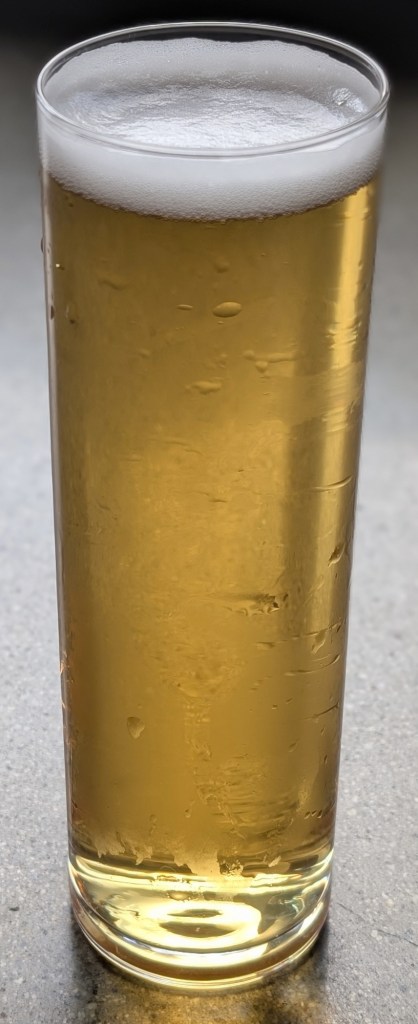
    • Clear, but short of brilliant; there is just a tiny touch of barely visible haze. It is a straw-colored beer that pours with a fine and persistent white head, which leaves some nice lacing on the glass.
  • Aroma
    • Light notes of cracker and honey in the malt, and a pleasant light floral hop aroma, with a touch of fresh hay. This beer smells awesome!
  • Flavor
    • Medium-high bitterness, grainy sweet malt character; hop flavor is lightly herbal. Minerally feel to finish out the flavor.
  • Mouthfeel
    • Medium carbonation, medium light body, dry finish. Minerally, but not unpleasantly so.
  • Would I Brew This Again?
    • I am feeling pretty good about this recipe overall. It is perhaps a touch more bitter than I prefer in all of my pils, but I like the hop aroma and malt character; the overall aroma is amazing! I wouldn’t mind a touch taller head (but that may be in the pour), and I also must ding the beer a bit for its clarity. I wonder if the persistent light haze is from the large dose of whirlpool hops? I could have used some finings, and might do that next time for a pilsner-type beer, because clarity is something important to me for these.
  • Overall
    • 8/10

Brew Year’s Resolutions 2025

It has been three years since I last did one of these posts, but I figured I would give it a go in 2025. I usually only somewhat loosely adhere to these resolutions, but they can be fun ways to frame the year.

  • More Small Batches.
    • I enjoy brewing, and sometimes it’s more about the brew day than consuming the final product. One way to get around an occasional backlog in beer (and to have more variety) is to brew smaller batches. So, I’m going to aim to do a greater percentage of 3 gallon brews this year. Although I anticipate continuing with 5 gallon batches as the bulk of my brewing (especially for favorites like German pils), I hope to work more 3 gallon batches into the rotation, especially for new-to-me styles.
  • Conditioning Time.
    • Somewhat paradoxically relative to the item above, some of my beers would benefit from a longer conditioning or lagering time before serving. For instance, my märzen was on tap within 6 weeks after kegging, but a minimum of 8 weeks and preferably 10 would have been ideal to hit the point of brilliance for this particular recipe. A German pils (not yet posted) is at 6 weeks and is now brilliant and ready to serve; I often have these beers on around 2 weeks after kegging. Beyond simple discipline, I think the key to achieving this goal is brewing frequently enough that I can afford to let a keg sit for longer lagering.
  • New Styles.
    • I have explored a good chunk of the styles out there, but there are still more to do. In the most recent Zymurgy issue that highlights the winners of the 2024 NHC, there was a really intriguing gose recipe. Sour beers aren’t my usual favorite, quick sour methods are sometimes a bit one dimensional or not advised for many styles, and the possibility of contamination always gives me second thoughts. But, this particular “Salty One” by gold medal winner Jonathan Hernandez relies on a blending technique that avoids souring on the cold side, and allows some complexity on the hot side. Basically, you make a fraction of the batch as sauergut, and then adding this to the rest of the wort at the boil. I’m going to give it a try!

2024’s Homebrew Highlights

2024 was a decent year for brewing; I focused in part on perfecting classic styles, in addition to returning to a few standby recipes. I feel that I know my brewing system pretty well and have been learning the mash and recipe formulation techniques to get to my destination. Interestingly, I think I was at 100 percent dry yeast during the past year–I might try one or two liquid yeast varieties for particular batches, but in the end the variety and convenience of dry yeast can’t be beat.

  • Favorite Batch(es)
    • Bear Butte Porter is on tap right now, and it hits every note that I love about classic American craft beer styles. It’s rich without being cloying, malty while still being drinkable, and low enough abv that I can enjoy a glass or two without getting knocked out. American porters are a style I keep enjoying, especially because they’re relatively scarce nowadays in a sea of IPAs.
    • I have been chasing the ideal hefeweizen for years, and finally hit that with Humboldt’s Hefeweizen 2024. I made some adjustments to technique, especially in the mash program, and the results paid off handsomely.
  • Least Favorite Batch
    • Snowdrop Kölsch 2024 Attempt 1 (not blogged) got infected; this was a disappointment, and led me to add Iodophor semi-regularly into my cleaning rotation. Thankfully my second attempt at this recipe went much more smoothly.
  • Experimental Recipe With Most Potential
    • Session Saison got soooo close to perfection, and I’m looking forward to dialing in this recipe.
  • Most Fun New Style/Recipe to Try
    • Levitation Ale Homage was a super tasty session ale, and I still remember the hop flavor on this one. It had so much going on for a lower alcohol beer, and I absolutely love that!
  • Upcoming Beer With Most Potential
    • I have a Belgian blond ale conditioning in the keg right now, for a recipe I’ve called “Unruly Gnome Belgian Blond Ale.” It’s intended to be an approximation of La Chouffe, which is one of my favorite beers.
    • My first rauchbier is lagering right now; it will go on tap once I have space in my keezer. Initial samplings have been very tasty!
  • Best Ingredient/Technique Added to Repertoire
    • Feijoa (Pineapple Guava): This unusual (to me) fruit has a unique taste and is perfectly suited for a sour. So, my Rated “PG” for Pineapple Guava recipe was born.
    • Mash schedules: I used my Anvil Foundry to its full potential this year, by adjusting mash schedules to achieve desired fermentation results. Exemplar number 1 is my hefeweizen–I added a ferrulic acid rest, which I am fairly sure tipped the beer’s character into perfection. Similarly, I used a long and low saccharification rest on my session saison, which finally got me the dryness I want and need on that style.
  • Favorite Books
    • No new books jumped out at me this year, which may be just as much a factor of me reading other things versus a dearth of interesting content. A new-to-me book that I greatly enjoyed was Experimental Homebrewing: Mad Science in the Pursuit of Great Beer Mad Science in the Pursuit of Great Beer by Denny Conn and Drew Beechum, published a full 10 years ago. It’s a time capsule in many ways, from a simpler era when the overlap between homebrewers and commercial brewers was blurrier, and it felt like the homebrewing scene was on an eternally upward trajectory. I like the approach they take to recipes, with an emphasis on thinking through the ingredient inputs needed for sensory outputs. This is not unique to them, but their way of relating it is quite approachable and fun to read.
  • Overall Stats