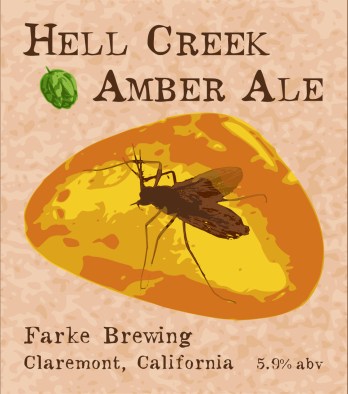
 Gimmick beers can be a fun way to liven up familiar styles, especially when there is a good pun involved. A friend recently located some wild (or more likely, feral) hops growing on an old homestead in eastern Montana. This happens to be right on top of the Hell Creek Formation, a ~66 million year old package of rocks that preserves some of the last dinosaurs to live on the planet. It also yields fossil amber…and a pun was born!
Hell Creek Amber Ale makes a great name–but could I capitalize on it any further? How could I build a recipe around the concept?
Early on, I made a decision to use ingredients primarily from the home region of the Hell Creek Formation (Montana, South Dakota, and North Dakota). I had a small quantity of wild Hell Creek hops on-hand, and supplemented them with a few ounces of my dad’s Cascade hops from South Dakota. Malt presented a bit of a challenge, though. After some research, I learned about MaltEurop’s Montana malting facility. Fortuitously, one of their flagship products is billed as being malted from barley “grown in and around Montana.” The recipe was rounded out with a few non-thematic malts, to produce a nice American amber ale.
The base recipe is a modification of the American Amber Ale from Zainasheff and Palmer’s Brewing Classic Styles. However, I used American malt instead of English malt, and substituted Special B malt for some of the darker crystal malts suggested by the recipe. The latter gambit was to create a slightly richer flavor, evoking the deep color of fossil amber as well as the rich aromas that must have permeated the ancient Hell Creek landscape. I also modified the hop additions a bit–the only late addition was that of the wild hops, with a steeping to allow any interesting aromas and flavors to come to the forefront. The dried hops had a moderate herbal aroma, which I expect should play nicely with the caramel qualities of the specialty malts.
Hell Creek Amber Ale
- 9 lbs. 2-row American pale malt (MaltEurop)
- 1 lb. Munich malt
- 0.8 lb. 40° crystal malt
- 0.5 lb. Special B malt
- 0.5 lb. Victory (biscuit) malt
- 2 oz. Cascade whole hops (5.1% alpha), 60 minute boil
- 0.44 oz. wild Hell Creek hops, 10 minute steep after boil
- 1 Whirlfloc tablet, 10 minute boil
- 1 pkg. California Ale Yeast (White Labs, WLP001), in 1L starter
Target Parameters
- 1.059 o.g., 1.014 f.g., 5.9% abv, 33 IBU, 14 SRM, 5.5 gallons into the fermenter
Procedure
- I mashed in with 4.75 gallons of water at 167.5°, to hit a mash temperature of 156°. It was down to 153° after 40 minutes.
- I added 1 gallon of water at 185°, stirred, let it rest for 10 minutes, vorlaufed, and then collected the first runnings. Subsequently, I added 3.5 gallons of water at 180°, let it rest for 10 minutes, vorlaufed, and collected the remainder of the wort.
- In total, I collected 6.6 gallons of wort with a gravity of 1.050, for 77% mash efficiency.
- I brought the wort to a boil, adding hops per the schedule above. At flame-out, I added the wild hops and then let them steep for 10 minutes before chilling the wort down to 80°.
- Approximately 5.5 gallons went into the fermenter, and I pitched the yeast immediately. I’ll be fermenting the beer at 66°.
- This beer was brewed on 10 October 2016.

 My first-ever
  Andy's Brewing Blog