Kitchen Sink Pale Ale

To ring in 2020, I did some “kitchen sink” brews to finish out some of my grain and hop stash. One of these was a mixed English/American pale ale, brewed using Brulosophy’s “Short and Shoddy” technique–essentially, using a 30 minute full-volume mash and 30 minute boil to reduce the brew time. It was a quick-turnaround, and has been a pretty good (even if not perfect) batch.

Kitchen Sink Pale Ale

  • 10.25 Maris Otter malt (Crisp)
  • 0.5 lb. Caramel Munich 60°L malt (Briess)
  • 0.25 lb. Caramel 20°L malt (Briess)
  • 0.80 oz. Warrior hop pellets (15.8% alpha), 30 minute boil
  • 1 Whirlfloc tablet, 5 minute boil
  • 2 oz. Cascade whole hops (est. 5.5% alpha), 5 minute boil
  • 1 pkg. Safale American Ale yeast (US-05)
  • 2.25 oz. East Kent Goldings hop pellets, 4 day dry hop in fermenter

Target Parameters

  • 30 minute full volume infusion mash, 154°
  • 1.050 o.g., 1.012 f.g., 5.0% abv, 39 IBU, 9 SRM
  • Claremont tap water, with 1 tsp. of gypsum added to boil

Procedure

  • I mashed in with 7.75 gallons of water at 160°, and hit my target temperature of 154° pretty closely. I added a scant 1 tbs. of 88% lactic acid to the mash, to bring the pH down to acceptable levels.
  • After 30 minutes, I vorlaufed and collected the runnings. I ended up with 6.6 gallons of runnings at a gravity of 1.049, for 77% mash efficiency. That’s a bit better than I usually expect for this kind of mash, more typically around 70 to 72%.
  • I added the gypsum to the kettle, brought everything to a boil, and added hops as required by the recipe. After 30 minutes, I turned off the heat and chilled down to 72°.
  • I transferred to my fermenter, noting a fair bit of trub loss due to the whole hops. I’ll want to remember to adjust accordingly for future recipes that use lots of whole hops!
  • Starting gravity was 1.050, right where I wanted it.
  • I started the fermentation on 2 January 2020, fermenting at ambient temperatures of around 56° to 60°. On January 6, ambient was down to 58°, so I moved the beer into the fermentation chamber and set the temperature for 66°.
  • On 12 January 2020, I added the dry hops.
  • On 13 January 2020, I cold crashed the beer.
  • I kegged on 16 January 2020, using a partial closed transfer into a CO2-purged keg.
  • Final gravity was 1.010, for 5.3% abv.

Tasting
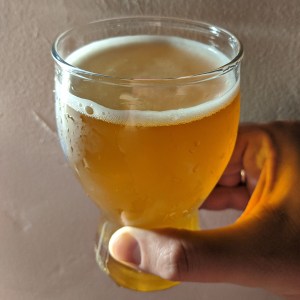
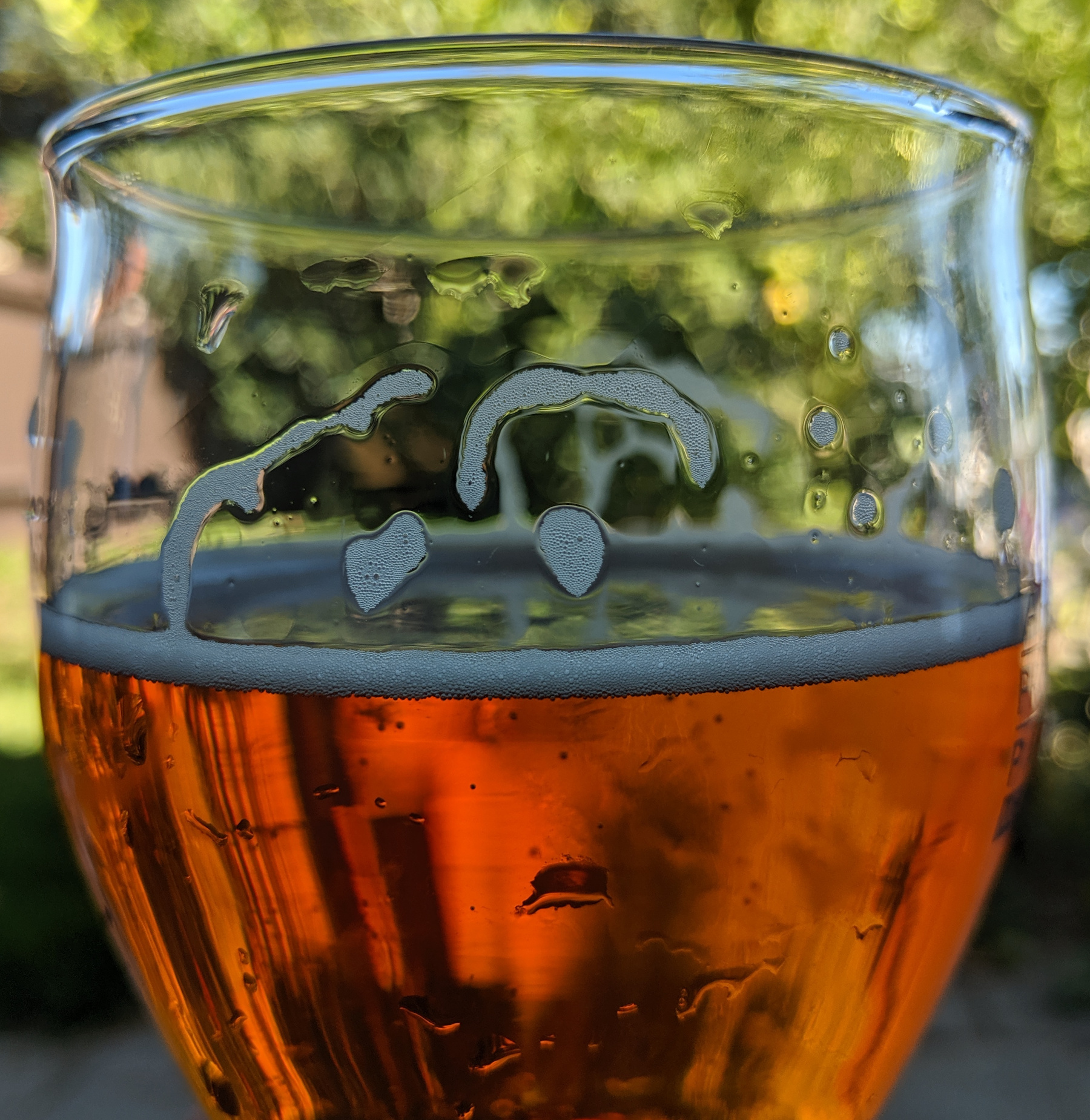
Gold colored beer in glass
  • Appearance
    • Gold, slight haze, with persistent off-white head.
  • Aroma
    • Slightly spicy hop aroma, with light caramel aroma alongside that.
  • Flavor
    • Moderately bitter, with hop qualities in the realm of slightly woody and herbal. The malt character is somewhat bready, with a bit of caramel (likely from the CaraMunich).
  • Mouthfeel
    • Medium-light body, only slightly dry; really nice on this count, actually! Moderate carbonation.
  • Would I Brew This Again?
    • This is a pretty decent beer, and is quite drinkable, but there’s nothing that really jumps out at me. As a pale ale, it’s very much in the realm of qualities that I like–not overly bitter, some malt character, some interesting hops in there too. But, there’s nothing that wows me, either. So, I can say this was a good way to use up some ingredients, but nothing to put on the “must brew” list. On the plus side, the short-and-shoddy technique worked just fine on this batch!
  • Overall
    • 7.5/10

Yule Log Smoked Scottish Ale

For Christmas this year, I wanted a special small-batch beer to sip on a cold, dark evening. I usually buy some barrel-aged commercial beers (Firestone Walker’s 2019 Old Man Hattan is particularly nice), so that flavor profile didn’t terribly appeal to me as a homebrew, especially not in larger volumes. After a bit of thought, I settled on a smoked ale. I’ve done a handful of those over the years, trying out the porter and brown ale styles previously. For this iteration, something in the Scottish ale space was appealing. I could get plenty of malt and plenty of body, and it would (hopefully) stand up well to any smokiness. Thus, the Yule Log Smoked Scottish Ale was born!

The recipe is built around the Scottish Export Ale BJCP style, which according to my reading sometimes is made with smoked variants. My version was based in part on Brulosophy’s Short & Shoddy Wee Heavy Recipe. To add a bit of smoked character, I put in two pounds (~16% of the total grain bill) of Briess cherrywood smoked malt.

In the spirit of the Short & Shoddy series, I cut a ton of corners in the brew day. I only did a 30 minute, full-volume mash, and a 30 minute boil. I used some oldish yeast, which meant I needed three packages total.

Yule Log Smoked Scottish Ale

  • 9 lbs. Maris Otter malt (Crisp)
  • 2 lb. Cherry wood smoked malt (Briess)
  • 5 oz. Biscuit malt (Dingemans)
  • 5 oz. Caramel 120° malt (Briess)
  • 5 oz. CaraPils malt (Briess)
  • 4 oz. Crystal 75° malt (Bairds)
  • 1 oz. Whitbread Golding Variety hop pellets (8.7% alpha), 15 minute boil
  • 2 pkg. Tartan yeast (Imperial Yeast #A31)
  • 1 pkg. Safale American ale yeast (US-05)

Target Parameters

  • 1.063 s.g, 1.019 f.g., 5.8% abv, 21 IBU, 15 SRM
  • 3.25 gallon batch
  • Full volume infusion mash, 156° target temperature
  • Claremont tap water, with Campden tablet treatment to remove chloramines

Procedure

  • I mashed in with 5.35 gallons of water at 165.5°, hitting a mash temperature of 155°. By the end of the 30 minute mash, temperature was down to 152°.
  • I vorlaufed and collected 3.75 gallons of wort with a gravity of 1.068, for 56% mash efficiency. This is a bit “thicker” than targeted, so I added 0.5 gallons of water to get 4.25 gallons of wort at a slightly lower gravity.
  • I boiled for 30 minutes, adding hops at the 15 minute mark. I then chilled down to 70°, transferred to the fermenter, and pitched the yeast.
  • Starting gravity was 1.066, on 24 November 2019. I fermented at 67°.
  • I kegged the beer on 10 December 2019. It had a final gravity of 1.014, for 6.9% abv.

Tasting

  • Appearance
    • Copper colored beer, moderately hazy, with a thin but persistent head.
  • Aroma
    • Faint smoke aroma, but not overbearing. Slight caramel note, and very mild fruity esters as the beer warms up.
  • Flavor
    • Modestly smoky, balanced nicely against the caramel and bready aspects of the malt. Bitterness is moderate, clean, and just about perfect for this beer. There is a very slight but pleasant sweetness to the beer. As I finish a glass, the smoke disappears behind the rest of the beer. On the one hand, it would be nice to smokiness be a bit more prominent, but on the other hand I think the drinkability would suffer. This is a rare smoked beer that can stand up to multiple pints!
  • Mouthfeel
    • This beer has a reasonable bit of body, and a medium-sweet finish. Carbonation level is moderate.
  • Would I brew this again?
    • I liked this beer pretty well! I find commercial smoked beers to be hit or miss, and I think the very moderate level of smoked malt I use paid off. Pretty much everything works about this one, and it’s a nice beer to enjoy on a cool SoCal winter day. I wish the clarity was a bit better at this point, but I never bothered to cold-crash the beer, nor did I use gelatin or even hot-side finings. I expect a combination of these would clear things significantly. I might also mash just a touch higher, as this beer would benefit from a slight bump in body.
  • Overall
    • 8/10

Bierstadt Pils Clone 1.1

I brewed this recipe nearly a year ago, and found the result to be super enjoyable. Why not give it another try? I made a few modifications for hopping rate, and ditched the whirlpool hops, which were apparently a mistake in the originally published recipe (now corrected at the link).

Bierstadt Pils Clone 1.1

  • 9.75 lbs. Barke Pilsner malt (Weyermann)
  • 0.5 lb. Acidulated malt (Bestmalz)
  • 1.25 oz. Hallertauer Mittelfrueh hop pellets (3.0% alpha), first wort hopping, 90 minute boil
  • 1.5 oz. Hallertauer Mittelfrueh hop pellets (3.0% alpha), 70 minute boil
  • 1.25 oz. Hallertauer Mittelfrueh hop pellets (3.0% alpha), 5 minute boil
  • 1 Whirlfloc tablet, 10 minute boil
  • 1 tsp. Fermax yeast nutrient, 10 minute boil
  • 2 pkg. Saflager lager yeast (W34/70)

Target Parameters

  • 1.048 s.g, 1.007 f.g., 5.4% abv, 34 IBU, 3.4 SRM
  • Infusion step mash with decoction
  • Water built from 8.75 gallons of RO water, with 4.3 g CaCl, 3.4 g gypsum, 2.7 g epsom salts, to achieve -47 RA, 59 ppm Ca, 8 ppm Mg, 89 ppm SO4, 63 ppm Cl

Procedure

  • I mashed in with 12 quarts of water at 140°, to hit 132°. After 10 minutes, I added 3.5 quarts of water just below boiling, to hit 145°. I let it rest here for 30 minutes. Finally, I added 5.5 quarts just below boiling, to hit 158°. After 40 minutes, I pulled 1.66 gallons of thin decoction and boiled it for 10 minutes. I added it back to the mash, which raised the temperature to 164°.
  • Next, I let the mash sit for 10 minutes, vorlaufed, and collected the first runnings. I added the first hop charge to the kettle at this time.
  • Next, I added the remaining sparge water (3.5 gallons) at ~170°, to hit a 164° mash temperature. I let it sit for 10 minutes, vorlaufed, and collected the second runnings.
  • In total, I collected 7 gallons at a gravity of 1.041, for 77% mash efficiency. I added 0.25 gallons of RO water to raise the volume to 7.25 gallons.
  • I brought everything to a boil, adding hops and other ingredients per the schedule.
  • After a 90 minute boil, I chilled and transferred. Gravity at this point was 1.052, a bit above my target. So, I added 7 cups of water heated to near boiling to top up and hit a gravity of 1.049.
  • I chilled in the fermenter down to 48°, before oxygenating and pitching the yeast.
  • I brewed this beer on 14 September 2019, fermenting at 50°.
  • I raised the beer to 60° on 30 September 2019. I cooled down to 50° on 4 October 2019, and down to 35° on 5 October 2019.
  • I kegged the beer on 11 October 2019, with a partially closed transfer. Gravity at this point was 1.010, for 5.2% abv.

Tasting

  • The Basics
    • 1.049 o.g., 1.010 f.g., 5.2% abv
  • Appearance
    • Clear, nearly brilliantly so, light yellow beer, with a fine, white, and persistent head.
  • Aroma
    • Clean, lightly malty aroma, with slight floral hop presence.
  • Flavor
    • Light, slightly sweet, and grainy malt character, with a crisp bitterness against that. The balance tilts slightly towards bitter, but not overly so.
  • Mouthfeel
    • Crisp and light-bodied, with moderate carbonation and a smooth finish.
  • Would I brew this again?
    • This is a great recipe. It’s a really smooth and drinkable beer, and was worth repeating from last time. I enjoy the grainy malt character, and the pleasant German hops alongside that. The head isn’t quite as firm and frothy as I might like (that honor belongs to the last German pils I did), but I’m not sure if that is a recipe flaw or something else. I think it will be worth playing with malts some more to see what happens when I switch those up. This recipe lacks some of what makes my other recent pils great, but in all it’s pretty decent.
  • Overall
    • 8/10

Stygimoloch Bock

I have a Thanksgiving tradition of crafting a new “fancy” beer for our holiday get-together. After consulting with my friend Justin, we settled on a dunkles bock. It’s rich, malty, and eminently drinkable–a perfect beer for a late fall celebration. I don’t think I’ve ever brewed this style before, either, although I certainly have enjoyed drinking it!

The recipe is a modified version of Gordon Strong’s traditional bock, from Modern Homebrew Recipes. The base grist of dark and light Munich malts is basically the same, although I had to substitute in Briess’s Caramel Munich and some melanoidin malts instead of Caramunich III. Also, I used Magnum hop pellets instead of whole Hallertauer cones. In terms of techniques, I used a straight infusion mash rather than a double decoction.

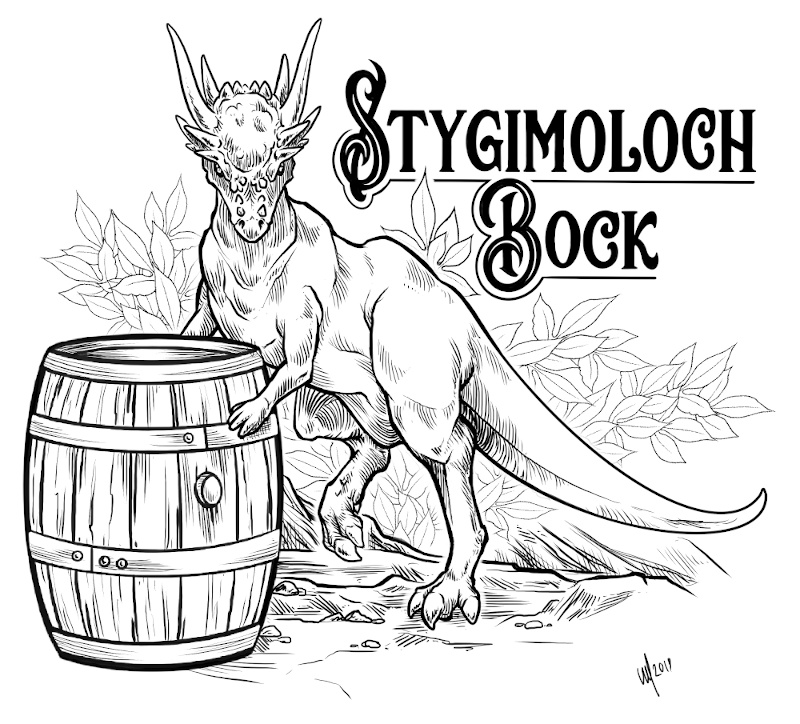
As an extra special treat, I wanted custom glassware with a unique logo for the beer. So, I commissioned the wonderfully talented Charon Henning to create a design. Bock labels often feature goats as part of a linguistic pun, but hey, I’m a paleontologist. Why not go with a prehistoric goat analog? The bone-headed dinosaur Stygimoloch*, with its goat-like spikes and potential butting behavior, seemed like a perfect fit. Charon did a superb rendering that pays homage to many old bock labels. Even better, she worked some leaves of prehistoric hops into the background!

StygiLoRes

Stygimoloch Bock

  • 9 lbs. Munich II malt (Weyermann)IMG_20191019_150917
  • 5 lbs. Munich I malt (Weyermann)
  • 8 oz. Caramel Munich 60L (Briess)
  • 4 oz. melanoidin malt (Weyermann)
  • 1 oz. Carfa Special III malt (Weyermann)
  • 0.65 oz. Magnum hop pellets (13.2% alpha), 60 minute boil
  • 1 Whirlfloc tablet, 10 minute boil
  • 1 tsp. Fermax yeast nutrient, 10 minute boil
  • 4 pkg. Bavarian lager dry yeast (Mangrove Jack’s M76)

Target Parameters

  • 60 minute infusion mash, 154°, batch sparge
  • 1.070 o.g., 1.017 f.g., 7.0% abv, 25 IBU, 15 SRM
  • Blend of Claremont tap water and RO water, with 3 g CaCl, to produce target water of 4 ppm Ca, 5 ppm Mg, 13 ppm Na, 22 ppm SO4, 53 ppm Cl, 119 ppm HCO3, RA=56 ppm.

Procedure

  • I mashed in with 5 gallons of Claremont tap water and 1/4 of a Campden tablet at 164°, to hit a 154.4° mash temperature.
  • After 60 minutes, I added 0.5 gallons of RO water blend (3 g of CaCl added to 4.5 gallons of water) at 185°. I let it sit for 10 minutes, vorlaufed, and collected first runnings.
  • I next added 4 gallons of the RO water blend at 185°, let sit for another 10 minutes, vorlaufed, and collected the second runnings.
  • In total, I collected 7.25 gallons of runnings with a gravity of 1.055, for 72% mash efficiency.
  • To up the gravity a touch, I boiled the wort for 15 minutes before adding the hops (a total of 75 minute boil). I figured this longer boil time would work well to add additional character.
  • After boiling for a total of 75 minutes, I turned off the heat, and chilled down to 80° before transferring into the fermenter and cooling overnight in the fermentation chamber. I oxygenated for 60 seconds, and added 4 packages of yeast. I used four packages because they were around 9 months past “best by” date. Nonetheless, they took off pretty well.
  • Starting gravity was 1.066, on 30 August 2019.
  • I fermented at 52°, until raising the temperature to 60° on 30 September 2019. I cooled back to 50° on 4 October 2019, and then down to 35° on 5 October 2019.
  • I kegged the beer on 9 October 2019. Final gravity was 1.020, for 6.1% abv.

IMG_20191021_185030Tasting

  • Appearance
    • Color is a gorgeous deep copper, and the beer has become brilliantly clear in the keg. The tan head is quite persistent.
  • Aroma
    • Amazing malty, bready aroma, with a touch of caramel.
  • Flavor
    • Rich, bready flavor, with some toastiness–it is very reminiscent of a hearty bread crust. The beer is a touch more bitter than appropriate for the style. (note: the bitterness had mellowed a bit when I tasted it again on November 24)
  • Mouthfeel
    • Medium-full body, nice rounded finish.
  • Would I brew this again?
    • Yes! This is a really nice beer, with a phenomenal maltiness and drinkability that approaches slightly dangerous. Color and clarity are exceptional, and it’s only going to get better as it matures towards a Thanksgiving official launch date (I did the tasting in mid-October). It is maybe a touch more bitter than I would like for the style, so if I brew it again I’ll dial back the hops slightly.
  • Overall
    • 8/10

*Yes, I mostly agree with the hypothesis that Stygimoloch is probably a younger form of something like Pachycephalosaurus, so the name itself may or may not be valid. Even so, let’s just agree that we shouldn’t let nomenclatural pedantry overrule the fact that “Stygimoloch Bock” rolls off the tongue more easily than Pachycephalosaurus Bock”.

Cascade-o Classico Pale Ale

IMG_20191005_144434Lately, I’ve had a soft spot for “classic” American pale ales, from the era before Citra, Mosaic, and Simcoe were a thing. I love the more subtle flavors of Cascade and Centennial…and the cheaper price point for those hops doesn’t hurt, either. I recently got a shipment of the new Cascade crop from my dad in South Dakota (he raises them for his own brewing), and decided to do another iteration of my Classico Pale Ale. Aside from the hops (Cascade instead of Falconer’s Flight), the only other change is upping the percentage of Maris Otter versus 2-row, from around 50/50 to 66/33 in the current recipe.
I know that you’re not supposed to put crystal malts in pale ales and IPAs, but I’ve decided that piece of advice is bunk in a well-brewed recipe with modest amounts of crystal malts. For this formulation, I think they add a subtle but important character, and I ain’t likely to remove them for future brews!

Cascade-o Classico Pale Ale

  • 7 lb. 0.5 oz. Maris Otter malt (Bairds)
  • 3 lb. 9 oz. 2-row pale malt (Rahr)
  • 8 oz. caramel 40 (Briess)
  • 4 oz. caramel 60 (Briess)
  • 0.70 oz. Warrior hop pellets (15.8% alpha), 60 minute boil
  • 1 Whirlfloc tablet, 10 minute boil
  • 2 oz. Cascade whole hops (~5.5% alpha), 5 minute boil
  • 1 pkg. Safale American ale yeast (US-05)
  • 2 oz. Cascade whole hops (~5.5% alpha), dry hop in keg

Target Parameters

  • 60 minute infusion mash, 152°, batch sparge
  • 1.058 o.g., 1.013 f.g., 46 IBU, 8 SRM, 6.0% abv
  • Claremont water with 1 tsp. of gypsum added during boil

Procedure

  • I mashed in with 3.2 gallons of water at 162°, to hit a 152.5° mash temperature.
  • After 60 minutes, I added 0.8 gallons of water at ~185°, let sit for 10 minutes, vorlaufed, and collected the first runnings.
  • Next, I sparged with 3.4 gallons of water, let it sit for 10 minutes, vorlaufed, and collected the second runnings.
  • In total, I collected 6.2 gallons of runnings with a gravity of 1.048, for 71% efficiency.
  • As I heated the runnings to a boil, I added 1 tsp. gypsum. Once the boil started, I added the various hops and Whirlfloc per the recipe.
  • After 60 minutes, I turned off the heat and chilled the wort. I transferred to the fermenter while aerating, and pitched the yeast. I am fermenting at 68°.
  • The beer was brewed on 24 August 2019, and fermentation signs were quite visible by the next morning.
  • I kegged the beer on 6 September 2019. Final gravity was 1.011, down from 1.058, for 6.2% abv. The dry hops were added to the keg in a mesh bag.

IMG_20191005_144934

Tasting

  • Appearance
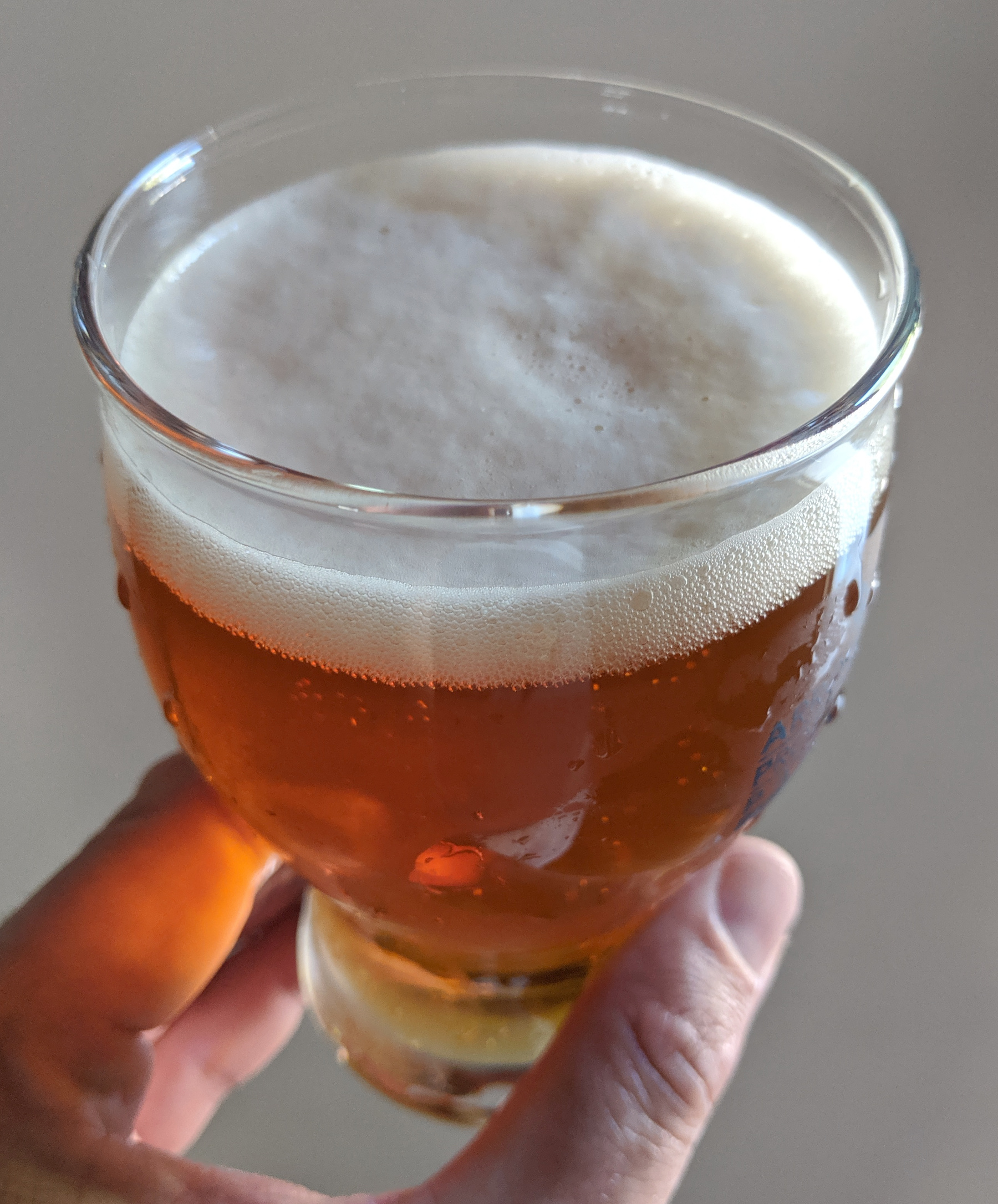
    • Pours with persistent ivory-colored head; brilliantly clear and copper-colored beer
  • Aroma
    • Lightly caramel, citrus/piney aroma
  • Flavor
    • Slightly grainy, caramel flavor, with firm bitterness. Bitterness is slightly piney
  • Mouthfeel
    • Medium-light body, moderate carbonation, off-dry finish.
  • Would I brew this again?
    • Yes! This is a nice base recipe, and a good way to highlight classic American hops. I feel like it could use just a touch more body, so might mash at 154° next time. It might be interesting to try this with 100% Maris Otter or even Vienna malt, too, to give a bit more malt character I love how clear this beer has turned out–it clarified really quickly and nicely, to make an incredibly pretty brew.
  • Overall
    • 9.5/10