Beer Tasting: Thumbspike Saison 2.0

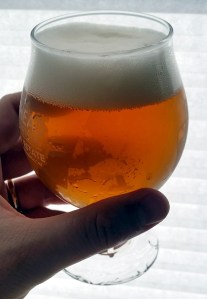
20170623_160401I managed to do a tasting with the very last glass of this! Talk about good timing.

  • Appearance
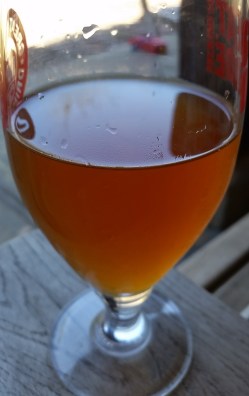
    • Thick white head, with excellent persistence. The beer itself is medium gold, with a slight haze.
  • Aroma
    • Tart aroma, with a hint of breadiness behind that.
  • Flavor
    • Pleasantly tart and very slightly fruity, with a bready maltiness that is quite pleasant. This is a moderately bitter beer, although the bitterness has a slight rough edge to it. I’ll blame the wild hops for that.
  • Mouthfeel
    • Light bodied, moderately high carbonation, and a nice dry finish.
  • Would I brew this again?
    • This is a surprisingly nice beer! I’m not sure what I expected, but in the end it turned out pretty good, especially with a bit of maturation. In the future, I might play with the hop bill, to take a bit of the “edge” off (probably due to the wild hops), but as a ‘gimmick’ beer this ain’t half bad! I like how the yeast worked in this one — the dominant tartness with a bit of fruitiness behind that makes for a tasty combination. It’s a bit different from the slightly more clove-y flavor I get from traditional Belgian saison yeasts, and I rather enjoyed it. Thumbs up for the Mangrove Jack M29 saison strain!
  • Overall
    • 7/10

Big Batch Update: Saison, Amber Ale, Pilsner

There’s lots to report with kegging and fermentation for a few recent batches. So, here’s what’s new:

  • Thumbspike Saison 2.0
    20170528_144954

    • This might have had the quickest turn-around on any kegged beer I’ve ever done! I brewed the beer on 12 May 2017, starting with an 80° fermentation temperature. On 16 May, I raised the temperature to 85°. Everything really churned along, from start to finish (as you might expect with fermentation at those temperatures)! I kegged the beer on 20 May 2017, with a final gravity of 1.004. That works out to 6.7% abv. I’ve had it on tap for about a week, and it’s a pretty interesting and enjoyable beer. All of the ingredients melded together quite nicely, and I am pleased with the results. It’s a very refreshing brew for a warm afternoon on the patio.
    • My first impressions are that it has a very lightly fruity aroma, with a slight tartness on the flavor. Head retention seems pretty miserable at this point, but I don’t know if that’s a real feature of the beer or because I didn’t wash my glass from a previous beer before pouring this one.
  • Hell Creek Amber Ale 1.1
    • I brewed this beer on 14 April 2017, with a starting gravity of 1.060. I kegged the beer on 7 May 2017. Final gravity was 1.016, which equates to 5.8% abv.
  • Czech-ed Out Pilsner
    • This batch has the honor of being my first dumper, ever. I’ve weathered warm fermentations, low gravities, and incomplete fermentations, and have always soldiered through in the end. Alas, this particular batch just wasn’t any good. The culprit wasn’t infection, bad fermentation, or anything like that. It was bad hops! As noted in my original post, the late hop addition smelled really grassy. I should have known better than to add them to the kettle, but wasn’t quite that smart. So, I kegged the beer, carbonated it, and pulled my first sample…to a whiff of pilsner that smelled pretty much like freshly mown lawn, and not in a good way. It was almost reminiscent of jalapenos, but in any case was not reminiscent of what a good European pilsner should taste or smell like. Lesson learned!
    • In terms of fermentation history, I started fermentation at 50° on 9 April. I raised the beer to 65° on 21 April, and then dropped it to 33° on 30 April 2017. I kegged the beer on 14 May, at which point it had a final gravity of 1.011. This equates to 5.6% abv.

Thumbspike Saison 2.0

I’ve only brewed a saison once before, and it turned out pretty decent. Not perfect, but decent. I dry hopped just a touch too much last time, and so the hop aroma overwhelmed the yeast character. Thus, I decided to ditch the dry hops entirely on this batch. My recipe is similar to what I used before, with a few differences on several fronts. First, I added a touch of Carafa II for color, and ditched the honey in favor of a lower mash temperature to dry things out a bit. Also, I had some wild hops left, and a saison seemed like a good place to let those meld with a strong yeast. Finally, I decided to try Mangrove Jack dry yeast, and see what that does for everything.

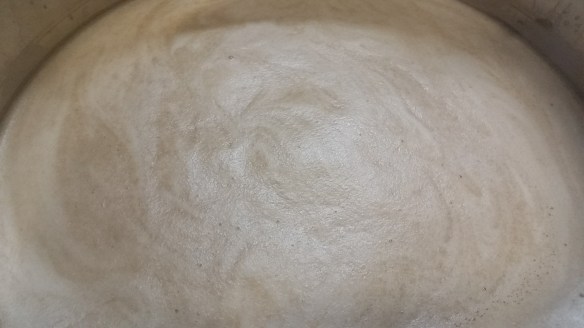
20170512_192441

A view of the brew kettle, just prior to the start of the boil

Thumbspike Saison 2.0

  • 9.25 lbs. floor-malted Bohemian pilsner malt (Weyermann)
  • 0.75 lbs. Munich I malt (Weyermann)
  • 0.75 lbs. white wheat malt (Great Western Malting Co.)
  • 1 oz. Carafa Special II (Weyerman)
  • 1.1 oz. whole wild hops (5.8% alpha), 60 minute boil
  • 1.15 oz. whole wild hops (5.8% alpha), 10 minute boil
  • 1 Whirlfloc tablet, 10 minute boil
  • 2 pkg. French Saison Ale dry yeast (Mangrove Jack’s M29)

Target Parameters

  • 1.057 o.g., 1.003 f.g., 7.0% abv, 29 IBU, 7 SRM, 5.5 gallons into the fermenter

Procedure

  • To use up my RO water and thin out the Claremont waters a bit, I added 1.25 gallons with 2.42 gallons of tap water for my mash water. I heated it up to 165°, added the water to the mash tun, and let it slide to 158.3°, before adding the grains. This hit a mash temperature of 148.7°, which was down to 147.1° after 20 minutes. The temperature didn’t drop much beyond this, and was hovering around 147° when I checked 60 minutes later.
  • I aimed for a 75 minute mash duration. After 65 minutes, I added 1.3 gallons of water at 180°, to raise the mash temperature to 150.4°. I let it rest for 10 minutes, vorlaufed, and collected the first runnings. I then added 3.3 gallons of water at 165°, let it sit for 10 minutes, vorlaufed, and collected the remainder of the runnings.
  • In total, I collected 6.75 gallons with a gravity of 1.047, for 77% efficiency.
  • I aimed for a 60 minute boil, adding the various hops and finings per the schedule.
  • After 60 minutes, I turned off the flame and started chilling. Once I hit 85°, I transferred to the primary fermenter and pitched the yeast.
  • I plan to have 80° as my base temperature, and let it free-rise from there as needed. I’ll probably leave it in the fermenter for at least 10 days.
  • I brewed this beer on May 12, 2017. Starting gravity was 1.055, just a hair under my target gravity. A successful brew evening all around!

Thumbspike Saison

Every once in awhile, I get bored with my usual styles and try something different. Lately, I’ve been brewing a lot of what I’ve brewed before: IPA’s, wheat beers, porters, and stouts and stuff. They’ve turned out nicely, but now I want to amp things up a bit. For some reason, I got the idea to try a saison.
saison The diverse Belgian styles don’t always appeal to me, but I think that’s because they’re often either done badly or overdone in the latest souring craze. I’m actually quite fond of the various witbiers and their cousins (including my white IPA). But, because I have another iteration of my white IPA planned, saison had a bit more appeal for the moment. I’ve had a number of good ones over the years, and they aren’t afflicted by the funky bacteria that seem to dominate so many US-brewed salutes to Belgian beers these days. Why not, then?

I did a bit of research on various websites, books, and magazines, and came up with a fairly simple recipe as my first attempt. It won’t be entirely authentic in terms of ingredients (I’m using American 2-row instead of Belgian pilsner malt, and the hops are New Zealand), but my aim is to get something that’s tasty and drinkable. In order to dry the beer out a bit, I’m incorporating some honey into the recipe.

When trying to figure out which hops I should use, I was reminded that I have four ounces of Pacific Jade in my freezer. The descriptors for the hops include words like “herbal”, “citrus”, and “black pepper”. A good combination for a saison! And, it will be a good way to use up these hops for which I’ve long been trying to find a purpose.

I elected to use WLP525, Belgian Saison I from White Labs. It has been consistently rated as a very fine yeast for saisons, and the peppery aroma and flavor intrigue me. I’ve read a lot about how it tends to stall out at lower temperatures, so I’ll be using a heating pad beneath the fermenter (which will also be outside of my fermentation chamber) and letting the beer free rise. Apparently it does quite well in the 80’s, so that should be a fun thing to try!

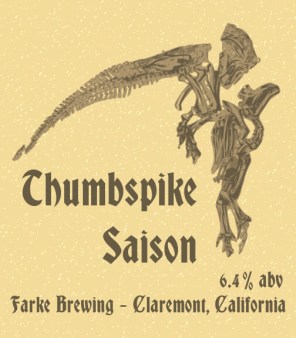
The name (and label) for this beer are inspired by Iguanodon, a plant-eating dinosaur characterized by a sharp spike for a thumb. The animal is represented by a whole set of beautiful skeletons from the coal mines of Bernissart, Belgium. Coincidentally, this area (part of the greater region known as Wallonia) is the home turf for saisons. I prettied up one of the old renderings of the Belgian Iguanodon fossils by Gustave Lavalette for the label.

Thumbspike Saison

  • 8 lbs. 2-row malt (Great Western Malting Co.)
  • 1.5 lbs. white wheat malt
  • 1 lb. Vienna malt
  • .2 lbs. rice hulls
  • 1.5 lbs. clover honey
  • 1 oz. Pacific Jade hops pellets (12.4% alpha), 15 minute boil
  • 1 oz. Pacific Jade hops pellets (12.4% alpha), 5 minute boil
  • 1 tsp. Irish moss, 10 minute boil
  • 2 tsp. BSG Fermax yeast nutrient, 10 minute boil
  • 1 pkg. Belgian Saison I ale yeast (WLP565, White Labs), prepared in 1.75L starter, 24 hours in advan
  • 2 oz. Pacific Jade hops pellets (12.4% alpha), 1 week dry hop

Procedure

  • I mashed in with 4.1 gallons of water at 159º, to hit a mash temperature of 150º. It was down to 145º after 45 minutes.
  • After 60 minutes had passed, I batch sparged with 4.75 gallons of water at 185º. After letting it sit for 10 minutes, I vorlaufed and collected the runnings.
  • All told, I collected 7.1 gallons of wort with a gravity of 1.042. This equates to a mash efficiency of 76%. Prior to the boil, I added the honey, which brought the gravity up to 1.052.
  • I boiled the wort for 60 minutes, adding the hops, Irish moss, and yeast nutrient as indicated.
  • I chose to use yeast nutrient because much of what I read online says it can be a big help in enabling WLP565 to ferment to completion. The yeast nutrient left a mild odor in the wort; nothing overpowering, but it was noticeable. The package suggested adding in 1 tsp. per gallon of liquid; reading more online, it looks like that is appropriate only for wines and meads. Beers should be given only 1/2 tsp. for a 5 gallon batch. At any rate, I also read that the yeast tend to use up the nutrient anyhow, so any aroma should disappear.
  • After 60 minutes, I turned off the flame and cooled the wort down to 78º, transferred to the fermenter, and pitched the yeast.
  • Starting gravity was 1.058, when I brewed the batch on 22 April 2016.
  • I started fermentation on top of a heating pad. The yeast had really taken off within 10 hours, with a temperature in excess of 85º. So, I turned off the heating pad and let the temperature ride freely. After 30 hours more, temperature was down to 70º. By this point, my fermentation chamber had freed up, and I moved everything into there. I set the temperature to 80º.
  • Five days after brewing, fermentation was still perking along, with an occasional bubble from the airlock.
  • On Tuesday, May 3, I kegged the beer. It had a final gravity of 1.009, which equates to 6.4% abv. Flavor seems to be pretty good; time will tell how successful it is!