Unruly Gnome Belgian Blond Ale

La Chouffe is a darned good beer, and I will often get a pour if I find it on-tap at a quality alehouse (shout-out to The Back Abbey!). Belgian Blond Ale (or Belgian Blonde Ale) is not a style I have brewed previously, so it’s time to rectify that! I did a bit of research to find a clone recipe for La Chouffe, and a version from Brewer’s Friend inspired my own version, along with “The Gnome” recipe in Gordon Strong’s Modern Homebrew Recipes. The original recipe on Brewer’s Friend used decoction, but I decided to just put a little melanoidin malt into the grist instead. I also included a mash rest at 126°, in an attempt to improve the head.
Because this is an experimental beer, and a high alcohol one at that, I decided to make a small (3 gallon) batch.

Unruly Gnome Belgian Blond Ale

  • 7.75 lb. pilsner malt (Rahr)
  • 3 oz. melanoidin malt (Weyermann)
  • 0.5 tsp. BrewTanB (mash)
  • 12 oz. clear candi sugar (added to boil)
  • 1 oz. Styrian Goldings hop pellets (3.2% alpha), 60 minute boil
  • 0.5 oz. Saaz hop pellets (2.0% alpha), 15 minute boil
  • 0.25 tap. BrewTanB, 10 minute boil
  • 0.5 Whirlfloc tablet, 5 minute boil
  • 0.5 oz. Saaz hop pellets (2.0% alpha), 5 minute boil
  • 0.5 tsp. yeast nutrient WLN1000 (White Labs), 5 minute boil
  • 6 g. coriander seeds (Turkish), 5 minute boil
  • 1 pkg. Abbaye Belgian ale yeast (Lallemand)

Target Parameters

  • 1.068 s.g., 1.009 f.g., 7.9% abv, 6 SRM, 21 IBU
  • Full volume step mash, with 15 minutes at 126°, 90 minutes at 146°, and 10 minutes at 168°; 60 minute boil
  • Water built up from RO and Claremont tap water, to hit water target parameters of 50 ppm Ca, 4 ppm Mg, 45 ppm Na, 56 ppm SO4, 82 ppm Cl, 10 ppm bicarbonate, RA=-30.

Procedure

  • To get my strike water, I mixed 2.5 gallons Claremont tap water and 2.5 gallons distilled water, added 2.1 mL of 88% lactic acid, 1/4 Campden tablet, 1 g CaCl, and 1 g CaSO4.
  • I heated the strike water to 131°, added the grains and 1 tbs. of 10% phosphoric acid, and held the mash at 126° for 15 minutes, before raising the temperature to 146° for 90 minutes. Then, I raised the mash to 168° for 10 minutes before pulling the grains.
  • In total, I collected 4.5 gallons of runnings at a gravity of 1.050, for 75% mash efficiency.
  • I brought the runnings to a boil, adding finings per the recipe. After a 60 minute boil, I turned off the heat and chilled to 74° before transferring to the fermenter and pitching the yeast.
  • I brewed this beer on 7 December 2024. Starting gravity was 1.070.
  • I had vigorous fermentation within 18 hours of pitching the yeast; temperature was down to 72°, and so I moved the fermenter into the fermentation chamber on 8 December 2024, and set it at 74°.
  • Fermentation (as evidenced by bubbling) was pretty much done by 10 December 2024.
  • I kegged the beer on 23 December 2024, adding 1 oz. of corn sugar in 0.5 cups of water for carbonation, and let it sit at room temperature.
  • Final gravity was 1.011, for 7.8% abv.

Tasting

  • Appearance
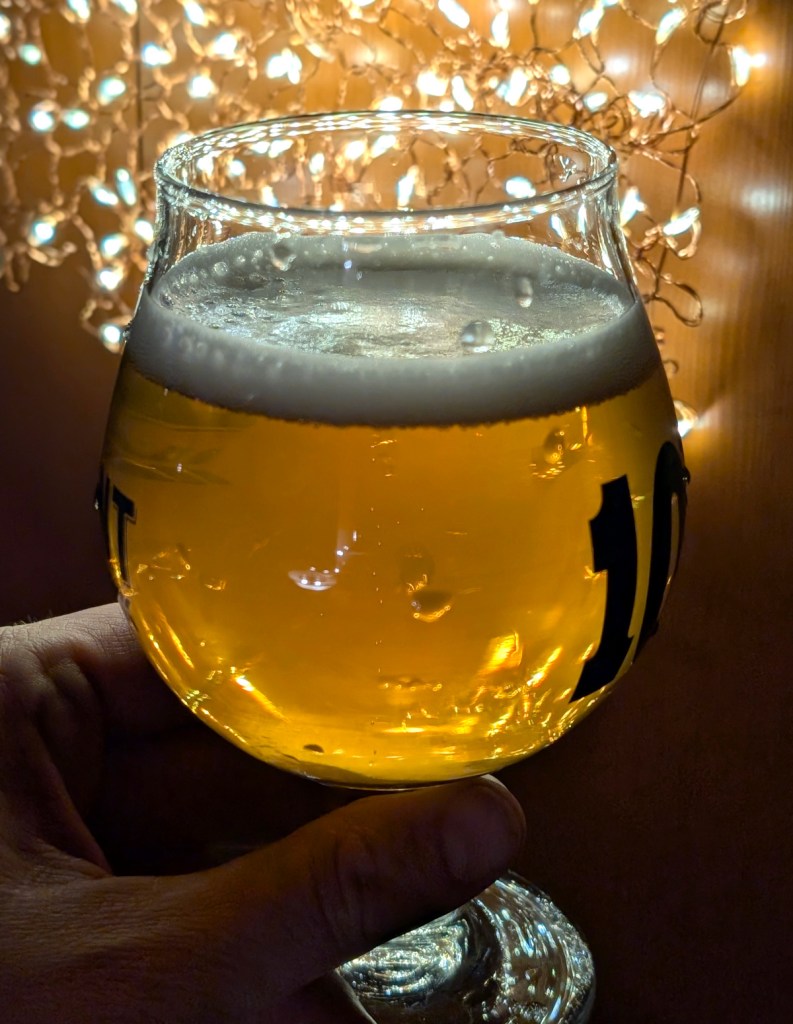
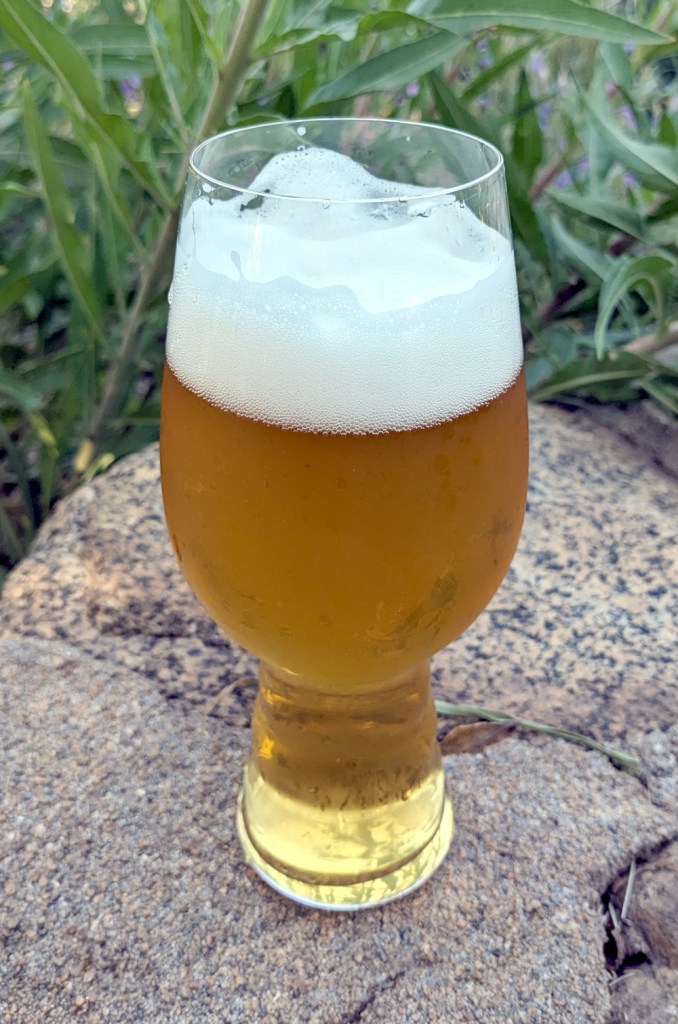
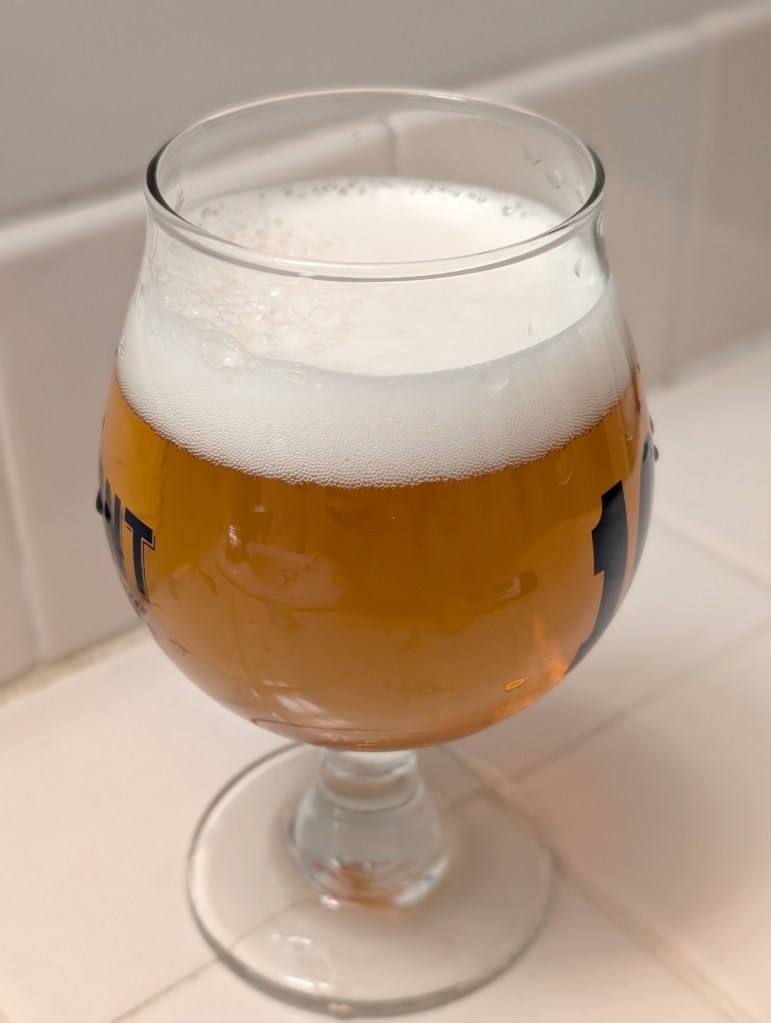
    • Very clear gold beer that pours with a creamy and persistent white head of foam. It’s quite pretty! I’ll note that it clarified a bit more after the photos were taken (about 10 days before this post).
  • Aroma
    • Moderate spicy phenolic notes, but overall pretty clean. A little light caramel malt comes through, and some citrus quality with light alcohol notes as it warms.
  • Flavor
    • Moderately high bitterness, crackery malt at a moderate level, with a touch of candy. Balance is towards the hops a bit. Orange peel citrus comes through as the beer warms. The yeast is perhaps a touch more prominent than what I remember in the commercial beer.
  • Mouthfeel
    • Highly carbonated, light body, dry finish. It drinks very easily!
  • Would I Brew This Again?
    • This is a good start. The yeast was perhaps a bit forward in the early samplings of the beer, but it has mellowed considerably over time. It might benefit from lower temperatures with this dry yeast strain, or a different strain at least relative to the style ideal (probably Ardennes for my next version, which isn’t available in dry yeast form; Belle Saison is another dry yeast I’m considering). Even so, this beer is dangerously drinkable! I might dial hops back a touch, perhaps to 15 IBU or so. The bitterness on the finish is just a touch harsher than I like. The coriander doesn’t come through, so I could safely ditch it; I don’t think anything would be lost. I might also try a fresher coriander from a different source area, which could also help.
    • Note added 10 February 2025: The beer has cleared to brilliant now!
  • Overall
    • 8/10

Collaboration Brews – Citra Blonde Ale and Andy’s Pilsner

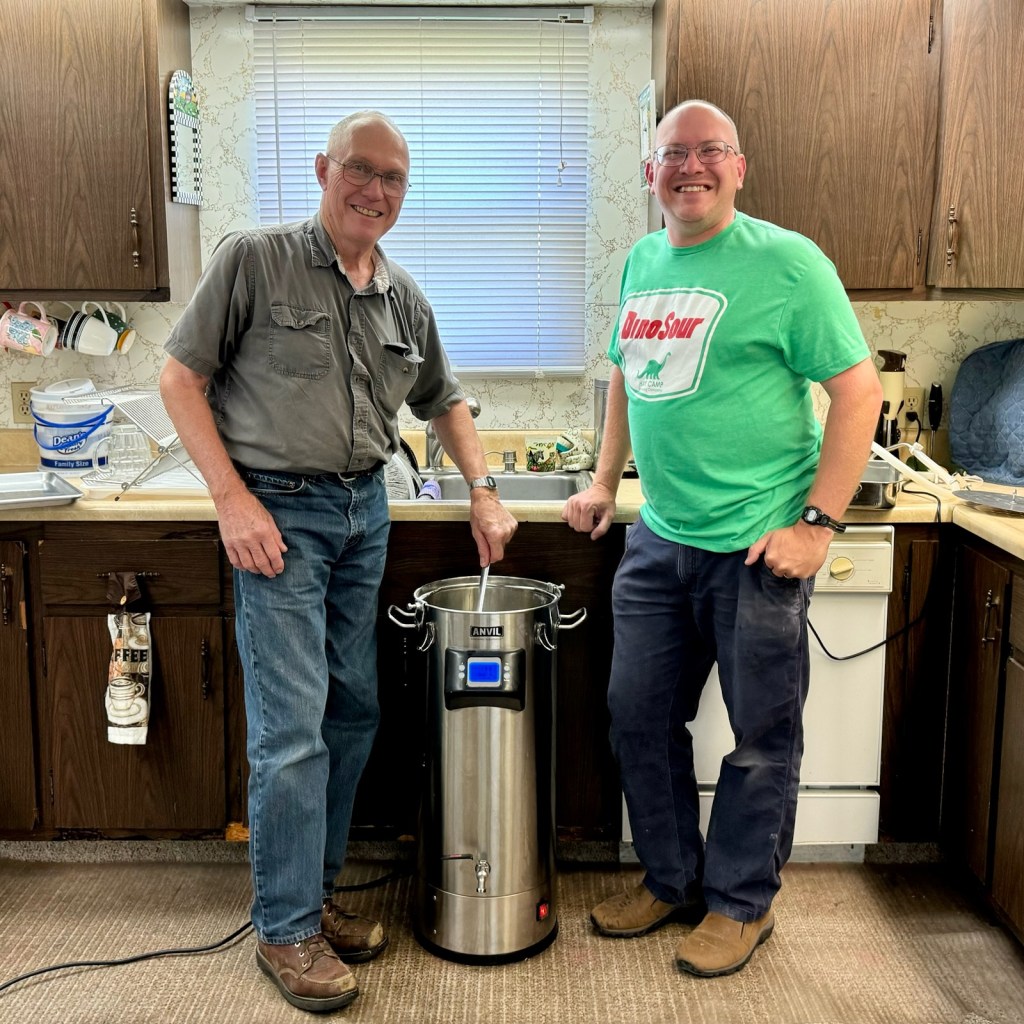
This past summer, I got to brew with my dad, who first got me thinking about brewing many years ago (I remember helping him way back as a teenager, even if I couldn’t enjoy the product at the time). He started as an extract brewer decades ago, took a break, got back into it, and then eventually switched to all-grain brewing (alongside wine making). Dad makes almost exclusively lagers, with his regular rotation including a Pre-Prohibition PIlsner and a Vienna Lager.

Dad currently brews on an Anvil Foundry 10.5 (gifted by us kids a few years back), doing a handful of batches annually to keep his cellar stocked. Awhile back, I shared my Citra Blonde Ale recipe with him, and he liked it enough to add a version into his repertoire. I also helped him put together a simple German pils, which is made with hops he grows himself.

We’ll usually brew something when I’m visiting, but I almost never get to sample the results due to the distance. So, it was extra nice to get a shipment with a bottle of each of the beers we made this summer. I was also able to get my hands on the notes (thanks, Dad!), which are presented in only lightly edited format.

Citra Blonde Ale

  • 5.25 lb. Briess Pilsen malt
  • 5 lb. Briess 2-row malt
  • 0.75 lb. Munich malt
  • 0.5 lb. Vienna malt
  • 0.5 lb. Carapils malt
  • 0.5 oz. Citra hops (boil 10 min.)
  • Whirlfloc tablet (boil 1- min.)
  • 0.5 oz. Citra hops (boil 5 min.)
  • 1.0 oz. Citra hops (steep for 5 min. after shutting the heat off).
  • BRY-97 American West Coast Ale (dry) and Safale US-05 (dry) yeast, 1 packet each

Procedure

Double-milled grains with 0.035 in. gap.  Steeped grains at 152 degrees.  Mashed out at 168 degrees for 10 minutes.  Boiled for 50 minutes.  Added 0.5 oz. Citra hops, Whirlfloc.  Boiled for 5 minutes.  Added 0.5 oz. Citra hops. Boiled for 5 minutes.  

Shut off heat.  Added 1.0 oz. Citra hops.  Steeped for 5 minutes.  Removed hops and cooled to 69 degrees.  S.G.=1.054.  Added American West Coast Ale yeast BRY-97 (best by 08-2024) and Safale US-05 (best by 01-24).

Fermented in the basement at approx. 65 degrees for 12 days.  S.G.=1.006.  Continued to ferment in the basement for 3 more weeks, then moved to 34-degree fridge.  Chilled for about 3 weeks, then filtered, force carbonated and bottled.

Brewed July 18, 2024.

Tasting

  • Appearance
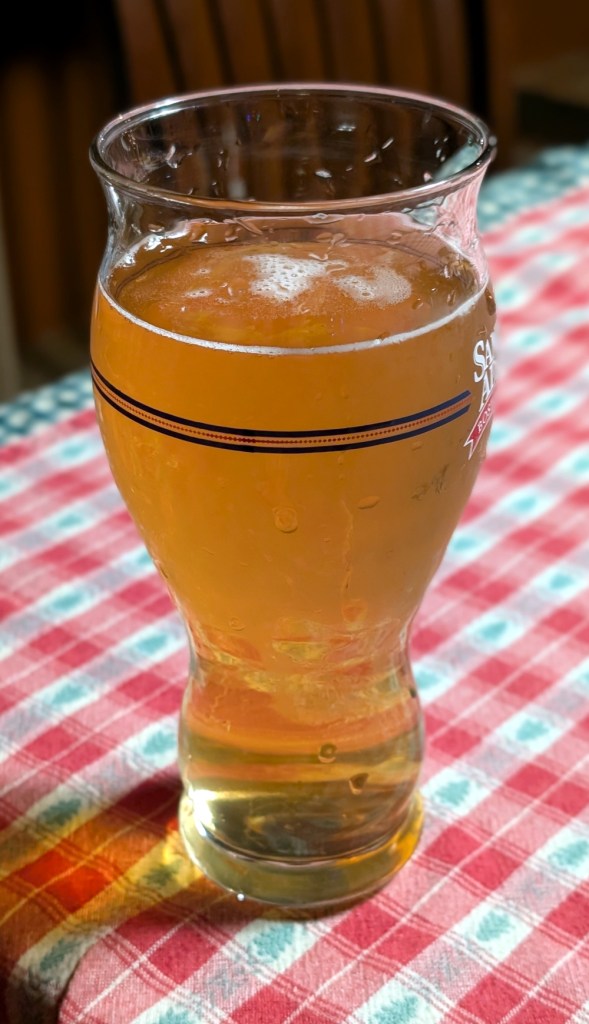
    • Medium yellow color, relatively clear. A touch of chill haze. Thin white head that subsides after pouring.
  • Aroma
    • A nice orange/ citrus hop aroma at a moderate level; moderate/low malty aroma
  • Flavor
    • Citrus hop flavor, low bitterness level, grainy malt character, no yeast to speak of. Nice round maltiness.
  • Mouthfeel
    • Medium-light body, moderate carbonation, smooth finish.
  • Would I Brew This Again?
    • This is a great recipe, even after a few months. Clean, drinkable, interesting but not overpowering.
  • Overall
    • 8/10

Andy’s Pilsner

This is a SMaSH-esque recipe, based on various SMaSH pilsners that I have made over the years. The closest equivalent would be Farke’s Best Pils.

  • 10 lb. Briess Pilsen malt
  • 1.0 oz. Saaz (2023) hops in boil (60 minute boil)
  • 1.0 oz. Mt. Hood (2023) hops (10 minute boil)
  • Whirlfloc tablet, 10 minute boil
  • 2 pkg. DIamond Lager dry yeast (Lallemand)

Procedure

Double-milled grain at 0.035 in. gap.  Steeped grain at 150 degrees for 50 minutes.  Mashed out at 168 degrees for 10 minutes.  Brought to a boil and added Saaz hops.  

Boiled for 60 minutes.  Added Whirlfloc tablet and Mt. Hood hops.  Boiled for 10 minutes.  Cooled to 70 degrees.  S.G.=1.051.  Added 1-1/2 qts. tap water.  S.G.=1.047.

Chilled to 52 degrees.  Added 2 packages of Diamond Lager yeast (BB 08-2024 & 09-2023).  Fermented for 10 days.  S.G.=1.006.  Racked to 5 gal. carboy.   Continued to ferment at 52 degrees for 12 days.  Warmed to 74 degrees for diacetyl rest for 4 days.  Chilled to 34 degrees for approximately one month, then cold filtered, force carbonated and bottled.

Brewed July 18, 2024.

Tasting

  • Appearance
    • Very clear, straw color, with thin white head that subsides fairly quickly.
  • Aroma
    • A bit of spicy hop at the forefront, and some grainy maltiness behind that. Very nice!
  • Flavor
    • Malty sweetness at the front, and medium level of spicy hopping. Clean fermentation profile.
  • Mouthfeel
    • Medium-low carbonation level; medium mouthfeel; smooth and slightly dry finish.
  • Would I Brew This Again?
    • This is a great recipe! Carbonation might help with giving a touch more head. Malt and hop levels are perfect. This is a nice pilsner.
  • Overall
    • 8/10

Totality Blonde Ale

It has been nearly six years since I’ve done a proper blonde ale, because pilsners are now my go-to for a light, drinkable brew. In the interest of returning to my roots, I made some light modifications to Gordon Strong’s New World Blonde Ale in Modern Homebrew Recipes. I have made a version of this previously, and the main edit here was to the hops. I wanted a beer that would be relatively simple to brew and ferment, but also with some interesting hop character. The name is a nod to the recent total eclipse–enhanced by the astronomically-themed hop varieties.

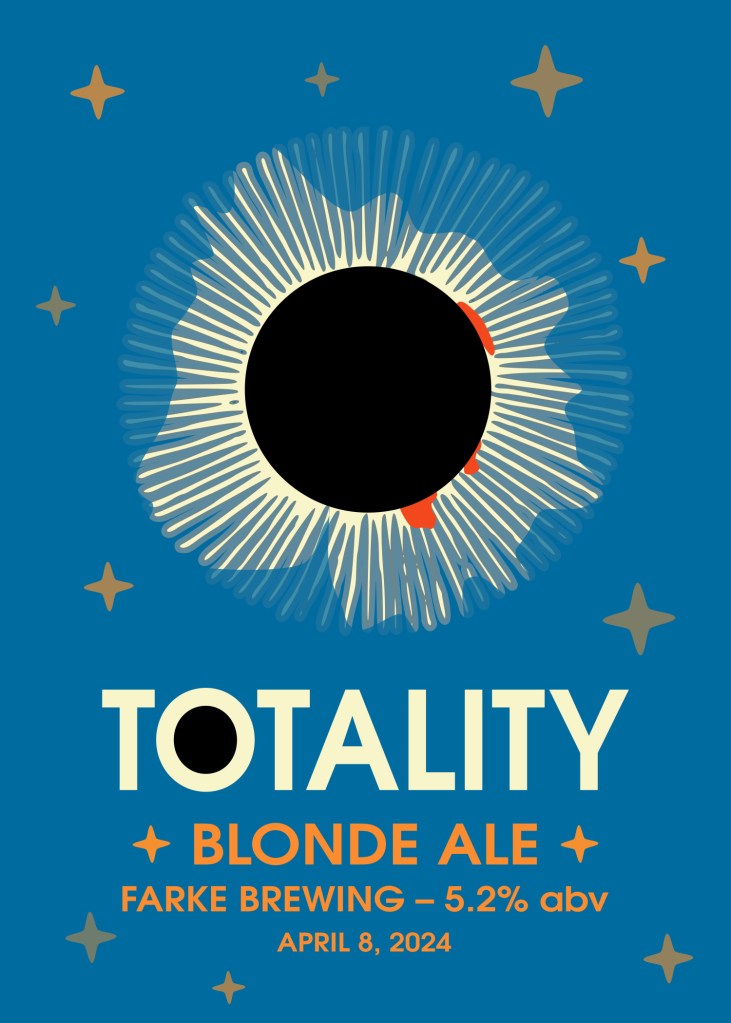
For a little extra fun, I drafted a bottle label for the beer — the stylized sun matches the pattern of prominences and the visible corona shape visible on April 8, 2024.

beer label with blue background and stylized sun in total eclipse surrounded by stars, with text that says Totality Blonde Ale, Farke Brewing, 5.2% abv, April 8, 2024

Totality Blonde Ale

  • 4.75 lb. 2-row malt (Briess)
  • 4.75 pilsner malt (Rahr)
  • 8 oz. Munich I malt (Weyermann)
  • 4 oz. Caravienne malt (Dingemanns)
  • 0.25 tsp. BrewTanB (added to mash)
  • 0.5 oz. Galaxy hop pellets (15.3% alpha), 10 minute boil
  • 0.25 tsp. BrewTanB, 10 minute boil
  • 1 Whirlfloc tablet, 5 minute boil
  • 0.5 oz. Galaxy hop pellets (15.3% alpha), 5 minute boil
  • 1 pkg. California Ale dry yeast (White Labs, WLP001)
  • 2 oz. Eclipse hop pellets (17.6% alpha), dry hop in keg
  • 1 oz. Galaxy hop pellets (15.3% alpha), dry hop in keg

Target Parameters

  • Full volume infusion mash to hit target of 152°, 60 minutes, no sparge
  • 1.047 o.g., 1.010 f.g., 4.8% abv, 16 IBU, 5 SRM
  • Water built from RO to hit 49 ppm Ca and 87 ppm Cl

Procedure

  • I formulated the strike water with 7.25 gallons of RO water and 5 g of CaCl, to match the desired water profile. I heated the water to 157°, before adding my grains and 0.9 mL of 88% lactic acid. I held the temperature at 152° for 60 minutes, with recirculation, before raising the mash to 168° for 10 minutes and then pulling the grains.
  • In total, I collected 6.5 gallons of runnings at 1.041, for 71% mash efficiency.
  • I brought the kettle to a boil and added hops and finings per the recipe. After a 60 minute boil, I turned off the heat and chilled to 68°. Once transferred to the fermenter, I pitched the yeast.
  • I brewed this beer on 12 April 2024. Starting gravity was 1.049.
  • I fermented the beer at 68°, and evidence of vigorous fermentation was visible by 14 April 2024.
  • Final gravity was 1.009, for 5.2% abv. I kegged the beer using a closed transfer on 11 May 2024, and added the hops in a baggie (very quickly opening the lid to the keg). I attempted to remove them a few days later after carbonation, but they had sunk to the bottom already.

Tasting

  • Appearance
    • Gold beer with very slight haze. Pours with a persistent and fluffy white head that leaves slight lacing on the glass.
  • Aroma
    • Medium-light hop aroma; some peach, maybe a bit of orange. This is alongside a light malty aroma, with slight caramel/candy aspects.
  • Flavor
    • Medium bitterness and medium maltiness. There is maybe a slight fruity nature in the beer, but it’s quite subtle; probably from the hops? As it warms, it becomes “peachier” in nature!
  • Mouthfeel
    • Medium body, moderate carbonation, smooth and slightly dry finish.
  • Would I Brew This Again?
    • This is a pretty decent blonde ale! It comes in perhaps a touch more bitter and dry than I would like, and the slight haze (probably from the dry hops) is a minor style ding, but overall it’s quite drinkable. I enjoy revisiting this classic style! The peach character–presumably from the Galaxy hops–is really nice
  • Overall
    • 8/10

Easy Days Ale

My lighter-colored beers lately have been primarily lagers, but it is nice to switch this up from time to time. So, I decided to create an experimental ale recipe that hit the target of being sessionable, flavorful (with some malt character and a bit of hop character too), and light in color. It doesn’t really conform to any style, although I guess you could make an argument that it’s an American(ish) blonde ale. No matter what you call it, it’s pretty darned good! I also have the memory of sharing a few glasses of this with a good friend who was going through a pretty rough spot in life…although it sounds cheesy (and perhaps it is), so much of brewing isn’t just the end product, but the memories that go with each glass and the people with whom it is shared.

Easy Days Ale

  • 4 lb. Finest Maris Otter Malt (Crisp)
  • 4 lb. 2-row Xtra Pale Malt (Viking)
  • 1.5 lb. white wheat malt (Briess)
  • 11 oz. caramel 10L malt (Briess)
  • 4 oz. Melanoidin malt (Weyermann)
  • 4 oz. rice hulls
  • 0.25 oz. Magnum hop pellets (10.1% alpha), 60 minute boil
  • 1 Whirlfloc tablet, 5 minute boil
  • 0.8 oz. Simcoe hop pellets (12.7% alpha), 15 minute whirlpool
  • 1 pkg. Safale American ale yeast (US-05)

Target Parameters

  • 1.047 s.g., 1.011 f.g., 4.7% abv, 18 IBU, 6 SRM
  • Claremont tap water, treated with Campden tablet to remove chlorine
  • Full volume infusion mash at 154°, 60 minutes

Procedure

  • I mashed in with 7.25 gallons of water at 160°, to target 154° for 60 minutes, with recirculation. I added 7.5 mL of 88% lactic acid, to reduce the mash pH. After 60 minutes, I raised the mash to 168° for 10 minutes, before removing the grains.
  • In total, I collected 6.4 gallons of runnings with a gravity of 1.041, for 67% mash efficiency.
  • I brought the runnings to a boil, adding hops and finings per the recipe. After a 60 minute boil, I turned off the heat and added the whirlpool hops for a 15 minute whirlpool.
  • After the whirlpool, I chilled the wort down to ~75°, before putting it into the fermentation chamber and chilling it the rest of the way to 68°.
  • I brewed the beer on 16 April 2021, and it had a starting gravity of 1.048.
  • I fermented at 68° until 23 April 2021, when I moved the beer to ambient temperatures.
  • I kegged the beer on 6 May 2021, and noted a final gravity of 1.015. This is a bit higher than expected, working out to 4.3% abv.

Tasting

  • Appearance
    • Medium gold with slight haze, moderately persistent white head
  • Aroma
    • Lightly malty; light bread dough character, with a light hint of caramel. No hop aroma.
  • Flavor
    • Moderate doughy, light malty character; relatively low, clean bitterness; a light tartness from the wheat that is pretty pleasant.
  • Mouthfeel
    • Moderately light body; smooth finish; moderate carbonation.
  • Would I brew this again?
    • This is a very solid session ale; it’s nothing spectacular, but I’m OK with that. I think it would benefit from a little more hop character; the bitterness is fine, but I think a little dry hop charge or a hop stand would help to liven this up a bit. It’s very drinkable, and makes a nice go-to on the tap selection. The malt character is pretty nice; it’s a little more interesting than the usual “2 row+crystal” malt zone that many ales of this type occupy.
  • Overall
    • 9/10

Citra Blonde Ale 1.1

I desperately needed to get my taps fully filled before a new baby arrived (I was down to only two armed and operational faucets, and one of those was ready to give out at any moment!). I had a schwarzbier and an IPA spooling up within the next few weeks, but wanted to have a light and drinkable beer to replace my wheat ale once that keg kicked. Something with fast turn-around and tasty, interesting drinkability.

Time for another batch of my Citra blonde ale! This beer turned out excellent last time (nearly two years ago), and is worth another go.

Compared to my last batch, I made some very minor edits for my ingredient stockpile (different brands of malt, etc.). I also went with a single infusion, rather than multiple infusions to hit different temperature rests.

Citra Blonde Ale 1.1

  • 5 lbs. Château Pilsen malt (Castle Malting)
  • 5 lbs. 2-row pale malt (Rahr)
  • 0.75 lb. Munich II malt (Weyermann)
  • 0.5 lb. caramel malt 20L (Briess)
  • 1 Whirlfloc pellet, 10 minute boil
  • 0.5 oz. Citra hop pellets (14.1% alpha), 10 minute boil
  • 0.5 oz. Citra hop pellets (14.1% alpha), 5 minute boil
  • 1 oz. Citra hop pellets (14.1% alpha), 5 minute whirlpool
  • 1 package American ale dry yeast (US-05, Safale)

Target Parameters

  • Full volume infusion mash to hit target of 152°, 60 minutes, no sparge
  • 1.050 o.g., 1.011 f.g., 5.1% abv, 20 IBU, 5 SRM, 5 gallons into fermenter
  • Water adjusted to hit 83 ppm Ca, 5.4 ppm Mg, 5.6 ppm Na, 79.4 ppm SO4, 87 ppm Cl, 50.7 ppm HCO3

Procedure

  • For the mash water, I mixed 1.8 gallons of Claremont tap water with 6 gallons of RO water, in addition to 3 g gypsum, 1 g epsom salt, and 5 g calcium chloride. I also added 3.1 mL of 75% phosphoric acid, to adjust the calculated pH.
  • I heated the sparge water to 160°, added it to the mash tun, and added the grain when the water hit 156.6°.
  • After 60 minutes, I vorlaufed and then collected 6.25 gallons of runnings. These had a gravity of 1.047 (a bit higher than expected), so I added 0.25 gallons of RO water to bring the gravity down to 1.045 and increase the overall volume a bit.
  • I boiled for 60 minutes, adding ingredients per the schedule.
  • After flame-out and the whirlpool addition, I chilled to 80° and finished the rest of the chilling in my fermentation chamber. Once the wort hit 66°, I pitched the dry yeast directly.
  • I brewed this beer on 15 July 2017, and fermented at 66° for two weeks. Starting gravity was 1.052.
  • I kegged the beer on 29 July 2017. It had a final gravity of 1.008, which works out to 5.8% abv. Then, I force carbonated.

Tasting

  • The Basics
    • O.G. = 1.0542; f.g. = 1.008; 5.8% abv; 5 SRM; 20 estimated IBU
  • Appearance
    • Light gold and beautifully clear. The beer pours with a thick white head that settles to an even blanket.
  • Aroma
    • Lightly grainy and slightly sweet malty aroma; a hint of citrus behind that.
  • Flavor
    • Light, very slightly sweet and candy-like aspect, with gentle maltiness; there is a bit of orange citrus behind that. Very clean flavor, with a mild and smooth bitterness.
  • Mouthfeel
    • Moderate carbonation, light body, with a gentle and moderately dry finish.
  • Would I brew this again?
    • As always, this is a very nice beer! I slightly prefer Great Western 2-row as a base malt, but Rahr is also respectable. I target mash-in a touch higher if doing a single infusion mash, or else follow the multi-rest schedule, because the beer ended up a bit more attenuated than expected, but that’s a minor point. The late-hopped Citra comes across really nicely, and this is a winner. As an additional variant for next time, I might follow the original Gordon Strong recipe a bit more closely and mix some Galaxy hops in with the Citra.
  • Overall
    • 8.5/10